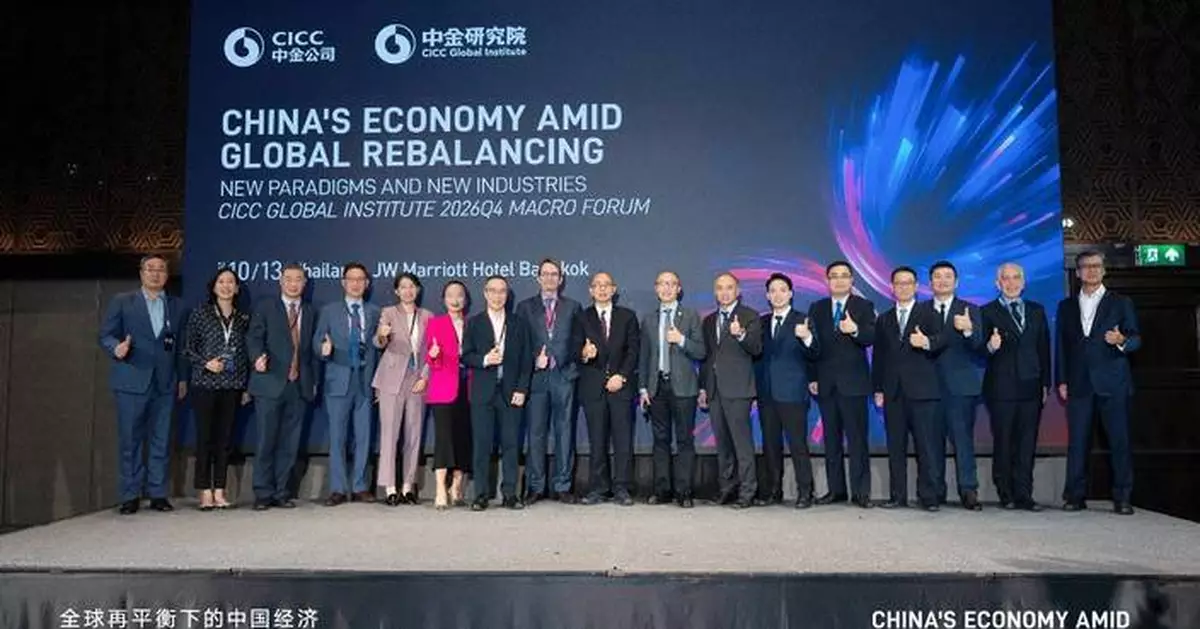
HONG KONG SAR – Media OutReach Newswire – 13 October 2026 – On October 13, the CICC Global Institute (CGI) held its 2026Q4 Macro Forum in Bangkok, Thailand, under the theme "China's Economy amid Global Rebalancing: New Paradigms and New Industries". The forum featured welcome remarks, keynote speeches, two thematic dialogues and an evening discussion session.
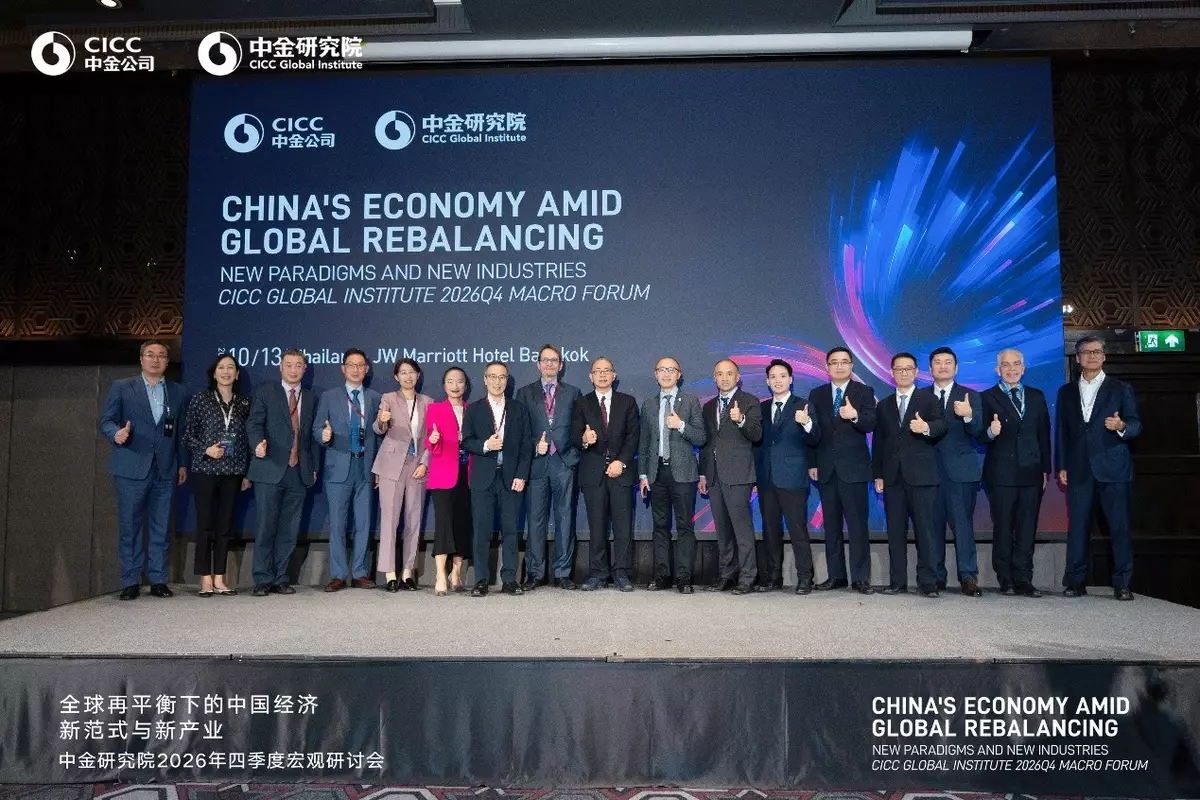
CICC Global Institute 2026 Q4 Macro Forum on "China’s Economy amid Global Rebalancing: New Paradigms and New Industries" Successfully Held in Bangkok, Thailand
Yanliang Miao, Chief Economist and Senior Managing Director of CICC, shared his insights on China's economic transformation and the evolving international monetary order in his opening remarks and keynote speech. He noted that understanding China requires a global rebalancing perspective, considering both the dynamism of emerging industries and the implications of the transition from old to new growth engines for jobs, incomes and demand. Alongside its green and digital transitions, China is also working toward a growth model supported by higher household incomes and services-led consumption. Turning to the international monetary order, he observed that shifts in the global economy, trade networks and financial technology are driving the evolution toward a more diversified international monetary system. Economic and trade strength do not automatically translate into international currency status: institutional credibility and the depth and breadth of financial markets remain central to understanding this evolution and the internationalization of the renminbi.
Huimin Wu, Executive Dean of CICC Global Institute and Deputy Head of Research Department at CICC, noted that, as discussed in The New Pattern of Dual Circulation, a book jointly published this year by CICC Global Institute and CICC Research Department, China's economy is entering a new stage of development. Its trade and outward investment are undergoing a paradigm shift, while emerging industries are becoming increasingly important drivers of growth in the global economy. These changes are both part of the broader process of global economic rebalancing and deeply shaped by it, giving rise to a new pattern of interaction between China and the global economy.
The forum brought together experts and industry representatives from institutions including the International Monetary Fund (IMF), ASEAN+3 Macroeconomic Research Office (AMRO), Shanghai Advanced Institute of Finance (SAIF) at Shanghai Jiao Tong University, National University of Singapore, ICBC Standard Bank, Wood Mackenzie, and NSQ Capital. Discussions focused on the transformations of China's trade and outward investment and their global implications, as well as the prospects for emerging industries such as innovative pharmaceuticals, green energy, and artificial intelligence.
This marked the first time the CGI Quarterly Macro Forum was held in Southeast Asia. Taking place during the week of the IMF and World Bank Annual Meetings, amid international discussions on global economic opportunities and challenges, the event brought Chinese perspectives to the global conversation and offered Chinese insights into key issues concerning China's economy that are of broad international interest.
As an important part of CGI's ongoing efforts to strengthen international exchanges, present China's perspective, and foster a deeper understanding of China's economic transformation process, the event was an innovative exploration. Looking ahead, CGI will continue to deepen its international engagement and work toward building an international dialogue platform focused on China's economy, contributing to greater mutual trust and consensus, and playing a positive role in this cause.
Hashtag: #CICC
The issuer is solely responsible for the content of this announcement.
About CICC
China International Capital Corporation Limited (CICC, 601995.SH, 3908.HK) was founded in 1995. Our experience in professional services includes leading several prominent transactions, reflecting our close involvement in China's economic reform and development. Our vision is to become a first-class investment bank with international competitiveness. Our extensive network and cross-border business practices have enabled us to offer high-quality, value-added financial services to a diversified client base. This includes a full-service and balanced business model that offers investment banking, equities, FICC (Fixed Income, Currencies and Commodities), asset management, private equity and wealth management services, all of which draw on our comprehensive research and technology capability. Headquartered in Beijing, the Group has over 200 securities business offices in China, and established subsidiaries or branches in places including Hong Kong SAR, New York, London, Singapore, Frankfurt, Tokyo, Ho Chi Minh City and Dubai. As an investment bank with Chinese roots and an international reach, we are committed to providing first-rate financial services to both our Chinese and global clients to help them achieve their goals.
** This press release is distributed by Media OutReach Newswire through automated distribution system, for which the client assumes full responsibility. **
HONG KONG SAR – Media OutReach Newswire – 14 October 2026 – Alaya Consulting today released its latest research, From Climate Narrative to Numbers: A Study of Quantitative Scenario Analysis Disclosure among Hang Seng Composite LargeCap Index Constituents, examining how leading Hong Kong-listed companies disclose quantitative climate scenario analysis in their public reports.
The study reviewed the 2025 climate-related disclosures of 112 constituents of the Hang Seng Composite LargeCap Index, focusing on whether companies provide scenario-based information that is quantitative, financially connected and decision-useful for investors and other stakeholders.
The research found that while climate-related disclosure has become more common among large-cap companies, supported by the introduction of HKEX's new climate-related disclosure requirements under Part D of the ESG Code, many issuers remain at an early stage in translating climate risk awareness into quantified analysis. Companies frequently identify climate risks, describe governance arrangements and refer to climate scenarios, but fewer disclose the numerical outputs, financial implications or strategic conclusions needed to assess business resilience under different climate futures.
Key findings include:
- 93% of companies disclosed some form of climate scenario analysis, but the depth of disclosure varied significantly;
- 25% fully quantified physical risks;
- 19% fully quantified transition risks; and
- only 12.5% fully disclosed scenario-linked financial effects.
The findings show a clear gap between climate risk recognition and decision-useful quantification. Many companies now acknowledge climate-related risks and opportunities, but fewer explain what those risks mean in measurable business or financial terms.
Tony Wong, Founder of Alaya Consulting, stated: "Climate scenario analysis should not be treated as a reporting box-ticking exercise. Its real value lies in helping companies understand how climate-related risks and opportunities may affect their assets, operations, cash flows and long-term strategy."
"Our study shows that Hong Kong large-cap companies are increasingly aware of climate scenario analysis, but the market now needs to move from narrative disclosure to numbers. As HKEX's mandatory climate-related disclosure requirements begin to apply to relevant issuers, quantitative and financially connected analysis will be essential for investors, boards and management teams to assess resilience and make informed decisions."
The study highlights that financial effects remain the weakest area of disclosure. While some companies quantify risk exposure — such as assets exposed to flooding, carbon pricing or transition risks — only a smaller group translates those exposures into potential impacts on revenue, operating costs, capital expenditure, asset values, profitability or cash flows.
This matters because quantitative scenario analysis helps companies and report users understand the magnitude, timing and business relevance of climate risks. Without quantification, disclosures may identify that a company faces climate-related risks, but provide limited insight into whether those risks are material, manageable, increasing, or already reflected in strategic and financial planning.
The research comes at an important time for the Hong Kong market. With mandatory climate-related disclosure requirements applying to relevant large-cap issuers for financial years commencing on or after 1 January 2026, companies will need to strengthen scenario analysis capability and improve the connectivity between sustainability reporting, financial planning and business strategy.
According to Alaya Consulting, companies should prioritise:
- selecting relevant physical and transition climate scenarios;
- disclosing key assumptions and time horizons;
- quantifying risk exposure by asset, geography, business unit or portfolio, where relevant;
- assessing potential financial effects under different scenarios; and
- linking scenario outputs to resilience planning, investment decisions and capital allocation.
"The next stage of climate disclosure is about usefulness," added Mr. Wong. "Companies that can explain not only what climate risks they face, but how those risks may affect financial performance and strategic resilience, will be better positioned to meet regulatory expectations and respond to investor demand for credible climate-related information."
To obtain the full report or arrange a discussion on FY2026 climate disclosure readiness, please contact Alaya Consulting.
Hashtag: #AlayaConsulting #ClimateDisclosure #ScenarioAnalysis
The issuer is solely responsible for the content of this announcement.
About Alaya Consulting
Alaya Consulting is a specialist ESG consultancy focusing on climate-related disclosure, ESG advisory, pre-assurance, data verification and ratings enhancement. Its advisory services cover evolving international and market-specific requirements, including climate-related disclosure requirements, supply chain-related regulations and sustainability reporting developments.
With offices in Hong Kong and Shenzhen, we advise clients across a wide range of industries, including real estate, environmental services, utilities, renewable energy and pharmaceuticals. We are an ISSB training partner, and the ESG Partner of the Hong Kong ESG Reporting Awards (HERA).
Since 2014, Alaya has contributed to the achievement of SDG 12.6 by advising on nearly 1,000 sustainability disclosure projects. Our latest approved science-based target is to reduce Scope 1 and 2 GHG emissions by 42% by 2030. Alaya has also achieved a CDP climate change score of B, reflecting our continued commitment to climate transparency and performance.
** This press release is distributed by Media OutReach Newswire through automated distribution system, for which the client assumes full responsibility. **