Skip to Content Facebook Feature Image

Residents in Saudi Arabia's capital say they have heard new explosions in Riyadh

News

Residents in Saudi Arabia's capital say they have heard new explosions in Riyadh
News

News

Residents in Saudi Arabia's capital say they have heard new explosions in Riyadh

2026-10-14 17:32 Last Updated At:17:40

CAIRO (AP) — New explosions have been heard in the Saudi capital, residents said Wednesday, as blame again quickly fell on Iran-backed Houthi rebels in neighboring Yemen. The Saudi-led military coalition fighting the Houthis said it intercepted a ballistic missile fired toward Riyadh.

The Houthis have repeatedly targeted Saudi airports, military facilities and oil infrastructure in the latest front in the Iran war. Separately, the rebel-run Health Ministry reported two dead in attacks in Yemen on Tuesday and blamed the Saudis.

The Houthis, hardened by years of civil war, have emerged as Iran's most effective armed proxy of the moment, but experts say they also have their own agenda. Either way, they are applying increasing pressure on a key U.S. ally.

The sight of smoke rising from some of Saudi Arabia’s most sensitive facilities has rattled the region and global markets, increasing questions for President Donald Trump, who has said he is evaluating whether the U.S. should join the Saudi strikes on the Houthis.

The Riyadh residents spoke about the latest blasts on condition of anonymity for their safety. One lives in northern Riyadh, where King Khalid International Airport — targeted multiple times in the past week with strikes that have killed 17 people and hurt over 300 more — is located.

There were no immediate reports of casualties or damage.

The Saudi civil defense reported air raid alerts in Riyadh and Kharj province southeast of the capital. Kharj is home to the state-owned Military Industries Corporation and Prince Sultan Air Base.

The Houthis on Wednesday claimed attacks against King Khalid International Airport, oil facilities in the eastern city of Dhahran, which hosts the headquarters of Saudi giant Aramco, and an Aramco refinery in Riyadh, calling them retaliation for “treacherous Saudi aggression” against the rebel-held Yemeni capital of Sanaa and other areas.

The Houthis have been warning in advance of attacks on both airports and oil facilities, and airlines have been suspending operations and pulling out planes. On Tuesday, a fire broke out in an administrative building at a facility operated by Aramco, one of the world’s largest oil companies.

The escalation has highlighted Saudi Arabia’s struggle to intercept Houthi missiles and drones, and the kingdom’s efforts to press allies like the United States for more military support. Regional officials say that Saudi Arabia, the world’s top purchaser of American weapons, is running low on interceptors.

The Saudis are trying to intercept daily attacks across a territory about three times the size of Texas. Experts have said trying to intercept all of the missiles and drones is impossible.

The Houthis have a large arsenal capable of striking targets well over 1,000 miles (1,600 kilometers) away. Some warheads change direction during flight.

Even interceptions are a danger. Overnight, Saudi Arabia’s Civil Defense said debris from two intercepted Houthi ballistic missiles fell on residential areas in Riyadh, injuring four people including a child and damaging 15 homes.

Meanwhile, the Saudis have been carrying out airstrikes in rebel-held areas of Yemen in support of the country’s internationally recognized government. The fighting erupted this year when the rebels blamed the Saudis for a strike on the airport in rebel-held Sanaa. That attack revived anger over a Saudi blockade of the Houthis. The rebels in turn declared their own blockade against the kingdom.

A week and a half ago, the Saudi-led coalition responded with a major military offensive.

On Wednesday, the Houthi-run Health Ministry said two people were killed in an airstrike Tuesday in the Ras Isa port area in Hodeida province. The strike hit a facility of the state oil company and wounded two others, the ministry said, and blamed Saudi Arabia. The Saudi-led coalition also attacked an oil facility in Sanaa.

The targeting of fuel storage facilities in Houthi-controlled areas marks a new phase in the Saudi-led coalition's campaign, said Ahmed Nagi, senior Yemen analyst at the International Crisis Group, a think tank. He added that in a war of attrition, the rebels could risk losing much of their military capacity.

“The Houthis are betting on pressure, while the Saudis are betting on time. The Houthis are trying to strike critical infrastructure in Saudi Arabia to raise the cost of continued military intervention and support for the Yemeni government,” Nagi added.

Associated Press writer Sarah el Deeb in Beirut contributed.
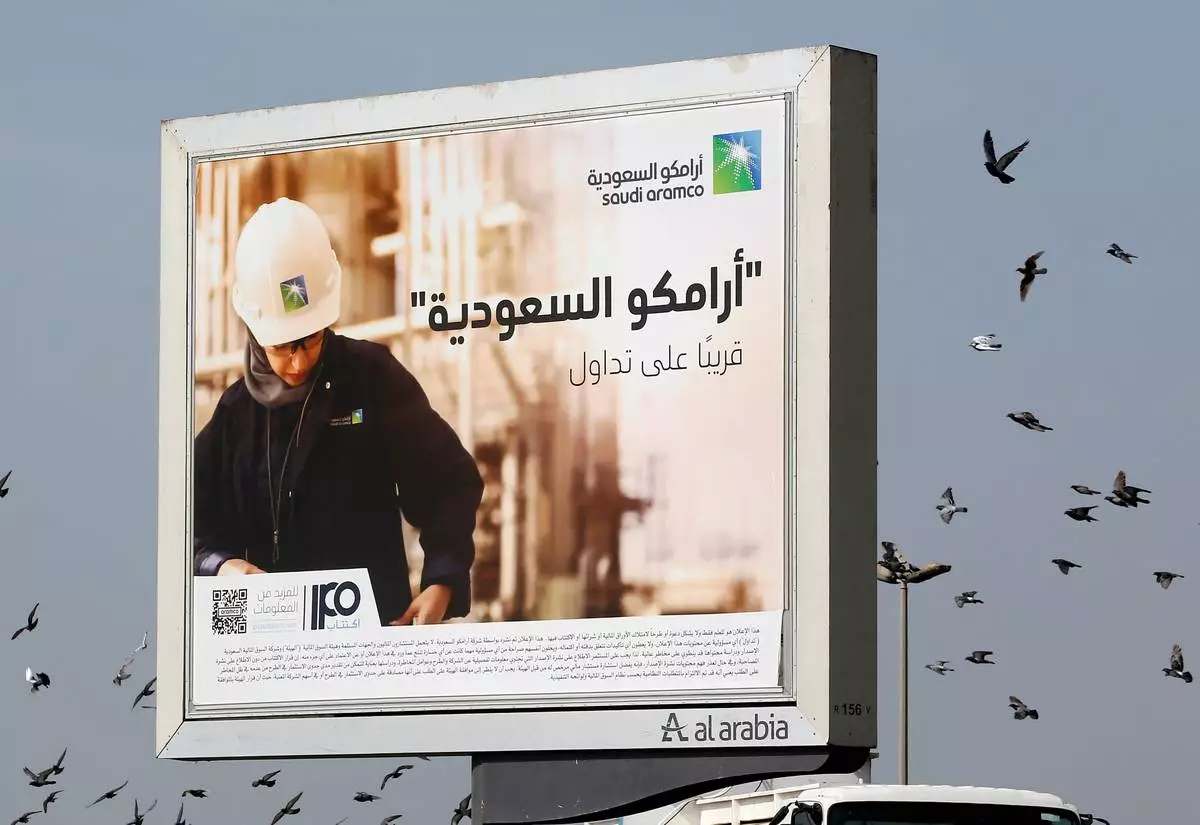
FILE -Birds fly over a billboard advertisement for Saudi Arabia's state-owned oil giant Aramco, with Arabic that reads, "Saudi Aramco, soon on stock exchange," in Jiddah, Saudi Arabia. (AP Photo/Amr Nabil, File)

FILE -Birds fly over a billboard advertisement for Saudi Arabia's state-owned oil giant Aramco, with Arabic that reads, "Saudi Aramco, soon on stock exchange," in Jiddah, Saudi Arabia. (AP Photo/Amr Nabil, File)
U.S. President Donald Trump said “massive” oil, gas and mineral exploration is set to begin in “our new and beautiful Greenland ” early Wednesday.

It wasn’t immediately clear what exploration or developments the U.S. president was referring to in his post, and Greenland is a self-governing territory of Denmark, rather than a part of the United States.

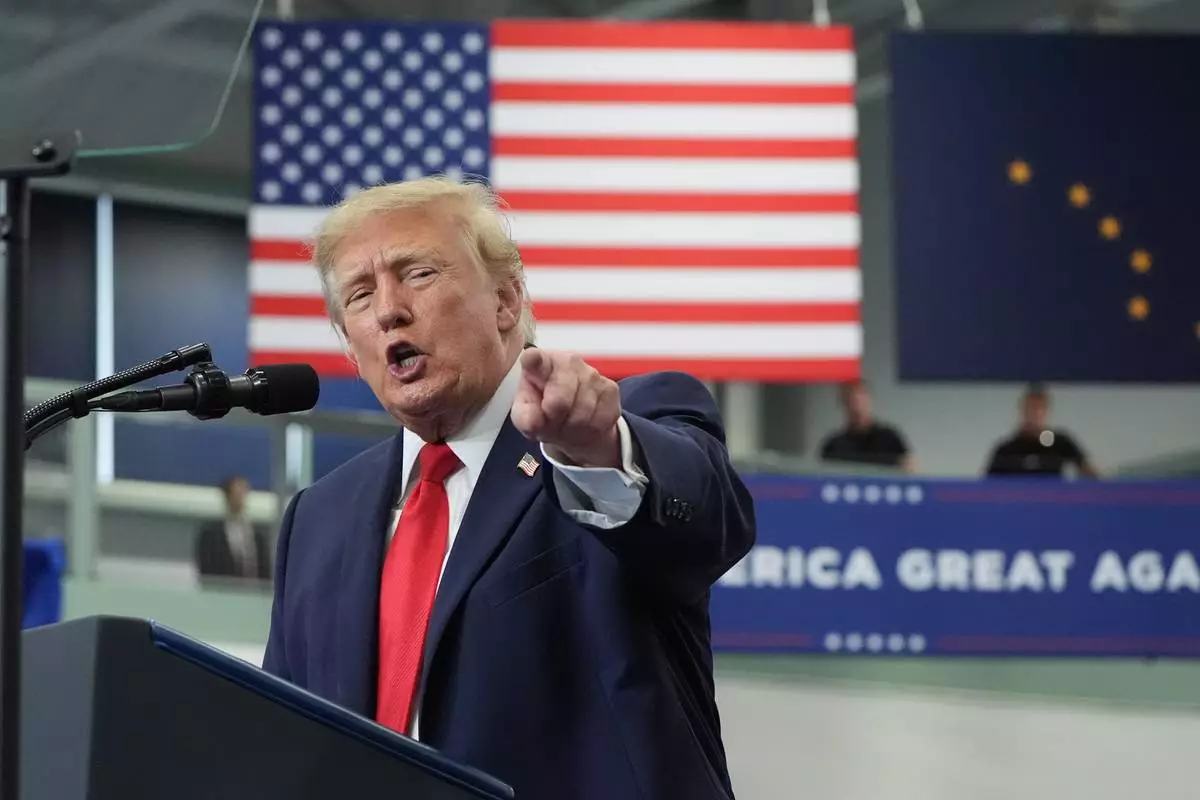
Trump posted on his Truth Social platform following a campaign event Tuesday in Wasilla, Alaska, to stump for Republican U.S. Sen. Dan Sullivan as he seeks his third term to represent the state in an election against Democratic former U.S. congresswoman Mary Peltola.

Rising energy prices — a direct result of Trump’s war in Iran — are creating serious and sustained financial hardships for America’s working class ahead of the midterm elections next month. Trump’s comments Wednesday are likely aimed at addressing voters’ concerns before they head to the polls.

But despite Trump’s optimism, resource exploration and extraction in Greenland has stymied companies for decades thanks to the island’s harsh climate, lack of key infrastructure and difficult geology. Previous efforts to extract so-called rare earth minerals, as well as oil and gas, have never progressed beyond the exploratory stage.

Trump’s comments about the Arctic island come less than a month after he signed an agreement with the leaders of Denmark and Greenland to strengthen security in the Arctic and North Atlantic following months of tensions with NATO allies over the U.S. president's repeated demands to take control of the semiautonomous Danish territory. It does not grant the U.S. any special exploration rights, but does place some limits on investments by non-NATO countries in strategic sectors.

The deal also paved the way for more U.S. bases in Greenland and eased tensions over Trump's repeated calls for Greenland to become part of the United States. The agreement would still apply if Greenland eventually chooses independence.

Trump has expressed his desire to acquire Greenland since as long ago as 2019 and, during his second term, issued threats to seize the territory from Denmark, a NATO ally.

Representatives of the leaders of Denmark and Greenland did not immediately return requests for comment Wednesday.

Greenland has large deposits of the rare earth minerals that are needed to make everything from computers and smartphones to the batteries, solar and wind technologies that will power the transition away from fossil fuels. China currently dominates the world's supply of these critical minerals and the Trump administration is seeking to break Beijing's chokehold on them.

The U.S. Geological Survey has also identified major potential offshore deposits of oil and natural gas.

But tapping these resources could be prohibitively difficult: the rare earth minerals are encased in rock, and the offshore oil and natural gas deposits are covered by Arctic ice.

Trump's Truth Social post also touted Greenland's strategic location, saying that “from a Security Purpose in the Defense and Offense of both the United States of America, and Europe,” the island is “second to none.”

“Any future attack on the United States will have to come across Greenland, where our Defense will routinely knock down drones, missiles, or any other form of weapon not yet even conceived," he wrote. "It gives us time, location, and sightline, like nowhere else in the World!”

The United States was prominent in Greenland for decades but, since 1945, the U.S. military presence in Greenland has decreased from thousands of soldiers on 17 bases and installations to roughly 200 soldiers on the remote Pituffik Space Base in the northwest. The base supports missile warning, missile defense and space surveillance operations for the U.S. and NATO.

Trump said last month that the U.S. would “immediately begin the process of developing a large military presence in the appropriate locations,” including “building two very major military bases.”

President Donald Trump speaks at a campaign rally at the Curtis D. Menard Memorial Sports Center, Tuesday, Oct. 13, 2026, in Wasilla, Alaska. (AP Photo/Alex Brandon)

President Donald Trump speaks at a campaign rally at the Curtis D. Menard Memorial Sports Center, Tuesday, Oct. 13, 2026, in Wasilla, Alaska. (AP Photo/Alex Brandon)

Recommended Articles