NATICK, Mass.--(BUSINESS WIRE)--Oct 14, 2026--
MathWorks, the leading developer of mathematical computing software for designing engineered systems, today announced that the TÜV SÜD certification of MATLAB ®, Simulink ®, Stateflow ®, and System Composer ™ included with IEC Certification Kit has been expanded to cover generic AI tool classification guidance in accordance with the automotive standard ISO 26262.
This press release features multimedia. View the full release here: https://www.businesswire.com/news/home/20261014427857/en/
MathWorks is the first tool vendor to provide guidance for select AI-assisted engineering workflows in functional safety applications, informed by specific use cases evaluated by TÜV SÜD. The guidance includes practical applications of AI-assisted Model-Based Design, focusing on workflows that use Simulink Agentic Toolkit for agentic model development, model review, and test case generation. By illustrating how these use cases can be integrated into safety-critical development processes in a controlled and auditable manner, the guidance helps organizations accelerate development while preserving engineering rigor, traceability, and standards compliance.
Agentic AI Capabilities Extend Model-Based Design
The MathWorks technology behind this approach integrates agentic AI capabilities with Model-Based Design workflows. These capabilities enable engineers to move beyond prompting AI systems to AI agents that operate directly on Simulink models and engineering workflows. MathWorks continues to expand its agentic AI capabilities with new skills that guide agents in applying MATLAB and Simulink functionality to engineering tasks.
Simulink Agentic Toolkit enables AI agents to understand model structure, create and modify designs, run simulations, generate tests, and connect requirements to models. The toolkit combines Simulink-specific tools with expert-authored skills for Model-Based Design workflows. Skills authored by MathWorks engineers and domain experts guide agents through model development, algorithm specification, plant modeling, testing, validation, and requirements generation. Expert-authored skills guide agents to apply the appropriate functionality for each task while engineers retain responsibility for validating results.
Polyspace Agentic Toolkit extends these workflows into software analysis and verification activities, supporting code robustness analysis, coding-standard compliance, and defect detection. Together, the toolkits allow organizations to incorporate AI agents across the development lifecycle while maintaining established validation and review practices.
“Engineering teams are looking for ways to benefit from agentic AI without sacrificing the rigor that system development demands,” said Michael Carone, Principal Product Marketing Manager - Simulink Platform, MathWorks. “By connecting AI agents to Simulink models, simulations, and testing workflows, MathWorks is helping engineers apply agentic AI within established engineering processes while preserving the accountability required for complex engineered systems.”
As organizations expand the use of agentic AI in engineering, they need approaches that combine AI capabilities with the domain-specific engineering context and deterministic verification required for engineering workflows. By connecting AI agents to executable engineering assets such as models, simulations and tests, MathWorks helps teams apply AI within established engineering processes.
Built on Model Context Protocol (MCP), the capabilities support AI agent platforms including GitHub Copilot, Codex, Gemini CLI, Claude Code, and other MCP-compatible agents. This gives organizations flexibility to incorporate agentic AI through the platforms they choose for their engineering workflows. Engineers can automate more development activities with AI assistance that is grounded in engineering results while remaining responsible for final decisions and approvals.
About MathWorks
MathWorks is the leading developer of mathematical computing software for designing engineered systems. MATLAB, the language of engineers and scientists, is a programming and numeric computation environment for algorithm development, data analysis, and visualization. Simulink is a block diagram environment for simulation and Model-Based Design of multidomain and embedded systems. MATLAB and Simulink provide a unified computing platform that empowers engineering teams to model, simulate, and deploy complex engineered systems spanning industries such as automotive, aerospace, energy, and medical devices. MATLAB and Simulink are fundamental teaching and research tools at the world’s top universities and learning institutions. Founded in 1984, MathWorks employs more than 6,500 people in 34 offices globally, with headquarters in Natick, Massachusetts, USA. For additional information, visit www.mathworks.com.
MATLAB and Simulink are registered trademarks of The MathWorks, Inc. See mathworks.com/trademarks for a list of additional trademarks. Other product or brand names may be trademarks or registered trademarks of their respective holders.
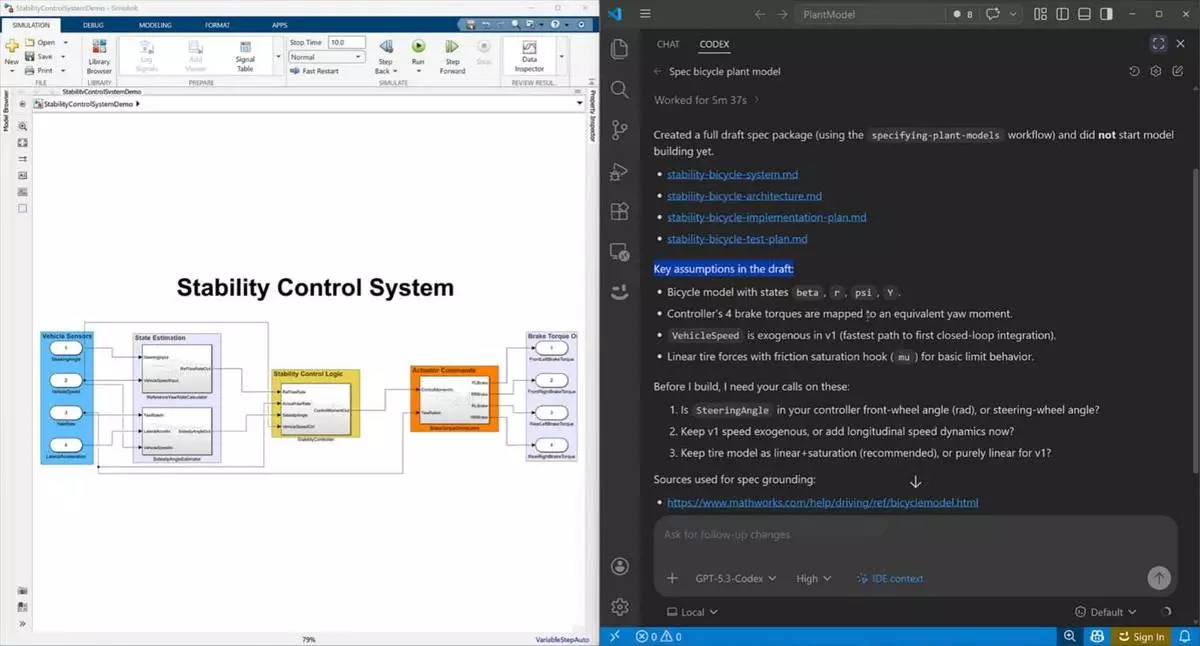
AI agents transform requirements into validated Simulink designs, accelerating development while reducing rework.
ROME (AP) — Pope Leo XIV spent a peaceful night in Rome’s Gemelli hospital after doctors removed the lower lobe of his right lung and confirmed he has cancer, the Vatican said Wednesday.
The surgery showed that the pope has the most common type of lung cancer, known as lung adenocarcinoma, the Vatican said in a medical bulletin late Tuesday. The revelation — within a few hours of an operation that was announced by Leo himself — offered further evidence that the American pontiff is taking a new approach to communicating about his health.
Doctors were waiting for the results of further tests before deciding on a course of treatment, the Vatican said. The press office pointed to the medical statement’s mention of the “radical” removal of the lobe as an indication that doctors took out all suspect tissue in hopes of removing any lingering traces of the cancer.
Experts said some of Leo’s lymph nodes also would have been removed and tested to determine if the cancer had spread. There was no word yet on those test results.
If the cancer has spread, more tests will be needed to determine what kind of therapy to pursue, said Dr. Stephen Liu, a lung cancer expert at Georgetown’s Lombardi Comprehensive Cancer Center. Options include chemotherapy, a combination of chemotherapy and immunotherapy or targeted therapy, which involves pills for specific cancers.
“Adenocarcinoma is the most common (type of lung cancer), also with the most favorable prognosis,” said Liu, who is not involved in the pope’s care. “While we know the diagnosis, we now need to know the stage.”
He added: “We now need to know how big it is, how many spots in the lung are involved. Is it just one nodule, or more than one, and the lymph nodes, are they cancerous?”
The American pontiff has offered a rare level of transparency about the first publicly disclosed major health problem of his 17-month papacy. He revealed the discovery of the nodule, or growth, on his lung during his Sunday noon prayer, announcing it to the world on live television almost as an aside at the end of his blessing.
“That was truly a revolution. It was like he was reading a medical bulletin himself,” said Giovanni Maria Vian, a church historian and the former editor-in-chief of the Vatican newspaper L'Osservatore Romano.
The Vatican has long been secretive about the health of popes and tightly controlled any such information - a practice encapsulated in the popular Italian saying, “ The pope is fine until he’s dead.”
St. John XXIII died in 1963, nearly a year after doctors diagnosed stomach cancer that was kept hidden at the time. St. John Paul II died in 2005 after suffering for years from the obvious effects of Parkinson's disease that the Vatican only confirmed after he died.
Pope Francis seemed more up front about his health problems, giving an Argentine doctor a tell-all interview for a book about his physical and mental health. But in the end Francis, too, tightly controlled the information that was released in his dying months.
Vian, who was part of the Vatican communications team from 2007 to 2018, said the Vatican's obsession with secrecy about the pope's health was due to both practical and cultural considerations. He noted the Vatican is a 2,000-year-old institution that is culturally European — and Europeans tend to be more guarded about health problems than people in the United States.
“In theory, the pope has an absolute power, so you can understand that there are many people who would aspire to that absolute power," he said. Secrecy about a pope's health, therefore "is a legitimate defense from both the pope in question and the institution itself.”
He attributed Leo's decision to reveal his health condition to his American outlook and serenity, and said he hoped it would extend to other aspects of Vatican communications.
That said, Leo didn't share everything he knew on Sunday when he announced the existence of the nodule: Tuesday's medical bulletin said doctors had suspected cancer based on tests, a suspicion that was confirmed in surgery.
The 71-year-old's surgery lasted approximately 90 minutes, the Vatican statement said Tuesday.
“The surgery was successful, and there were no complications,” the statement said, adding that the pope later returned to his room. Gemelli has a papal apartment that past popes have used, but it is undergoing renovations, so Leo is recovering in a nearby room, according to the Vatican press office.
The right lung has three sections or lobes while the left has two. After one lobe is removed, the rest of the lung can gradually compensate, especially in otherwise healthy and physically active people. Leo is known to be sporty, with weekly tennis games and swimming.
Before the surgery, Leo walked into the Gemelli hospital through the main entrance and waved to dozens of well-wishers.
Oncologists said prior to the operation that even if the nodule turned out to be cancerous, Leo’s prognosis would be “excellent” since it would have been removed at an early stage.
The Vatican on Monday canceled all Leo’s audiences through Oct. 20. But there was no word on whether he would be able to keep his planned trip to South America next month.
Oncology surgeons often advise patients not to fly for three weeks after surgery — which would give the pope just enough time to make his planned Nov. 6-17 trip to Uruguay, Argentina and Peru. But whether he can go will depend on his recovery.
The current itinerary for the trip is ambitious and the longest of his papacy to date, calling for Leo to clock just over 31,000 kilometers (19,000 miles) on a dozen flights and two helicopter rides, and a significant altitude change in Peru.
“If it is stage 1, he can complete these trips. If more treatment is needed, I would likely advise against the trips,” said Liu.
Barry reported from Milan. Associated Press writer Lauran Neergaard in Washington contributed to this report.
Associated Press religion coverage receives support through the AP’s collaboration with The Conversation US, with funding from Lilly Endowment Inc. The AP is solely responsible for this content.
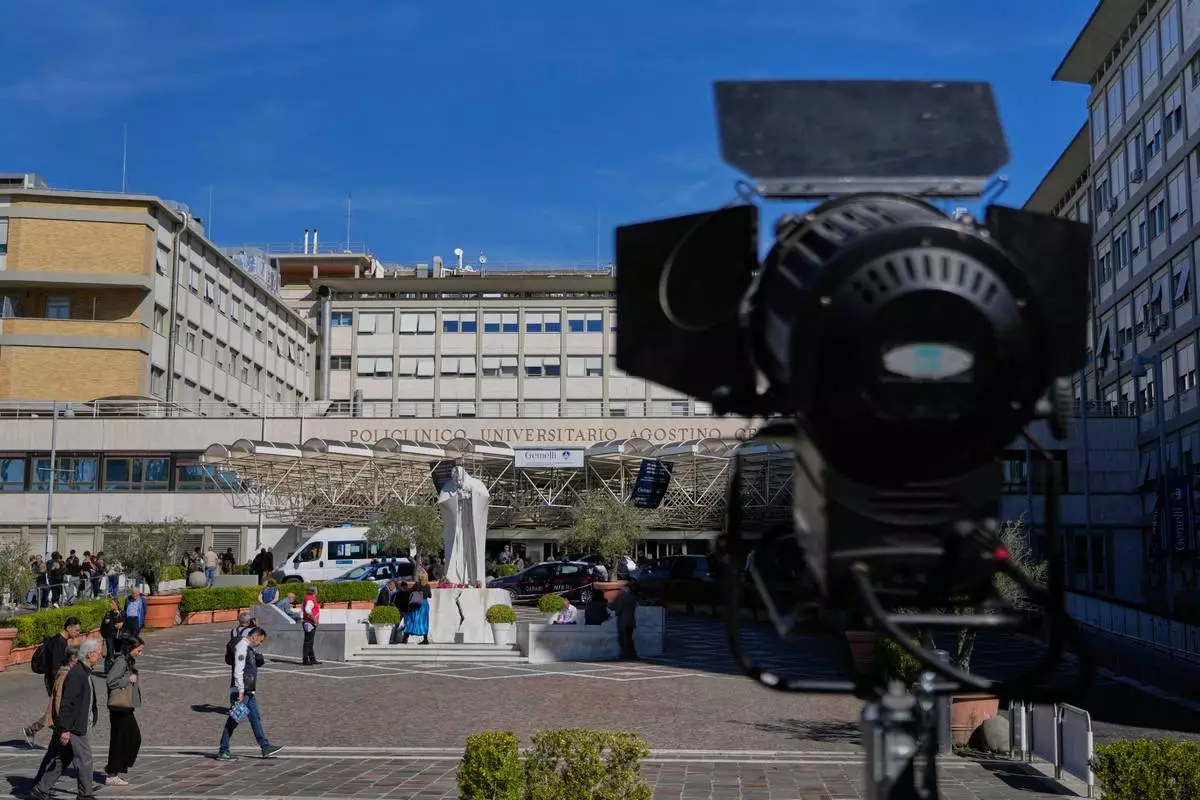
A television light is pointed towards the Agostino Gemelli Polyclinic, where Pope Leo XIV is hospitalized after undergoing a surgery, in Rome, Wednesday, Oct. 14, 2026. (AP Photo/Gregorio Borgia)
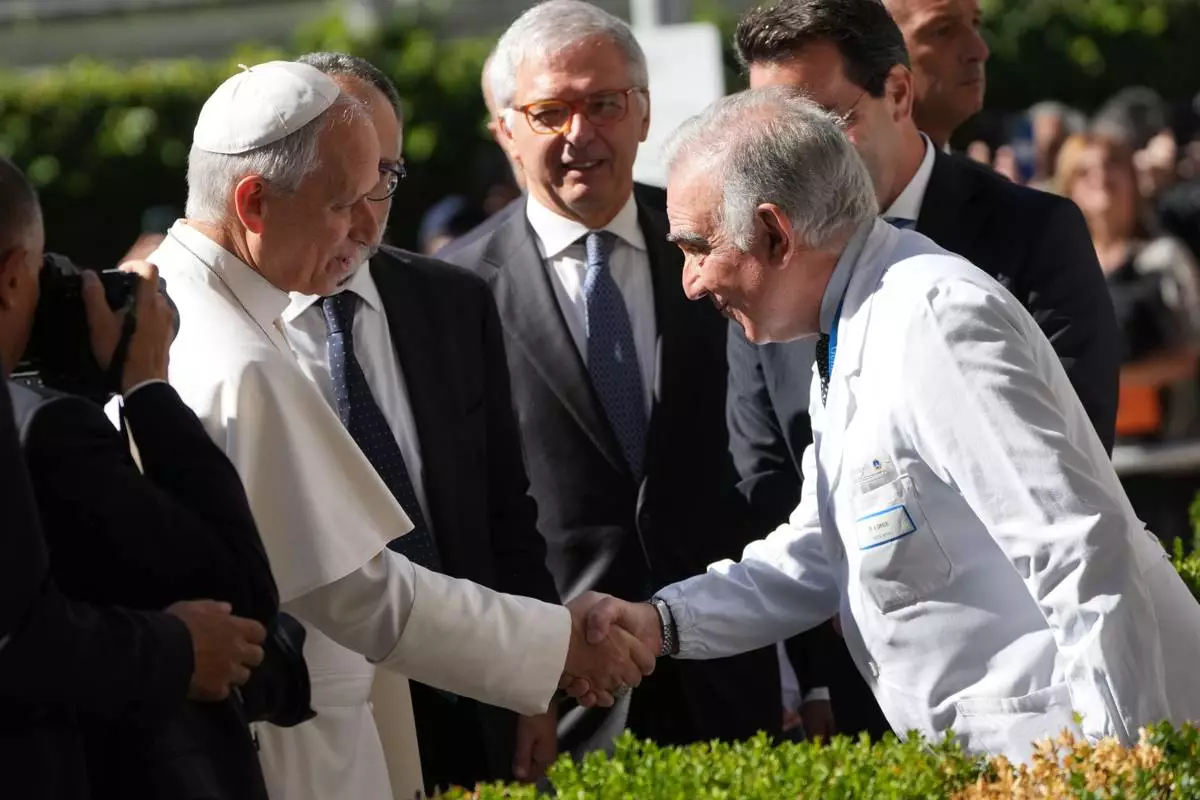
Medical Director Andrea Cambieri, right, receives Pope Leo XIV as he arrives at the Agostino Gemelli Polyclinic in Rome, Tuesday, Oct. 13, 2026, where he's expected to be operated to remove a lung nodule. (AP Photo/Gregorio Borgia)
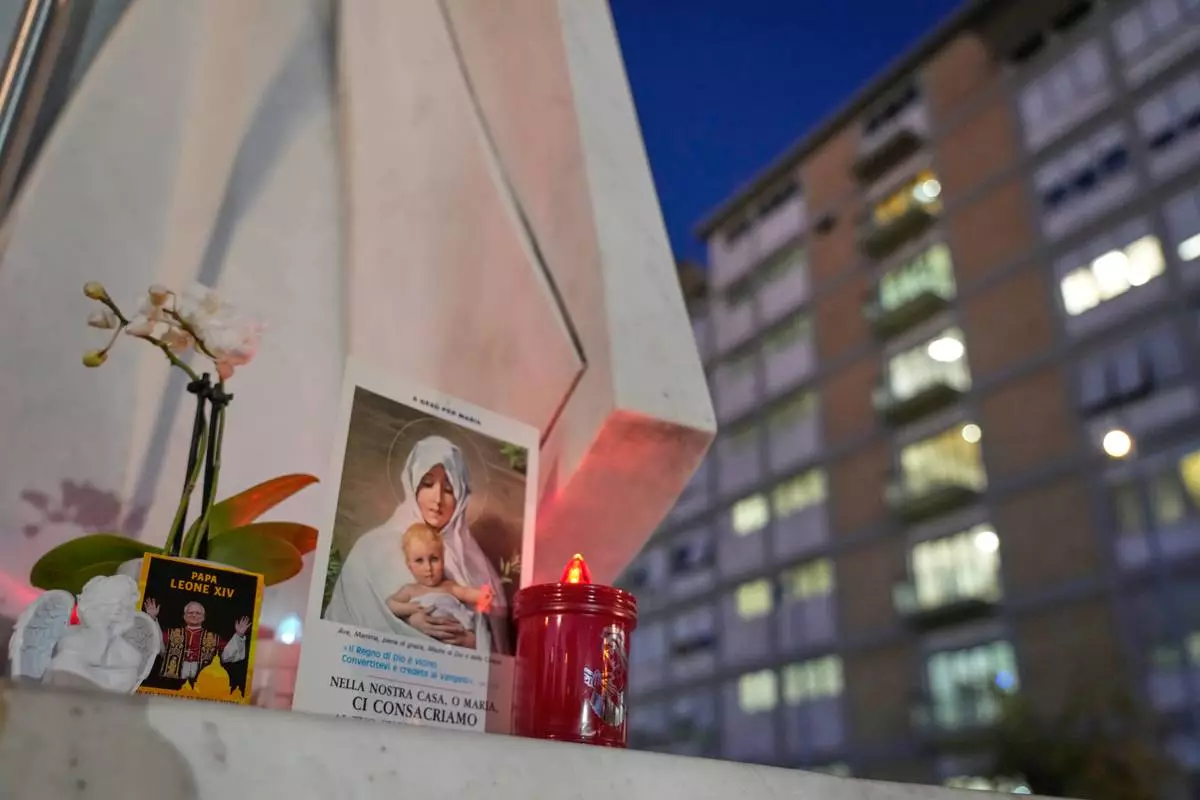
An image of Pope Leo XIV rests at the base of a statue of the late Pope John Paul II outside the Agostino Gemelli Polyclinic, where Leo is hospitalized for surgery to remove a lung nodule, in Rome, Tuesday, Oct. 13, 2026. (AP Photo/Gregorio Borgia)