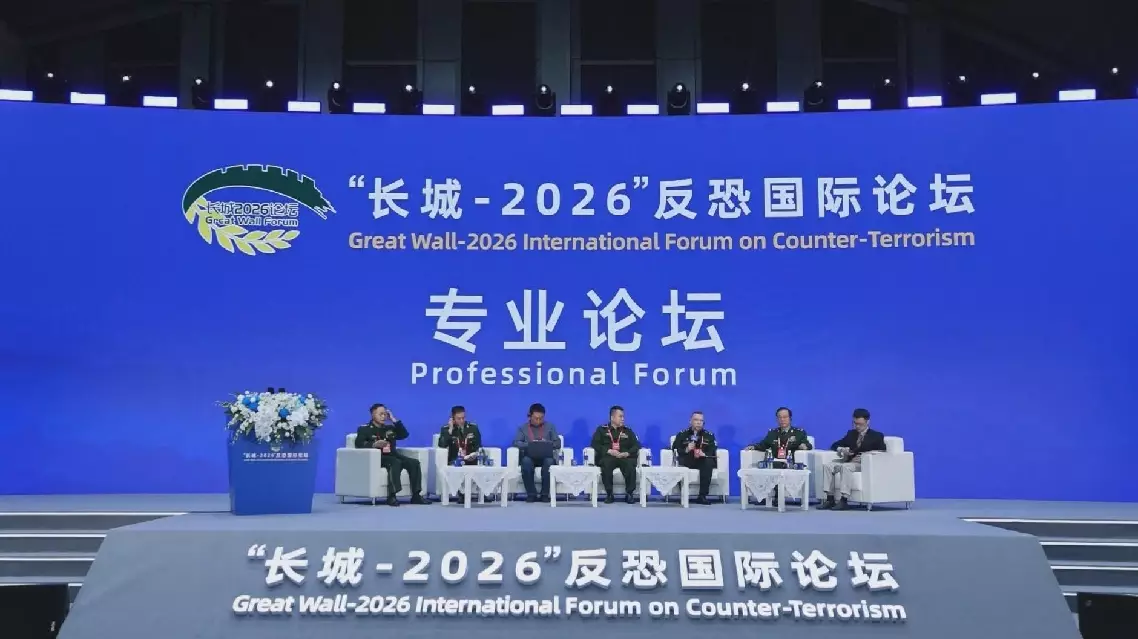
Military experts from around the world gathered at a forum in Beijing on Wednesday to discuss trends in terrorist activities and counter-terrorism capacity building involving unmanned systems and artificial intelligence (AI).
The professional forum was held as part of the three-day Great Wall-2026 International Forum on Counter-Terrorism that opened on Tuesday, drawing more than 320 representatives from research institutes, counter-terrorism agencies and think tanks from 62 countries and international organizations.
At the event, participants shared their theoretical analysis on emerging terrorist threats and challenges posed by unmanned systems and AI, alongside counter-terrorism experiences and strategies.
"Unlike from large-scale military conflicts, terrorist activities are smaller in scale, unfold very quickly and may last only a short time, so countries should maintain normalized and institutionalized cooperation and information exchanges," said Zhou Bo, a research fellow at the Center for International Security and Strategy at Tsinghua University.
Experts said the rapid iteration of AI and unmanned systems is reshaping counter-terrorism operations in a systematic and all-round manner, with AI penetrating the entire process of counter-terrorism operations, including perception, response and assessment.
"For example, AI enables agents to know where its target and means are. As for operations, AI can help each piece of equipment, such as a robot or a drone, carry out its mission. And finally, assessment. So AI has penetrated into the entire process of counter-terrorism operations," said Wu Mingxi, a military expert on AI and equipment. Wu noted that the spread of new technologies such as AI has spawned non-traditional risks such as cyberattacks and deepfakes, creating new challenges for counter-terrorism governance.
"Some terrorists may use AI for learning, and to prevent that requires optimization of large language models. They can also use it to develop new equipment and generate deepfake videos. We have to know how to handle these fake contents," Wu said.
In terms of equipment development, Wu pointed out that unmanned counter-terrorism equipment is evolving from human-controlled systems to autonomous individuals and heterogeneous swarms, with integrated air-ground swarm operations already seen in real conflicts.
"For example, when drones are equipped with AI, they become fully autonomous. They can also form swarms and even carry out systemic attacks. We have noted this time that such attacks have already happened on battlefields in regional conflicts. On the one hand, we have new weapons and equipment for counter-terrorism missions. On the other hand, we have to deal with the challenges brought by terrorists' use of technology," Wu said.
Noting smart terrorist threats know no border, Peng Jijun, secretary-general of the forum's organizing committee, called on all countries around the world to intensify the sharing of intelligence, technology and practical experience to build global counter-terrorism synergy.
"People from different regions and countries have different security needs because of their different national conditions, environments or geopolitical positions. But counter-terrorism is a common cause for all humanity. Only by reaching a worldwide counter-terrorism consensus, building a firewall against terrorism, and jointly developing counter-terrorism capabilities and means can we form a counter-terrorism synergy to prevent and combat terrorism to the greatest extent and to build a wonderful world and a wonderful home," Peng said.
Counter-terrorism forum highlights AI risks in Beijing