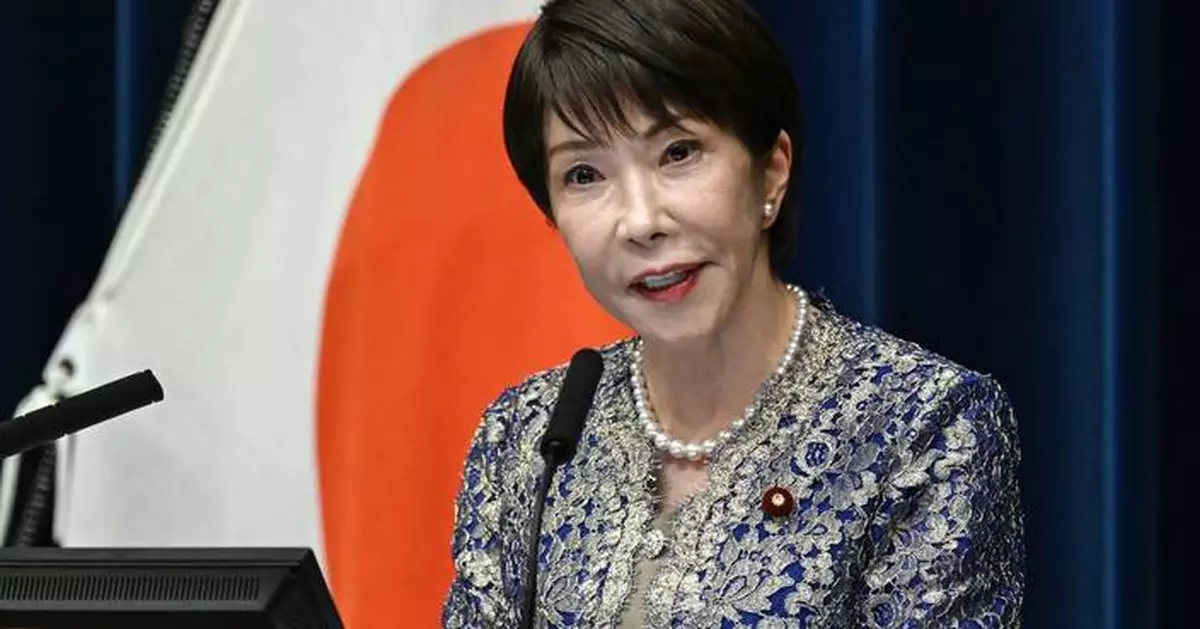
TOKYO (AP) — Japan’s Prime Minister Sanae Takaichi ’s comments about the additional work she has to take on as a woman compared to her male predecessors have sparked a debate about gender roles in the country and have put her performance under the spotlight.
On Wednesday, Takaichi said she works longer hours than her male predecessors because she needs to fulfill requirements for women, such as house chores and applying makeup.
“In the morning, I take a bath, fix breakfast and do the dishes, then apply makeup," Takaichi told a parliamentary session Wednesday. “Doing these things, I feel I'm spending three or four more hours than male prime ministers."
It took a while for her aides to learn that she needs extra time to fix her makeup and be more presentable before going on camera, Takaichi said.
Her emphasis on makeup, bathing and house chores quickly backfired, because she was seen as promoting old-fashioned gender roles and excessive working hours that have long been considered problems in Japan.
In a country where gender roles remain rigid and long hours at work are the norm for men, working women are also burdened with house chores and child care. Women spend nearly five hours doing house chores daily, compared to about 40 minutes spent by an average male, the latest government figures show.
Comments on social media noted that many working women in Japan who raise children or take care of elderly parents face even heavier demands than Takaichi, saying that her comment is a matter of time management and her outdated view on gender equality.
“As long as she gets her job done, it's fine if she needs more time than men ... but seeking forgiveness because she needs time to put on makeup as an excuse is unacceptable," said Fusako Miwa, a lawyer, on social media.
Takaichi's work mantra and her revelation of zero to three hours of sleep at night due to her homemaking burden on top of her heavy workload after taking office last year triggered criticism that she was setting the wrong example for a work-life balance and gender equality.
While Takaichi regularly comments on X, she has been scaling back on her appearances at parliament and has largely holed up at her residence at night and on weekends, a tendency criticized as neglect of policy debate.
Takaichi also suffered a setback as her newly-appointed farm minister Kazuo Yana resigned Wednesday over multiple scandals, including boasting about cutting road construction budget for municipalities that did not support him in an election. Yana also admitted arranging questionable free transportation for his supporters at his political rallies.
The prime minister's time management was brought up by Fumitake Fujita, a top official of Takaichi's junior coalition partner, Japan Innovation Party, on Wednesday when he suggested reducing hourslong parliamentary sessions that ministers need to attend almost daily.
Japan's prime minister attended parliamentary sessions for 72 days in 2022, compared to 50 in Britain and 13 in Germany, Fujita said, citing a recent report by a political think tank NXJI Research.
The report proposed introducing cooks and other housekeeping staff at the prime minister's official residence so the leader can concentrate on official duties and get sufficient sleep.
Takaichi said managing her busy schedule has been difficult, and she routinely brings home a thick stack of documents.
“I do enjoy reading them late at night,” Takaichi said. "Honestly, I feel it is not easy to squeeze out time to sit down and think about the future direction of Japan or have a grand vision.”
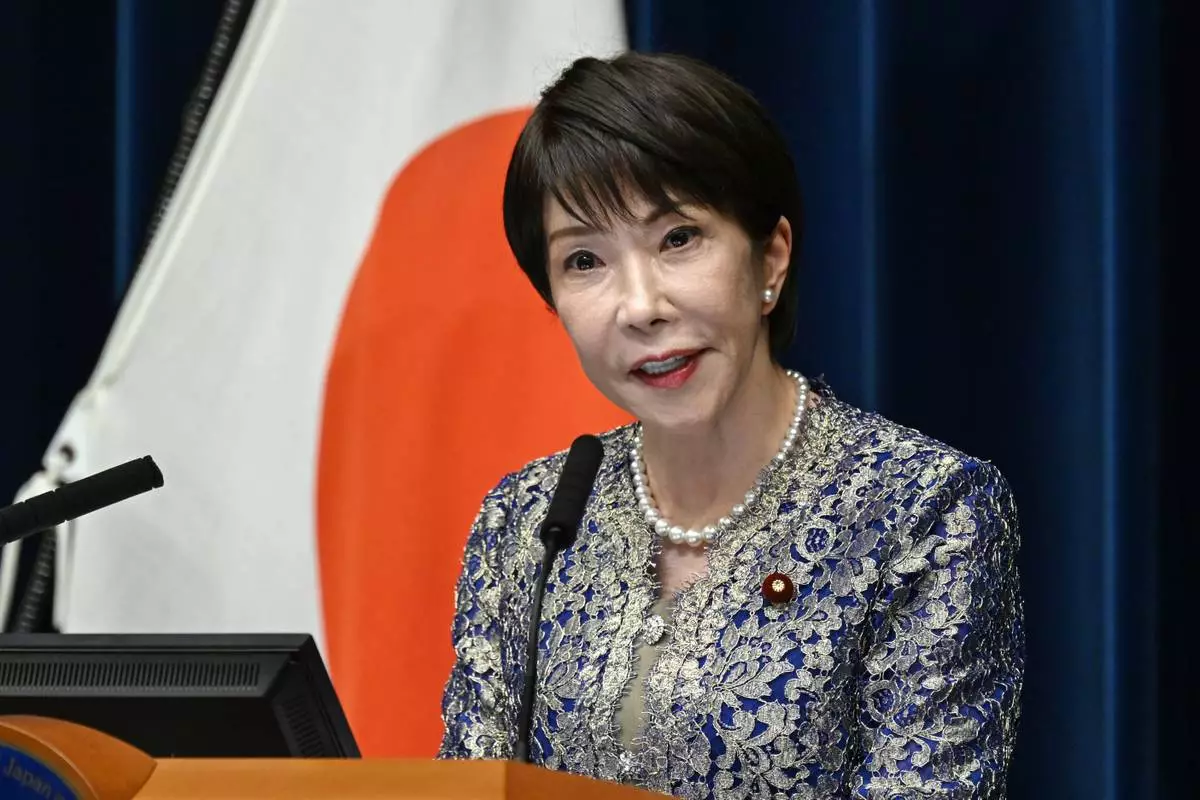
FILE - Japan's Prime Minister Sanae Takaichi speaks during a news conference at the prime minister's office in Tokyo, Sept. 17, 2026. (Rie Kikuchi/Pool Photo via AP, File)
CHICAGO (AP) — Illinois authorities believe a 19-year-old man charged with planning a mass shooting at a Hindu temple in suburban Chicago entered the building’s parking lot on Sunday, hours before police arrested him near his home after receiving a tip about the alleged attack plan.
Authorities announced Wednesday that they had arrested Alexandros Paporakis and provided the additional detail about his suspected movement during a news conference Thursday. The leaders of Sri Venkateswara Swami (Balaji) Temple in a statement said a security threat had “targeted our Temple” and announced an increased security presence.
Palatine Police Chief William Nord said a red Acura RDX registered to Paporakis entered a temple parking lot on Sunday around 12:25 p.m. and left less than 15 minutes later. He was seen alone inside the car around 2 p.m., driving near his home in another suburb about 40 miles away.
Paporakis faces felony charges of making a terrorist threat and unlawfully possessing a rifle. Prosecutors have said his co-workers at a Taco Bell location called 911 after Paporakis told them he “couldn't wait to kill Indian people” and said Sunday would be the “special day.”
Sri Venkateswara Swami (Balaji) Temple in Aurora, around 40 miles west of downtown Chicago, said leaders were in contact with police.
“Please know that the safety of our devotees, employees and volunteers is our highest priority, and we have implemented additional security measures effective immediately, including increased armed security presence at the Temple,” a statement said.
Rep. Raja Krishnamoorthi, who represents Illinois' 8th congressional district, said he was at the Hindu temple on Sunday.
“I visited not knowing that there was an attacker lying in wait with a sinister motive to commit a mass shooting, and only because his AR-15 weapon jammed was he not able to commit a massacre that day," Rep. Krishnamoorthi told The Associated Press on Thursday.
Rep. Krishnamoorthi said he had increased his security in response to the alleged planned attack. He called on the FBI to “investigate and prosecute this particular matter as a hate crime,” and the Trump administration to release federal nonprofit security grants to bolster security at religious institutions.
“People are really shaken up,” he added.
Paporakis told a coworker on Sunday afternoon that his gun jammed and he left quickly, but promised to “retry,” according to prosecutors. He sent the coworker a video showing an AR-style rifle and a photo of himself wearing a tactical vest, they added.
Paporakis also sent the coworker an eight-page manifesto called “Why I fought: A.K.A. (Aurora Shooter’s Manifesto)" in which he described non-white people as “subhumans” and expressed a plan to “sacrifice myself to take revenge on the world," according to prosecutors. In the document, he described himself as a “sociopathic white supremacist Neo Nazi," they say.
Police arrested Paporakis later that day. Detectives who searched his home found an AR-style rifle without a serial number, loaded magazines and “hundreds of rounds” of ammunition, a gas canister labeled with a slur referring to South Asians, a tactical vest and a patch depicting Nazi symbolism, authorities say.
Paporakis' mother was questioned, but she is not cooperating with the investigation, police said on Thursday.
At a Wednesday court appearance, a judge ordered Paporakis to remain in detention. His next court hearing is scheduled for Oct. 30.
“This case is in the earliest stage of what will likely be a lengthy process,” the office of the Cook County Public Defender, which is representing Paporakis, said in a statement emailed to The AP. "We would remind the public that statements made by police and prosecutors are only allegations and that cases can change significantly as they continue to be investigated.”
The targeting of the Hindu temple is another example of heightened threats in the last few years against South Asians in the U.S., according to Stop AAPI Hate, the national reporting center for anti-Asian hate incidents. Online slurs and threats have risen significantly, co-founder Manjusha Kulkarni said in a statement.
“We are grateful this violent plot was thwarted and that no one was hurt – but it doesn’t erase the fear Hindu, Indian, and South Asian people feel after years of escalating hate,” Kulkarni said. “Violence against South Asian people is not inevitable. It is fueled when leaders stoke fear of immigrants and people of color for political gain.”
She attributed some of the anti-South Asian sentiment to the Trump administration’s rhetoric around Indian immigrants who hold work visas. She also pointed to a Texas Republican last month posting a social media video of South Asian students cheering at a University of Texas football game and referring to them as “foreigners.”
The temple, like other Hindu temples and households around the country, has been celebrating Navratri, a Hindu festival that lasts nine days. It “should be a time for celebration and unity, not terror and hate,” Kulkarni said.
Associated Press writer Terry Tang in Phoenix contributed to this report.
Mayes-Osterman is a corps member for The Associated Press/Report for America Statehouse News Initiative. Report for America is a nonprofit national service program that places journalists in local newsrooms to report on undercovered issues.
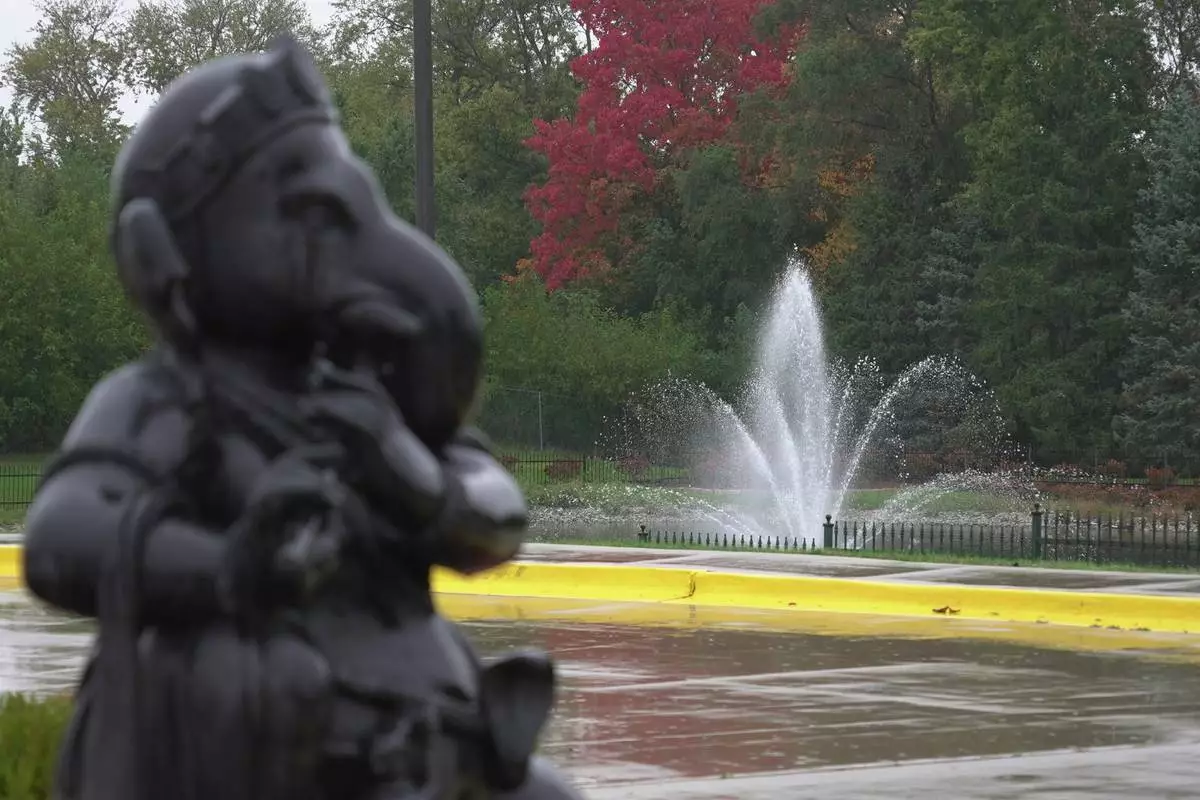
A statue and fountain are displaued outside of Sri Venkateswara Swami (Balaji) Temple in Aurora, Ill., Thursday, Oct. 15, 2026. (AP Photo/Laura Bargfeld)
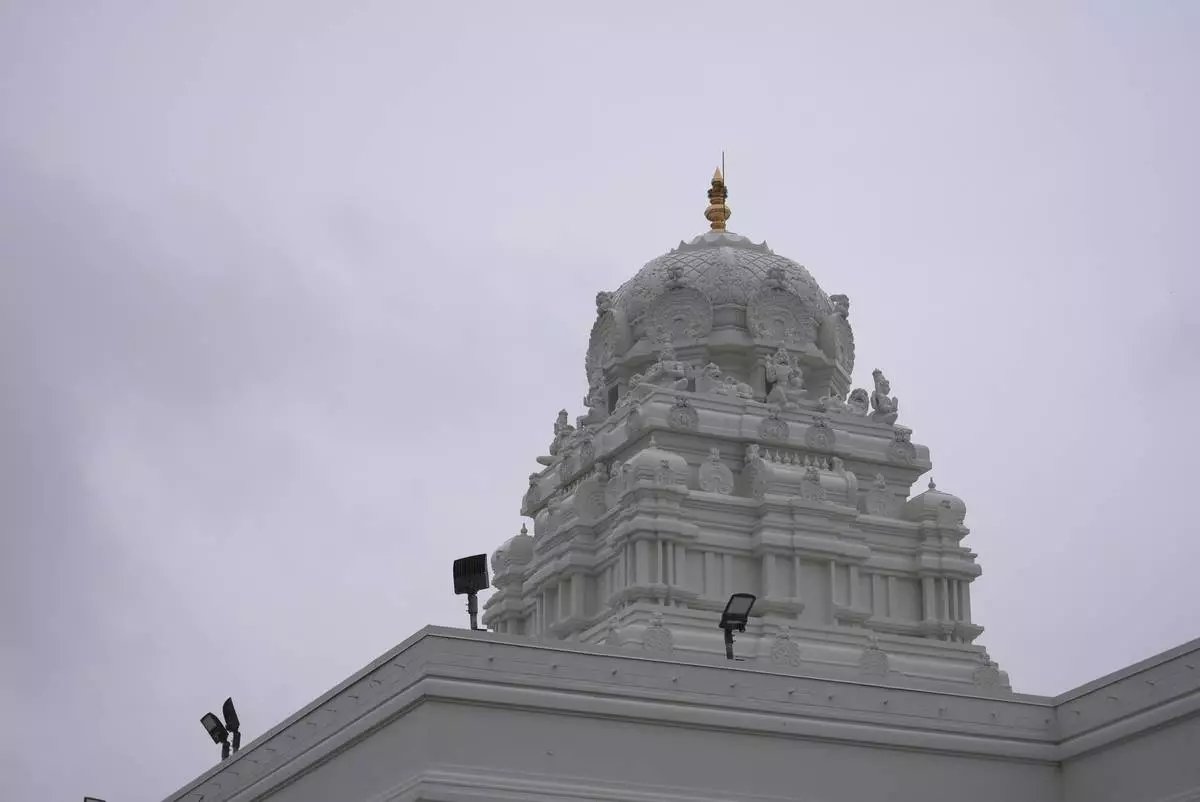
The top of Sri Venkateswara Swami (Balaji) Temple is seen in Aurora, Ill., Thursday, Oct. 15, 2026. (AP Photo/Laura Bargfeld)
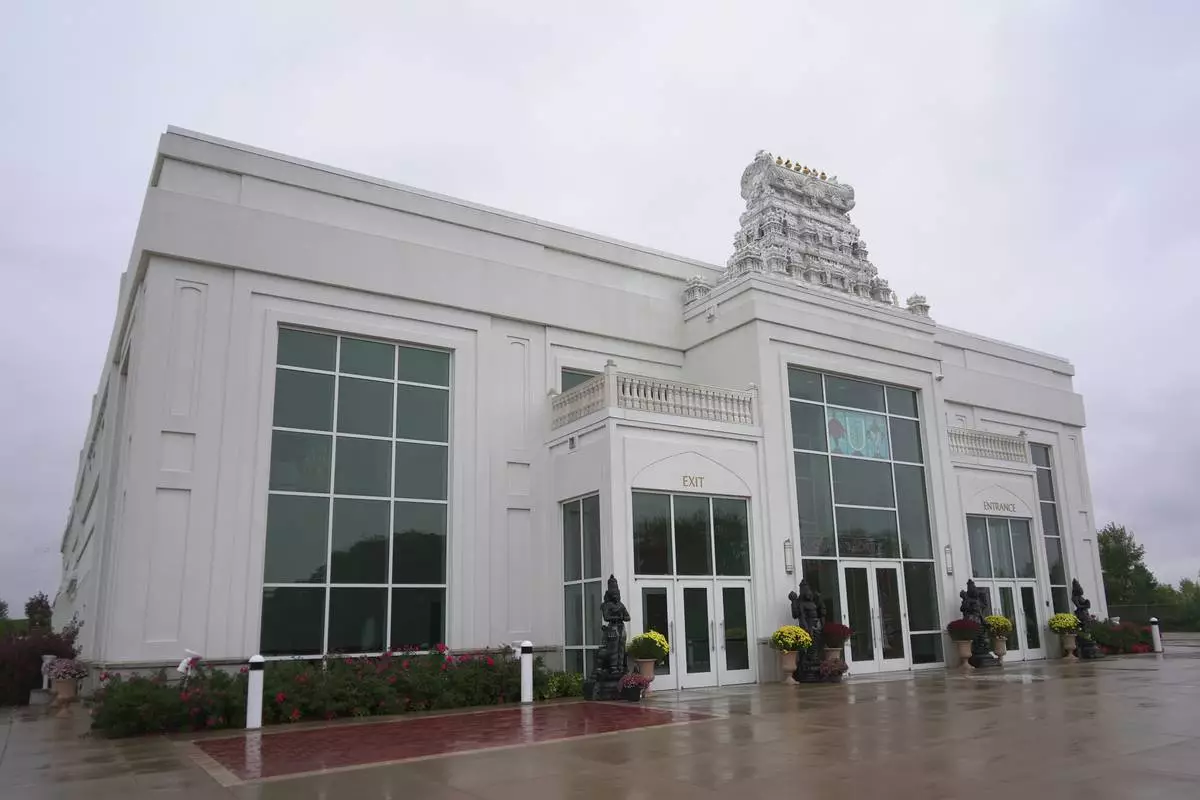
The front of Sri Venkateswara Swami (Balaji) Temple is seen in Aurora, Ill., Thursday, Oct. 15, 2026. (AP Photo/Laura Bargfeld)
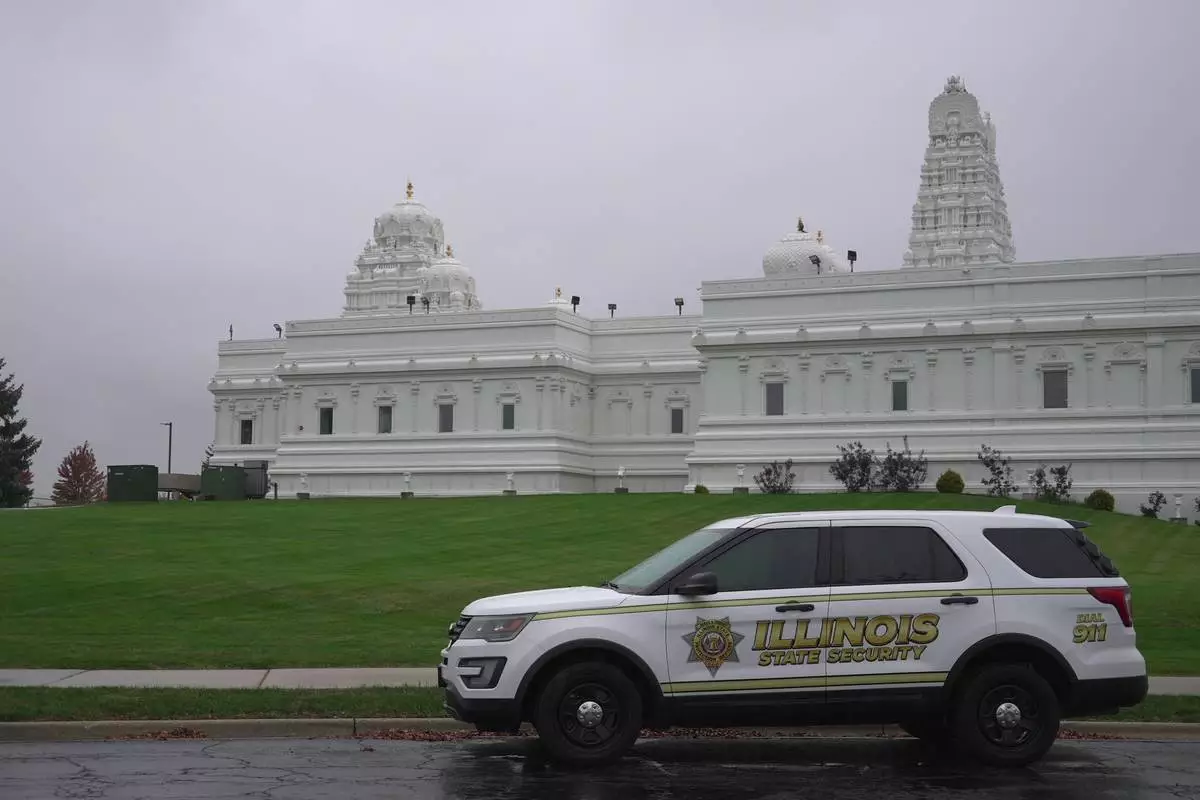
A security vehicle is parked outside of Sri Venkateswara Swami (Balaji) Temple in Aurora, Ill., Thursday, Oct. 15, 2026. (AP Photo/Laura Bargfeld)