A few months after infrared cameras in China's Northeast Tiger and Leopard National Park captured a rare six-member Amur tiger family, researchers have found evidence of unusual maternal behavior: a mother appears to be handing over part of her territory to her daughters.
The behavior was recorded in the Hunchun area of the park, which spans Jilin Province and neighboring Heilongjiang Province in northeast China. The family first made headlines last November, when infrared cameras captured all six tigers -- an adult tigress and her five cubs -- in a single frame, an extraordinary moment for Amur tiger conservation in the region. The cubs were each estimated to be about six to eight months old.
Wild Amur tigers typically give birth to one to four cubs, making a litter of five exceptionally rare even in areas with abundant prey. The footage offered researchers invaluable insight into Amur tiger reproduction in northeast China.
The family was filmed again in February this year, with the cubs visibly bigger. Rangers gave each of the five its own name and collectively nicknamed them the "Five Little Fortunes."
By comparing footage from November and February and assessing tracks on the ground, researchers recently identified a young female tiger patrolling a forest path alone as most likely one of the five cubs.
"She has walked this route at least seven or eight times, all on her own. It used to be one mother with five cubs, but now the female cub has been walking this route by herself. Experts say her mother gave her this path, and the tigress no longer walks it, leaving the cub to patrol this route alone," said Gu Baochen, an instructor at the Northeast Tiger and Leopard National Park.
Long-term observations by a Beijing Normal University research team found that female Amur tiger dispersal generally follows one of three patterns: they establish a new home range near their mother's territory; their mother cedes part of her usual territory to them; or their mother moves elsewhere entirely, leaving her old territory to the young.
The five cubs, now about one year old, are approaching what researchers call the sub-adult threshold. Tigresses typically raise cubs until they are one and a half to two years old, after which the young gradually leave their mother and fend for themselves in the wild.
Researchers said the young female seen roaming the forest alone is not yet formally taking over an adult territory, but is more likely following familiar scent boundaries before she is ready to live independently.
"She started walking around here in August, and through September, she walked around here multiple times on her own," Gu said.
During the same period, other cameras captured the mother walking with two other cubs along a different route, leading researchers to a preliminary conclusion that the tigress is preparing to pass her territory to her female offspring.
"An adult tiger will pass its territory on to her cubs, and she will then go on to find a new territory," said Liu Guoqing, a staff member at the park's Hunchun management and protection center.
Passing down home ranges to female offspring is a distinctive reproductive strategy among Amur tigers: The mother cedes the land she depends on to cubs with limited survival capability while venturing out to establish new territory. This enhances the reproductive success of her offspring while reducing competition for the same resources.
China officially established the Northeast China Tiger and Leopard National Park in 2021. Over the past few years, the park has seen the number of wild Amur tigers increase from 27 to 72, and that of wild Amur leopards from 42 to 115, according to the National Forestry and Grassland Administration.
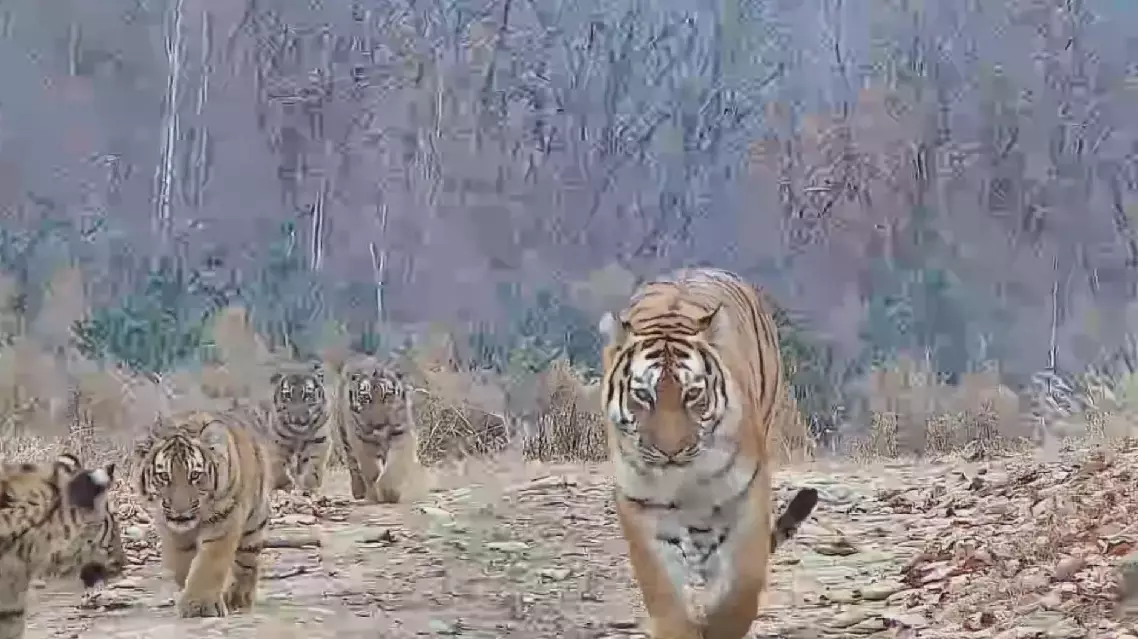
Rare case of Amur tigress passing territory to cubs recorded in China's national park