MONTRÉAL--(BUSINESS WIRE)--Oct 16, 2026--
The Québec members of the Knights of Columbus have launched the 50th edition of their annual charity fundraising appeal, known as La campagne des œuvres charitables des Chevaliers de Colomb du Québec. The organization aims to raise $1.5 million to support hospital foundations, food banks, and other local charities across Québec. Under the theme of Unite to Build the Future and Grow, the campaign’s fundraising efforts span three levels, namely: provincial, regional, and local. Each level receives a share of the proceeds and independently determines how the funds will be distributed. This year, the Knights of Columbus State Council of Québec has decided to allocate a significant portion of its funds to Réseau Solidarité Itinérance du Québec.
This press release features multimedia. View the full release here: https://www.businesswire.com/news/home/20261016606606/en/
“Our goal has always been to support organizations that improve the lives of people in our communities, and many of them need our help,” explained Jocelyn Ross, State Deputy of the Knights of Columbus in Québec. “This campaign is a testament to the generosity and selflessness of people from all walks of life, especially the volunteers who visit neighbourhoods throughout the fall and winter seasons inviting residents to get involved. Every ticket sold helps support and advance the work being done in our communities.”
Tickets are available from Knights of Columbus members across Québec at a cost of $2 each, three for $5 and six for $10. Sales run until mid-March 2027. The draw will be held in April during the organization’s annual province-wide convention in Victoriaville, at which time the winners will also be announced. The lottery features over $210,000 in prizes, including a $50,000 grand prize, gift cards, a snowblower, an all-terrain vehicle (ATV), and additional cash prizes.
Established in 1882 and active in Québec since 1897, the Knights of Columbus is a Catholic fraternal organization known for its charitable work. Each year, its members give millions of hours of volunteer time and help fund charitable organizations and community initiatives across the province.
Since its launch, the annual appeal has raised more than $53 million for local charitable organizations across Québec, representing an average of over one million dollars per year.
Founded by Blessed Michael J. McGivney, a humble and selfless parish priest who spent three years studying at a seminary in Québec, the Knights of Columbus is the world’s largest Catholic men’s fraternal organization in the world, guided by principles of charity, unity and fraternity. Active in Québec since 1897, the Knights of Columbus boasts a membership of more than 70,000 across the province, with 402 councils and nearly 50 round tables serving its communities. The Knights of Columbus’ charitable initiatives are also supported by its life insurance program, which in Québec is managed by the Le Bouthillier, Angy Dion, and Duval agencies.*
Multigenerational and international, the Knights of Columbus empowers Catholic men to live out their faith and serve their families, parishes, communities and country.
To learn more, visit chevaliersdecolomb.com.
Lottery Licence No. L-05572 issued by Québec’s Régie des alcools, des courses et des jeux (RACJ).
100 % of the proceeds from this fundraising campaign are donated to charitable organizations in Québec dedicated to humanitarian, community and spiritual causes, all of which share the common goal of helping those in need.
* Life insurance, annuity, long-term care insurance, and disability income insurance products are offered by the Knights of Columbus, 1 Columbus Plaza, New Haven, CT 06510.

Members of the Knights of Columbus have begun selling tickets as part of a province-wide campaign to raise funds for worthy charitable organizations. This marks the 50th anniversary of the campaign which, according to organizers, has raised approximately 53 million dollars to help local causes. Photo: Knights of Columbus
BANGKOK (AP) — Guardrails are urgently needed to contain potential risks from the boom in artificial intelligence, the head of the International Monetary Fund said Friday, likening the technology to a Formula 1 race car that might go off the track and run people over.
“We are racing, and the question is how do we put barriers? So if a car was to fly out it doesn’t kill people,” IMF Managing Director Kristalina Georgieva said.
“I have high respect for the industry. I think what you’re doing is incredibly important for humanity. You may give us the biggest gift, but if the car runs over people, that gift may not be so worthwhile,” she said while speaking on a panel on the impact of AI on the world economy along with experts including Anthropic co-founder and head of policy Jack Clark.
Clark is among technology industry leaders pushing for faster action on regulating AI. In a blog post last month, the rival to OpenAI proposed that the world’s top artificial intelligence companies come up with a coordinated way to pause development of advanced AI systems, warning the technology is improving so quickly there’s a risk humans would lose control.
“I think it’s worse than you describe. I think it’s Formula 1 at night without maybe brakes in the cars,” Clark said. “And it’s remarkable to me that the toys I buy for my children are regulated more than the literal superintelligence I work on at my day job.”
He added that the effort to build policy frameworks to regulate AI is underway.
“The world is now taking this seriously, and I think if we take it seriously, we are going to be able to get our arms around it,” Clark said. “But it cannot only be companies making these decisions. And if we’re negligent about this, we’re going to get some form of chaos.”
The impact of AI on jobs is yet to be fully understood, but an IMF study found three main trends. About 10% of jobs might be transformed or newly created, while work involving repetitive tasks will be gone, Georgieva said.
The third category will be service sector jobs generated by people who benefit from the investment boom.
“The net impact is positive," she said, though she added that “services don’t pay a lot.”
“So you get young people who normally would have gone into professional routine jobs now serving coffee in Starbucks. And that is not what I think young people in the world aspire for,” she said.
Tiff Macklem, the governor of the Bank of Canada, compared that to the effects on employment from more open trade, which has generated great global wealth and raised millions out of poverty. But many millions also lost their livelihoods as manufacturers moved jobs to China and other developing countries.
He said “in aggregate there is an overall benefit,” but acknowledged that in both trade and technology “there will be winners and losers.”
“You have to find a way to help the losers," Macklem said. “Without a system to help them cope with the loss you get a backlash.”
Dozens of people marched in Bangkok on Thursday and Friday in peaceful protests, seeking to draw attention to growing inequality and other frustrations.
Georgieva noted that to ensure that the benefits of AI can reach the maximum number of people, they have to have electricity and access to digital networks. Cybersecurity also is essential.
During the wide ranging session, the speakers were also asked about how they used AI in their own lives. Georgieva said she'd used it to track calories and lose weight.
The IMF chief, who has described her personal AI assistant as bossy, joked that she'd like AI agents to be more polite.
“I mean, the agents we get, they can be really annoying,” she said. “So can we work on, like, their manners?”
Maybe, said Clark.
“We have this dial between sycophantic and rude,” he said. “So we'll spin it around the other way.”
AP journalists Haruka Nuga, Tian MacLeod Ji and Sakchai Lalit contributed.
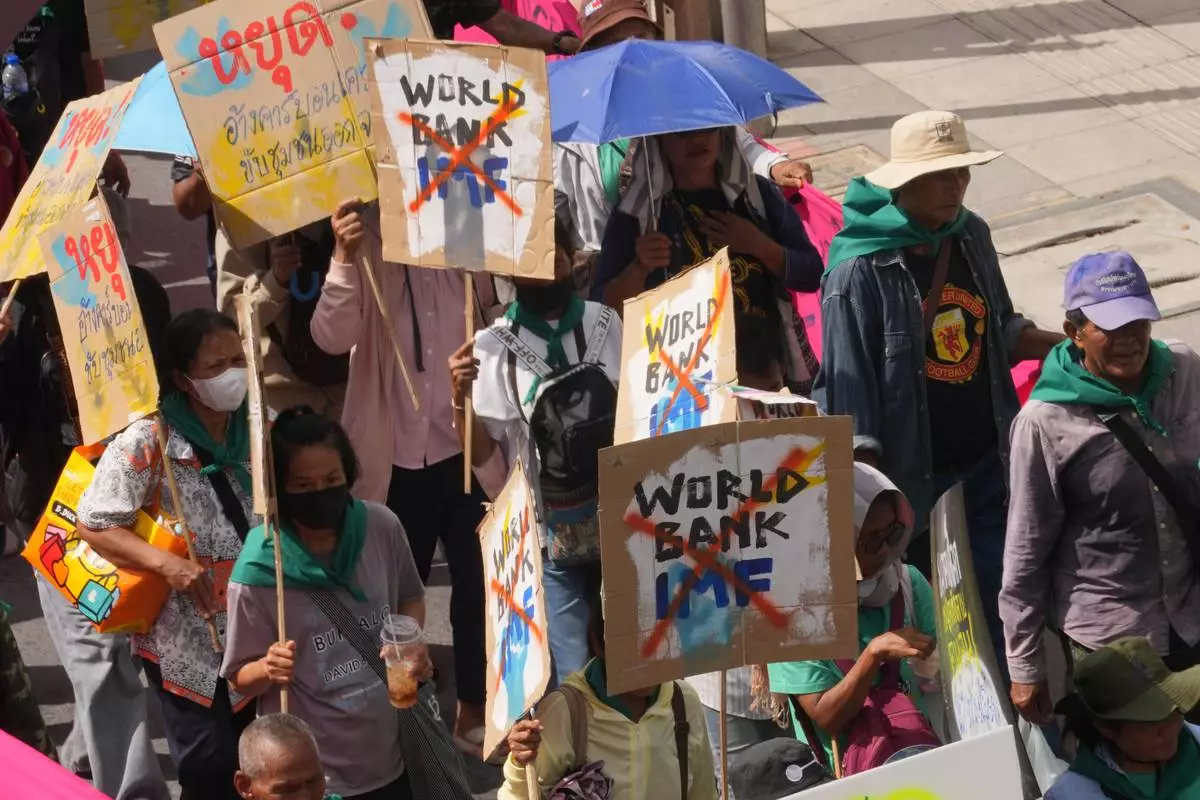
Protesters march to a meeting venue during a demonstration against the International Monetary Fund and the World Bank Group in Bangkok, Thailand, Friday, Oct. 16, 2026. (AP Photo/Sakchai Lalit)

Protesters march to a meeting venue during a demonstration against the International Monetary Fund and the World Bank Group in Bangkok, Thailand, Friday, Oct. 16, 2026. (AP Photo/Sakchai Lalit)
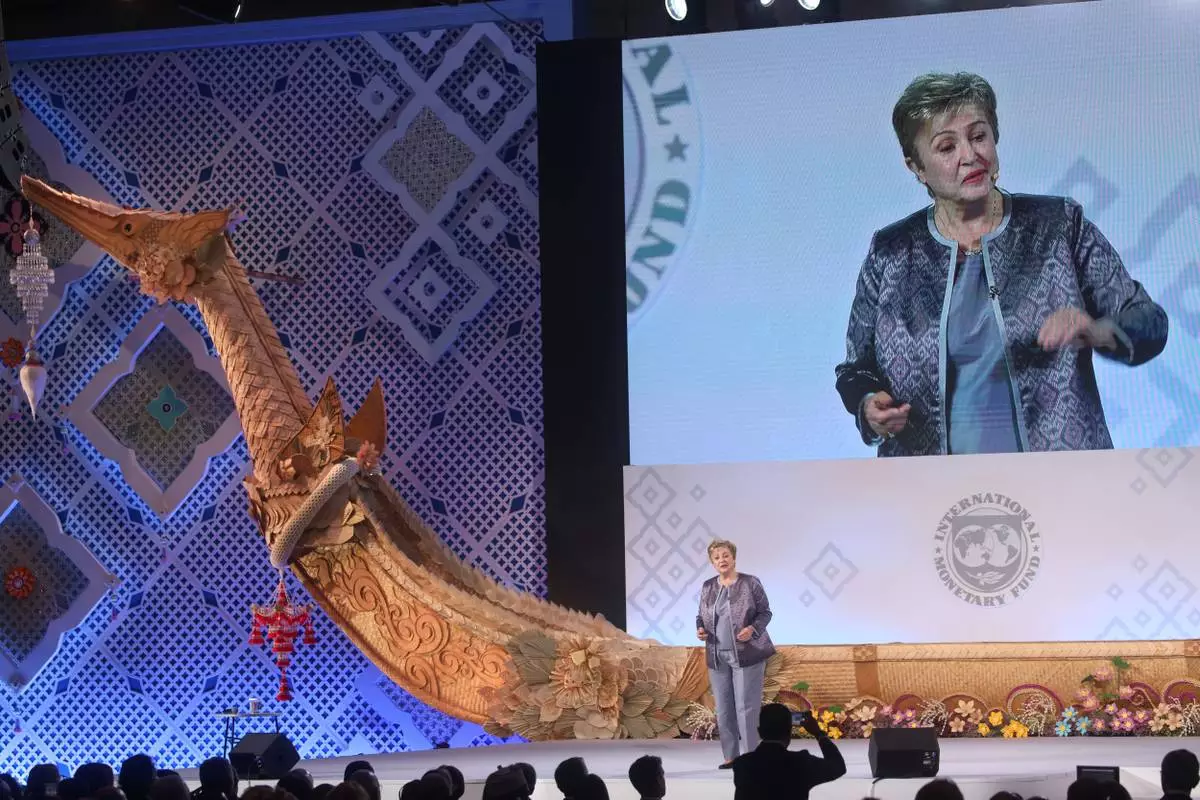
International Monetary Fund (IMF) Managing Director Kristalina Georgieva speaks during the annual meetings of the International Monetary Fund and the World Bank Group in Bangkok, Thailand, Friday, Oct. 16, 2026. (AP Photo/Dhitaraht Dhanarahtsombat)
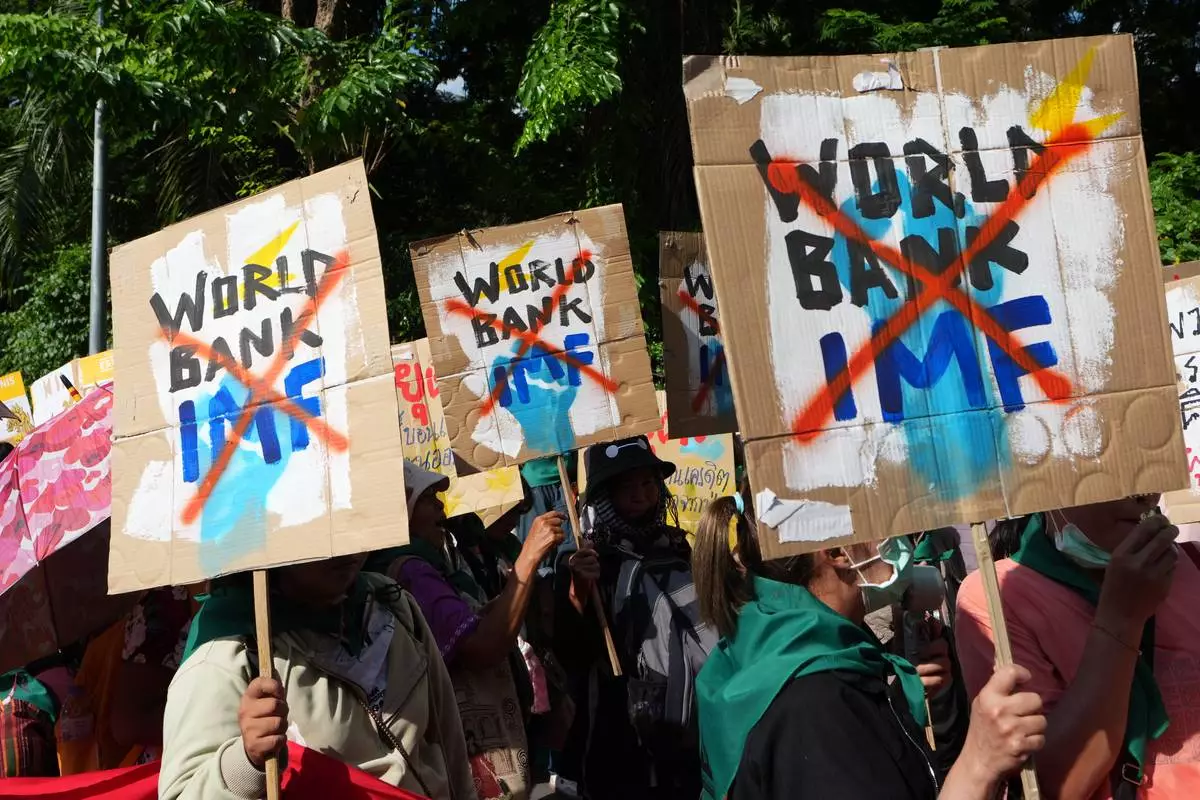
Protesters march to a meeting venue during a demonstration against the International Monetary Fund and the World Bank Group in Bangkok, Thailand, Friday, Oct. 16, 2026. (AP Photo/Sakchai Lalit)
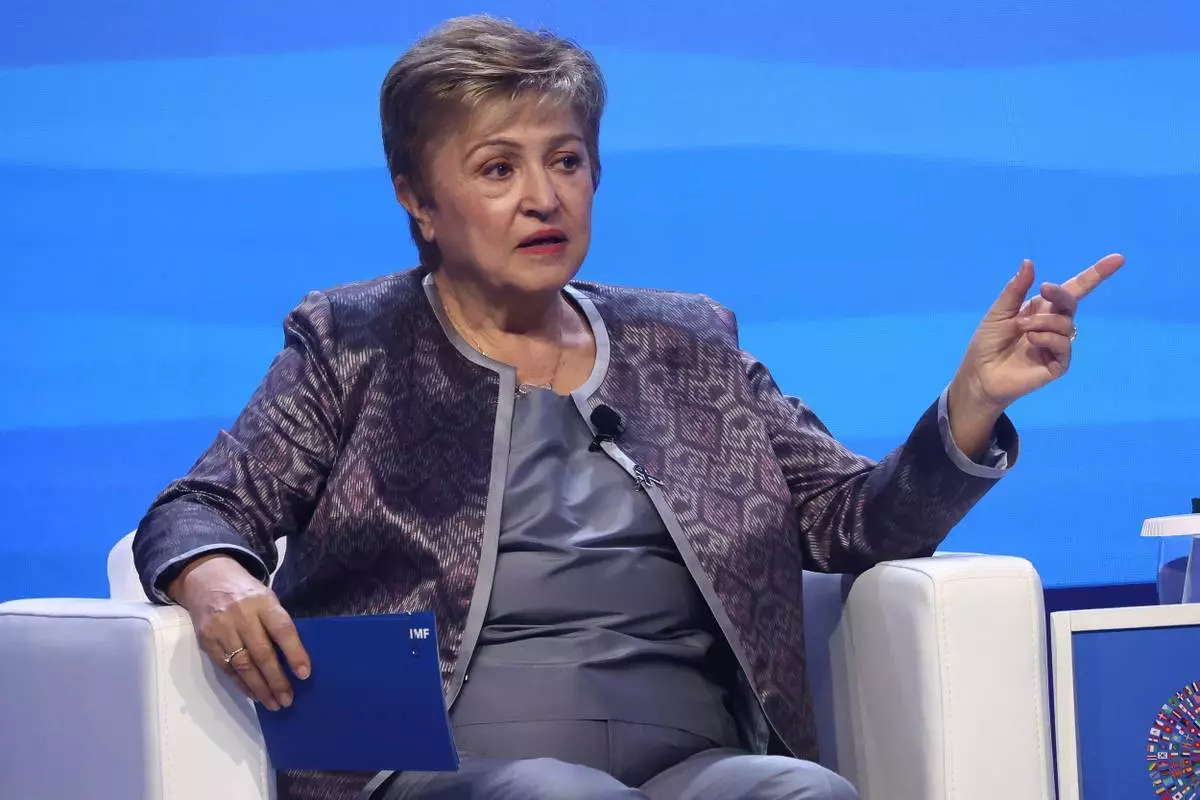
International Monetary Fund (IMF) Managing Director Kristalina Georgieva speaks during the annual meetings of the International Monetary Fund and the World Bank Group in Bangkok, Thailand, Friday, Oct. 16, 2026. (AP Photo/Dhitaraht Dhanarahtsombat)