WASHINGTON (AP) — In Wisconsin, a narrator complains that “groceries, utilities, everything's getting more expensive and Congressman (Derrick) Van Orden is adding to the list. He voted for the costly Iran war and spiking gas prices."
In Nebraska, Democratic candidate Chris Backemeyer says families are drowning. “And Mike Flood opened the gates. Flood voted six times for Trump's tariffs and the Iran war, flooding us with higher prices on groceries, gas, cars and medicine, costing us a thousand dollars more a year.”
And in Iowa, a group called Vote Vets Action Fund said Republican Senate candidate Ashley Hinson voted five times for the Iran war, “giving us record prices for gas and fertilizer.”
Those ads are but a few examples of how Democrats and aligned advocacy groups are using an unpopular war as they challenge Republicans, aiming to win back power in the House and Senate. It's the culmination of a strategy Democrats launched in the spring, when they began to repeatedly bring up war powers resolutions aimed at ending the conflict. The votes had little practical effect, but forced lawmakers to go on record and take a stand.
Now those votes are being highlighted in campaign ads across the country, according to an Associated Press analysis of data from AdImpact, which charts media spending.
In some cases, the Republicans targeted have never served in Congress before, so they couldn't possibly have voted on the various war powers resolutions. Even then, Democrats are portraying them as destined to be rubber stamps for President Donald Trump when it comes to the war.
The Associated Press analyzed data on broadcast and cable ads aired from Sept. 1 through Oct. 14 in the most competitive midterm races. The analysis focused on House and Senate races rated as either tossups or leaning Democratic or Republican by the Cook Political Report. A smaller number of streaming ads were also examined.
At least half of the 50 races featured Iran-related ads, most of which included household cost-of-living messages. All told, the ads aired on TV more than 43,000 times since Sept. 1, costing an estimated $42 million. The AP used both AdImpact’s own issue designations along with additional analysis of the ads’ language to identify them.
Of the 65 unique Iran-themed ads identified by the AP, 61 of them stressed household cost-of-living messages such as rising prices for fuel and other items.
Republicans are largely ignoring the Iran war in their ads. Their best strategy is to go after Democratic weaknesses so voters say “this guy is worse,” said Ron Bonjean, a Republican strategist.
“In the end, you're trying to get as many Republicans out to vote for you as possible and bring over some independents," Bonjean said. “And talking about the Iran war is really not a winning message because you're playing on the Democratic turf.”
The major themes addressed in the Republican advertising since Sept. 1 are taxes and crime, followed by issues tied to character, healthcare and immigration.
Some Republicans have sought to distance themselves from the Iran conflict outside the airwaves. In Michigan, Republican Senate candidate Mike Rogers has said the “war with Iran needs to end — and end quickly.” His opponent, Democratic nominee Abdul El-Sayed, has run ads saying that a billion dollars a day is going to a war “we have no business fighting” and he was running to “invest our tax dollars here in Michigan.”
In Maine, Republican Sen. Susan Collins emphasized in a recent debate that she voted nine times to end the conflict, prompting Democratic challenger Troy Jackson to say she voted five times to “make it happen.”
In all, the Senate has voted 14 times on resolutions seeking to halt or restrict Trump's military action against Iran. The House has held six such votes since the conflict began in late February.
In the latest House vote, seven Republicans ended up siding with Democrats in voting to end the war. That includes four Republicans seeking reelection in highly competitive districts: Tom Barrett of Michigan, Brian Fitzpatrick of Pennsylvania and Mariannette Miller-Meeks and Zach Nunn in Iowa. Barrett and Fitzpatrick had voted previously to remove U.S. troops from hostilities, but the yes votes were the first for Miller-Meeks and Nunn, reflecting the growing weariness with the war.
While the Iran war ads made up about 5% of the total TV spots aired across the competitive races, some contests leaned into the topic heavily. The highest concentration was in California’s 48th Congressional District in the San Diego area.
Roughly a third of the 12,000 aired ads touch on Iran. Democrats are seizing on a remark that Republican Jim Desmond made in the early days of the war, in which he said “no pain, no gain” as part of an interview on Real America's Voice. He also said in that interview he believed the higher prices were just “a spike” and would come down once the U.S. eliminated Iran's nuclear capability.
“No pain, no gain?" asks an ad from Democratic candidate Marni von Wilpert. “Tell that to a family filling up their gas tank.”
Desmond and the National Republican Congressional Committee responded with an ad that doesn't mention Iran but criticizes von Wilpert for raising taxes and fees when she was on the San Diego City Council. In contrast, the ad says Desmond fought to lower costs and supports suspending the gas tax.
Not far behind in Iran-related ads are Virginia’s 2nd Congressional District, now held by Republican Rep. Jen Kiggans, and Maine’s 2nd Congressional District, an open seat. Roughly a quarter of the ads in those districts touch on Iran. Both are highly competitive races.
Meanwhile, some 4,000 Iran-themed ads have aired in Ohio, or about 4% of the total in one of the nation's most expensive contests. Nearly all were from Democrat Sherrod Brown's campaign and leaned heavily on pocketbook themes.

Republican nominee for U.S. Senate Rep. Ashley Hinson, R-Iowa, speaks to supporters, Thursday, Oct. 15, 2026, in Ankeny, Iowa. (AP Photo/Charlie Neibergall)

Republican nominee for U.S. Senate Mike Rogers, right, faces off against Democratic nominee for U.S. Senate Abdul El-Sayed, during a televised debate at WOOD-TV, on Thursday, Oct. 8, 2026, in Grand Rapids, Mich. (AP Photo/Paul Sancya, Pool)

President Donald Trump listens as Rep. Mike Flood, R-Neb., speaks at a campaign rally at the Pinnacle Bank Expo Center, Monday, Oct. 5, 2026, in Grand Island, Neb. (AP Photo/Charlie Riedel)
Food and medical supplies have been scarce for months in Oleshky, which sits on the Dnipro River that separates Ukrainian forces from the city’s Russian occupiers. There’s no electricity, heat or running water. Roads leading from town are mined and dotted with burned-out cars. Menacing drones buzz overhead.
One desperate resident watched the front-line city slide further toward a humanitarian crisis as its trapped population dwindled to fewer than 2,000 people. She decided it was time to escape via what's been dubbed “the road of death.”
So the 40-year-old former hairdresser walked -- for 20 kilometers (12 miles), along the partially mined road — fearing that “every step could have been my last," she said.
Once a city of about 24,000, Oleshky was captured by Moscow’s forces on the first day of their full-scale invasion of Ukraine in 2022. Its buildings were shelled and burned, and its infrastructure damaged. Further calamity struck in June 2023 when floodwaters inundated the city after the Kakhovka Dam collapsed from an explosion that an Associated Press investigation found was likely caused by the Russian military, killing hundreds of residents.
And now those still left in the battered city along Ukraine's southeastern front face death from hunger or disease as another harsh winter looms, with no agreement in sight for even a humanitarian evacuation.
“There is nothing left in Oleshky,” said the woman, who fled in August and spoke to The Associated Press on condition of anonymity because she feared for her security. “No food, no supplies, no medical care, no aid whatsoever.”
Both sides blame each other for the catastrophe. Russia says Ukraine deliberately blocks supplies and evacuations; Kyiv counters that Moscow is effectively holding civilians hostage.
Ukraine has appealed repeatedly for a local ceasefire to organize evacuations. Russia, which as the occupying power is obligated by international law to ensure civilians under its control have what they need to survive, has made no commitment.
President Volodymyr Zelenskyy mentioned Oleshky’s suffering at the hands of Russia on Oct. 12 at an international forum in Poland, saying the city had been “razed to the ground.”
Ukraine is "trying to help these people, but they are under occupation,” he said. “Unblock the city of Oleshky and bring our citizens back.”
In a phone call Friday with President Vladimir Putin, Pope Leo XIV urged a ceasefire to allow food and medicine deliveries to Oleshky and to safely evacuate civilians, the Vatican said. The Kremlin said Putin voiced support for the Vatican efforts to help protect the population and secure vital supplies, and voiced readiness to cooperate.
Remaining residents reportedly scrounge for food amid destroyed buildings, or try to grow vegetables in garden plots. Water is drawn from wells. Firewood is used for warmth. Bodies at the city morgue decompose with no electricity.
Another 100 bodies fill the basement of Oleshky's hospital, said Tetiana Hasanenko, the exiled head of the city's Ukrainian military administration.
The U.N. human rights office said the last regular food delivery by road was May 26. Oleshky's Russian-installed officials said this month they delivered 2 tons of aid, although they admitted it was hardly enough.
The U.N. office said Oleshky's hospital lacks medicine and basic supplies, drone attacks prevent ambulances from reaching patients, and it's unsafe to take them elsewhere.
“It is impossible to live in Oleshky, there is no life left there,” said another resident who fled to Russian-held Mariupol and spoke on condition of anonymity because he feared for his security.
Even the Russian soldiers have moved deeper into the occupied part of the Kherson region, farther from the Dnipro, according to the former hairdresser. The Moscow-appointed authorities seemed to have "given up on us a long time ago,” she said.
She considered herself lucky to have survived the journey from Oleshky to the village of Radensk, also occupied by Russia but farther from the front line and thus better off.
She said an acquaintance who tried to bring food into Oleshky was killed on the road when his car came under fire, adding that she saw a photo of him “covered in blood, with bread and chicken legs scattered around him.”
Hasanenko said the route from Oleshky to Radensk is known as “the road of death” because "corpses lie on this road and no one is taking them away." She cited an explosion this month that killed four people and left an 86-year-old man badly wounded.
Russian troops were driven out of the larger city of Kherson across the Dnipro in 2022 but mined the roads around Oleshky, said Lt. Yevhen Voronetskyi, a spokesman with Ukraine’s 34th Separate Marine Brigade. Kyiv's drones also remotely mined forest paths used by Russian troops, he said.
Some evacuees who make it to Radensk try to return to Oleshky with food “because they have children waiting at home, or immobile elderly parents," Hasanenko said, saying at least 35 children remain there.
Ksenia Arkhipova, who fled Oleshky in 2022 and now helps others leave, said nearby occupied towns and villages in a zone along the Dnipro face similar dire conditions and mined roads.
It takes six to eight hours to walk or cycle from Oleshky to Radensk, she said, because evacuees might be older and weakened by hunger, or they have to wait out attacks or carry their bikes to avoid the mines.
Travel is only possible in dry weather, Arkhipova said, and "I'm terrified at the thought of the coming winter, when many people in Oleshky will be simply doomed."
Some of them don't want to leave their homes or risk a dangerous journey, Voronetskyi said.
Russia and Ukraine have discussed a possible temporary ceasefire and humanitarian corridor but reached no agreement, the U.N. human rights office said. “With winter approaching, the issue is urgent,” it said.
While communications with Moscow continue, "Russia has not provided clear, verifiable guarantees for conducting a humanitarian operation,” according to the office of Ukrainian human rights commissioner Dmytro Lubinets.
The mined roads make an evacuation impossible, and not all residents want to leave, according to the city's Russian-installed officials.
Vladimir Saldo, who was appointed by Moscow as governor of the occupied part of the Kherson region, promised earlier this month to help anyone who wants to leave the town. The former hairdresser told AP that residents have appealed to local authorities several times for a humanitarian corridor and submitted lists of those hoping to leave, but nothing came of it.
The International Committee of the Red Cross was ready to assist an evacuation but only if both countries agree and there are security guarantees for civilians, said ICRC spokesperson Sarah Davies.
Voronetskyi, the Ukrainian lieutenant, said the food shortages in Oleshky have persisted for months and are getting “worse and worse.”
His brigade has flown drones capable of carrying at least 20 kilograms (44 pounds) each over the Dnipro into the city with food aid for at least a year, he said, adding that more than 7 tons were delivered since September.
The parcels contained canned food, ingredients for baking bread, along with buckwheat, rice, sugar and candy for children. along with hygiene kits and medicine, including insulin, he said.
But Voronetskyi cautioned that these supplies weren't meant to get people through the winter but to help them "gather their strength, pack their things ... and still try to leave Oleshky.”
Russia should “come in and take the people out,” he said. "No one will stop you.”
Karmanau reported from Tallinn, Estonia, and Arhirova reported from Kyiv, Ukraine.
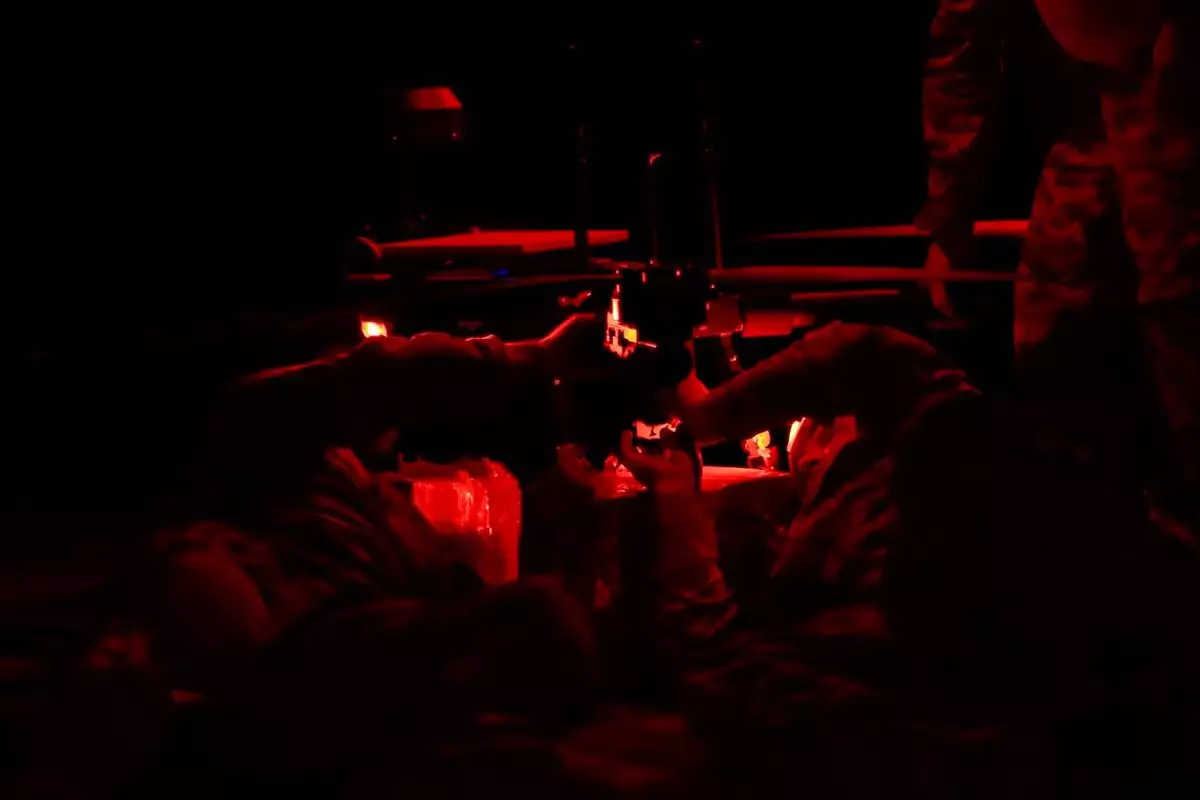
In this undated image from video provided by the Ukrainian 34th Separate Marine Brigade "Borysfen" on Oct. 4, 2026, Ukrainian soldiers at an undisclosed location in the Kherson region of Ukraine attach a parcel of supplies to a drone before a flight to the Russian-occupied city of Oleshky. (Ukrainian 34th Separate Marine Brigade "Borysfen" via AP)
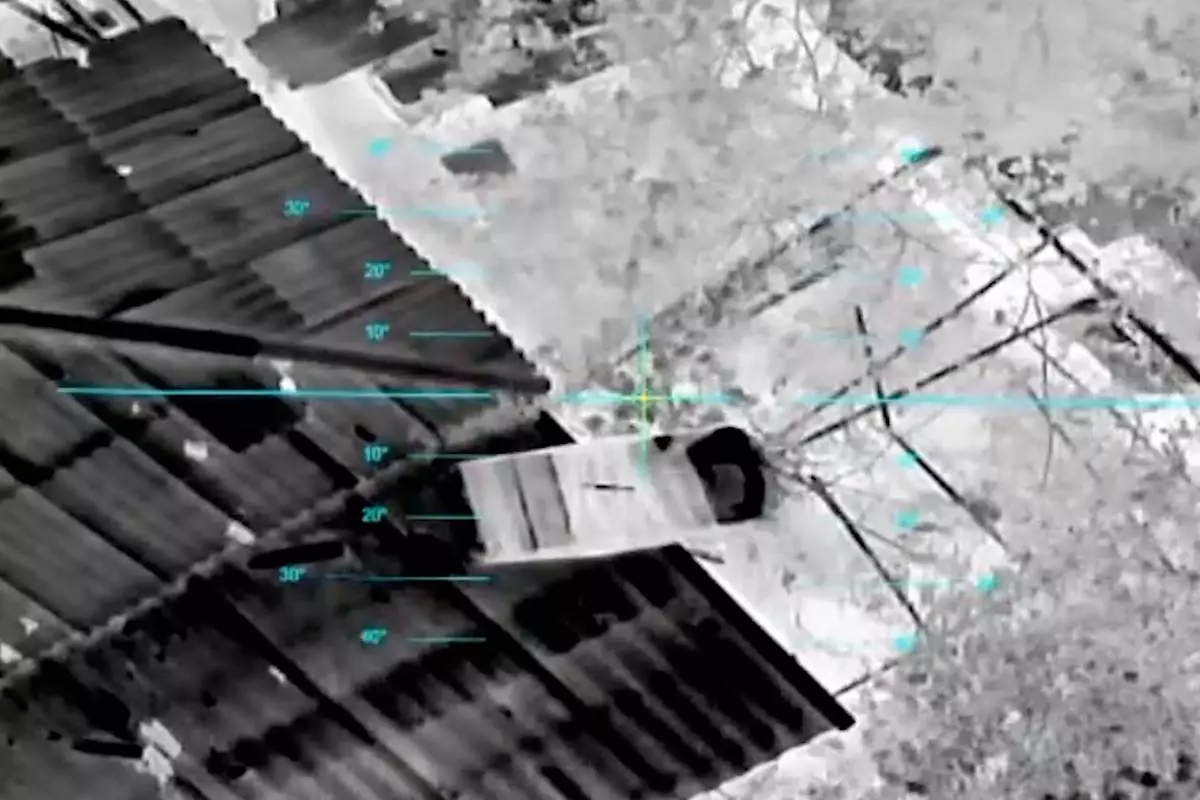
In this undated image from video provided by the Ukrainian 34th Separate Marine Brigade "Borysfen" on Oct. 4, 2026, a drone drops a parcel of supplies to civilians in the Russian-occupied city of Oleshky in the Kherson region of Ukraine. (Ukrainian 34th Separate Marine Brigade "Borysfen" via AP)

In this undated image from video provided by the Ukrainian 34th Separate Marine Brigade "Borysfen" on Oct. 4, 2026, a Ukrainian soldier launches a drone above the Russian-occupied city of Oleshky from an undisclosed location in the Kherson region of Ukraine. (Ukrainian 34th Separate Marine Brigade "Borysfen" via AP)
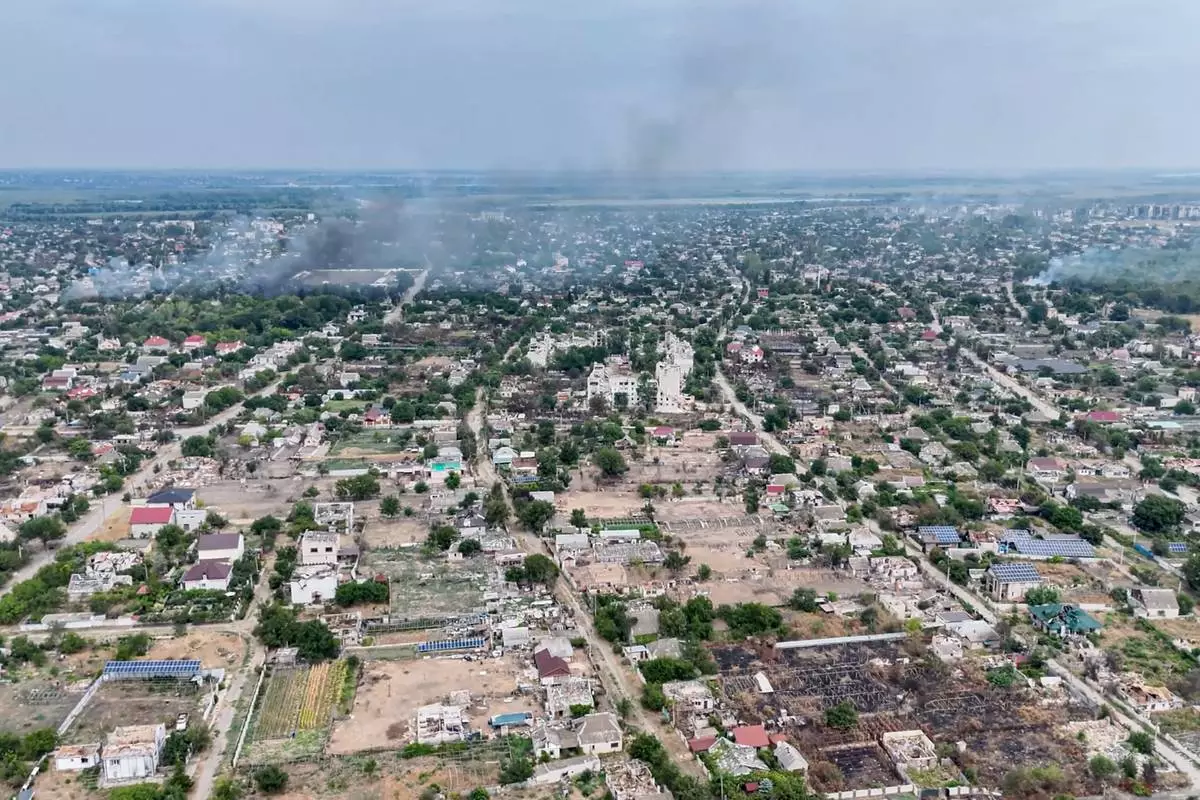
In this undated image from video provided by the Ukrainian 34th Separate Marine Brigade "Borysfen" on Sept. 22, 2026, smoke rises from a residential neighborhood in the Russian-occupied city of Oleshky in the Kherson region of Ukraine. (Ukrainian 34th Separate Marine Brigade "Borysfen" via AP)
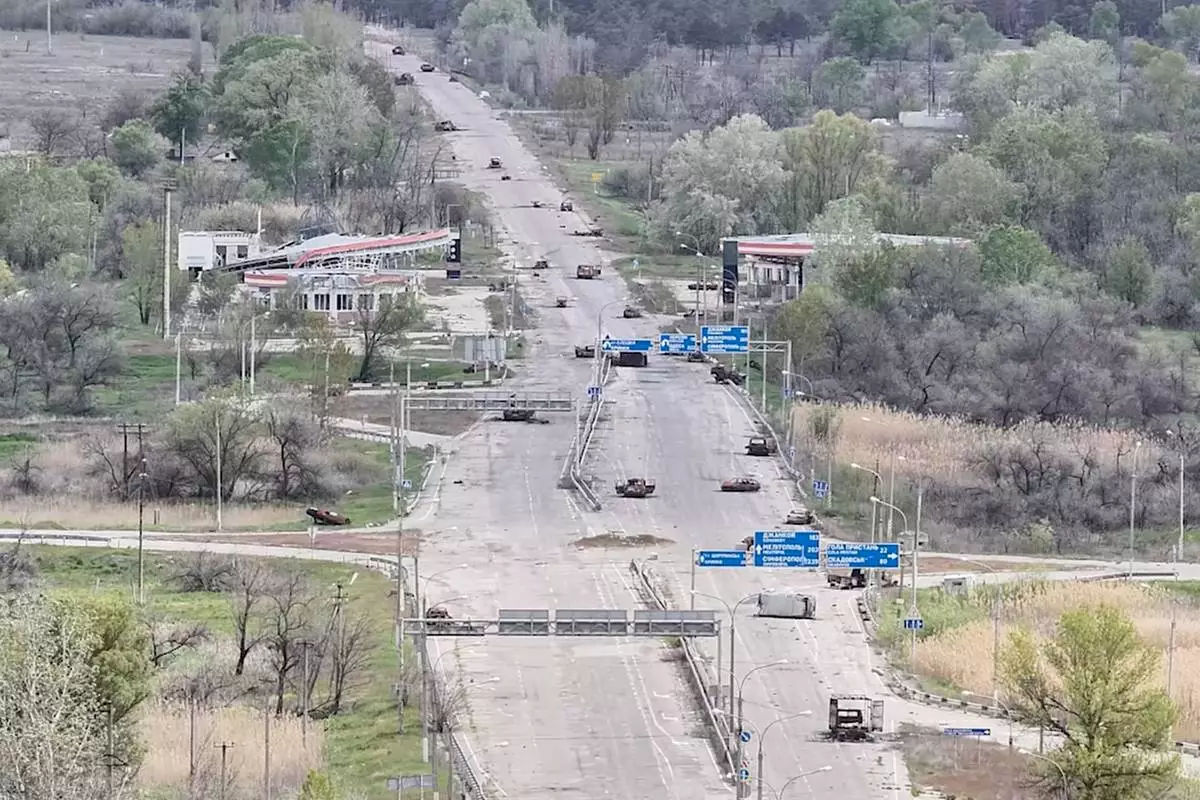
In this undated image from video provided by the Ukrainian 34th Separate Marine Brigade "Borysfen" on Sept. 30, 2026, destroyed cars are seen on a highway from the Russian-occupied city of Oleshky in the Kherson region of Ukraine. (Ukrainian 34th Separate Marine Brigade "Borysfen" via AP)