A growing number of South Korean seniors are choosing work over retirement, as government agencies explore new employment models that move beyond basic manual labor toward skilled and professional roles in the rapidly aging society.
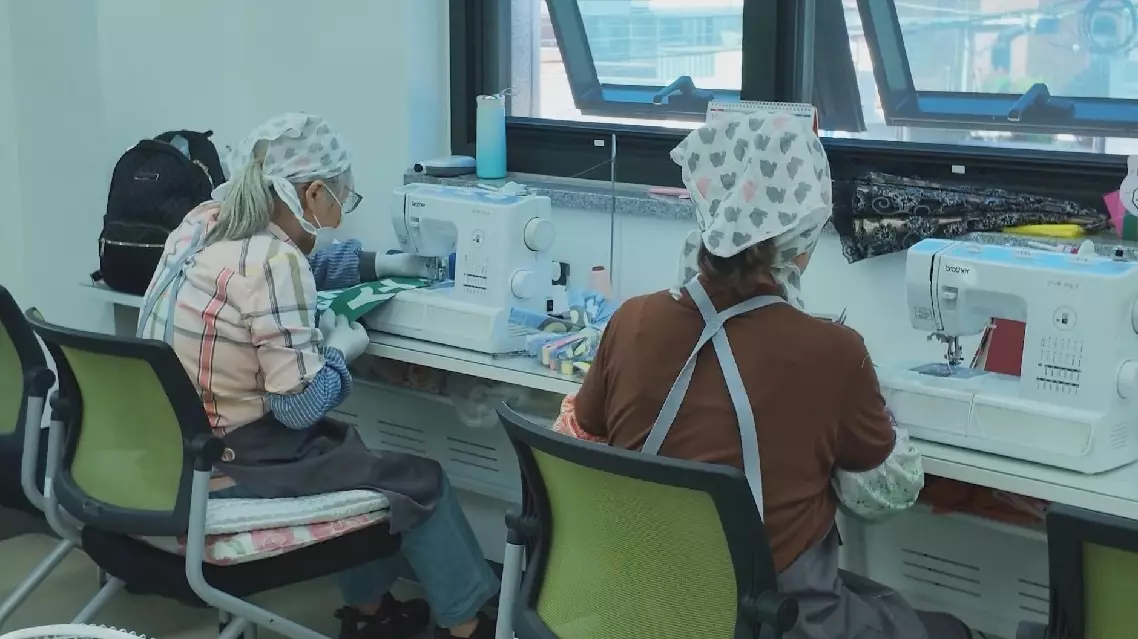
The population aged 65 and older climbed to more than 11 million this year, accounting for about 22 percent of the country's total, according to the Ministry of Data and Statistics, a fresh sign of the deepening aging trend. In Jeonju City in North Jeolla Province, 71-year-old Ryu Bo-yeon, a retired seamstress, now earns a steady income at a social welfare center through a senior employment program. Her main job is collecting discarded promotional banners and turning them into eco-friendly bags for nearby supermarkets. Working 20 days a month, three hours a day, she earns about 730,000 won (about 540 U.S. dollars) per month and is enrolled in the country's four major social insurance programs.
"Staying at home all day is boring. I only see friends occasionally. Now I can work and spend time with everyone here, which makes me really happy. And being able to recycle old discarded banners is so rewarding and great. I've been working here for three years," said Ryu.
To enrich retirees' lives, the welfare institution also offers digital skills training, helping seniors learn to use electronic devices and understand artificial intelligence. This year, Jeonju has allocated a budget of about 80 billion won (about 60 million U.S. dollars) to provide employment opportunities for nearly 17,000 seniors, gradually shifting senior employment from simple public-service work such as street cleaning toward skilled and professional positions.
Interest in the senior posts far outstrips supply, according to Anna Yoo, who heads the institution.
"Jeonju now operates 315 senior employment project teams. The number of participating seniors increased 18 percent from last year. As the population ages, demand for senior employment is growing year by year. At our institution, the competition ratio for public-service positions is about 5 to 1, while for competency-based types, it is at least 10 to 1," said Yoo.
Data show that the number of employed South Koreans aged 65 and above grew from nearly 2 million in 2015 to more than 4 million in 2025, more than doubling over the decade. In the same period, the employment rate for seniors rose from about 30 percent to nearly 40 percent, an increase of about 9 percentage points.
The desire to work among elderly Koreans continues to strengthen as well. A survey found that nearly 60 percent of South Koreans aged 65 to 79 hope to continue working in the future, up about 1 percentage point from last year.
Senior employment rises in S Korea as skilled job programs expand