Skip to Content Facebook Feature Image

Botswana's president on UN "Correct the Map" resolution

China

China

China

Botswana's president on UN "Correct the Map" resolution

2026-10-18 18:07 Last Updated At:21:47

The recently adopted United Nations resolution on correcting the map concerns more than choosing the right representation of the Earth, but treating the African continent and all African people with respect and integrity, Botswana's President Duma Gideon Boko said.

In an interview with China Media Group (CMG) in Beijing on Thursday, President Boko, who was in a state visit to China, said promoting the Equal Earth projection is an act of justice and honesty aimed at pushing back against long-standing systemic prejudice against African people.

"[The international community] failed miserably to be truthful and honest about realities that confront it. To diminish, conceptually, and even in the drawing of maps, the size and the scale of Africa relative to other parts of the world, was a denigration of the width and integrity, not just of Africa as a territory, but of the peoples of the African continent. And that was dishonestly normalized and validated on the world stage. It was about time that the world was jolted out of this attitude and all the attendant attitudes and instrumentalities that have served to undermine Africa and diminish the worth of its peoples and civilization," he said.

The president said that the UN resolution inspires African countries to take on another historic task: striving for reparations from colonizers and exploiters.

"And so we believe that this is now an attempt to atone for grave injustices that have been visited upon on the African continent, and it now will give impetus to another effort that is underway, that those that colonized Africa, that plundered its resources, that kidnapped its people and took them to their own countries, and used not just the wealth of Africa in terms of resources, but the wealth of Africa in terms of its people, to build and power their own economies, are in debt. They owe Africa. They owe all those people that they captured and enslaved. They owe them reparations. They must atone, and in good conscience," he said.

The UN General Assembly voted on Sept 4 to adopt a non-binding resolution that encourages the use of the Equal Earth cartographic projection in maps worldwide to replace the Mercator projection widely used so far, which distorts the sizes of continental landmasses.

The resolution of "Correct the Map" aimed at rebalancing global cartographic representation and promoting equitable representation of the world's regions, particularly Africa, was adopted with 164 votes in favor, 1 against, and 6 abstentions. The United States was the only member state that voted against it.

Botswana's president on UN "Correct the Map" resolution

Botswana's president on UN "Correct the Map" resolution

A new China Global Television Network (CGTN) documentary explores how the historic Long March spirit is driving modern innovation, as young Chinese researchers and engineers are channeling this relentless drive to overcome critical bottlenecks in the EV and AI industries.

Titled "The Source of AI: Not a Single Rock Goes to Waste", the documentary highlights the pioneering journeys of Zhong Yu and He Pengyu.

Two years ago, Zhong made a pivotal career shift, leaving a long-established automaker to return to China and join Farasis Energy, a homegrown battery manufacturer based in Ganzhou City of east China's Jiangxi Province.

Working around the clock, Zhong and his team are developing solid-state batteries. This next-generation technology promises higher energy density and enhanced safety, having the potential to completely disrupt the current automotive landscape.

Through his research, Zhong is determined to establish China as a global leader in the battery sector.

While Zhong focuses on the power sources of the future, He Pengyu is tackling the foundational raw materials required for the EV and AI boom.

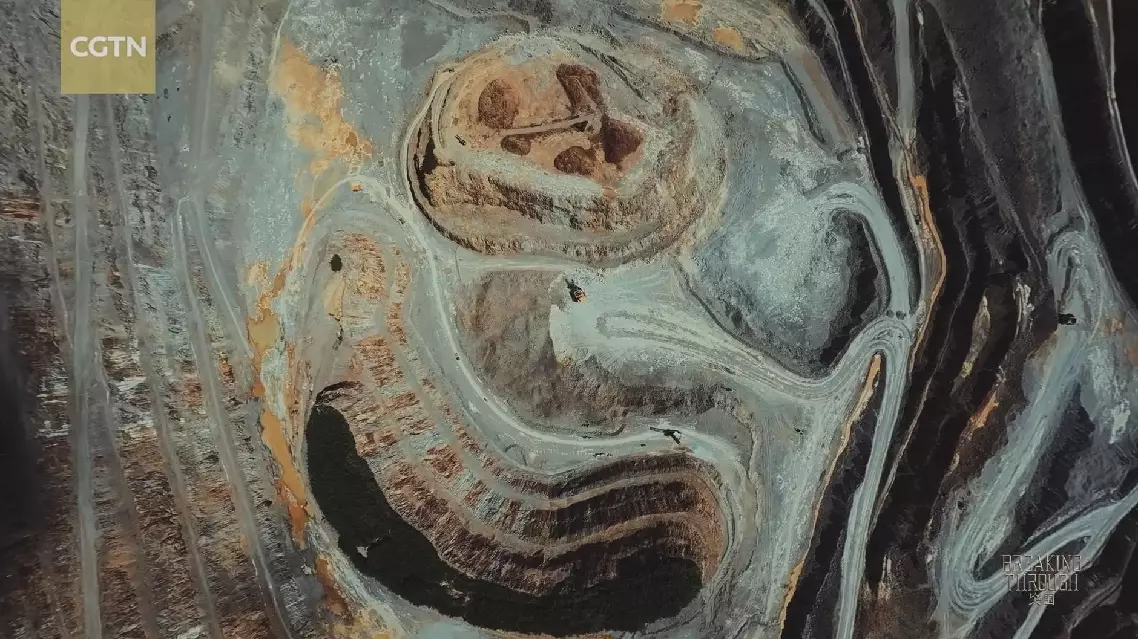
The rapid expansion of these sectors has triggered a massive surge in demand for copper and rare earth elements. However, extracting and separating these valuable minerals from raw ore has long been a formidable technical hurdle.

Without advanced equipment, China's mining industry once relied on grueling, inefficient manual sorting.

Determined to change this paradigm after returning from his studies in France, He founded HPY Sorting. The company has developed a revolutionary AI-driven optical ore sorting system capable of automatically separating waste rock from valuable ore.

Processing up to 300 tons of ore per hour, this intelligent sorting technology is now deployed in mines across the world, replacing tasks that once relied on human experience with precision-driven algorithms and automated machinery.

He Pengyu hopes that through his innovation, not a single rock goes to waste.

The documentary is part of CGTN's "Breaking Through" series, which traces China's journey from the historic Long March undertaken by the Red Army nine decades ago to its modern-day achievements, highlighting the resilience, ingenuity, and determination of its people.

Long March spirit drives critical breakthroughs in China's EV, AI industries: documentary

Long March spirit drives critical breakthroughs in China's EV, AI industries: documentary

Recommended Articles