A heartwarming story of local farmers serving bowls of buckwheat noodles to a commander, who later proved to be Chairman Mao Zedong, during the Central Red Army's Long March highlighted the extreme hardships of the trek and the close bond between the people and the Red Army.
This year marks the 90th anniversary of the victory of the Long March, the epic military trek conducted by the Red Army that contributed to the founding of the People's Republic of China.
The Red Army, led by the Communist Party of China (CPC), was mainly made up of soldiers from peasants' and workers' families during the Chinese revolution. Between 1934 and 1936, the army trekked up to 12,500 kilometers to break through the Kuomintang party (KMT) siege, a journey later known as the Long March.
In October 1935, after a year of marching and fighting, the Central Red Army arrived at Zhangwanzi Village in northwest China's Shaanxi Province to rest for the night.
There, the family of Zhang Tingjie cooked buckwheat noodles for a tired officer -- little knowing that he was the man who would lead the Chinese revolution to victory.
"As grandpa recalled, a bodyguard came up to him. Grandpa asked him what he needed. The bodyguard said their commander hadn't eaten properly the whole day and was even ill and asked if he could cook him a meal. Grandpa said of course. In northern Shaanxi, welcoming guests with buckwheat noodles is a tradition. Grandpa brought the noodles to the 2nd doorway. The bodyguard took over from there. But just a moment later, he came back out and asked if the commander could have some more. Grandpa said of course. He had to make sure the guest ate his fill. By the third bowl, as grandpa brought it to the doorway, the bodyguard stopped him and said Zhang was a kind and honest man, and that the commander would like to meet him. So grandpa brought it in himself. Chairman Mao ate three bowls in a row. He wiped the sweat from his forehead and said it had been a year, he hadn't eaten this well on the Long March. He said that northern Shaanxi was truly a wonderful place," said Liang Xuemei, granddaughter-in-law of Zhang Tingjie.
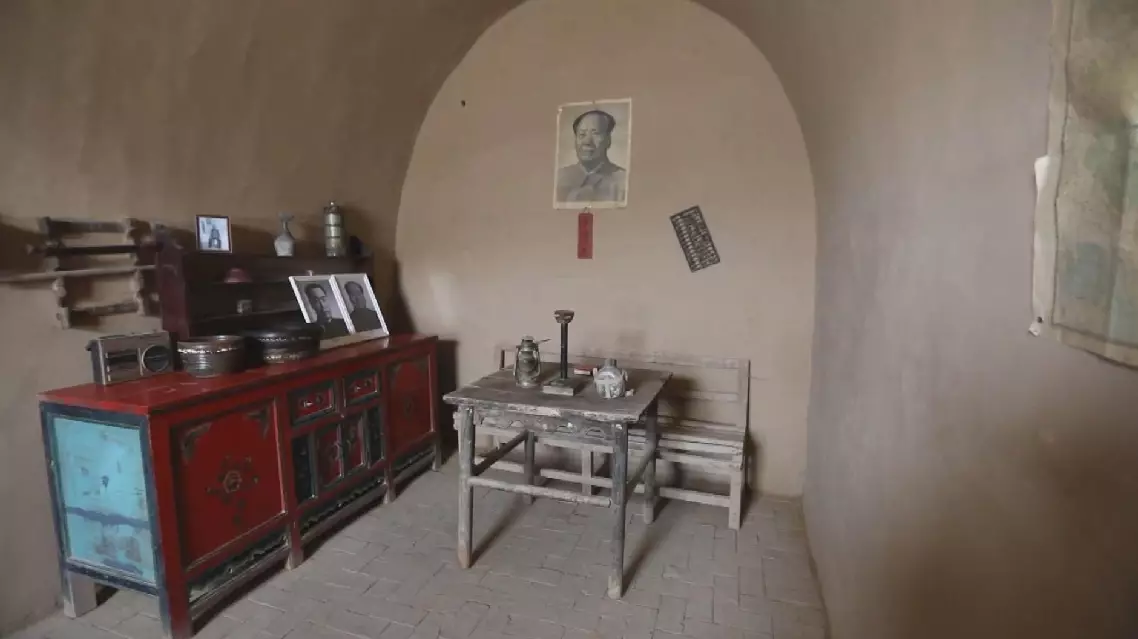
After the meal, in that same cave dwelling, the leadership gathered late into the night to hold an important meeting.
"In this cave dwelling, the Standing Committee of the Political Bureau of the CPC Central Committee held the Zhangwanzi meeting," said Liang.
It was at Zhangwanzi that the Central Red Army set its course toward Wuqi Town, the final stop of the Long March.
In Wuqi, the Central Red Army fought its last battle of the Long March, destroying the enemy forces that had been chasing them for months -- a fight later remembered as the "tail-cutting" battle.
"Mao Zedong, Zhou Enlai, and Peng Dehuai accessed the situation and chose their ground. Wuqi's steep mountains and narrow valleys worked in their favor. They hid the troops in 3 valleys: Toudaochuan, Erdaochuan, and Sandaochuan. At seven in the morning on October 21, 1935, the Wuqi 'tail-cutting' battle began. After just over two hours of fierce fighting, the Central Red Army secured the victory," said Zhang Xiaoqin, a guide at the Wuqi Long March Victory Memorial of the Central Red Army.
With that, the hardest stretch of the Long March was finally behind them. Years rolled on, and in 1949, a new China was born. And those who had lent a hand along the way were not forgotten.
"Nearly thirty years later, in 1964, Chairman Mao's bodyguard Chen Changfeng came back. Chairman Mao said that the army was growing stronger, life was getting better and it was time to go and thank that family. He asked grandpa if he ever knew who that tall commander was. Grandpa said no and the bodyguard told him then the man was Chairman Mao," said Liang.
Heartwarming noodle story during Long March highlights bond between people, Red Army