CHICAGO--(BUSINESS WIRE)--Oct 19, 2026--
BDO USA released its 2026 Board Survey today, an annual report polling more than 200 public company board directors on their priorities and challenges in the year ahead. As boards contend with technological disruption, geopolitical instability, economic uncertainty, and rising expectations for growth, directors are increasingly confronting a fundamental governance challenge: determining where limited time, attention, and resources can have the greatest impact.
This press release features multimedia. View the full release here: https://www.businesswire.com/news/home/20261019207951/en/
More than one-third (36%) of directors say balancing competing priorities on the agenda will be among their boards' most significant challenges over the next 12 months. Fifty-one percent also say keeping pace with AI and emerging technologies will be the top challenge, while another 35% cite prioritizing capital allocation amid resource constraints.
“Boards today are being asked to oversee a growing number of interconnected risks and opportunities,” said Amy Rojik, National Managing Principal of Corporate Governance and founder of the Center of Corporate Governance at BDO USA. “Effective governance increasingly requires directors to be deliberate about where they focus their attention — understanding the external forces they need to navigate, the areas where they can influence organizational readiness, and where they have the ability to exercise control over how they govern.”
The survey finds that mounting pressure is reshaping how boards approach governance, technological innovation, external volatility and growth. Directors are placing greater emphasis on strong governance foundations and organizational readiness while making more deliberate choices about capital, capabilities, and strategic priorities. The survey’s findings highlight four areas shaping board oversight in the year ahead:
Grounding Governance Processes Amid Rapid Change: As board agendas become more crowded, fundamental governance responsibilities risk being pushed aside. Forty-two percent of directors identify board effectiveness — including evaluations, refreshment, structure, and continuing education — as an area that may be deprioritized amid competing demands, more than any other governance area measured. Meanwhile, just 58% rate their boards as highly effective at collaborating with the CEO and management, down from 69% in 2025. Twenty percent report that their boards are ineffective at conducting meaningful member evaluations and executing refreshment strategies, compared with 9% last year. Effective crisis management also saw a noticeable decline, with 22% calling their boards ineffective in crisis response, up from 13% in 2025.
Strengthening the Foundations of AI and Technological Innovation: Boards increasingly view technology fluency and governance as core capabilities, but gaps remain. Twenty percent of directors say their boards do not have a clear governance framework for overseeing AI adoption and cybersecurity risk, while 15% say their boards lack the right skills and experience to oversee AI, cybersecurity and data governance. Technology and innovation is now one of the most sought-after areas of board expertise, cited by 49% of directors, up from 42% in 2025, while 45% increasingly prioritize cybersecurity and data protection expertise in board composition, up from 35% last year.
Responding Effectively to External Volatility: Directors are navigating a risk environment shaped by technological change, trade and regulatory uncertainty, and geopolitical conflict. Fifty-seven percent cite the pace of AI and cyber capabilities as a significant external concern for the next six to 12 months, followed by tariff, sanctions, and trade policy changes (46%); regulatory uncertainty amid the U.S. midterm elections (41%); and geopolitical conflict (38%). The impact varies considerably by company: 65% of large-cap directors identify geopolitical conflict as a concern, compared with 27% of mid-cap directors, underscoring the need for boards to assess external developments through the specific lens of their company's exposure.
Returning to Organic Growth: Boards are concentrating growth strategies closer to the core business while becoming more selective about capital deployment. Thirty-four percent of directors say investing in new or enhanced products and services is their board's primary growth focus, while 20% prioritize customer experience and retention — more than double the 9% reported in 2025. By contrast, just 13% identify strategic M&A or partnership transactions as their primary growth focus, down from 30% last year. The shift comes as 35% of directors say determining where to direct limited capital and resources will be a significant challenge in adapting to change.
As boards prepare for 2027, the survey suggests that disciplined prioritization will be essential to effective oversight amid crowded agendas. Learn more about how directors are responding to competing demands and positioning their organizations for change by downloading the 2026 BDO Board Survey,Governance In Focus: Navigating From Pressure to Disciplined Prioritization.
About the 2026 BDO Board Survey
Conducted by Rabin Roberts Research, an independent market research consulting firm, on behalf of the BDO Center for Corporate Governance, the 2026 BDO Board Survey examined the opinions of more than 200 corporate directors of public company boards in June 2026. Respondents sit on public boards spanning micro- to large-caps across a variety of industries, including technology, retail, manufacturing, financial services, energy, healthcare, life sciences, real estate, education and hospitality. Survey questions included a mix of “select one,” “select three,” and “select all that apply” questions. Percentages have been rounded to the nearest whole number and may not total 100%.
About BDO USA
At BDO, our purpose is to be the people you count on to grow with confidence and achieve what matters most. Our professionals provide assurance, tax and advisory services for a diverse range of clients across the U.S. and in over 160 countries through our global organization. We are proud to be an ESOP company, inspiring an ownership mindset that enables our collective success.
BDO is the brand name for the BDO network and for each of the BDO Member Firms. BDO USA, P.C., a Virginia professional corporation, is the U.S. member of BDO International Limited, a UK company limited by guarantee, and forms part of the international BDO network of independent member firms. For more information, please visit: www.bdo.com.
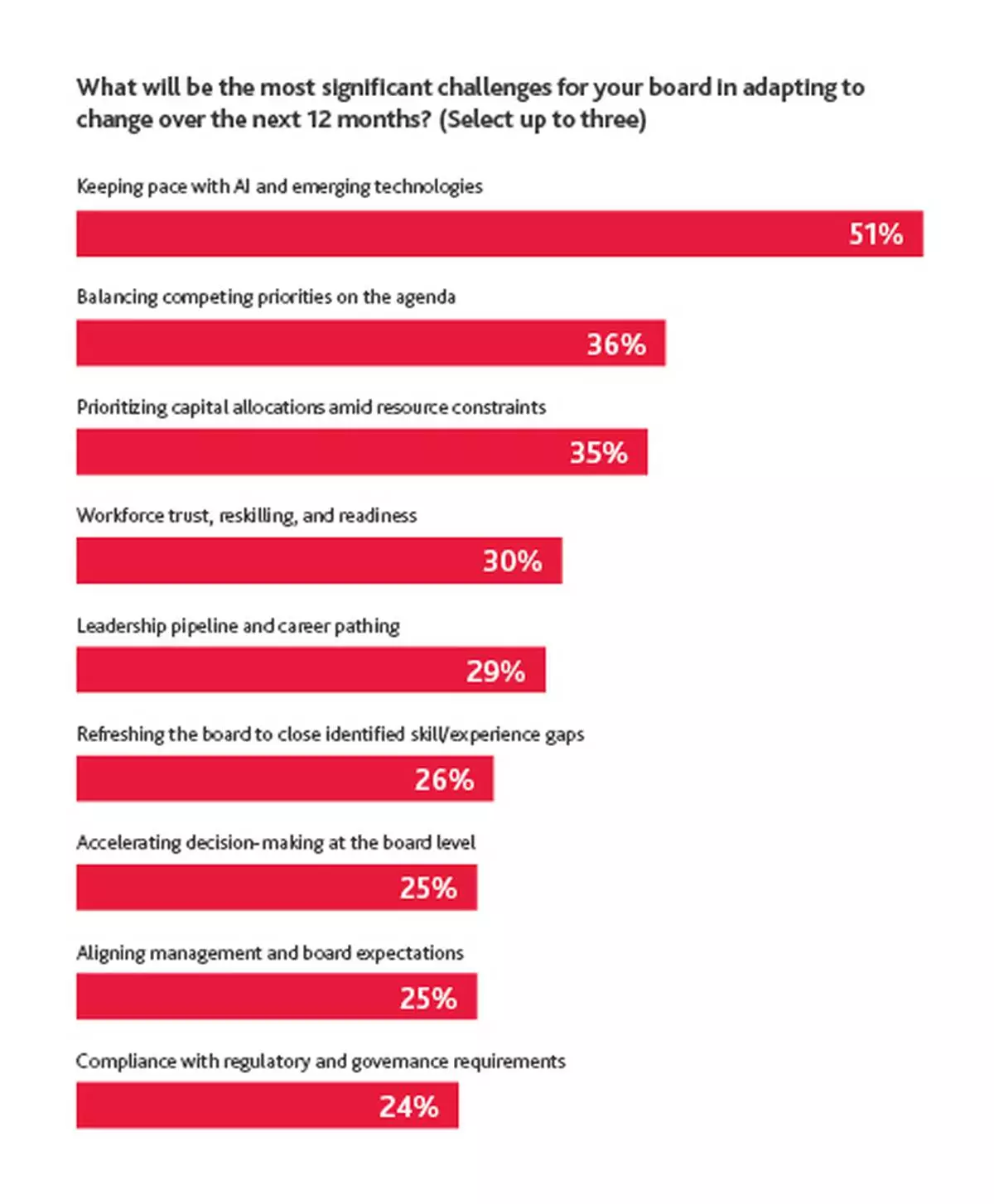
2026 BDO Board Survey. Board’s Top Challenges: What will be the most significant challenges for your board in adapting to change over the next 12 months? (Select up to three)