The 2026 Wuhan Open concluded on Sunday with Poland's Maja Chwalinska crowned a new WTA 1000 champion, drawing 200,000 spectators and generating an estimated 890 million yuan (about 133 million U.S. dollars) in economic benefits.
The final featured Chwalinska, the No. 16 seed, coming from a set down to defeat Britain's Sonay Kartal 2-6, 6-4, 6-2 and claiming her first WTA 1000 title.
As the final WTA 1000 tournament of the year, the nine-day Wuhan Open offered a record total prize of 4.08 million U.S. dollars and staged over 100 world-class matches throughout nine days, attracting tennis fans from around the country.
"Our ticket sales this year are quite good, up about 30 percent year on year. We also found that more spectators came here to watch Wuhan Open from other cities. Last year, about 40 percent of the spectators were from other cities. This year, the figure is between 50 percent and 60 percent," said Wang Qing, president of the Wuhan International Sports Event Management Company.
Outside the arena, a Wuhan Open carnival that covered an area of 10,000 square meters also drew large crowds, with more than 100 booths offering sports and trendy products, food and other activities. The site also served as an offline coupon collection and redemption point, allowing visitors to claim coupons and spend them on the spot.
"I just got a 10-yuan coupon, which can be used for sports goods. We are going to buy some tennis merchandise," said Ms. Li, a tourist from Xi'an, capital of northwest China's Shaanxi Province.
Ticket stubs from the tennis games can also act as coupons, allowing holders to enjoy discounts on food, retail and parking in various business districts around the city.
The provincial authorities issued 20 million yuan in sports consumption coupons. For each ticket stub, spectators could receive a 300-yuan voucher package for fitness activities and sports equipment.
"I bought a Wuhan Open ticket. Holding the stub, I can get an 80-yuan coupon, which makes it a good deal to play tennis here," said Mr. Xie, a local resident.
Hubei has launched premium tourism routes to integrate scenic spots, hotels and catering resources and leverage the spectator influx, along which ticket-stub holders could enjoy discounts in scenic areas across the province.
The event is estimated to generate a total economic benefit of 890 million yuan, which is 26.24 percent higher than last year's edition.
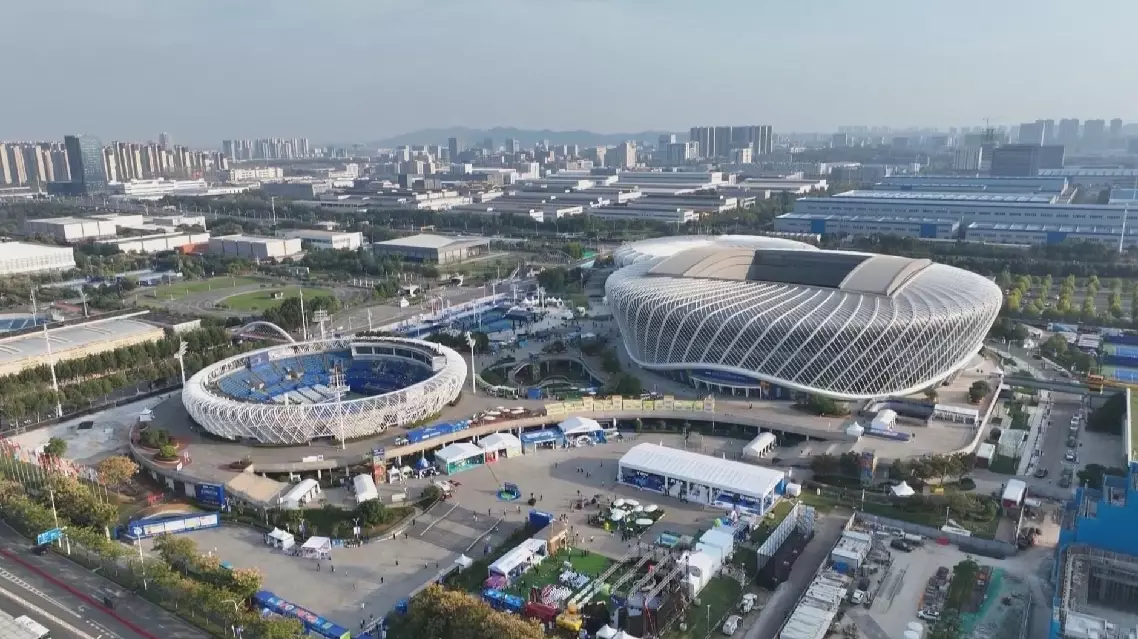
Wuhan Open turns tennis fever into consumption boom
The China Import and Export Fair, also known as the Canton Fair, has reflected and embodied the development and industrial upgrade of China's economy over the seven decades since inauguration.
The 140th edition of the biannual fair opened in Guangzhou, capital of south China's Guangdong Province on Oct 15, and will be held in three phases through Nov 4, with a wave of AI-powered products making their debuts and injecting fresh momentum into China's export growth.
As China's largest and longest-running import and export expo, the Canton Fair has been held twice a year for the past 70 years, with its exhibition space and buyer volume surging more than 100 times. The exhibition venue is a living microcosm of China's manufacturing transformation.
At this year's event, the service robot hall is the hottest zone swarmed by overseas buyers, where AI is quietly reshaping people's daily life.
Robot vacuum cleaners glide around homes, while smart lawn mowers tend gardens automatically. Artificial intelligence is no longer just a concept, and it solves real household pain points for users across the globe.
"We think robots today are built for wider accessibility and to get closer to people," said Kang Yuqi, director of public affairs of High Torque Robotics.
Technology can go even further. Wearable robotic devices are enabling AI to understand human better. The technology adapts to us, not the other way around.
"[This leg exoskeleton] has built-in AI algorithms, which makes it able to figure out the user's movement intention. Meanwhile, it also adapts these algorithms to suit each individual," said Liang Linchao, founder of TransitX Intelligent Technology Co., Ltd, a smart exoskeleton company based in Hangzhou City, east China's Zhejiang Province.
"For climbing upstairs, it gives you a big advantage. I was thinking using it for my older family members," said a foreign visitor.
All these devices are mass-produced and ready for export, but the Canton Fair looked nothing like this in the very beginning. Back then, in 1957, labor-intensive goods formed China's main export portfolio. Facing international trade embargoes, the fair opened a critical channel for China. The very first two editions of the Canton Fair reached 86 million U.S. dollars in turnover, accounting for 20 percent of China's foreign exchange earnings that year.
Global buyers have come here to strike deals for decades -- agriculture products in the 1950s, electric motors in the 1980s, and now AI-powered high-tech machines.
The Canton Fair is inclusive, efficient, overwhelming in the best possible sense. Seventy years on, generations of Chinese entrepreneurs continue to innovate, embracing new technologies and markets.
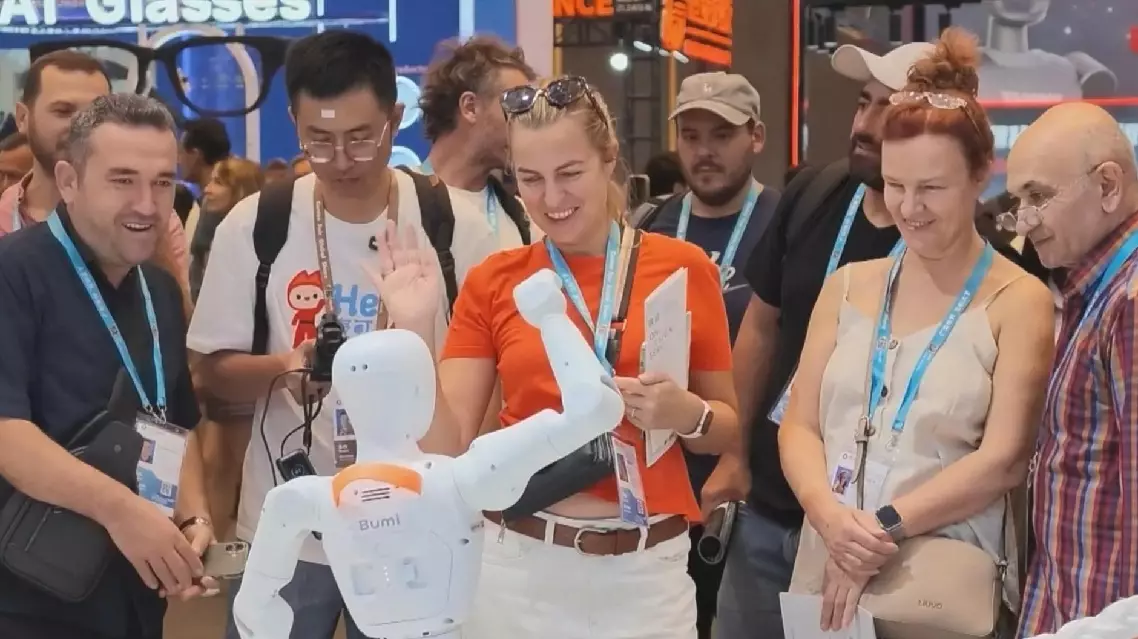
Long-running trade fair chronicles evolution of China's economy, innovation