Bloomberg reported on October 14 local time that the EU is negotiating with China. Brussels hopes Beijing will lift sanctions on the small German company Sindlhauser Materials GmbH. That small firm supplies the Dutch ASML, the world's most important chip equipment manufacturer. The sanctions now threaten its survival.
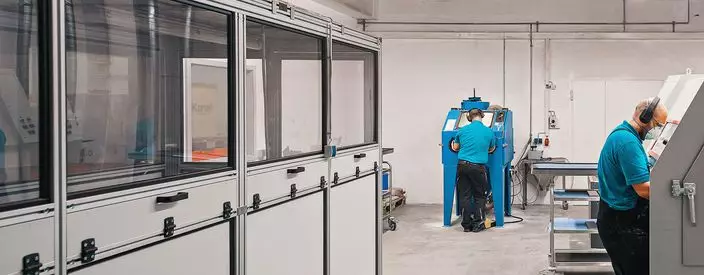
EU seeks China deal to free ASML supplier Sindlhauser.
The Deal on the Table
Click to Gallery
EU seeks China deal to free ASML supplier Sindlhauser.
ASML, Dutch semiconductor equipment giant.
Sindlhauser's rare earth supply nearly all Chinese.
EU trade chief Šefčovič met Wang Wentao in Beijing.
Bloomberg cited people in the know as saying the EU will remove trade restrictions on an unnamed Chinese company in exchange. That company is accused of assisting Russia in launching war against Ukraine.
In July this year, China imposed sanctions on Sindlhauser and 13 other European companies. The move retaliated for the EU's 21st round of sanctions against Russia. Sindlhauser is a small German company specializing in precision manufacturing and advanced coating technology for semiconductors and other industries.
In that round of sanctions, the EU listed several Chinese entities as sanctions targets. The EU said they were suspected of providing Russia with key components that could be used to manufacture weapons. Companies placed on the relevant EU and Chinese lists are subject to export controls.
People familiar with the matter said Sindlhauser relies on Chinese supplies of rare earths and critical minerals. If China's sanctions continue, the company will face the risk of bankruptcy within the coming months. It was also said this German company is part of ASML's supply chain.

ASML, Dutch semiconductor equipment giant.
Berlin and Brussels Race to Rescue Sindlhauser
Bloomberg sees a message in China's choice of target. Imposing controls on such an obscure company, the report argues, shows China knows exactly where Europe's economic bottlenecks sit.
An EU official says the European Union has begun discussions with China on whether each side would remove the entities from its own list. That means China's export control framework on one side, and the entities the EU has listed under its own regulations on the other.
The official added that any removal decision on the EU side would require unanimous support from all member states.
The trouble began in July when China's Ministry of Commerce put Sindlhauser on its export control list, and the company's first reaction was panic.
For weeks after the announcement, Sindlhauser had no clear view of whether, or how, it could keep operating.
Help came quickly. According to the people who knows what’s happening, the German government and the Bavarian state government, where Sindlhauser is headquartered, stepped in immediately to help the company find alternative suppliers wherever possible.
The two governments also explored other workarounds, such as recycling existing materials and seeking whatever financial support was available.
Brussels was watching too. Some officials there understood the company's plight and raised the matter with the Chinese side for several weeks.
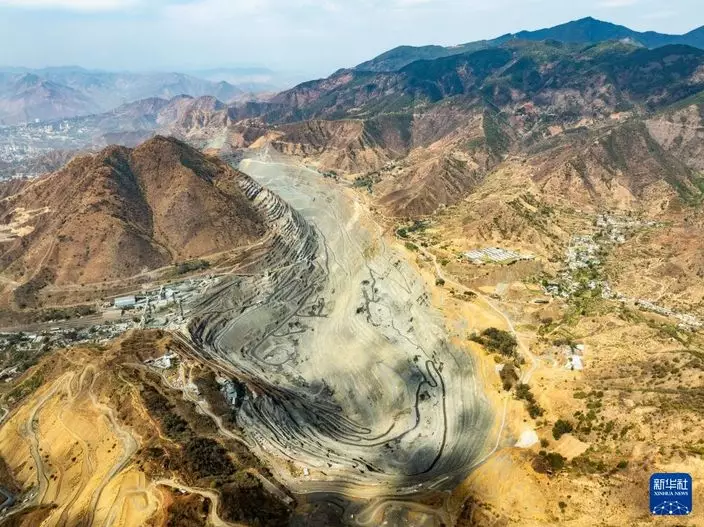
Sindlhauser's rare earth supply nearly all Chinese.
A Policy Dilemma, an Intelligence Blind Spot
Sindlhauser sits squarely inside China's rare earth grip. According to the report, the company relies almost entirely on Chinese rare earths, and its placement on the export control list dealt a direct blow to its supply chain.
The company had previously taken almost no measures to diversify its supply sources or reduce its dependence on Chinese raw materials.
Some officials see a problem with the rescue. Removing companies such as Sindlhauser from the sanctions list, they worry, could once again weaken the urgency for these European companies to build supply chain networks outside China.
That leaves the German government and EU officials in a bind. Deciding through negotiations which companies go onto or come off trade restriction lists could set a bad precedent for other companies also hoping for sanctions exemptions. It would also mean the EU must make concessions on the question of certain Chinese entities.
But officials involved in handling the matter see a deeper problem. The situation behind the case, they argue, is more concerning, though not surprising.
The explanation: over the past year and a half, China has been collecting information on global supply chains as much as it possibly can. That is how China identified a small company in Bavaria as a supplier to the world's most important chip equipment manufacturer.
Beijing's map of global supply chains runs remarkably deep. The report credits that insight to the licensing system China has built for exports of critical minerals and rare earths.
The system requires foreign companies to submit detailed information, including their customers, how and where Chinese raw materials are used, and photos of the final products.
Germany shows the cost. Some companies have been leaking business secrets to China, while the German government remained completely unaware and unable to obtain the same or even similar information.
More important, the German government still has not formulated any strategy to address its shortcomings in economic intelligence.
A Possible Template, and China's Stated Position
The talks went straight to the top. According to the report, EU Trade Commissioner Maroš Šefčovič visited Beijing last week and met with Chinese Commerce Minister Wang Wentao. The two sides discussed lifting restrictions on Sindlhauser in exchange for relief for a Chinese company.
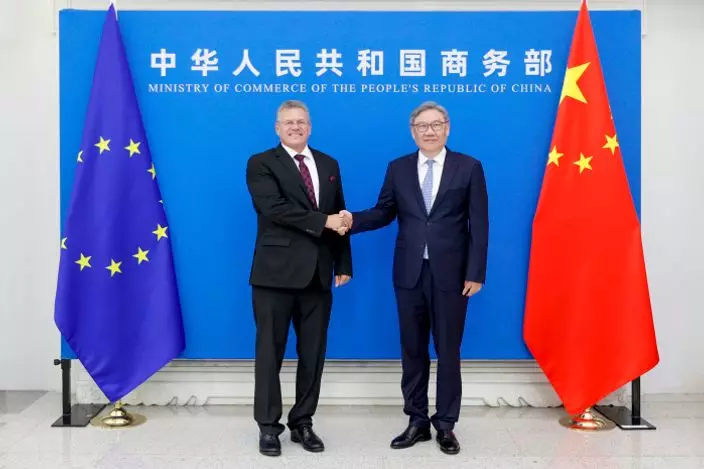
EU trade chief Šefčovič met Wang Wentao in Beijing.
The backdrop is stark. The EU is hunting for a fix to a massive trade deficit that exceeds $1 billion every single day.
People familiar with the matter say the two sides agreed in Beijing to strengthen information sharing and to give each other advance notice of export restriction measures.
The "one-for-one" arrangement around Sindlhauser, in which each side takes the other's company off its restriction list, could become a template for similar moves in the future. The EU is expected to act first. Only then would China lift its restrictions on the German company.
China's message has stayed consistent. The Chinese side has repeatedly stressed that China holds an objective and impartial position on the Ukraine crisis, stays committed to promoting peace talks, and plays a constructive role in advancing a political resolution of the crisis.
The opposition is just as firm. China firmly rejects the EU's blame-shifting, smears and denigration over the Ukraine crisis. It equally and firmly opposes the EU's unjustified listing and sanctions against Chinese companies and citizens.
Mao Paishou
** 博客文章文責自負,不代表本公司立場 **
Outside 1515 Broadway in Times Square, the usual line mostly leads upstairs to the theater where The Lion King musical has been running for twenty years. But on September 19 local time, this line turned the corner, stretched all the way to the next intersection, and seemed endless.
The Line That Stopped Times Square
The source of the line was not the premiere of a new Broadway show, but a newly opened Chinese camera store.
The store opening that day was the first US flagship store of Chinese imaging brand Insta360. It was also the brand's first directly operated store outside Asia.
Insta360 was founded in Shenzhen in 2015. It first made its name with a camera designed for shooting panoramic footage. Its main products are panoramic and action cameras that do not require cumbersome equipment and can be shared directly after shooting.
In June 2025, it listed on the Shanghai STAR Market. Its market value once exceeded 70 billion yuan, about 76 billion Hong Kong dollars. Industry insiders have called it the world's first listed smart imaging company. Overseas markets contribute about 70 percent of its overall revenue.
The store was originally scheduled to open at noon, but the number of people lining up far exceeded expectations. According to US imaging media outlet PetaPixel, the crowd on the scene that day may have exceeded 1,000 people. The first customer arrived at 2:30 a.m. and waited nearly 10 hours.
One American netizen uploaded footage to social platform X. She described the line as a massive procession that turned two corners. She jogged while high-fiving people in line, and it took her a full 61 seconds to reach the end.
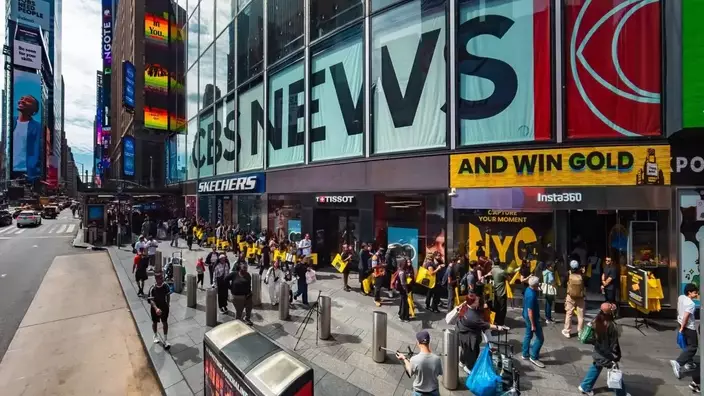
Insta360's New York flagship opening drew massive launch-day crowds.
The young man at the front of the line wants to become a YouTuber. He headed straight to the site after finishing work and queued overnight, becoming the day's 'number one fan.' He received a limited-edition new gimbal camera with an exclusive gold logo.
When asked why he was so enthusiastic about a Chinese brand, his answer captured a recent shift in the US imaging market. He said he used to ride his bike near Central Park a lot. Back then everyone was using GoPro, but now almost everyone has switched to Insta360.
In the line there was also a race car driver who flew nearly 10,000 kilometers from Egypt specifically for this. Egypt still has no Insta360 dealer, and he had tried many places without being able to buy one. So he simply flew directly to New York.
There was also an American father who specially brought his 10-year-old son to New York so they could experience Insta360's latest camera together as a birthday gift.
Coincidentally, Tim Cook, who has stepped down as Apple's chief executive officer and now serves as chairman of the executive board, also posted on Weibo on September 20.
He said every time he sees customers experiencing Apple's new products at Apple Store retail locations in China, it is especially uplifting. The accompanying photo showed customers waiting outside the store in long, multi-layered lines.
It so happened that on September 18 this year, Apple's iPhone 18 Pro series also went on sale in many places around the world. That triggered a fair amount of queuing as well.
But the mindset behind the two types of lines is completely different. Most people buying an iPhone have a hard need to upgrade and see it as routine. People who queued overnight to buy a Chinese camera were actively pursuing an emerging category that was previously unheard of.
The difference is also why outsiders are paying attention to Insta360's opening.
GoPro Fades as Chinese Brands Take Over
To understand the weight of that New York line, you first need to understand the global imaging industry's power map over the past few decades. Japanese camera brands long monopolized the industry's discourse. The American brand GoPro defined the action camera category and was once synonymous with the product type. But market research data shows the landscape has reversed in recent years.
In 2022, GoPro still held about 84% of the global action camera market. That was an absolute monopoly. Within just a few years, its share collapsed. By the first three quarters of 2025 it had fallen to about 18%. In the same market, GoPro went from roughly eight out of ten cameras to fewer than two in ten.
In August this year, GoPro submitted documents to the US Securities and Exchange Commission that included the blunt warning "substantial doubt about its ability to continue as a going concern." A company that once defined an entire industry now has to admit operating difficulties in public filings.
It has even agreed to merge with an American company in the artificial intelligence optics business. The deal is valued at $285 million, about HK$2.22 billion. Original shareholders would keep only about 10% of the merged company's equity.
In name it is a merger. In substance it is close to being swallowed.
Meanwhile, DJI and Insta360 together account for about 87% of the global handheld smart camera market. This queue is not just one Chinese brand selling well. It is an industry reshuffle. The American company that once set industry standards has been pushed to the margins by Chinese brands in just a few years.
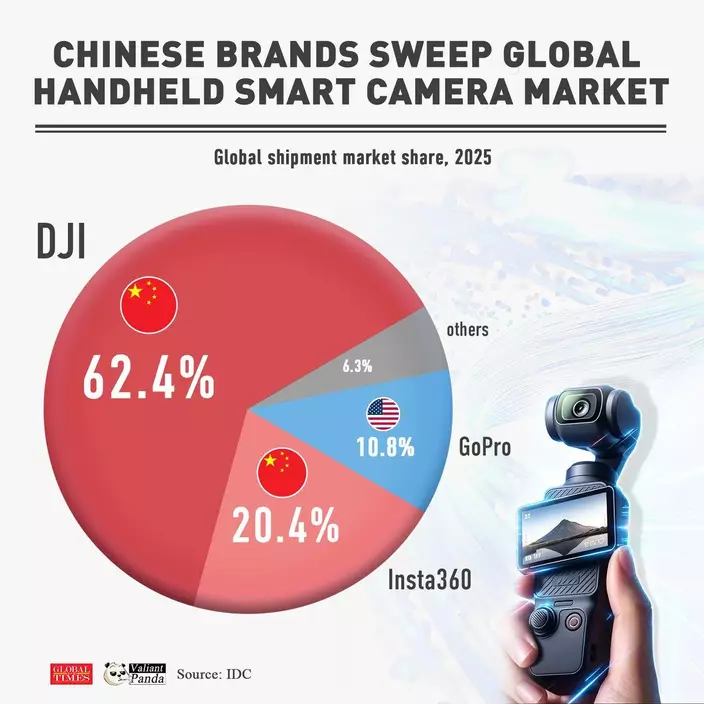
DJI and Insta360 now control about 87% of the global handheld smart camera market.
The shift in Japan is even more telling. Japan has long been seen as the birthplace of the global imaging industry. Local consumers are fiercely loyal to camera brands. On July 2 this year, Insta360 held a launch event for a new gimbal camera in Shibuya, Tokyo.
By 6 a.m. consumers had already arrived to line up. The longest wait reached 9 hours. The organizer temporarily distributed 450 admission tickets, and they were all claimed within half an hour. The white version sold out online in just 5 minutes.
Retail data makes the point even sharper. Japanese research firm BCN reports that in 2025, a Chinese brand won the annual sales crown in the action camera category for the first time. DJI and Insta360 together took about 78% of the Japanese market. GoPro's share collapsed from 34.3% the previous year to 18.9%.
In other words, even in Japan, widely regarded as the birthplace of global imaging technology standards, local consumers would rather queue overnight to buy Chinese cameras.
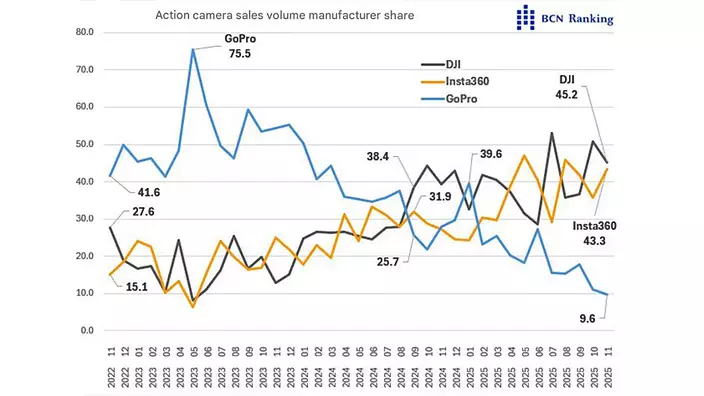
Chinese brands now lead Japan, overtaking long-time giant GoPro.
What the Queues Really Mean
Back in New York, that flagship store means far more to Insta360 than an opening ceremony. On opening day, Insta360 also announced cumulative global camera shipments had passed 10 million units. That is more than 10 million cameras sold over ten years.
The opening event drew Casey Neistat, a North American imaging creator with more than 10 million followers, along with die-hard users who have followed the brand for years. One of them, Anthony Quintano, was first in line at 3 a.m. for Insta360's first new-product pop-up in New York last year. He became the first person in the world to buy that new model.
Another was Kevin, a cycling community leader. He and 100 local riders in bright yellow jerseys rode through New York landmarks on opening day. They recorded the journey on Insta360 cameras the whole way.
From top influencers and veteran loyalists to ordinary citizens, three seemingly unrelated stories map Insta360's ten-year localization effort in the United States. This Chinese company did not simply move a store into another country. It cultivated local creator circles and vertical communities, embedding itself in local life.
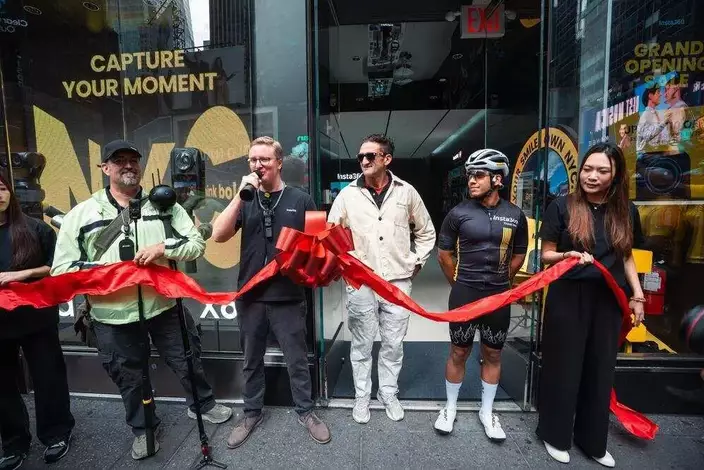
Top creators and local cyclists joined the store ribbon-cutting.
Around Times Square, Insta360's store sits not far from a cluster of Chinese brands that have already entered the US market: Pop Mart, Miniso, and Heytea. But compared with these 'Chinese neighbors' opening stores in New York, Insta360 has cultivated the US market for a full decade. It started out unknown, and now it draws a thousand people to queue overnight at the world's crossroads.
From Tokyo's Shibuya to New York's Times Square, Chinese camera brands are not riding a one-city viral moment. They are on a structural upward trajectory that spans regions and is backed by data.
Going overseas has never meant copying a store into a foreign country. It means making yourself part of local life. That may be the real strength of Chinese brands that has been most easily underestimated in recent years.