ORLANDO, Fla.--(BUSINESS WIRE)--Oct 19, 2026--
Only 13% of CIOs reported their enterprise has realized significant or transformational value from AI so far according to Gartner, Inc., a business and technology insights company. While AI use cases have accelerated over the past two years, the likelihood of use case success remains one-in-five.
This press release features multimedia. View the full release here: https://www.businesswire.com/news/home/20261019796927/en/
Speaking at Gartner IT Symposium/Xpo in Orlando today, Alicia Mullery, VP Analyst at Gartner, said, “Volume is not value. AI is creating a reckoning for organizations that lack fundamental disciplines, such as defining use-case value ahead of time and establishing criteria for when to walk away.”
The Gartner 2027 CIO and Technology Executive Agenda survey of 2,002 CIOs and technology executives from May to July 2026 found that vanguards, defined as CIOs who are delivering better performance on business outcomes while also reporting high CEO-perceived AI value, are more likely to establish stopping rules at two points in the lifecycle: pilots and production. Defining these guidelines becomes essential as organizations rapidly transition from initial experimentation to active deployment across GenAI, traditional AI and AI agents.
Organizations with guidelines for determining when an AI pilot should not move to production are 2.3 times more likely to be vanguards, while those with guidelines for abandoning low-value AI initiatives already in production are 2.6 times more likely to be vanguards. However, only 31% and 17% of CIOs, respectively, reported having these practices in place.
“Establishing and adhering to these criteria is a team sport,” said Mullery. “CIOs need business partners who are willing and ready to walk away from low value investments.”
CIOs Must Be Responsible for AI Economic Stewardship
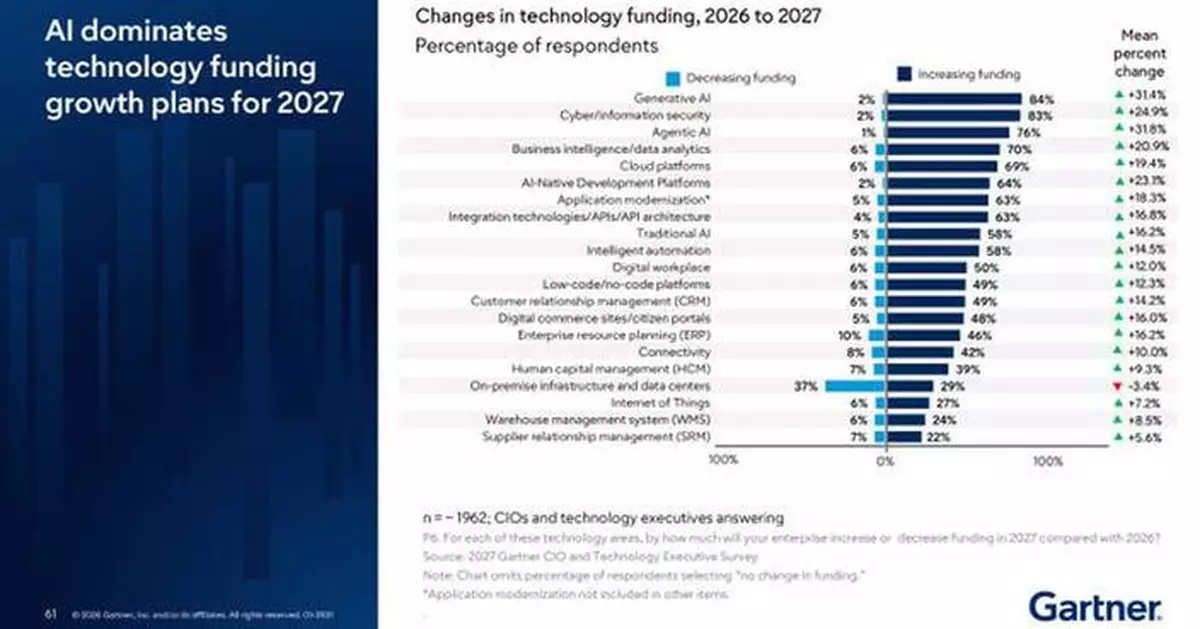
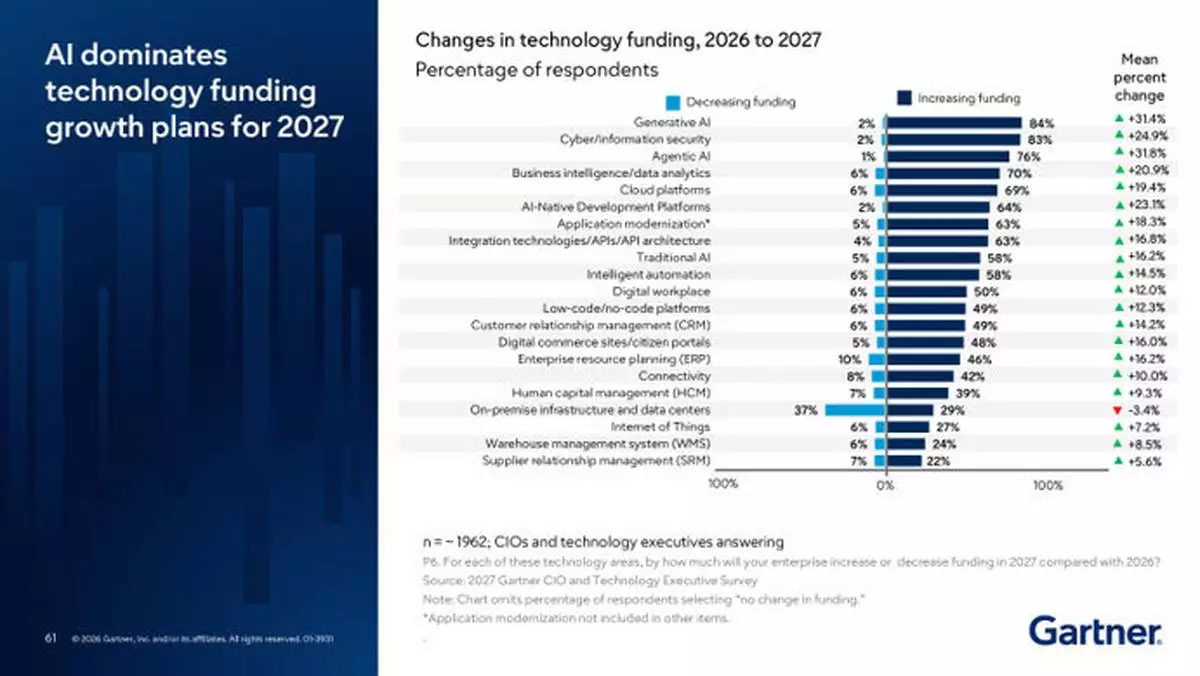
Funding for AI is increasing, and 58% of CIOs said they have increased pressure to deliver cost improvement from AI. At the same time, 51% of CIOs expected AI to increase the total cost of ownership of technology solutions (see Figure 1). CIOs need to help their organizations govern AI economics across the full lifecycle, not simply approve an initial technology purchase.
Figure 1: Changes in Technology Funding, 2026 to 2027
“Many organizations continue to apply funding and governance models designed for traditional technology investments such as cloud and SaaS,” said Mullery. “Unlike traditional technology costs, which are largely predictable, AI costs are probabilistic and determined at run time. As enterprise technology funding shifts towards GenAI and agentic AI while investments in legacy infrastructure contract, CIOs will need new approaches to funding, governance and cost accountability.”
CIOs Must Bridge the IT Workforce Gap by Expanding What Humans Do
Organizations with explicit plans to redesign roles for a human-agent workforce are 2.4 times more likely to be vanguards, yet a significant execution gap exists, as only 4% of CIOs reported having such plans in place.
“While many leaders assume AI will primarily serve to reduce technology headcount, the true vanguard differentiator lies in workforce redesign,” said Mullery.
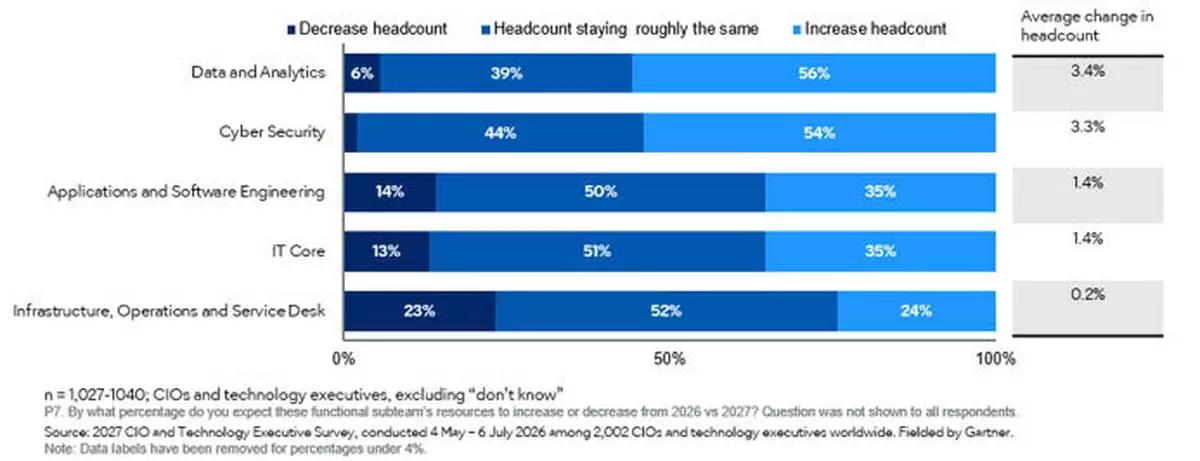
This workforce transformation provides the essential foundation for understanding headcount trends: as AI lowers the cost and effort required to produce technology, overall demand for technology work actually increases. This creates a dual workforce shift where IT headcount can grow, with 40% of respondents expecting to increase IT headcount in 2027, particularly in cybersecurity and data and analytics (see Figure 2), while roles simultaneously compress and expand.
Figure 2: Expected Changes in Headcount within IT Functional Sub-teams Within 12 Months (Percentage of Respondents)
“Rather than maintaining static job definitions, Vanguards recognize that as AI takes on specialized tasks, the boundaries between established technology jobs begin to blur,” said Mullery. “For example, designers can increasingly perform testing activities, while testers participate in design. Consequently, organizations will require fewer distinct role types, even as the span of responsibility within each role expands.”
Additional Insights Available
Gartner clients can read more in Bridging the AI Trough: 3 Gaps To Close for the 2027 CIO and Technology Executive Agenda.
Non clients can learn more here.
Gartner is the World Authority on AI
Gartner is the indispensable partner to C-Level executives and technology providers as they implement AI strategies to achieve their mission-critical priorities. The independence and objectivity of Gartner insights provide clients with the confidence to make informed decisions and unlock the full potential of AI. Clients across the C-Level are using Gartner's proprietary AskGartner AI tool to determine how to leverage AI in their business. With more than 2,500 business and technology experts, 6,000 written insights, as well as more than 4,000 AI use cases and case studies, Gartner is the world authority on AI. More information can be found here.
Gartner IT Symposium/Xpo
Gartner IT Symposium/Xpo is the world's most important gathering for CIOs and other IT executives. CIOs and IT executives rely on these conferences to learn how to become agents of change in their organizations and harness AI for successful digital transformation. Follow news and updates from the conference on X and LinkedIn using #GartnerSYM, and on the Gartner Newsroom.
Upcoming dates and locations for Gartner IT Symposium/Xpo include:
November 4-6, 2026 | Yokohama, Japan
November 9-12, 2026 | Barcelona, Spain
November 16-18, 2026 | Kochi, India
About Gartner for IT Leaders
Gartner for IT Leaders provides actionable, objective insight to CIOs and IT leaders to help them drive their organizations through digital transformation and lead business growth. Additional information is available at www.gartner.com/en/information-technology.
Follow news and updates from Gartner for IT Leaders on X and LinkedIn using #GartnerIT. Visit the IT Newsroom for more information and insights.
About Gartner
Gartner (NYSE: IT) delivers actionable, objective business and technology insights that drive smarter decisions and stronger performance on an organization's mission-critical priorities. To learn more visit gartner.com.
Gartner Survey Finds Only 13% of CIOs Say Their Enterprise Has Realized Significant or Transformational Value from AI
Gartner Survey Finds Only 13% of CIOs Say Their Enterprise Has Realized Significant or Transformational Value from AI
LOS ANGELES (AP) — Federal authorities charged more than two dozen foreign nationals Monday in California as part of a statewide sweep targeting people who officials say have illegally registered or voted in U.S. elections.
The arrests are part of a Trump administration effort to root out noncitizen voting ahead of next month's midterm elections, even though data shows that the problem is incredibly rare, difficult to prove and has not been shown to change the outcome of races.
Federal officials on Monday blamed California officials for the alleged crimes, accusing them of facilitating noncitizen voting through inadequate voter roll maintenance and hiding it from the public. The charges escalated a simmering voter roll fight that came into focus last week when the Justice Department sued California officials and warned that local election workers who knowingly process or tabulate ballots submitted by noncitizen voters are at risk of investigation and potential prosecution.
The Justice Department said the 28 people who were charged as part of a sweep dubbed Operation Protect the Vote are lawful permanent residents — but not U.S. citizens who are permitted to legally vote. They are charged with crimes including making false statements on a naturalization application and submitting fraudulent voter registrations.
“This causes real damage to real elections and real damage to American citizens," Trent McCotter, the acting deputy attorney general at the Justice Department, said during a news conference in Los Angeles.
Rob Bonta, California's Democratic attorney general, said Monday that there is no widespread voter fraud in California and that while “one-off” examples of voter fraud are possible, those instances are “a drop in the bucket” considering the state has 23 million registered voters.
Bonta said he expects his state to prevail in the federal government's lawsuit, saying the Republican administration “has provided us with no facts of any ineligible voters, just a conclusory statement with no evidence to back it.”
The federal government has made noncitizen voting a priority this year, demanding detailed voter information — including dates of birth, addresses, driver’s license numbers and partial Social Security numbers — from the states. While some states voluntarily handed over the information, the department sued 30 states and the District of Columbia to obtain it — lawsuits that so far have been unsuccessful.
The Justice Department said Monday it has charged 113 people in 20 states with illegal voting and illegal registration offenses over the last several weeks, It earlier said it had charged about 90 people for various types of election misconduct so far this year, including 50 who are alleged to have voted as noncitizens. There were more than 227 million registered voters in the United States during the 2024 presidential election.
The operation Monday involved the four U.S. attorneys' offices across California in what the Justice Department intended as a statewide show of force.
Among the dozens of people arrested was a 72-year-old Belize-born man who is accused of voting illegally in four elections.
Dozens of federal agents descended on the man's residential cul-de-sac in Commerce, a small city in Los Angeles County, to make the arrest. The man was put in handcuffs in his pajamas and taken into federal custody downtown. Others emerged from the house to watch and questioned the number of heavily armed officers present for the arrest, as well as the need for handcuffs.
The arrests were the latest in a flurry of activity that has unfolded in heavily Democratic California, which is not typically regarded as a key battleground state but does have a handful of competitive congressional races that could help determine which party controls the U.S. House for the final two years of President Donald Trump’s term.
The administration last week sued California to prevent it from counting mail ballots from people the federal government has identified as “likely” noncitizens until their immigration status can be confirmed.
The complaint was filed after California officials were given, and did not meet, a 48-hour deadline to review a password-protected thumb drive that contained a list of 20,000 names. The federal government says those are likely noncitizens who were sent ballots to participate in the Nov. 3 election, although the secretary of state said the administration has provided no evidence to support that claim. The state mails ballots to all registered voters.
McCotter said the 20,000 number was likely to rise.
“That’s just the floor,” he said.
He said the lawsuit against California was necessary because “state-facilitated voter fraud is unacceptable,” and accused state officials of creating the last-minute emergency before Election Day by not working with Justice Department officials sooner to check alleged noncitizen voters.
Explaining why it was important to address voting by noncitizens even thought it's rare, he noted that some races in California have been decided by just hundreds of votes.
Bill Essayli, the top federal prosecutor in Los Angeles, criticized the state's election officials for not cooperating with the department's demands.
“Why is California refusing to show their voter rolls?” he asked. “What are they afraid of? What are they hiding?”
As part of its lawsuit, the Justice Department filed paperwork Monday seeking a court order that would force California to set aside ballots from suspected noncitizens and to independently, or in conjunction with the federal government, verify their citizenship status before tabulating their mail-in ballot. The Justice Department asked for the order to be entered in time for the Nov. 3 election.
Absent that order, the government said, “there is a significant risk that American votes will be diluted.”
Requests for comment sent Monday to the secretary of state and governor's office were not immediately returned.
On Friday, the Justice Department followed up with a letter warning that state election officials who knowingly process ballots cast by noncitizen voters are at risk of investigation.
“The legal consequences for either facilitating or ignoring a federal crime are significant. Noncitizen voting in a federal election is a federal crime — and knowingly facilitating such conduct is equally unlawful,” warns the letter from McCotter.
It adds: “If persons knowingly tabulate ballots cast by individuals identified by federal agencies as noncitizens, they risk becoming aiders and abettors to a federal crime.”
The letter is addressed to the Los Angeles County Counsel’s office and also is copied to California Secretary of State Shirley Weber and Los Angeles County Registrar Dean Logan, effectively putting the entire state on notice.
In response to the letter, Logan said his office is focused on conducting a fair and secure election while noting that Election Day is a mere 18 days away.
“The U.S. Department of Justice has chosen to litigate their unverified assertions of voting eligibility. At this point, it is best for this to be addressed in court,” he said.
Associated Press writers Eric Tucker in Washington and Ali Swenson in New York contributed to this report.

Acting U.S. Deputy Attorney General Trent McCotter stands next to a display showing photos of people charged with illegally registering to vote during a news conference in Los Angeles, Monday, Oct. 19, 2026. (AP Photo/Jae C. Hong)

A Homeland Security Investigations task force officer stands near police tape marking a perimeter during a federal operation targeting suspected illegal voter registration in Commerce, Calif., Monday, Oct. 19, 2026. (AP Photo/Jae C. Hong)

Homeland Security Investigations task force officers escort a suspect accused of illegally registering to vote to a processing facility at Federal Building in Los Angeles, Monday, Oct. 19, 2026. (AP Photo/Jae C. Hong)

Homeland Security Investigations task force officers arrest a suspect accused of illegally registering to vote during a federal operation in Commerce, Calif., Monday, Oct. 19, 2026. (AP Photo/Jae C. Hong)

Homeland Security Investigations task force officers escort a suspect accused of illegally registering to vote during a federal operation in Commerce, Calif., Monday, Oct. 19, 2026. (AP Photo/Jae C. Hong)

FILE - Ballots are sorted the day after California's primary election at the LA County Ballot Processing Center, June 3, 2026, in City of Industry, Calif. (AP Photo/Jae C. Hong, File)