The United Nations World Food Program (WFP) announced on Monday that funding shortages had forced it to cut food assistance to around 500,000 people in the Gaza Strip, reducing its monthly beneficiaries from 1.6 million to 1.1 million. In a press statement, the agency warned that recent improvements in food security remained fragile as winter approaches and declining humanitarian funding threatens to reverse the gains.
Starting this month, the WFP has halved food rations, with families receiving one food parcel instead of two, along with smaller quantities of wheat flour, according to the statement.
The agency has also reduced daily hot meal distributions from 250,000 to 150,000 and cut the value of cash assistance provided to 75,000 families.
Despite the cuts, the WFP will continue supporting bakeries that supply about one-third of Gaza's bread needs, providing nutrition assistance to 300,000 women and children, and distributing school snacks to 200,000 children.
According to the latest food security assessment cited by the WFP, around 1.4 million people, or 67 percent of Gaza's population, are experiencing acute food insecurity at crisis levels or worse, classified as Phase 3 or above under the Integrated Food Security Phase Classification.
The agency said it had received less than half the funding for its operations in Palestine in 2026 compared with previous years and urgently needed 450 million U.S. dollars to maintain operations in Gaza and the West Bank from October 2026 to March 2027.

WFP cuts food aid to 500,000 people in Gaza amid funding shortages

WFP cuts food aid to 500,000 people in Gaza amid funding shortages

WFP cuts food aid to 500,000 people in Gaza amid funding shortages
Ninety years after the Red Army completed the Long March in Yan'an City, northwest China's Shaanxi Province and survived on barren loess through self-reliance, the enduring spirit is thriving in Nangou Village, where two generations of farmers work side by side with elders transforming wasteland into orchards while the young selling apples via livestreaming.
Modern farming has turned remote gullies into flourishing apple gardens, a modern rebirth of the Long March spirit -- resilience, self-reliance and legacy -- captured in every red apple from the Loess Plateau.
"The government paved brick roads, and the Fruit Industry Technical Service Center supplies the saplings. The whole farm was designed for mechanized and smart farming. The trees began to bear fruit in the second year after planting and reach full production in the third. The survival rate is 99 percent. Out of the 1,000 sapling we planted, only four died. The trees we planted last year have already started bearing fruit this year. After this demonstration orchard was established, it has encouraged villagers across the community to follow suit," said Zhao Shengsheng, a fruit farmer from Nangou Village, Ansai District, Yan'an.
Yan'an began systematically experimenting with imported apple varieties as early as 1940. Yet traditional growing methods meant trees took five years to bear fruit and seven years to reach full production, a wait many villagers found too long to bear.
"In terms of cultivation, we use a high-density dwarf planting system. It makes mechanized operations easier, reduces labor and costs, and improves profitability. For soil, fertilizer and water management, we use organic fertilizer and drip irrigation. Ground cover retains moisture and reduces evaporation. We also use drones and apply biopesticide formulations, which help improve operational efficiency. This farm serves as a demonstration base. After proving successful here, the model was promoted county-wide," said Guo Liping, Deputy Director at Fruit Industry Technical Service Center, Ansai District, Yan'an.
Ninety years ago, the Red Army overcame seemingly impossible odds and forged a path through adversity. Today in Nangou Village, modern agriculture is overcoming the limitations of mountainous terrain, turning barren hills into productive orchards and using science and technology to create new opportunities.
Zhao Shengsheng returned home in May 2023 after his startup failed and took over the family orchard.
His father, he explained, knows the techniques but is getting older and no longer has the strength to do the work himself.
Watching short videos of other sellers thriving on online platforms, Zhao wondered why he couldn't do the same, and gradually began embracing online sales.
In a single night he can bring in more than 100 orders; each box of 24 apples sells for 120 yuan (about 18 U.S. dollars) including delivery, earning him a profit of half.
The older generation laid the foundation by planting apple trees, while the younger is opening new markets through livestreaming. This is how the Long March spirit lives on today: through practical efforts to support local communities and a legacy of perseverance passed down from one generation to the next.
"Without the hard struggle and perseverance of the Long March, we wouldn't have the good life we enjoy today," said Zhao.
When the Long March ended in Yan'an, it left a legacy of resilience and renewal. Nine decades later, that spirit is flourishing in the orchards of Nangou Village. The once-barren hills now yield abundant harvests of bright red apples, carrying local people's hard work to markets across China and around the world.
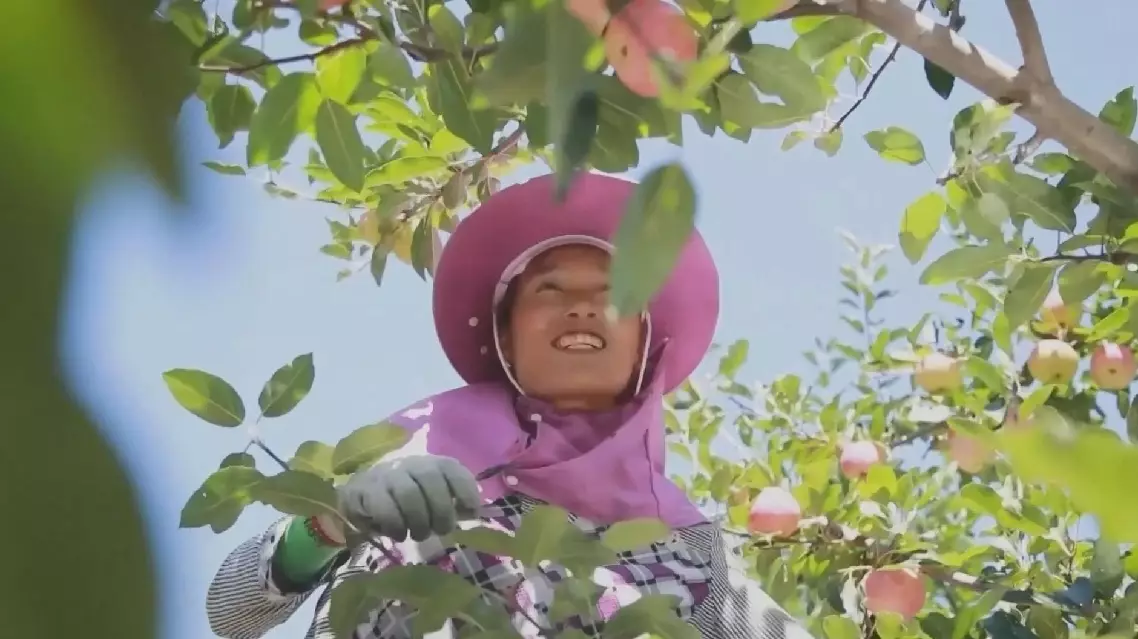
Yan'an's Long March spirit drives modern apple farming, livestream sales