DH steps up enforcement action against premises providing injection treatments with unregistered pharmaceutical products
The Department of Health (DH) announced today (October 20) that it has conducted a series of raids over the past few days in an effort to crack down on premises suspected of providing injection treatments involving unregistered pharmaceutical products. Four premises offering beauty services in Tsim Sha Tsui, Mong Kok, Tsuen Wan and Yuen Long were searched. Among them, over 100 vials/ampoules of suspected Part 1 poisons for injection and more than 70 vials/ampoules of suspected unregistered pharmaceutical products for injection were seized from the two premises in Tsim Sha Tsui and Mong Kok. These included a product called Elravie Re2O, which was packaged in Korean, indicating that it is for injection and claiming to contain human tissue. A 38-year-old woman was arrested.
The DH raided the above four premises on October 16 and today. At the premises located in Tsim Sha Tsui and Mong Kok, the DH seized a total of more than 100 vials/ampoules of suspected Part 1 poisons and more than 70 vials/ampoules of suspected unregistered pharmaceutical products. Among the seized products, 20 vials/ampoules were Elravie Re2O. During a joint operation with the Police in the Mong Kok premises, a 38-year-old woman was arrested on suspicion of unlawful possession of Part 1 poisons and unregistered pharmaceutical products, and suspected unlawful commercial dealing in human organs.
"The Elravie Re2O seized in the operation is claimed on its packaging to contain human tissue. It is classified as a 'regulated product' under the Human Organ Transplant Ordinance (Cap. 465) and also as a 'pharmaceutical product' under the Pharmacy and Poisons Ordinance (Cap. 138). The DH previously received an application for exemption in respect of the 'regulated product' concerned and is processing the application. No exemption has been granted for the product to date. The DH has not received any application for registration of the product as a pharmaceutical product. The DH will continue to follow up on the case and trace the source of the unregistered pharmaceutical products," the Controller for Regulatory Affairs of the DH, Dr Fung Ying, said.
"The product concerned lacks clinical safety data and poses potential public health risks. The DH has previously written to all doctors and private healthcare institutions in Hong Kong reminding them of the need to comply with relevant legislation. The sale or possession of unregistered pharmaceutical products in Hong Kong is illegal," she added.
Products manufactured from human tissue are classified as "regulated products" under the Human Organ Transplant Ordinance. Before such products may be sold in Hong Kong, an application for exemption must be submitted to and approved by the Director of Health. Any person convicted of an offence under the Ordinance is liable, on first conviction, to a fine of $50,000 and imprisonment for three months and, on any subsequent conviction, to a fine of $100,000 and imprisonment for one year. Apart from the above-mentioned operation at the Mong Kok premises, the DH has also referred other cases involving the alleged sale of non-exempted "regulated products" in contravention of the Human Organ Transplant Ordinance to the Police for follow-up.
Under the Pharmacy and Poisons Ordinance, any product that meets the definition of a pharmaceutical product must satisfy the relevant standards of safety, efficacy and quality, and must be registered with the Pharmacy and Poisons Board of Hong Kong before it may be sold in Hong Kong. The unlawful supply or possession of unregistered pharmaceutical products or Part 1 poisons is a criminal offence. Upon conviction, offenders are liable to a maximum penalty of a fine of $100,000 and imprisonment for two years for each offence.
The DH has been taking stringent enforcement action against the illegal supply and/or possession of unregistered pharmaceutical products to safeguard public safety. From 2023 to September 2026, the DH's Drug Office handled 108 convicted cases involving the sale and/or possession of unregistered pharmaceutical products. The heaviest sentence imposed was 10 months' imprisonment (for all offences taken together), while the highest fine imposed was $242,000 (for all offences taken together).
The DH has an established mechanism to closely monitor the sale of pharmaceutical products and "regulated products" in the market, whether through online or physical sales channels. Upon discovering any suspected illegal supply and/or possession of unapproved "regulated products" or unregistered pharmaceutical products, the DH will immediately commence investigations and take enforcement action. Where necessary, the DH will conduct joint operations with other law enforcement agencies or refer cases to the relevant enforcement authorities for follow-up. Cases involving healthcare professionals will be referred to the relevant professional regulatory bodies for follow-up.
Dr Fung reminded members of the public that injection procedures are medical procedures and should only be performed by registered medical practitioners or registered dentists. Before undergoing any injection procedure, members of the public should ascertain the full name of the doctor concerned and check the List of Registered Medical Practitioners maintained by the Medical Council of Hong Kong or the List of Registered Dentists maintained by the Dental Council of Hong Kong to verify his or her professional qualifications. Members of the public should not assume that an injection procedure is risk-free simply because it is marketed as a cosmetic treatment or provided at premises offering beauty services. Furthermore, persons with questions about the prevention or treatment of disease should consult a registered doctor, who can provide professional advice based on the individual's health condition and the latest medical evidence. Members of the public should not place reliance on unsubstantiated medical claims and should take steps to protect their own health and safety.
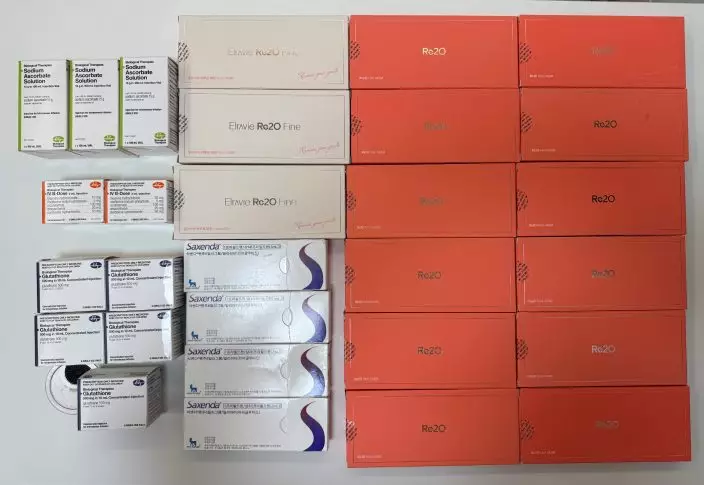
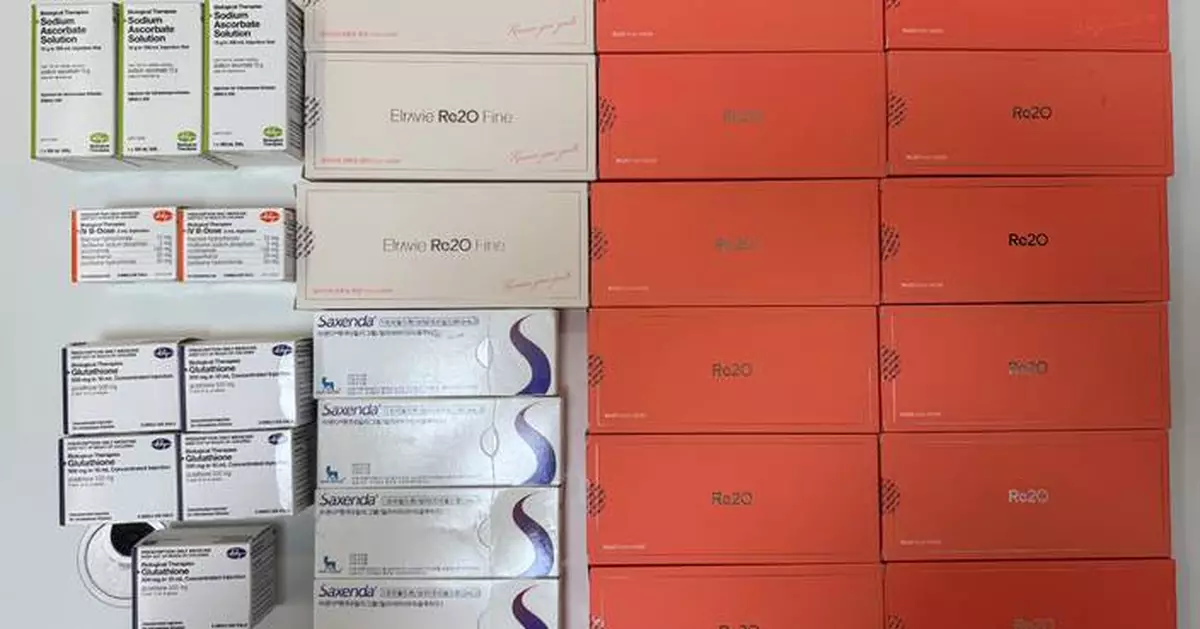
The Department of Health (DH) announced today (October 20) that it has conducted a series of raids over the past few days in an effort to crack down on premises suspected of providing injection treatments involving unregistered pharmaceutical products. Four premises offering beauty services in Tsim Sha Tsui, Mong Kok, Tsuen Wan and Yuen Long were searched. Among them, over 100 vials/ampoules of suspected Part 1 poisons for injection and more than 70 vials/ampoules of suspected unregistered pharmaceutical products for injection were seized from the two premises in Tsim Sha Tsui and Mong Kok. These included a product called Elravie Re2O, which was packaged in Korean, indicating that it is for injection and claiming to contain human tissue. Photo shows the suspected Part 1 poisons for injection and suspected unregistered pharmaceutical products for injection seized in the operation. Source: HKSAR Government Press Releases