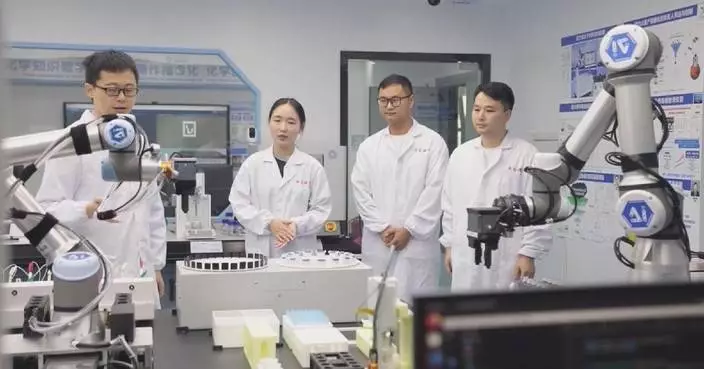
China on Sunday released the top 10 achievements of applications built on its first homegrown 100,000-card artificial intelligence (AI) supercluster during the 2026 CCF National Annual Conference on High Performance Computing in Shenzhen, in south China's Guangdong Province.
A 100,000-card AI supercluster is a computing infrastructure that links 100,000 AI computing cards through high-speed connections.
Completed and put into operation in July this year, the Chinese supercluster, known as Dawning 8000 (Dengfeng), has made a core breakthrough not simply in its scale but also in its ability to bring together two approaches to computing -- supercomputing and AI computing, on a unified infrastructure. This enables it to handle both high-precision scientific simulations and large-scale AI model training and inference.
The top 10 application achievements include supporting the creation of the world’s first digital twin of the human brain to the scale of 100 billion neurons, the "HyperMillennium" project that simulates the evolution of a universe spanning tens of billions of light-years, and a next-generation weather forecasting model capable of completing global forecast calculations down to a single kilometer within one hour.
A research team from the Institute of River and Ecology at Tsinghua University has received great aid from the supercluster's computing capacity on their research of the Yellow River in Zhengzhou, central China's Henan Province.
They use horizontal water samplers to collect suspended sediment concentrations at depths from 0.5 meters to 5 meters in the Yellow River channel. These first-hand data are the starting point for reconstructing a digital model of the Yellow River. In the past, before the model could run, the team first had to overcome the computing power hurdle.
"Due to limited computing power, previous models used grids of tens of meters and actually could not simulate the relationships between them. Our current basic goal is to make it one meter," said Sun Jian, director of the institute.
The Yellow River's water-sediment interplay is complex and changeable, making it difficult for traditional models to simulate precisely. Now, the research team is trying to rebuild the Yellow River model using the Dawning 8000 supercluster.
"The overall results are quite satisfactory, which shows that our model can run successfully," said Sun.
The area of Zhengzhou where the supercluster has been built was empty land just three years ago. Now it has grown into the largest AI computing pool in China, deploying 100,000 domestic intelligent computing chips, currently operating near full capacity.
"This is like a cockpit for a 100,000-card system, where you can observe the status of every component. All 13,440 nodes are in status and providing services to users," said Bu Jingde, chief high-end computing engineer at the National High-Performance Computer Research Center.
"Generally, many tasks are executed and applied together. Occasionally, there are applications that would use the entire 100,000-card supercluster to execute. We support scientific, engineering and AI computing. We just listed the top 10 tasks here, while there are more than 6,000 running in real time," said Bu.
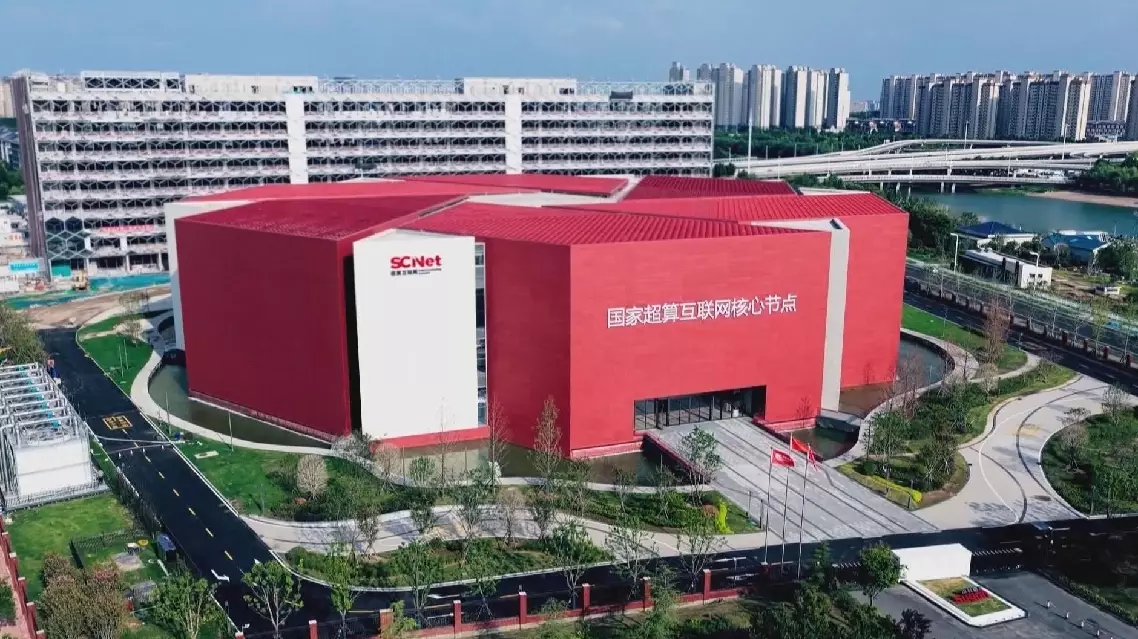
China releases top 10 major application achievements of its first homegrown 100,000-card supercluster