Philadelphia Eagles quarterback Jalen Hurts is expected to miss the remainder of the season with blood clots in his lungs that started in his left calf.
The one-time Super Bowl MVP is expected to make a full recovery.
A timeline of Hurts' medical issues this season:
Hurts takes a cleat to his left calf during a game against the Los Angeles Rams.
Hurts visits the Eagles training room requesting treatment for his calf after practicing in full for two days. It was the first treatment on the calf since the injury against the Rams.
Hurts receives treatment, practices in full and is added to the injury report with a calf injury for the Oct. 11 game against Jacksonville in London.
Medical staff performs an ultrasound on Hurts' calf following the team's flight to London, revealing a left calf superficial deep vein thrombosis. The Eagles' medical staff and doctors in London review the results, clearing him to play after concluding “activity and mobility were important.” Doctors recommend a follow-up ultrasound within 72 hours of the game and the return flight to Philadelphia.
Hurts throws for 220 yards and a touchdown in the Eagles' 19-17 loss to Jacksonville, playing without limitation, according to the team. He flies home with the team and receives medical treatment over the next two days in Philadelphia.
Hurts returns to practice in full and speaks for the first time about the injury.
“It was a very unique experience, to say the least,” Hurts said. “I don’t want to get into the details of kind of leading up to the game and whatnot. But got nicked up in the Rams game.”
A follow-up ultrasound that night shows movement in the small blood clot.
Eagles coach Nick Sirianni is asked about Hurts’ injury. He deflects most of the questions, including why Hurts didn’t have an ultrasound until after the team left for London.
“I know there’s a great deal of interest in Jalen’s health, but I’m not going to get too much into any of that,” he said. “Jalen’s health is of the utmost importance to all of us in this building, (we) care deeply about Jalen. Like I said, I’m not going to get too much into that.”
The Eagles place Hurts on injured reserve, meaning he will miss at least four games, starting with the Oct. 18 game against the Carolina Panthers.
“Jalen will be out for Sunday's game vs. the Panthers as we determine the appropriate course of treatment,” the Eagles say in a statement. “His health and safety are our highest priority.”
The Eagles lose 25-14 to Carolina with Tanner McKee at quarterback. Hurts is not on the sideline with the team.
The Eagles and Hurts' agent announce the quarterback has deep vein thrombosis and bilateral pulmonary emboli, meaning a blood clot has traveled to the lungs. His treatment involves blood thinners, and he won’t be allowed to participate in any football activities until he is off them.
A timeline for Hurts' return is not announced.
“Jalen's prognosis is very good and we expect a full recovery,” Hurts' agent Nicole Lynn said. “We anticipate that he will have the opportunity to resume contact football activities when off the blood thinners. In the meantime, he will remain active around the team and continue to condition. More importantly, we anticipate that he will have no long-term effects.”
Sirianni is the only member of the organization made available to the media and he largely deflected questions about Hurts’ health or how the team handled the situation.
“I’m not a medical expert,” Sirianni said. “I lean on our guys in all those situations. I’m a football coach. I lean on our medical experts in every situation. I have full trust and full faith in them. It’s not just me that has major care for our players. It’s them, as well.”
See AP’s full NFL coverage here

Philadelphia Eagles quarterback Jalen Hurts (1) stands on the field during an NFL football game against Jacksonville Jaguars in London, Sunday, Oct. 11, 2026. (AP Photo/Alastair Grant)

Philadelphia Eagles quarterback Jalen Hurts (1) passes the ball during an NFL football game against Jacksonville Jaguars in London, Sunday, Oct. 11, 2026. (AP Photo/Ian Walton)
It’s not always patience and luck that get patients off the organ transplant waiting list and into the operating room.
Unlike in many areas of medicine, experts say there’s a lot of variation in the U.S. transplant system. Knowing there are differences and what to ask might help.
“I had to ask a lot of questions to figure out what it was that I could do to move the needle,” said Katherine Screws of Phoenix, who got a rare intestine transplant after she decided to get on the waiting list at more than one hospital to increase her chances.
It can be difficult to learn how to navigate that search, but there's publicly available information about which hospitals perform the most of each type of transplant, plus their waiting times and outcomes. Long used by experts analyzing the transplant system, the Scientific Registry of Transplant Recipients, or SRTR, database has new patient-friendly tools developed in the hopes that more would-be transplant recipients will use it.
“People are making these really high-stakes decisions without understanding the options,” said Dr. Allyson Hart of Minnesota’s Hennepin Healthcare Research Institute, who helped design the tools.
Here are some things to know.
There are about 100,000 people on the U.S. transplant list at any given time, the vast majority of whom need a kidney. With just over 49,000 transplants performed in the U.S last year, more people than ever are getting new organs. It’s mostly thanks to over a decade of increases in donations from the deceased, which are recovered by organ procurement organizations, or OPOs.
But more organs are needed to meet the demand, and different transplant hospitals have different criteria for who they'll accept on their waiting list.
Sometimes, “if a patient receives a ‘no’ at one place, they can go somewhere else and be successfully transplanted,” said Dr. Syed Ali Husain, a kidney specialist at NYU Langone Health.
Each transplant program's waiting list is linked to a national automated matching system. OPOs enter information about viable organs into that system, which generates lists of possible matches at multiple hospitals in order of priority. When the OPO offers an organ, the transplant team must quickly decide if it's a good choice for that patient or the offer moves to the hospital with the next-in-line candidate.
Some hospitals are more conservative than others about which organs they’ll accept, said Husain, who studies such differences.
One large study of kidney transplants found “there’s about a 16-fold variation in how quickly a patient will get transplanted at one center versus another,” he said. That's partly because some surgeons have more experience than others using kidneys with complex anatomy such as extra arteries, or those from older, sicker donors that still may be better than dialysis for the right patient.
Typically, a doctor or other health worker points patients to the nearest hospital offering the kind of transplant they need. But the SRTR database allows people to compare transplant centers around the country in multiple ways.
Search for a particular organ and a list of the highest-to-lowest-volume centers pops up, with dials to show how they perform on such measures as getting a transplant faster, survival on the waiting list and the new organ's survival. Click on those of interest for more data.
For certain organs, there's a “personalized decision guide” to customize the search a little more with demographic and medical information that compares outcomes for patients similar to you. It may be important to know, for example, if hospitals you’re considering perform transplants for a lot of older adults or people with certain chronic illnesses, Hart said.
There's more data about kidneys, the most-transplanted organ, and a kidney decision aid also allows adding factors such as blood type and diabetes that play a particular role in those transplants. That tool shows the chances of getting a transplant in the first five years after joining the waiting list, or the alternatives — still waiting or having died or become too sick to get a transplant.
Like Screws, the Phoenix patient, some people choose to “double list” at a hospital closer to home and another higher-volume transplant program further away.
While not everyone is able to travel, the search tools can also help inform discussions with your chosen transplant program.
It's OK to come to a transplant program to say, “'Hey, there are other centers that do this faster. Help me understand why,'” Hart said. “Sometimes, that conversation is really enough to prompt maybe more aggressive offer acceptance than that center might otherwise do on their own.”
The Associated Press’ health and science coverage receives financial support from the AP Fund for Journalism and private foundations. AP is solely responsible for all content. Find AP’s standards for working with philanthropies, a list of supporters and funded coverage areas at AP.org.
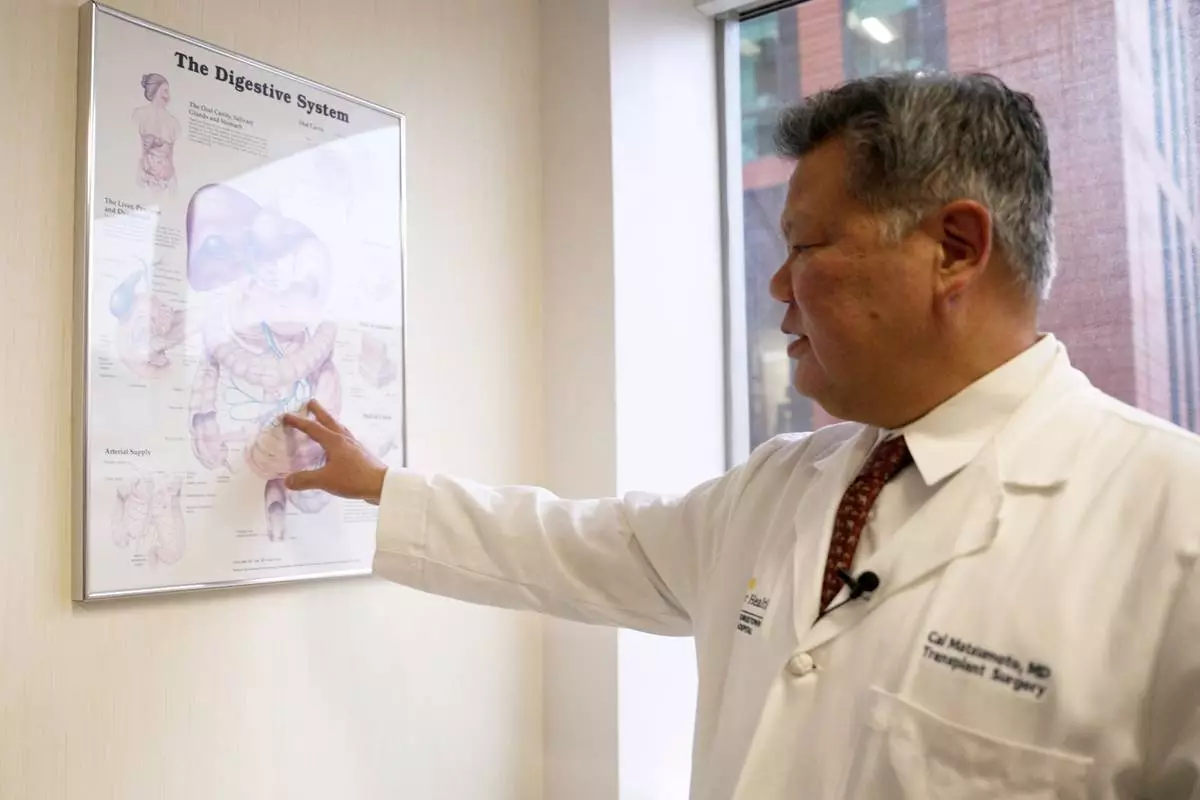
Dr. Cal Matsumoto, a MedStar Georgetown University Hospital transplant surgeon, gestures to a chart on the digestive system on March 4, 2026, in Washington. (AP Photo/Shelby Lum)