A judge on Wednesday ordered Meta to pay New Mexico $25 billion after a jury found the company liable for deceiving users about privacy on Facebook, marking the biggest fine ever against the tech giant.
Facebook’s deception was intentional and executives consistently misled users about how the platform worked, state District Court Judge Francis J. Mathew wrote in his ruling.
“Facebook promised users that they (the users) controlled their data. This was false,” he said.
Jurors in September found Meta liable for over 43 million violations of New Mexico consumer protection laws for making misleading public statements about how it handled users' personal data. The case was brought after political consulting firm Cambridge Analytica harvested Facebook data to generate targeted political ads during the 2016 election season.
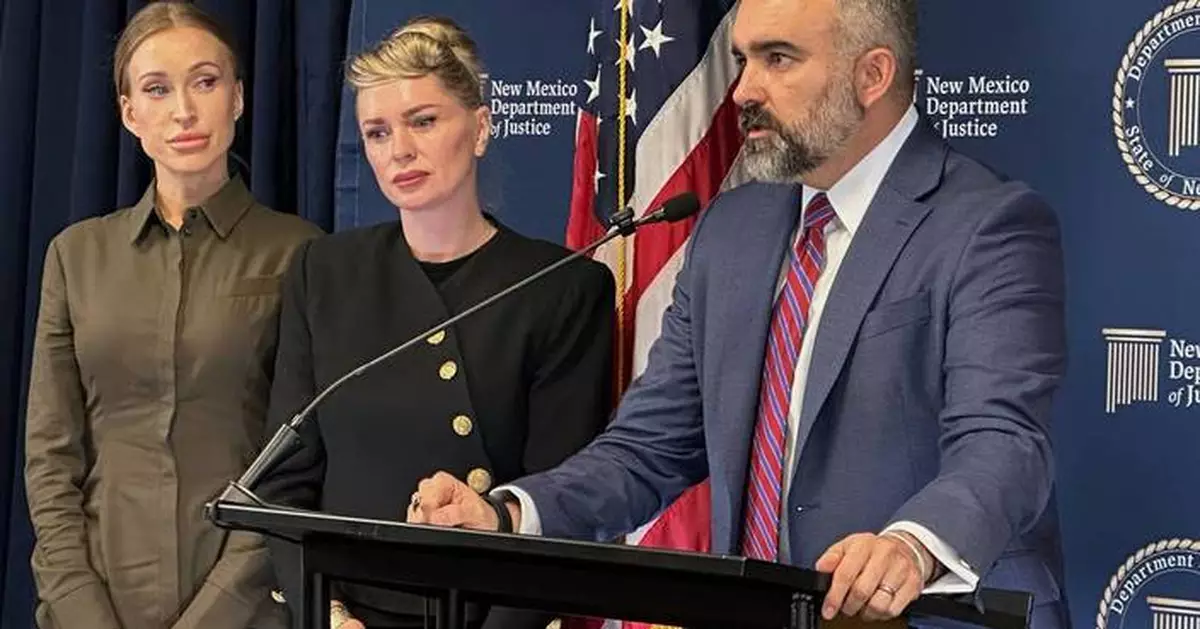
The award will serve as a warning to tech companies that New Mexico will hold them accountable, state Attorney General Raúl Torrez said at a news conference.
“This judgment should be a signal, an unambiguous message, to Silicon Valley,” he said.
Meta said the ruling and Torrez's office's approach to enforcement “makes it all but impossible to do business in the state of New Mexico.”
“At its core, this lawsuit seeks to impose a tax on speech to enforce new rules for what people can say online. We are confident we will prevail on appeal,” C.J. Mahoney, the company’s chief legal officer, said in a statement.
The Menlo Park, California, company’s shares were trading 2% higher in the immediate aftermath of the penalty announcement, and it was scheduled to report its quarterly earnings later Wednesday.
In August, Meta reached a settlement with nearly all states and territories — except New Mexico and Florida — to pay $18 billion and add stronger child-safety measures to its Facebook and Instagram platforms.
The settlement ended a trial over teen social media addiction and resolved a pivotal case years in the making that sought to hold the tech giant accountable for the role its platforms played in undermining children’s mental health. The effort targeted features designed to grab young people’s attention.
New Mexico didn’t join the multistate settlement, choosing to go after the company on its own.
During the trial, prosecutors cited a 2010 Washington Post op-ed from Facebook CEO Mark Zuckerberg, in which he wrote that the company didn't sell user data.
“You have control over how your information is shared,” Zuckerberg said. “We do not and never will sell any of your information to anyone.”
Attorneys for New Mexico had sought $35 billion to $40 billion, arguing that the company would only change its ways with a sum that affected its stock price.
Meta's lawyers, meanwhile, argued that the state failed to prove the company made misleading statements about privacy and that content moderation actually harmed New Mexicans. They contended that the company should pay no more than $3.4 billion, saying an award 10 times that or even more would violate due process, was unconstitutional and would not hold up on appeal.
Although interest would accrue on the penalty during the appeal process, Meta could succeed in reducing the number of violations for which it is found liable.
The $25 billion award far exceeds the $5 billion fine that the Federal Trade Commission levied against Facebook in 2019.
Peter Ormerod, an associate law professor at Villanova University, was surprised by the size of the New Mexico judgment because previous legal settlements over Cambridge Analytica were much lower.
“It comes out to about $12,000 per person in New Mexico, and that’s just a very large number. It’s quite unlike anything else we’ve seen,” Ormerod said.
Under the New Mexico Constitution, fines for violations of consumer protection laws go toward state education spending. But it could take years before the state sees any of the money while the company appeals.
The state's case focused on accusations that Facebook deceived users about a breach stemming from a third-party personality quiz that harvested data from roughly 87 million profiles and sold it to Cambridge Analytica. The now-defunct firm’s clients included Donald Trump's 2016 presidential campaign.
Attorneys for New Mexico argued that the state's entire population, not just Facebook users, were deceived by the company. They also said Facebook allowed misinformation or violent content to proliferate.
Meta attorneys vehemently denied the allegations, saying the company’s content moderation policies were robust and that freedom of speech must be considered. They argued that the state failed to prove people were harmed by deceptive statements.
In one of the tech giant's few wins, jurors found that the state didn’t prove Facebook made false claims about removing harmful content, including misinformation about the COVID-19 pandemic.
During a video deposition, Zuckerberg denied the state's claims that Facebook profited off harmful content. He said the company had to balance freedom of speech with content moderation.
Attorneys for the company said it has changed its policies since the lawsuit was filed in 2021 and that it catches and removes an estimated 99% of the content that violates its standards.
This story was updated to correct the spelling of the judge's last name.
Associated Press reporter Matthew Brown and Technology Writer Barbara Ortutay contributed to this report. Schuettler is a corps member for The Associated Press/Report for America Statehouse News Initiative. Report for America is a nonprofit national service program that places journalists in local newsrooms to report on undercovered issues.

New Mexico Attorney General Raúl Torrez discusses a judgment in the state's Facebook case during a news conference in Albuquerque, N.M., on Wednesday, Oct. 21, 2026. (AP Photo/Susan Montoya Bryan)
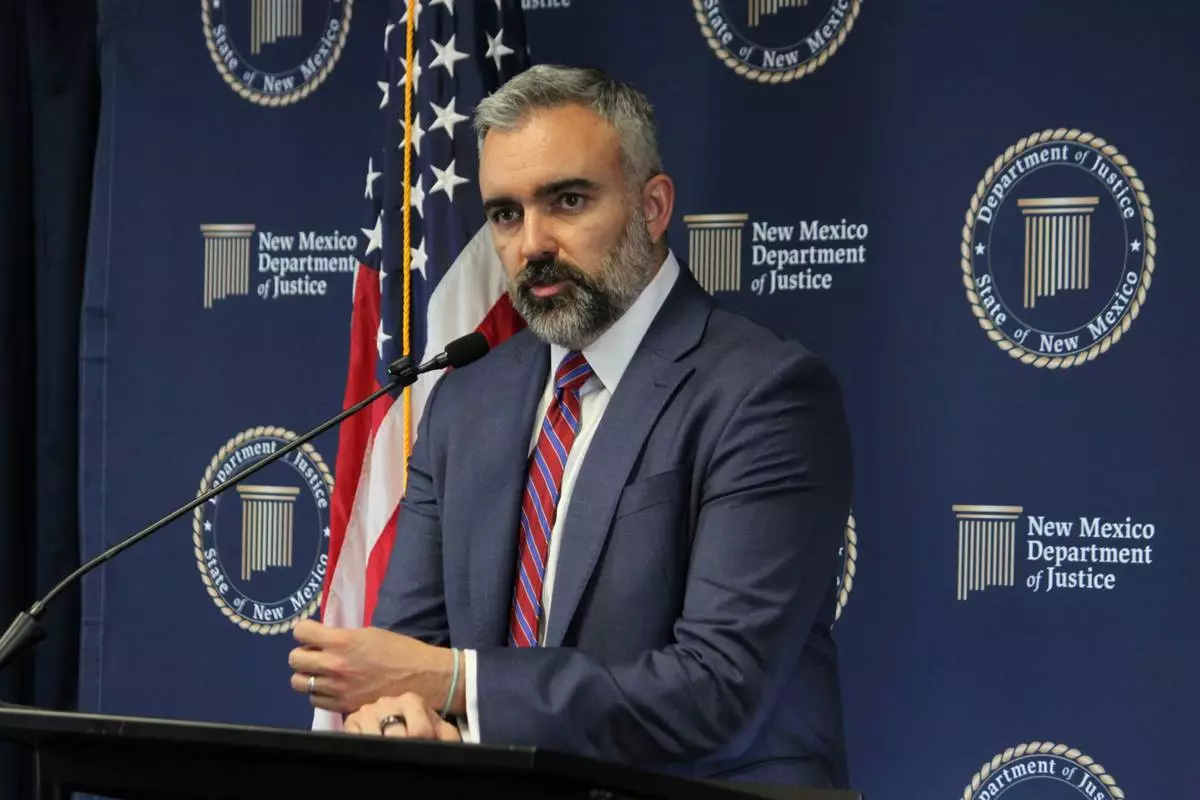
New Mexico Attorney General Raúl Torrez discusses a judgment in the state's Facebook case during a news conference in Albuquerque, N.M., on Wednesday, Oct. 21, 2026. (AP Photo/Susan Montoya Bryan)
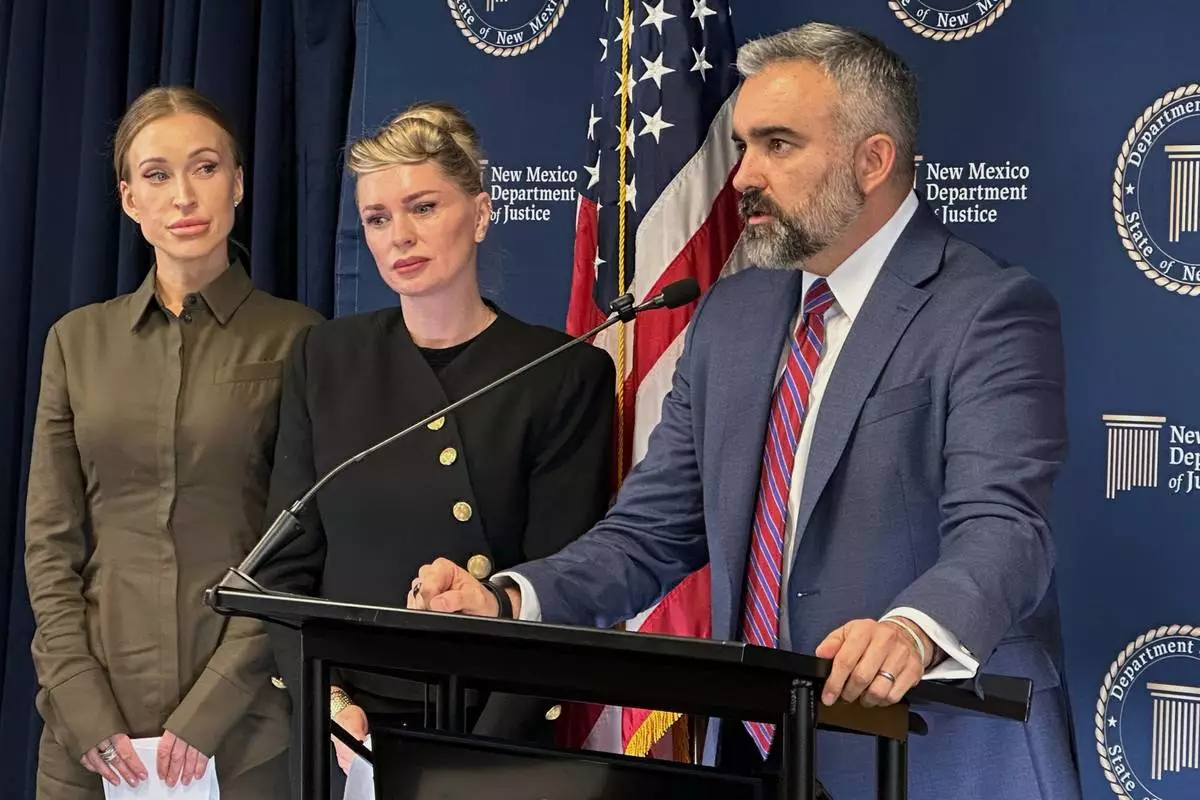
Julia Molchanova, left, Anouska De Georgiou, center, and New Mexico Attorney General Raúl Torrez speak at a news conference where Torrez announced a lawsuit against the co-executors of Jeffrey Epstein's estate, Wednesday, Oct. 21, 2026, in Albuquerque, N.M. (AP Photo/Susan Montoya Bryan)
LEWISTON, Maine (AP) — Maine Republican Susan Collins has promoted her reputation as one of the most independent U.S. senators and she is using the waning days of the election season to sell that message to voters by campaigning with a former Democratic colleague who has endorsed her.
Collins is trying to fend off a challenge from Democrat Troy Jackson, a onetime state Senate president, and on Wednesday she made appearances with Joe Manchin, a West Virginian who became an independent late in his career before retiring.
After stopping for breakfast at Simones' Hot Dog Stand in Lewiston, Collins spoke of how she and Manchin were “part of every piece of bipartisan legislation that passed and became law” during their time together in office.
Manchin said to lose Collins would be “to lose the soul of the Senate.” He praised her independent streak, her willingness to buck Republican President Donald Trump and her record of fighting for Maine's interests.
“This is a true blue-blooded Maine person who knows exactly where she came from,” Manchin said.
They stopped later a New Balance shoe facility in Norway. Jackson, 58, is scheduled to campaign Thursday in Portland with Alexandria Ocasio-Cortez, the progressive congresswoman from New York.
Collins, 73, is in what may be her toughest reelection fight as she seeks her sixth term.
It's only the second time that she's sought reelection in a midterm with a sitting Republican president, and the national trends are much less favorable to the GOP than they were the last time she did so, in 2002. Trump's approval has fallen well below where it was when he took office last year, and a recent poll from The Associated Press-NORC Center for Public Affairs Research found that a strong majority of voters want change in Washington.
Collins has been working to persuade voters that she is independent of Trump and willing to break with him. In Manchin, she enlisted a politician who was one of the most moderate voices in the Senate. Manchin said in 2023 that Trump would “ destroy democracy in America” if he was elected to a second term.
Among the few dozen Collins supporters at the Lewiston event was Mike Marcotte.
“I may not have always been a fan of her complete package of votes, but when I look at the vitriol that's in the U.S. Senate right now, we need more people like Susan Collins,” he said.
Jackson got a late start on campaigning after the party's initial nominee existed the race, but trails Collins in the money race by less than $3 million after an aggressive quarter in which he raised more than $20 million. Jackson has campaigned relentlessly and his events have drawn hundreds. Collins has largely stuck to smaller appearances.
Some of Jackson's backers demonstrated across the street from the hot dog stand. A few held signs bearing the face of Brett Kavanaugh, the U.S. Supreme Court justice whom Collins voted to confirm and whose vote eventually helped overturn the constitutional right to abortion.
“Someone needs to stand up and be a check on Donald Trump and his harmful policies,” said David Sysko.
Collins has broken with Trump and Republicans over the years. She voted to convict him at his impeachment trial in 2021. Increasingly during the campaign, she has worked to distance herself from the president as Democrats argue that she is too close to him.
Collins said in early October that she is “not exactly his favorite senator,” and that she did not expect Trump to campaign in Maine. He has steered clear of the state with the Nov. 3 election nearing.
Pinning Collins to Trump is central to the Democrats’ strategy. In one ad, a nurse says the state is in a healthcare crisis “because of Susan Collins and Donald Trump,” citing Collins’ vote for Trump’s push for Medicaid cuts. Collins did vote to advance the bill in a procedural move to open debate, but ultimately voted against it.
Trump also was a major focus of four contentious debates between the candidates this month, where Collins sought to distance herself from the president and Jackson repeatedly accused her of doing Trump's bidding.
Asked at the final debate to name a time in which she bucked her own party and succeeded, Collins gave the example of rallying support against Trump's nomination of Pete Hegseth, who was confirmed as defense secretary.
Democrats seized on the moment and released a statement that said the exchange “underscores a central question in the Maine Senate race: Does Collins, a Republican in a state that disapproves of President Donald Trump and has grown bluer in recent years, stand up to her party enough to earn the independent streak she has staked her career on?”
Jackson has characterized Collins as out of touch with the struggles of working-class people in Maine. He has described Collins as a “rubber stamp” for the president and criticized her votes on Kavanaugh and Robert F. Kennedy Jr., Trump's second-term health secretary. Collins has said she does not regret either vote.
Republican ads against Jackson, a logger from northern Maine, have focused more on accusations of his having a volatile personality and behaving like a bully with female colleagues. Jackson has denied those accusations.
Collins distanced herself on Wednesday from a Republican super PAC attack ad that she said “should be taken down.”
The senator was a top target of Democrats in 2020 when she defeated challenger Sara Gideon by nearly 9 percentage points. Collins is the only Republican senator from New England, a distinction she has had since January 2013.
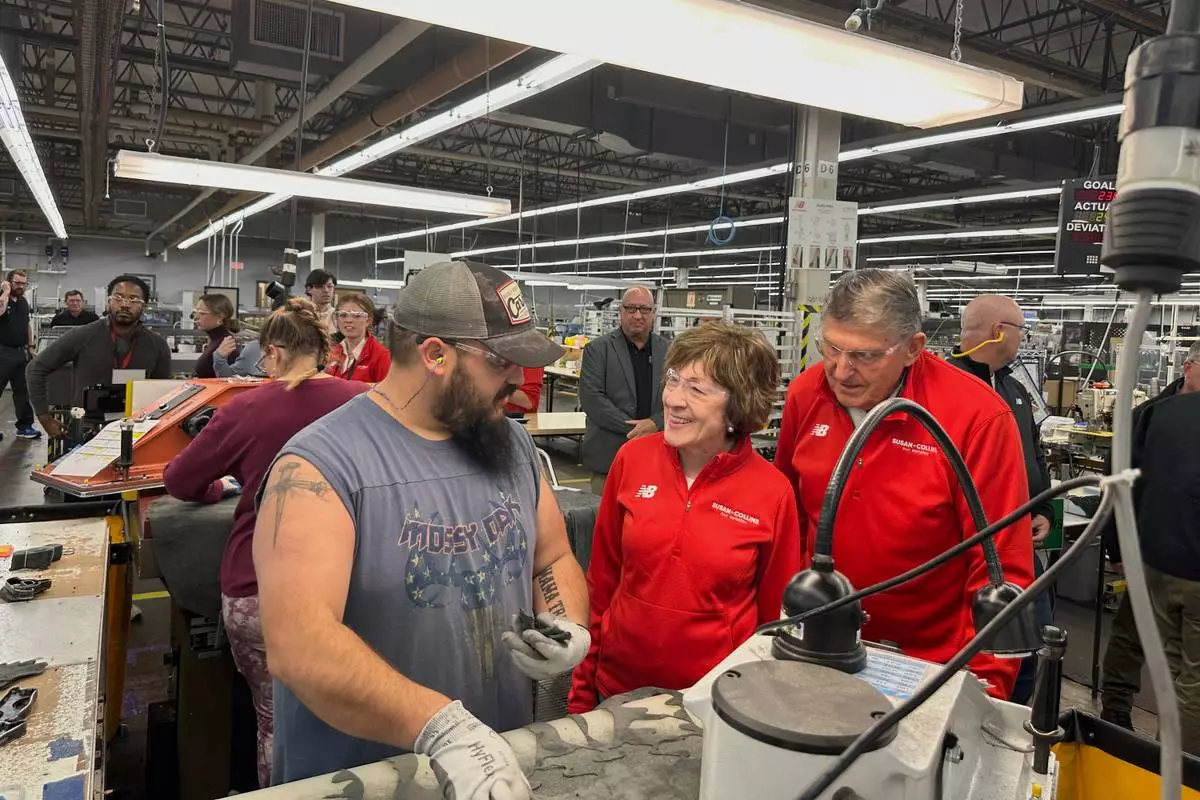
In this photo taken with a smartphone, Sen. Susan Collins, R-Maine, and former Sen. Joe Manchin, D-W.Va., tour a New Balance shoe factory in Norway, Maine, on Wednesday, Oct. 21, 2026. (AP Photo/Patrick Whittle)
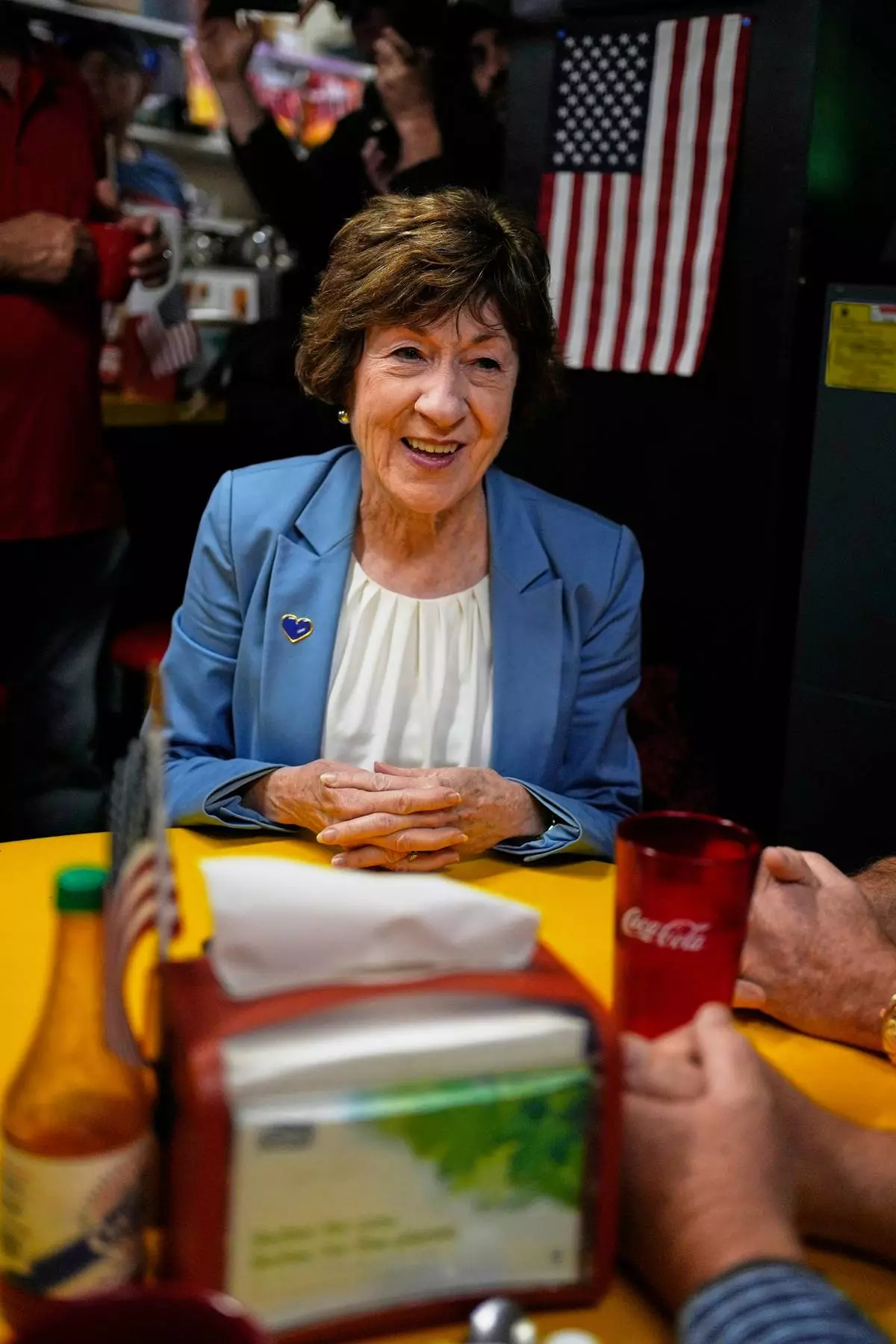
Sen. Susan Collins speaks to diners at a campaign stop Wednesday, Oct. 21, 2026, in Lewiston, Maine. (AP Photo/Robert F. Bukaty)

Sen. Susan Collins (R) looks to Troy Jackson (D) as he answers a question during the final Maine U.S. Senate debate in Bangor, Maine, Thursday, Oct. 15, 2026. (Gregory A. Rec/Portland Press Herald via AP, Pool)
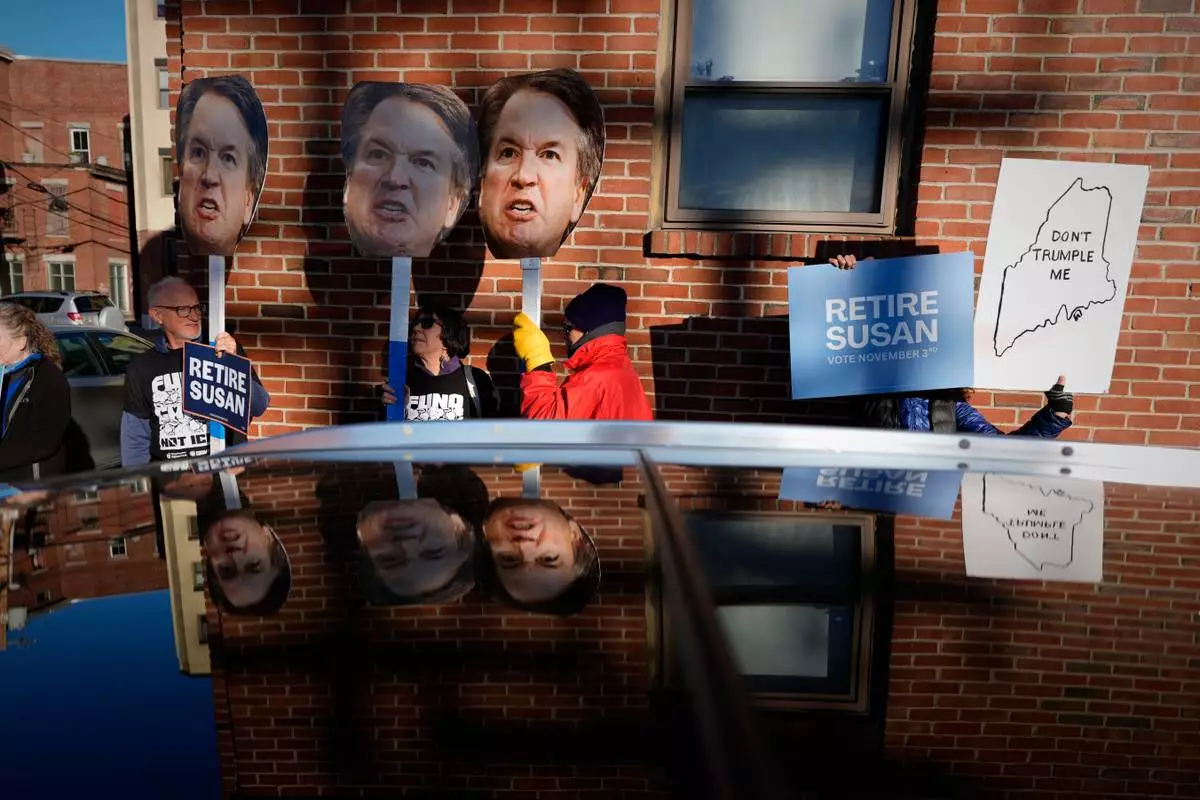
Protesters hold photos of U.S. Supreme Court Justice Brett Kavanaugh near a campaign stop by Sen. Susan Collins Wednesday, Oct. 21, 2026, in Lewiston, Maine. (AP Photo/Robert F. Bukaty)
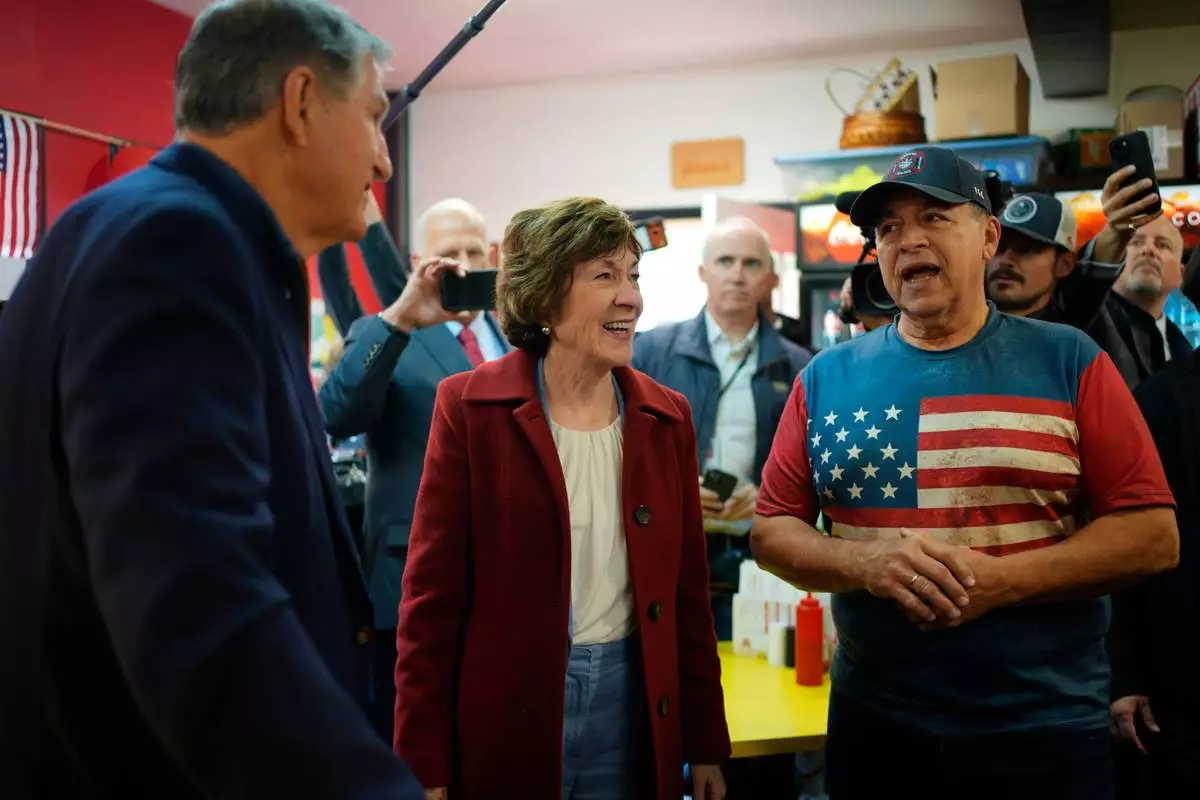
Sen. Susan Collins, with former West Virginia Sen. Joe Manchin, left, talk with Jimmy Simones at his restaurant Wednesday, Oct. 21, 2026, in Lewiston, Maine. (AP Photo/Robert F. Bukaty)
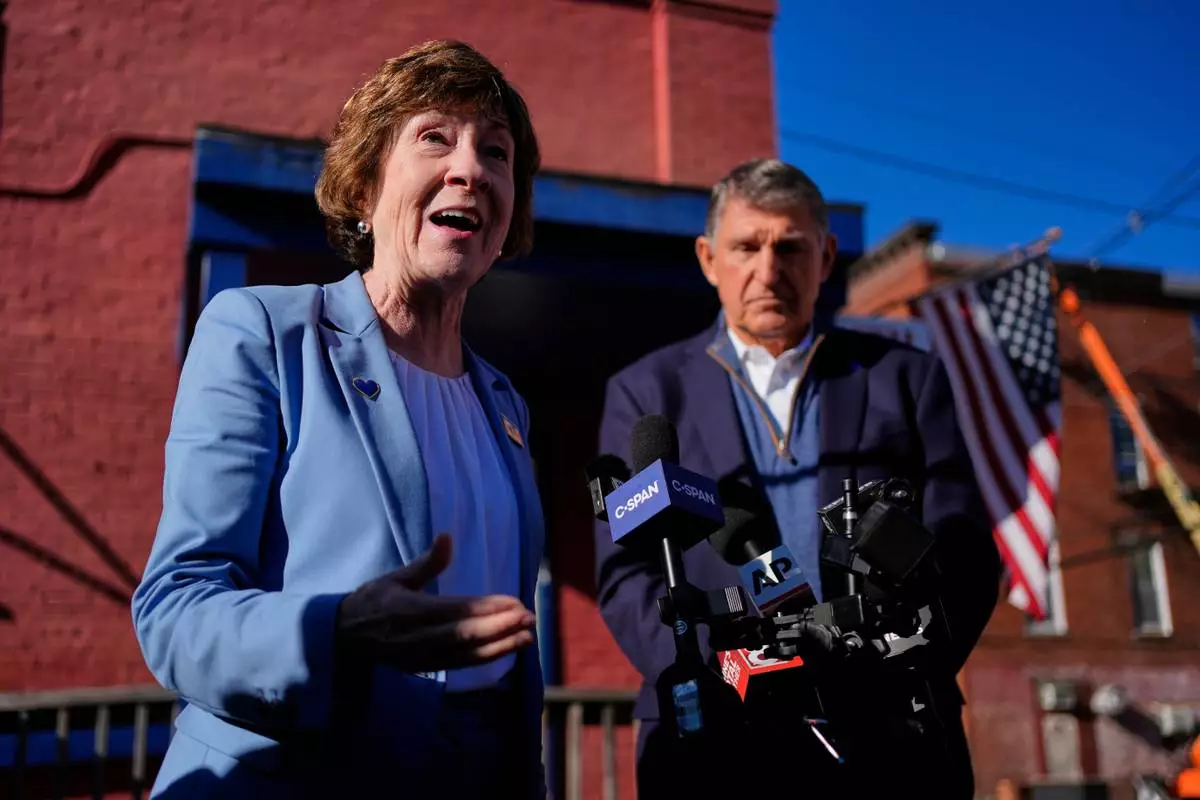
Sen. Susan Collins, with former West Virginia Sen. Joe Manchin, speaks to reporters following a campaign stop Wednesday, Oct. 21, 2026, in Lewiston, Maine. (AP Photo/Robert F. Bukaty)
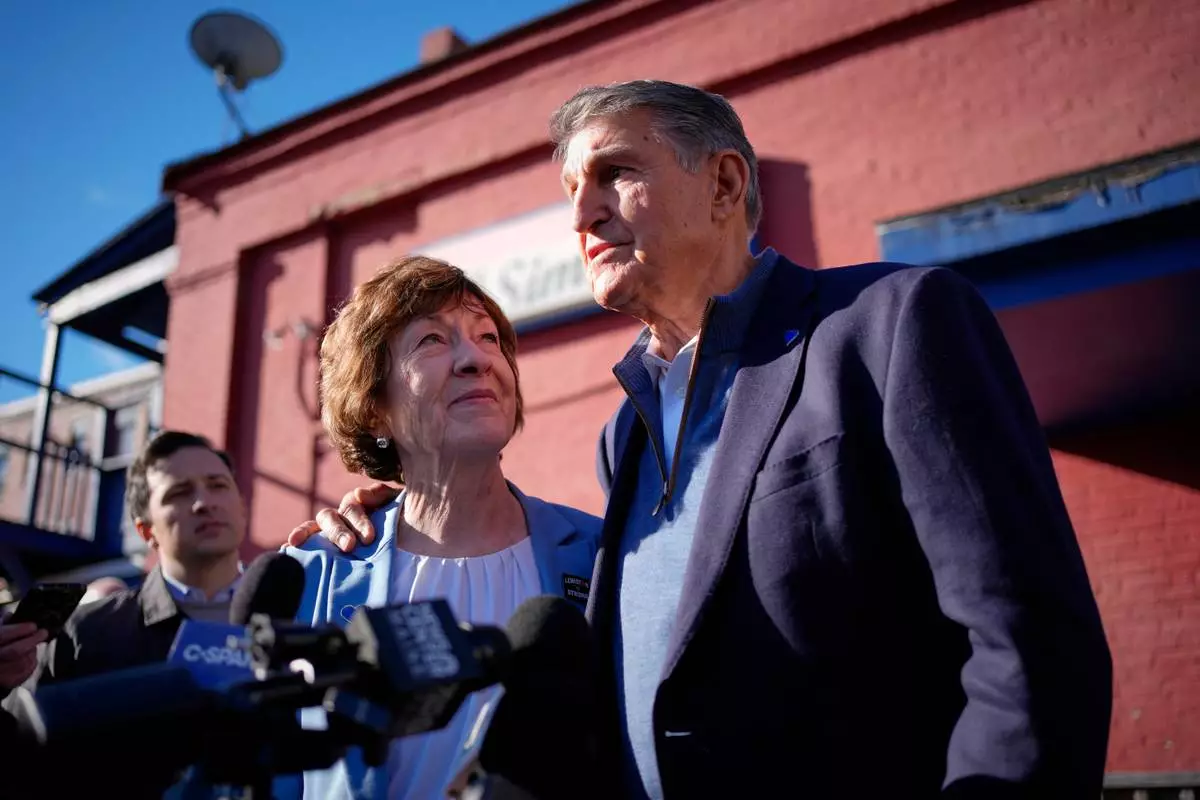
Sen. Susan Collins listens as former West Virginia Sen. Joe Manchin speaks to reporters following a campaign stop Wednesday, Oct. 21, 2026, in Lewiston, Maine. (AP Photo/Robert F. Bukaty)