Skip to Content Facebook Feature Image

UL Solutions Expands Capabilities to Help Companies Navigate Growing Packaging and Sustainability Regulations

Business

UL Solutions Expands Capabilities to Help Companies Navigate Growing Packaging and Sustainability Regulations
Business

Business

UL Solutions Expands Capabilities to Help Companies Navigate Growing Packaging and Sustainability Regulations

2026-10-22 04:10 Last Updated At:04:21

NORTHBROOK, Ill.--(BUSINESS WIRE)--Oct 21, 2026--

UL Solutions Inc., a global leader in applied safety science, today announced the expansion of its extended producer responsibility (EPR) capabilities to help companies manage an increasingly complex and rapidly evolving regulatory landscape tied to packaging, sustainability and product stewardship.

This press release features multimedia. View the full release here: https://www.businesswire.com/news/home/20261021828157/en/

To support customers in this environment, UL Solutions is expanding its EPR offerings through enhanced advisory services, regulatory intelligence and software-enabled data insights. Together, these capabilities help companies understand applicable requirements, report the right data and determine the appropriate fees, providing greater confidence that they are effectively managing their EPR obligations.

This expansion includes the recent acquisition of Evnia, a Montreal-based provider of EPR services in Canada and the United States. Evnia brings nearly two decades of experience helping organizations manage environmental obligations through regulatory monitoring, reporting and technology-enabled advisory services.

“With EPR requirements expanding globally, this is a pressing business reality for companies operating around the world,” said John Genovesi, executive vice president and president of Risk and Compliance Software at UL Solutions. “Organizations are looking for trusted experts who can help them navigate this increased responsibility for how they package their products and what happens to the waste after the product is consumed.”

EPR regulations are transforming how manufacturers, retailers and consumer-facing brands manage the life cycle of their products. These requirements hold producers accountable for the environmental impact of packaging and materials, including recycling, reporting and compliance obligations. While traditional product compliance focuses on what is inside a product, EPR shifts the focus to what surrounds it and what happens to the packaging after use.

More than 60 jurisdictions worldwide have implemented EPR laws, including California, Colorado, Maine, Maryland, Minnesota, Oregon and Washington, with additional U.S. states expected to adopt new requirements in the coming year. As these regulations grow in scope and complexity, companies are facing increasing pressure to manage fragmented reporting obligations, evolving legislation and environmental responsibilities across multiple markets.

“EPR is quickly becoming a critical requirement across industries, including consumer products, automotive, pharmaceuticals and manufacturing,” said Josh Warren, vice president and general manager of Appliances, HVAC and Lighting and Retail and Consumer Products at UL Solutions. “By expanding our capabilities, we are helping customers stay ahead of regulatory change while building more sustainable products and supply chains.”

About UL Solutions

A global leader in applied safety science, UL Solutions Inc. (NYSE: ULS) transforms safety, security and sustainability challenges into opportunities for customers in more than 110 countries. UL Solutions delivers testing, inspection and certification services, advisory offerings and software solutions that support our customers’ product innovation and business growth. The UL Mark serves as a recognized symbol of trust in our customers’ products and reflects an unwavering commitment to advancing our safety mission. We help our customers innovate, launch new products and services, navigate global markets and complex supply chains, and grow sustainably and responsibly into the future. Our science is your advantage.

Source Code: ULS-IR

As packaging regulations evolve, UL Solutions helps companies understand and manage extended producer responsibility requirements.

As packaging regulations evolve, UL Solutions helps companies understand and manage extended producer responsibility requirements.

NEW YORK (AP) — Tesla reported a decline in profit for the latest quarter but a measure of cash its business generated surged, leaving investors with a mixed picture as it prepares for a possible merger with Elon Musk’s other big company, SpaceX.

The electric vehicle maker reported third-quarter net income of $787 million, or 22 cents per share, down 44% from the year-earlier period. Excluding certain items, though, earnings per share of 48 cents beat Wall Street analyst expectations by 3 cents.

One standout for the quarter was Tesla's $1.5 billion in free cash flow, a measure of cash generated after subtracting investments needed to keep the business running. Given big artificial intelligence spending, analysts had expected Tesla would report it had burned through cash, not generated it.

“It seems Tesla is taking a more capital-efficient approach, delaying longer-term projects to be able to self-fund their AI growth,” said Morningtar analyst Seth Goldstein, calling the cash jump the big surprise of the quarter.

Revenue was basically flat at $28 billion, falling slightly short of analysts’ forecast.

In a SpaceX conference call after that company reported earnings on Tuesday, Musk said a long-rumored merger with Tesla might be in the works. He said that special committees had been set up at each company to discuss a possible combination, while cautioning that many hurdles remain.

Musk declined to discuss the possible merger further on Tesla’s conference call.

Tesla stock fell 2.4% in after-hours trading after climbing 3.6% during the regular trading session.

Tesla reported that a big selling feature of Tesla's cars, driver-assistance software that Tesla owners pay for separately, are in high demand with 75% of vehicles sold in North America including a subscription to the service.

The company calls the feature Full-Self Driving (Supervised), the word in parenthesis added after regulators said the term was misleading because the software requires drivers to stay alert and ready to take control at any time.

Profit margins also held up despite concerns that discounts to boost sales may have squeezed profitability in recent quarters. For the three months through September, Tesla reported that it made 18.1 cents for every dollar of car sales, up almost 3 cents from a year earlier.

Tesla had previously reported selling nearly 490,000 vehicles last quarter, a rise from the prior three months. The increase followed a brutal drop stretching more than a year amid backlash over Musk’s support for President Donald Trump and right-wing politicians in Europe.

The company increased capital spending, a major concern for tech investors who’ve been questioning future payoffs from artificial intelligence and how the investments will be financed. Tesla’s capital spending doubled in the third quarter to $4.7 billion.

In the conference call, Tesla said it was cutting estimates of capital spending for the full calendar year from $25 billion to $20 billion. It also noted that it had secured $30 billion in borrowing capacity should it need money to fund big projects, but probably wouldn't draw on it this year.

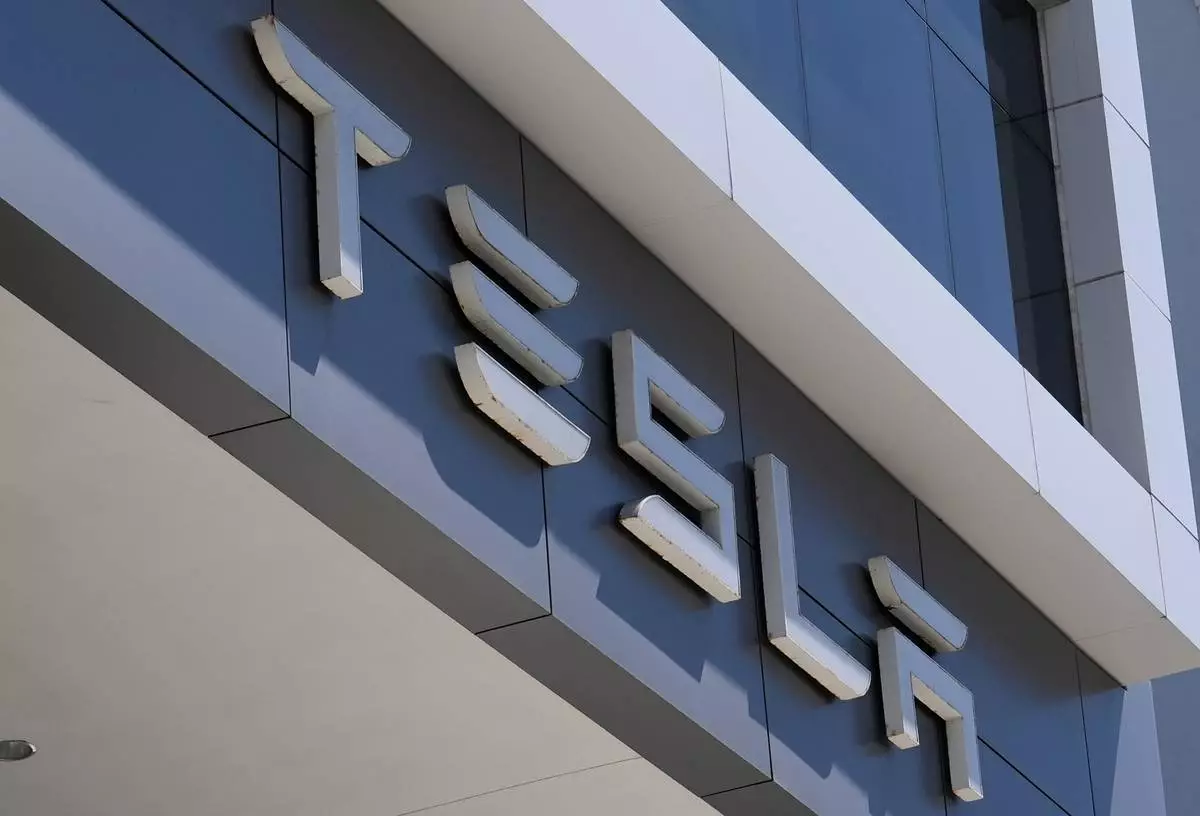
FILE - The Tesla logo is displayed at a Tesla dealership Thursday, Mar. 13, 2025, in Miami. (AP Photo/Lynne Sladky, file)

FILE - The Tesla logo is displayed at a Tesla dealership Thursday, Mar. 13, 2025, in Miami. (AP Photo/Lynne Sladky, file)

Recommended Articles