
JERUSALEM (RNS) — When Rivka Neriya-Ben Shahar, an Orthodox Jew who lives in Jerusalem, first arrived in Lancaster County, Pennsylvania, in 2011 to research Amish communities, she had only visited the U.S. once and could barely speak English.
But after years of researching women in Israel’s Haredi, or ultra-Orthodox, community, one of her academic advisers, Yehiel Limor, “basically forced me to read about the Amish,” she told RNS. “I tried to negotiate and say, ‘look, I don’t have time, and everything is in English.’” When she relented, “I just fell in love with this community,” she said.
Fast-forward over a decade later, and Neriya-Ben Shahar, whose research straddles media, sociology and anthropology, has visited with the Amish more than 100 times for short and extended visits in Lancaster and beyond. She conducted the first comparative study of ultra-Orthodox Jews in Israel and old-order Amish communities with a 2024 book, “Strictly Observant,” relaying her findings and experience. She made her most recent visit to Lancaster in September, researching her second book on Amish women. She now considers some of the women she’s lived with her extended family.
This content is written and produced by Religion News Service and distributed by The Associated Press. RNS and AP partner on some religion news content. RNS is solely responsible for this story.
A tenured senior lecturer at Sapir Academic College in Sderot in southern Israel, Neriya-Ben Shahar said her research was challenging to pursue at the start. In addition to the language barrier and her lack of knowledge about the U.S., it was difficult to procure funding. She was eventually awarded a Fulbright Grant to study the rituals that Jewish women create for themselves and investigated the Amish when time would allow. She and her husband found positions at Brandeis University and Harvard University, respectively, and moved to Massachusetts for the 2011-2012 academic year.
Soon, Neriya-Ben Shahar and her husband began driving to Lancaster County, which has the largest Amish population in the world. They had been warned by friends that the community was extremely insular.
On their first visit, they followed a buggy until they saw a young Amish woman emerge from a farmhouse. She recalled jumping from the car and approaching her.
“I said the first sentence I had in my mind: ‘Hi, my name is Rebecca (Rivka, in Hebrew), like Rebecca from the Bible. I came from Jerusalem, from the Holy Land, can I speak with you?’” she asked.
Seeing Neriya-Ben Shahar’s own modest hair covering and long dress, “Suzi” (all research subjects were given a pseudonym, in accordance with research standards) invited her into her home.
The Amish are a Protestant denomination that dates back to 16th-century Europe. Today, they live in 32 states, mostly in Pennsylvania, Ohio and Indiana, according to the Young Center for Anabaptist and Pietist Studies at Elizabethtown College.
Despite many differences, both Orthodox Jews and Amish strictly observe their religions and eschew certain elements of modern life. Amish do not drive cars, use electricity, televisions or computers, and do not have phones in their homes, but some have landlines in their shops or businesses.
Conversely, Haredi Jews in Israel are increasingly using smartphones and computers with filters that keep the content they consider to be “kosher” and block everything that is not. They drive cars and use electricity but do not turn it on and off on Shabbat. Most rely on their own media outlets for news.
Despite such differences across culture, religion and location, when Neriya-Ben Shahar met Suzi’s mother, “Anna,” the two women felt an instant connection and agreed to meet again, Neriya-Ben Shahar said. Following that first encounter, the two women exchanged letters.
During her first scheduled visit, Neriya-Ben Shahar arrived at the farm after the family’s six children had left for the day. The kitchen was full of dishes from breakfast and lunchbox preparations, so she went to the sink and started washing the dishes before tackling laundry, setting off a regular practice helping the family with daily chores while she stayed with them.
Cumulatively, she has spent “many months” with Amish families, including three weeks living on Anna’s farm. Anna’s family has since become her “home base” in the U.S., Neriya-Ben Shahar said.
“They keep boxes containing my kosher dishes and clothes in their attic,” she said. “On the plastic bags they have written, ‘Rebecca from the Holy Land, don’t touch.’”
Her Amish hosts have been eager to accommodate Orthodox Jewish customs, Neriya-Ben Shahar said. They offered her their highest shelf in a small, propane-powered refrigerator to prevent their unkosher food from falling onto her kosher items.
She cooks her own food with her own pots and pans but dines with the family. On Shabbat, the family brings her a lit flashlight to help her find her way in the dark.
She tries to reciprocate. Although traditional Amish do not drive cars, they allow her to drive them to various errands. One Sunday, as Anna took a nap knowing that the strawberries and peas in the fields would spoil because the Amish do not do manual labor on the Christian sabbath, Neriya-Ben Shahar harvested them.
“We just care about each other and try to help whenever we can,” Neriya-Ben Shahar said. “Anna knows that I will behave well and not harm her family” by exposing them to things like the internet or smartphones, which the Amish community bans.
Neriya-Ben Shahar’s research for her first book revealed striking similarities between Amish and ultra-Orthodox women, alongside striking differences.
As mothers of large families, both view themselves as the transmitters of their community’s values in societies they see as under threat from modernity and technology. And both communities place enormous importance on modesty, but they approach it differently. “The ultra-Orthodox try to separate everything by gender, and the Amish try to live together and stay very modest at the same time,” she explained.
Courtship is another difference. Many Haredi parents hire matchmakers to marry off their children, while “the Amish fall in love in their youth groups,” Neriya-Ben Shahar said. “It was something hard for me to believe.”
Additionally, Haredi Israelis liberally use Israel’s universal health care system, while the Amish use the American medical system as a last resort.
Education is another dividing line. Neriya-Ben Shahar says ultra-Orthodox girls generally receive 12 years of formal education followed by seminary or professional training. Traditional Amish schooling for both boys and girls, by contrast, ends after eighth grade. Most Haredi women work outside the home, while most married Amish women become homemakers.
“Both call the internet and smartphones Satan’s tool, something that will destroy our community,” the researcher said.
Her next book will focus solely on aspects of Amish women’s lives, such as child-rearing, marriage, prayer, mutual aid and housework. At the same time, she is working on new studies of haredim and health and welfare services in Israel.
Nimrod Bar-Am, dean of research at Sapir College, credited Neriya-Ben Shahar with deepening “our anthropological understanding of the dynamics and challenges of closed, zealous communities that manage to sustain themselves at the very heart of open liberal societies.”
“She does so through a uniquely brilliant use of her own theoretical, biographical and personal background as someone who herself grew up within a religious society, and she is thereby able to generate compelling universal insights into how such communities contend with their existential challenges,” he told RNS.
Neriya-Ben Shahar said the 14 years she has known the Amish “have changed my life in so many ways.” They taught her to appreciate simple things she had long taken for granted.
She recalled how, when she drove Anna and Anna’s daughter to see the ocean for the first time, “they were thrilled to see the waves moving.” They had only seen the ocean in photographs. When she brought Anna water from the Jordan River, “she cried, ‘Oh, Jesus walked on this water!’”
It was “one of the most religious moments in my life, just to see how excited she was,” Neriya-Ben-Shahar said.
Neriya-Ben Shahar thinks often about what she learned from watching Amish families make choices in the modern world.
“They know everything they could buy and have,” she said. “They know that there is electricity and internet and smartphones and that they could drive, but they choose not to. When you talk with them, they look at you, they listen to you, they wait before they respond.”
She misses the families who welcomed her into their lives when she has not seen them for a while. And every morning, when she prays, she remembers the people who began as research subjects and became dear friends.
“Every day when I pray the morning prayers, I pray for them and thank God for the fact that they are in my life,” she said.
In a letter Anna wrote to Neriya-Ben Shahar for the latter’s 50th birthday, and shared with RNS with the Amish woman’s consent, Anna said she cherishes these prayers.
“Words fail to express our appreciation and love we have for you,” Anna wrote. “There are so many things that you have enriched our lives with. Number one is to thank you for the many, many prayers that you have prayed on our behalf. Only God knows how many. Your prayers have made a difference.”
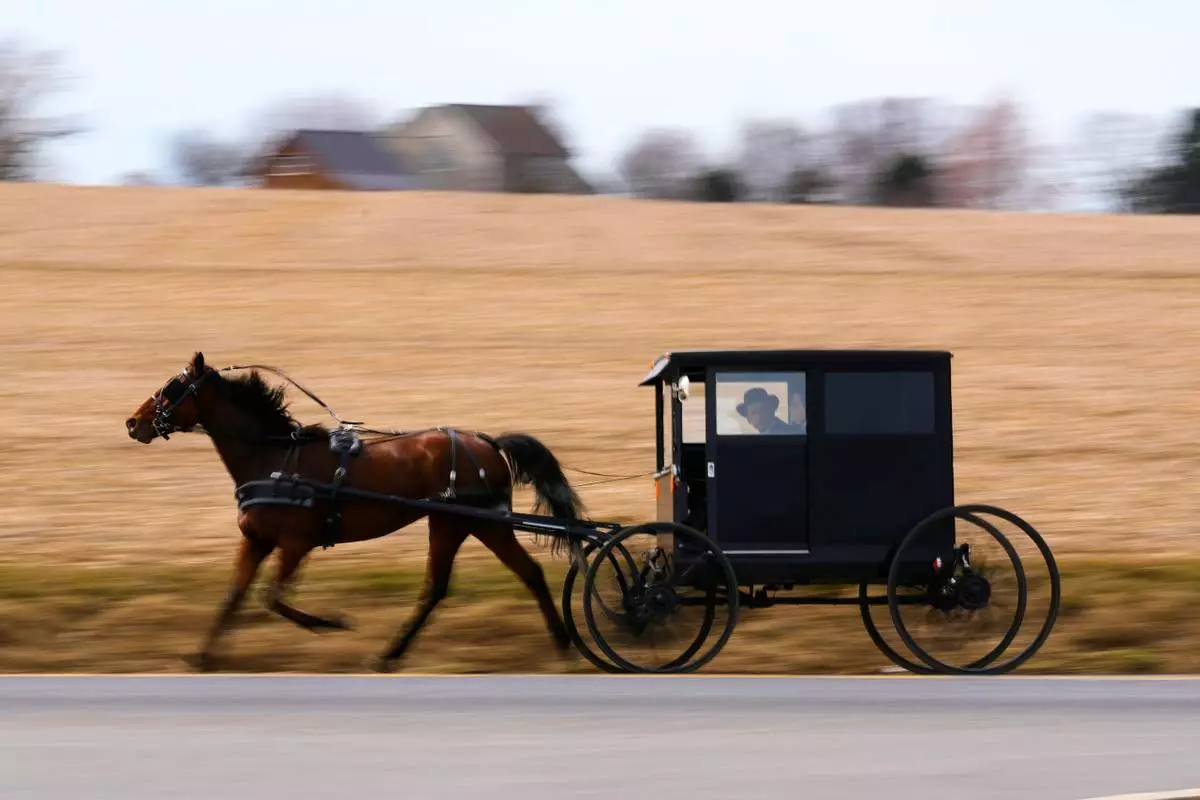
FILE - A buggy is driven on a country road, March 8, 2026, in Lancaster County, Pa. (AP Photo/Robert F. Bukaty, File)