Skip to Content Facebook Feature Image

Federal judge orders Trump administration to halt noncitizen voting investigation in 9 states

News

Federal judge orders Trump administration to halt noncitizen voting investigation in 9 states
News

News

Federal judge orders Trump administration to halt noncitizen voting investigation in 9 states

2026-10-23 03:16 Last Updated At:03:20

A federal judge in California has ordered the Trump administration to halt investigations in nine states into whether noncitizens are registered to vote.

U.S. District Court Judge Araceli Martinez-Olguin in Oakland found the government's effort is relying on data that is full of errors and that it's leading to intimidation of groups performing voter assistance efforts. She said it should be halted until polls close on Election Day, Nov. 3.

She put her ruling, which was made Wednesday, on hold until Friday to give the administration a chance to appeal.

The ruling applies to investigations in California, Connecticut, Georgia, Missouri, Nevada, New York, Pennsylvania, Washington and Wisconsin.

It comes as the Trump administration has been hunting for noncitizen voters throughout the country in the months leading into the midterm elections. The administration has signaled that it's a major problem, when in fact it's quite rare, as even its own investigations have shown.

The lawsuit was filed by the California Nurses Association and National Nurses United, along with the Voto Latino Foundation, San Francisco and Santa Clara County.

In response to the ruling, the Department of Homeland Security issued an email statement Thursday saying it's focused on “removing aliens who vote and dilute the votes of U.S. citizens,” while adding, “We have no plans to question or investigate people we believe to be U.S. citizens.”

The judge based the decision to halt the investigation only on the unions’ assertion that the probe is harming voter assistance and mobilization efforts involving citizens. She did not find that union members' right to vote was being infringed because most of them do that by mail and not in person. She said investigations don’t need to target U.S. citizens, use armed agents or intimidate citizens who are urging others to vote.

According to legal filings in the case, investigators were told to target naturalized citizens to see whether they had voted before they became U.S. citizens. The lists of voters to check came from sources that included state and local governments and publicly available information. Martinez-Olguin called them “voluminous and unreliable.”

“Even under the best conditions, there is a high likelihood of error in review because there is no federal database containing citizenship status of U.S. residents,” Martinez-Olguin wrote in her ruling. “The time limitations implemented during the Surge further exacerbate the risk of error.”

The Department of Justice has been demanding detailed and unredacted voter roll data from the states and has sued the 30 states that have refused to turn it over, losing each of those cases so far. The judge noted that for states that refused to share their records, the administration was trying to obtain them through “unreliable commercial versions of voter roll data.”

She said during a “surge” phase of the investigation starting in late August, agents were ordered to complete reviews of flagged individuals taking no more than 12 minutes per person to assess whether they were legally qualified to vote.

In their challenge, the plaintiffs said some U.S. citizens felt they were wrongly identified and investigated as part of the probe. Martinez-Olguin said those fears “are well understood as intimidation” that has chilled people from attending campaign events and working as poll monitors during the election.

Beau Tremitiere, a lawyer representing the unions and voter group, said in a statement that the ruling affirms the groups’ position.

"It was clear from the start that DHS built its lists on bad data, never checked how often it was wrong, and recklessly sent agents to people’s homes weeks before an election," Tremitiere said.

Details of the investigation, known as the "Unlawful Voter Initiative,” came to light last month after Democratic Senate Minority Leader Chuck Schumer of New York and Democratic Sen. Alex Padilla of California released a whistleblower report about it.

Homeland Security Investigations task force officers escort a suspect accused of illegally registering to vote during a federal operation in Commerce, Calif., Monday, Oct. 19, 2026. (AP Photo/Jae C. Hong)

Homeland Security Investigations task force officers escort a suspect accused of illegally registering to vote during a federal operation in Commerce, Calif., Monday, Oct. 19, 2026. (AP Photo/Jae C. Hong)

WASHINGTON (AP) — Calley Means, a top adviser to Health Secretary Robert F. Kennedy Jr. and a chief advocate for the Make America Healthy Again movement, resigned from his position with the Trump administration Thursday.

In a statement, Means did not say why he was leaving. His departure comes as leading voices in the MAHA movement have expressed discontent with what they say is the Trump administration’s lack of progress on a variety of issues, including food security and regulating the weed killer glyphosate.

Means said he “leaves with tremendous respect” for President Donald Trump and Kennedy.

“The past two years have seen historic policy and cultural change to confront the chronic disease crisis and healthcare incentives that profit from us being sick,” Means said. “This movement is in the first inning and just getting started.”

Means was hired as a White House adviser early in the second Trump administration. He used his perch at the Health and Human Services Department to attack the nation’s leading physician groups, federal agencies and government scientists, claiming they only protect their own interests.

White House spokeswoman Allison Schuster said the Trump administration is “grateful” for Means’ time and “he has done a fantastic job for the MAHA movement.” A representative from Health and Human Services did not respond to a request for comment.

Health activist Kelly Ryerson, a leader of American Regeneration who is also known as Glyphosate Girl on social media, said she is “impressed that he completed over two years at HHS fighting the food battle, despite all of the obstacles presented by corporate interests.”

“At the heart of MAHA is a shared belief that the nation’s health must not be sacrificed to corporate profit, and that a preventable slide into chronic disease is a threat to America itself,” she said.

Means is the brother of wellness influencer, author and entrepreneur Dr. Casey Means, who failed to be confirmed as surgeon general earlier this year after doubts were raised over her vaccine stance.

Means, along with his sister, came to prominence within the MAHA movement by arguing that ultraprocessed foods, additives and pesticides could be blamed for many of the chronic health conditions facing Americans.

Means brought those arguments into the Trump administration and frequently clashed with senior White House officials who worried about alienating the powerful food industry.

At the same time, Means’ emphasis on food was a source of frustration for other figures within the MAHA movement who wanted to see Kennedy focus on “medical freedom” issues. For many, that meant rolling back federal recommendations and approvals for vaccines.

Despite Means’ efforts, the administration’s progress on food reforms has been slow going.

Kennedy had promised the release of a first-ever government definition of ultraprocessed food in April. Instead, FDA’s acting commissioner, Kyle Diamantas, told a conference that month that defining the class “is really hard.”

In August, Kennedy staffers again suggested an announcement on the issue was imminent. Instead, the announcement focused on a proposal bringing greater scrutiny to food additives. It made only passing mention of ultraprocessed foods.

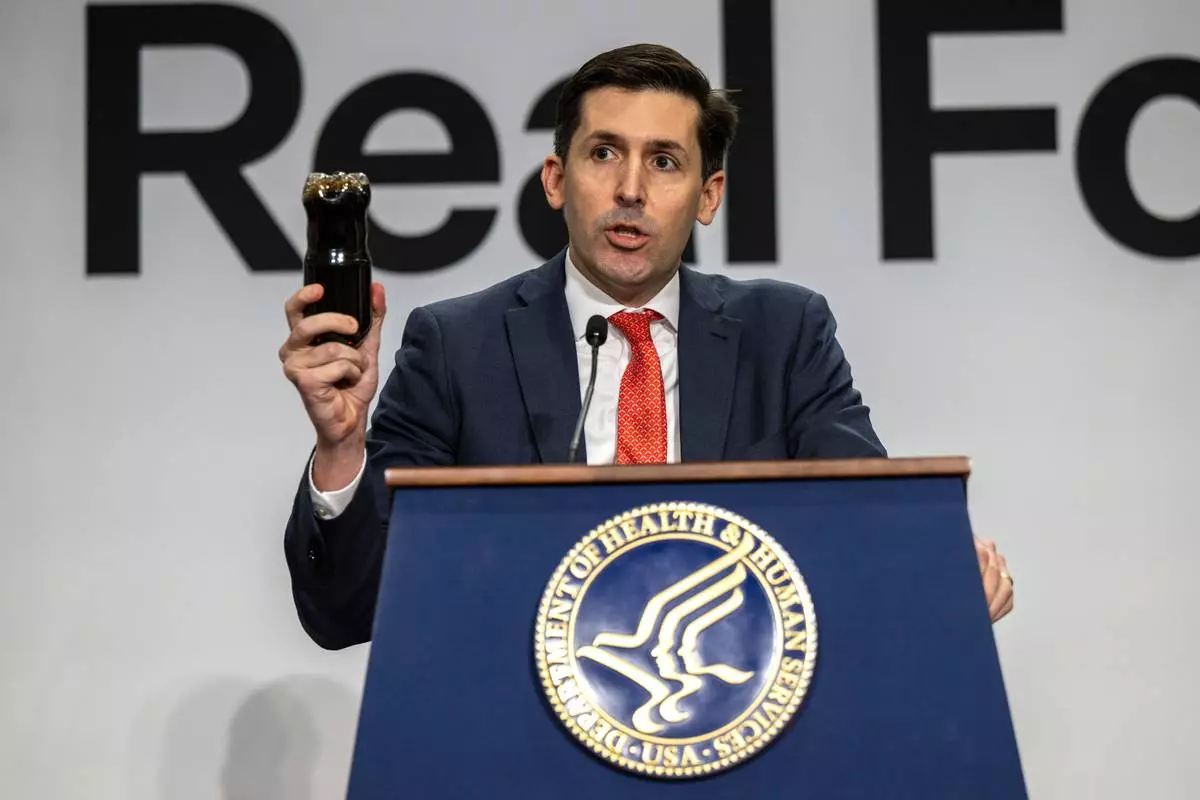
In this image provided by the U.S. Department of Agriculture, Calley Means, senior advisor for the U.S. Department of Health and Human Services, delivers remarks at HHS Headquarters in Washington, Feb. 11, 2026. (Christophe Paul/USDA via AP)

In this image provided by the U.S. Department of Agriculture, Calley Means, senior advisor for the U.S. Department of Health and Human Services, delivers remarks at HHS Headquarters in Washington, Feb. 11, 2026. (Christophe Paul/USDA via AP)

Recommended Articles