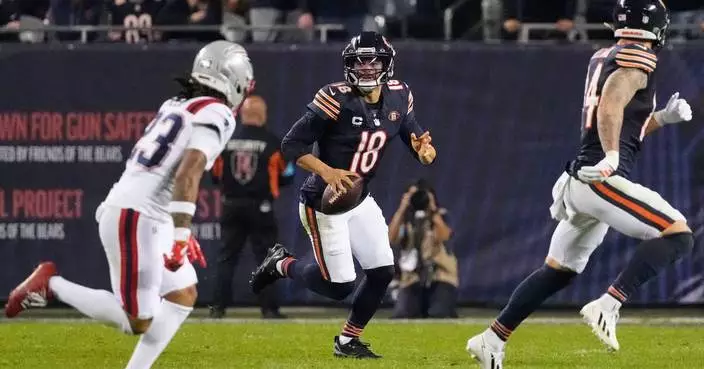
LAS VEGAS (AP) — The tone for the Rams' season was set from the beginning when they went to Australia using a tight travel schedule that was highly criticized and were blown out by San Francisco.
Los Angeles, which entered the season as the heavy favorite to win the Super Bowl, hasn't quite recovered, the losses piling up as well as the number of injured players.
The Rams go into Sunday's game at Las Vegas at 2-4 with the odds considerably stacked against them to even make the playoffs, making this matchup against the Raiders (3-3) close to a must-win.
“We can’t sit there and look at the big picture and go, ‘OK, we have X amount of games left. These guys are doing that,’ or whatever,” Rams quarterback Matthew Stafford said. “That’s not the mindset at all around here.”
Since the playoffs expanded from 12 to 14 teams in the 2020 season, only seven of the 36 clubs that opened 2-4 have made the postseason. Should the Rams win this weekend, the numbers are slightly better at 10 of 41. But only four of the 33 teams that began 2-5 made the playoffs.
Las Vegas — the oddsmakers and the Raiders — still believes in LA.
The Rams are fifth across the sportsbooks at 12-1 to win the Super Bowl.
“I know the Rams are 2-4, but when you watch the tape and see the statistics behind the record, you see a really, really good football team that could easily have one of the best records in the league,” Raiders quarterback Kirk Cousins said. “So we understand the challenge we have, the great players they have and great coaches, and we’ve got to be at our best.”
There's an argument the rebuilding Raiders also have a record that doesn't tell the complete story, even after a three-game losing streak.
They have played only one stinker, a 45-17 loss at New England two weeks ago. Sandwiched around that loss were a pair of three-point defeats to Super Bowl contenders Kansas City and Buffalo.
“It’s such a competitive game and if you’re just hoping to keep it close in the fourth quarter, that’s not a winning mindset,” Las Vegas first-year coach Klint Kubiak said.
Maybe the Raiders will find a way if this game is close in the fourth quarter.
The Rams, who are 4 1/2-point favorites after the betting line opened at 8 1/2, need to find a way to win despite a slew of injuries, including to star defensive end Myles Garrett and wide receiver Davante Adams.
“Our full focus and concentration is on the Raiders,” coach Sean McVay said. “That’s the exact sense that I’ve gotten from the guys.”
Los Angeles Rams (2-4) at Las Vegas (3-3).
When/where to watch: Sunday, 4:25 p.m. EDT, Fox.
Latest odds: Rams by 4 1/2.
Against the spread: Rams 2-4; Raiders 5-1.
Last week: Rams lost to the Cardinals 18-16; Raiders lost to the Bills 33-30.
Last meeting: Rams won 20-15 on Oct. 20, 2024, in Inglewood, California.
Series record: 8-8.
Raiders tight ends vs. Rams pass coverage. Since Brock Bowers returned a knee injury in Week 3, the Raiders have used multiple tight ends on an league-high 83% of plays, according to the NFL's Next Gen Stats. Their 1,345 yards receiving by tight ends when two or more on the field is the league's highest.
— The Rams have been above .500 after six games only once in the five seasons since they won the Super Bowl in February 2022.
— This is the Rams’ first regular-season visit to Allegiant Stadium, the Raiders’ $2 billion arena that opened in 2020.
— NFL MVP Matthew Stafford leads the league with 1,794 yards passing and 164 completions, but has six interceptions. He didn’t throw that many picks last season until Dec. 29.
— The Rams have a four-game winning streak in the series, but they haven’t had a 300-yard passer against the Raiders since Jim Everett in October 1991.
— Raiders kicker Matt Gay won a Super Bowl ring with the Rams, but they allowed him to walk in free agency in early 2023. Los Angeles has had upheaval at the position ever since. Newcomer Brandon McManus will become their sixth kicker in only 58 games since Gay’s departure. Gay has made 8 of 9 field goals for Las Vegas.
— Bowers averages 95.5 yards receiving, which if it holds will break Kellen Winslow's record for a tight end when he averaged 94.7 in 1984.
— Cousins is tied for first with Jacksonville's Trevor Lawrence and San Francisco's Brock Purdy with 14 touchdown passes.
— Las Vegas has scored at least 25 points five times this season to tie Buffalo and Detroit for most in the NFL.
AP Sports Writer Greg Beacham in Los Angeles contributed to this report.
See AP’s full NFL coverage here

Las Vegas Raiders quarterback Kirk Cousins (8) huddles with teammates during an NFL football game against the Buffalo Bills in Las Vegas, Sunday, Oct. 18, 2026. (AP Photo/David Becker)

Los Angeles Rams quarterback Matthew Stafford (9) reacts toward teammates during the second half of an NFL football game against the Arizona Cardinals in Inglewood, Calif., Sunday, Oct. 18, 2026. (AP Photo/Gregory Bull)
MADRID--(BUSINESS WIRE)--Oct 23, 2026--
Genialis, the therapeutic intelligence company, will present data at the European Society for Medical Oncology (ESMO) Congress 2026 showing that its biology-first models predict treatment response even with limited available patient data. Across three distinct cancer types and treatment regimens, the models demonstrated superior predictive performance in cohorts of fewer than 70 patients, addressing one of the fundamental challenges in developing predictive biomarkers for precision oncology.
This press release features multimedia. View the full release here: https://www.businesswire.com/news/home/20261022380424/en/
Clinical trials are small data. Early-stage studies often enroll relatively small patient populations, creating challenges for conventional modeling approaches attempting to extract meaningful predictive signals. Yet drug developers must make critical decisions about pipeline advancement and patient selection criteria, often before independent validation data are available.
A tumor RNA-seq profile measures roughly 20,000 genes; with 50 patients, a conventional deep learning model risks identifying statistical noise rather than meaningful biological signals. Overcoming this “curse of dimensionality” has been central to Genialis’ approach to predictive modeling since its founding.
The Genialis™ Supermodel is a large molecular model of cancer biology trained on hundreds of thousands of transcriptomic samples. The Supermodel transforms tens of thousands of individual gene-expression measurements from RNA sequencing (RNA-seq) into biologically meaningful features called “biomodules,” each representing a fundamental aspect of cancer biology, including oncogenic signaling, immune activation, and DNA damage response. By reducing the complexity of molecular data into interpretable biological features before model training, Genialis can develop predictive biomarkers from relatively small patient populations while providing insight into the biological mechanisms driving treatment sensitivity and resistance.
The ESMO poster (abstract #8664) evaluates this approach across datasets from three different cancer types in a typical size of early clinical studies: pretreatment RNA-seq from anti-PD-1-treated melanoma (n=41), pembrolizumab-treated gastric cancer (n=45) and KRAS G12C-mutant non-small cell lung cancer (NSCLC) treated with sotorasib (n=66). Under strict held-out testing, biomodule models outperformed matched gene-expression models in every cohort. In NSCLC, biomodules predicted sotorasib response with an AUROC of 0.8, against 0.6 for the best gene-expression model, and predicted responders stayed on treatment a median of 337 days versus 178. Each prediction came with a biological rationale, with predicted NSCLC responders showing MAPK-addicted biology, while non-responders exhibited PI3K bypass programs.
From Small Cohorts to an N-of-1 Application: The Sid Sijbrandij Case Study
When GitLab co-founder Sid Sijbrandij was diagnosed with osteosarcoma in November 2022, he faced a rare bone cancer diagnosed in roughly 1,000 people each year in the United States. When his cancer returned and standard treatment options ran out, Sijbrandij built a team to pursue an extraordinary approach to understanding and treating his disease. Combining what they call “maximal diagnostics” with personalized experimental therapies, the team collected and publicly shared more than 30 terabytes of Sid’s clinical and molecular data at osteosarc.com.
Genialis retrospectively analyzed four tumor RNA-seq libraries generated over 25 months by three clinical laboratories from different specimens. The Supermodel enabled consistent biological comparisons across the four samples, even where raw gene-expression data were not comparable. By linking each sample's biology to therapeutic hypotheses, the analysis demonstrated how researchers can revisit those hypotheses as additional samples become available. Genialis expects this approach to become increasingly valuable as precision oncology advances toward smaller, more precisely defined patient populations and, ultimately, treatment strategies tailored to individual patients.
“For patients facing rare cancers and researchers working with limited patient data, the ability to compare tumor biology across samples collected over time opens new opportunities to investigate disease and develop therapeutic hypotheses,” said Rafael Rosengarten, PhD, Chief Executive Officer and Co-Founder of Genialis. “Together, the ESMO findings and Sid’s case study demonstrate the potential of biology-first AI to extract meaningful insights from limited patient data, whether across a clinical cohort or within a single patient's cancer journey.”
Poster details
Title: Biology-first modeling enables interpretable patient-selection strategies from small oncology cohorts
Abstract: #8664
Date and time: Poster Display session, Sunday, October 25 | 12:00–12:45 CET | ESMO Congress 2026, Madrid, October 23–27, 2026
Poster Category: AI for clinical research and drug development
Presentation no.: 152P
Single-patient analysis:https://www.genialis.com/2026/10/19/a-biology-first-approach-to-precision-medicine-tracking-sids-tumor-biology-with-the-genialis-supermodel/
About Genialis
Genialis provides therapeutic intelligence with its Supermodel of cancer biology. We develop and validate clinically actionable AI models informed by the world’s most ethnographically diverse cancer data sets to predict patient responses and guide treatment decisions for targeted inhibitors, immunotherapies, and other emerging therapeutic classes. Genialis is trusted by pharma and diagnostics partners, and together, we are transforming medicine through data. The company is headquartered in Houston, Boston and Ljubljana.
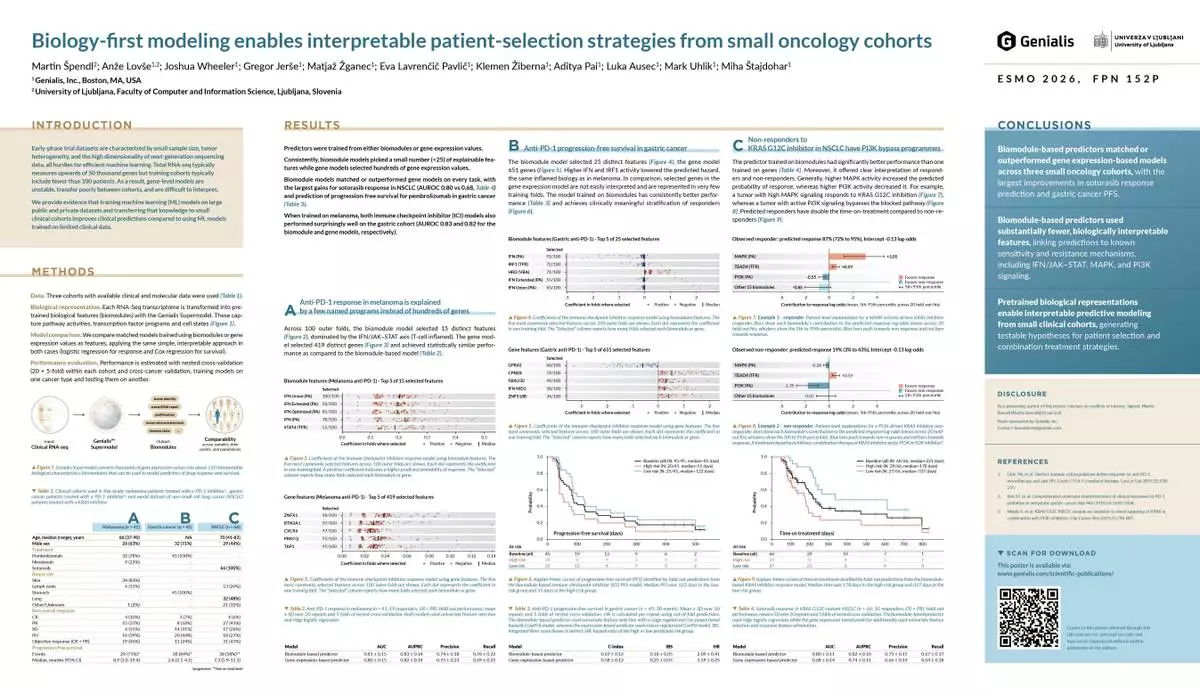
ESMO 2026 Poster