MADRID, Spain & ESPOO, Finland--(BUSINESS WIRE)--Oct 23, 2026--
Telefónica and IQM Quantum Computers, a global leader in superconducting quantum computing, have joined forces to deploy the first quantum computer in the Community of Madrid. The initiative will strengthen the region’s scientific and technological capabilities, while driving the development of real-world cases for companies across the Community of Madrid.
This press release features multimedia. View the full release here: https://www.businesswire.com/news/home/20261022980581/en/
The IQM Spark quantum computer, an all-in-one solution specifically designed for research, education and early-stage development, will be installed at the Universidad Politécnica de Madrid before the end of 2026. It will enable universities, hospitals, research centers and start-ups, direct access to real quantum hardware to develop and test quantum algorithms and build the expertise needed to explore future use cases.
This will be the first quantum computer of its kind in the Community of Madrid, significantly increasing the region’s capacity to develop quantum capabilities locally and through hands-on experience. The computer will join the other two quantum computers provided by Telefónica and IQM to CESGA (Galician Supercomputing Centre).
Once the new quantum computer is operational, the Community of Madrid will have greater capabilities to foster the creation of its own quantum ecosystem, bringing together all stakeholders involved in developing real-world use cases that deliver direct benefits to local industry. This ecosystem will help attract talent and strengthen Madrid’s position as a leading hub for advanced digital innovation, while also contributing to the development of European technological sovereignty.
Borja Ochoa, non-executive Chairman of Telefónica España and CEO of B2B, said: “This project marks another step forward in Telefónica’s close collaboration with the Community of Madrid in the deployment of quantum technologies, both in networks and in the encryption and protection of critical data in particularly sensitive sectors such as healthcare and security, and now also through the research opportunities offered by quantum computing. In line with its goal of becoming the best gateway to digital technologies for citizens, businesses and public administrations, Telefónica is the first operator in Spain to offer communications between data centers protected by the new post-quantum cryptography standards. Our company is also helping to build a national ecosystem by developing technologies and communications, specialized centers and strategic projects ranging from the development of cancer treatments to reducing the use of cardboard by packaging companies.”
Jan Goetz, CEO and Co-founder of IQM Quantum Computers, said: "By investing in its own quantum computer, the Community of Madrid is creating an infrastructure that will enable its researchers, students and industries to grow their capabilities over the long term. Quantum computing becomes truly valuable when it moves beyond remote laboratory environments and is placed directly in the hands of those working closest to the real-world challenges it can help address. This deal represents an important step forward for Madrid and for Europe in its ambition to lead the development of quantum computing."
This project further expands IQM’s growing international footprint, with full-stack quantum computers already deployed across Europe, Asia and North America, including computers supplied to some of the world´s leading supercomputing centers. IQM is also driving the adoption of quantum computing in areas such as research, materials science, financial modeling and other fields, by giving end users direct ownership of the infrastructure needed to turn experimentation into real-world, high-impact applications.
About IQM Quantum Computers
IQM Quantum Computers (Nasdaq: IQMX) is a global leader in superconducting quantum computers, delivering full-stack quantum computers and cloud platform access to enterprises, research institutions, universities, high-performance computing centers, and national laboratories worldwide. IQM’s on-premises deployment model gives customers direct ownership and control of their quantum infrastructure. Founded in 2018 and headquartered in Finland, with major operations in Munich, IQM employs over 450 people and operates across Europe, Asia, and North America. IQM is the first publicly listed European quantum company on Nasdaq Stock Market.
About Telefónica
Telefónica is one of the world’s leading telecommunications service providers. The company is committed to becoming the leading gateway to digital technologies for citizens, businesses and public administrations, contributing to economic and social progress in the markets where it operates.
Telefónica provides fixed and mobile connectivity services, together with a broad portfolio of digital solutions for residential and business customers. With more than 299.8 million accesses, the company focuses its operations on its four core markets: Spain, Brazil, Germany and the United Kingdom.
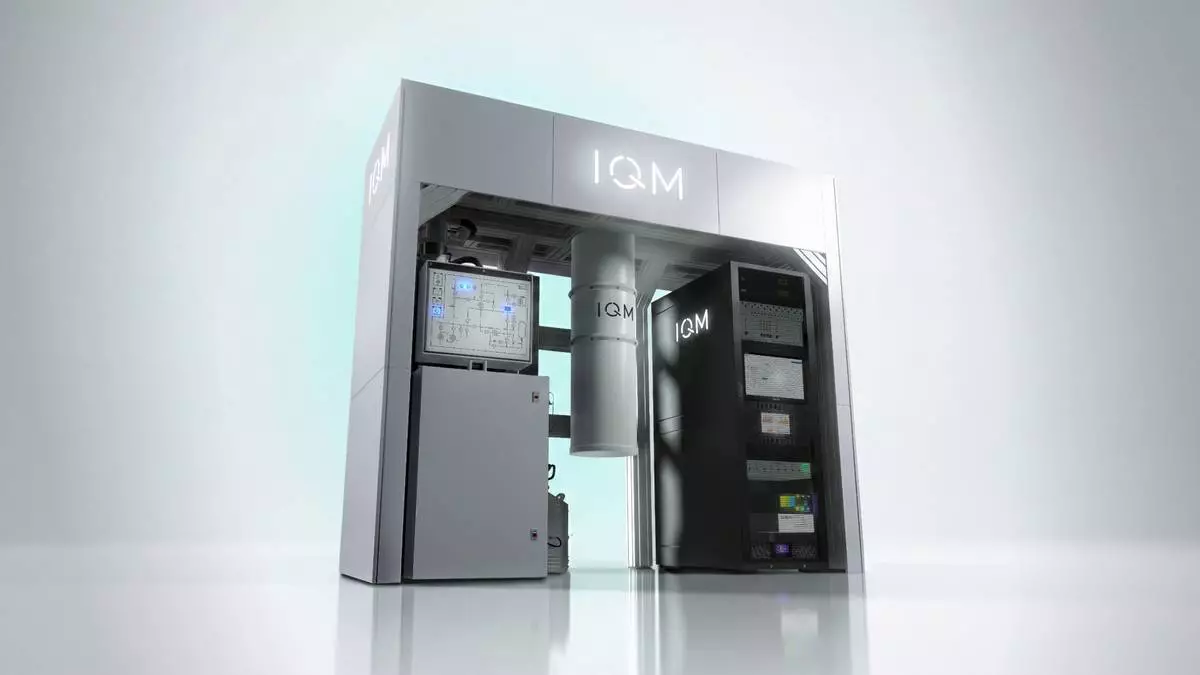
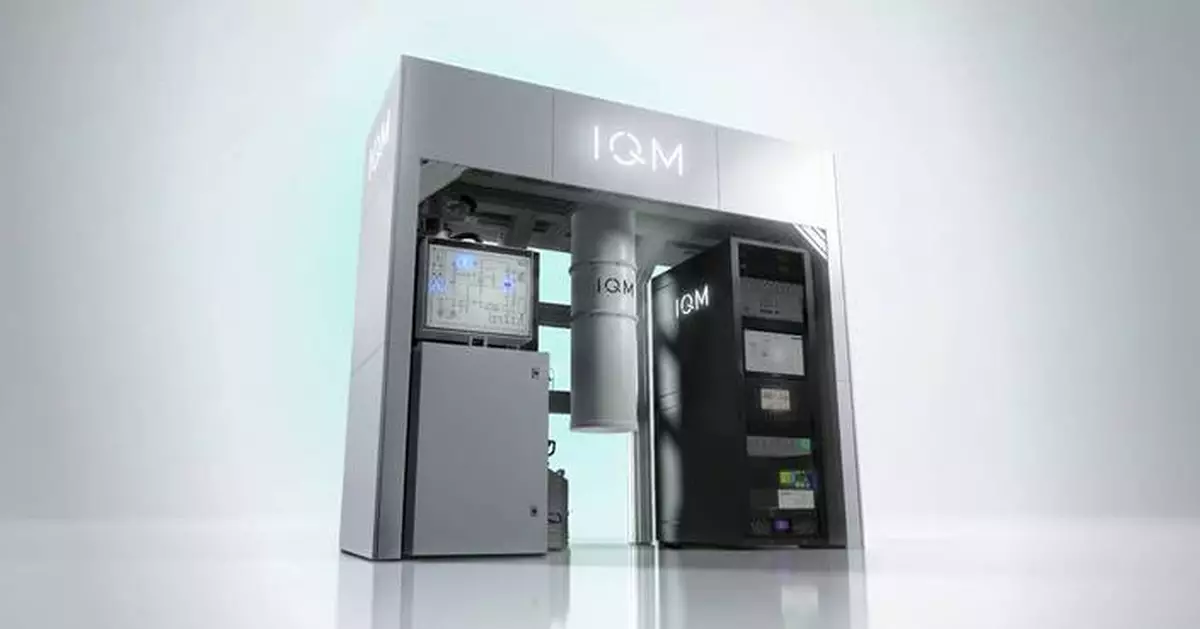
IQM and Telefónica are bringing an IQM Spark quantum computer to Universidad Politécnica de Madrid, giving researchers, students and industry across the Community of Madrid hands-on access to real quantum hardware.
MADRID--(BUSINESS WIRE)--Oct 23, 2026--
Genialis, the therapeutic intelligence company, will present data at the European Society for Medical Oncology (ESMO) Congress 2026 showing that its biology-first models predict treatment response even with limited available patient data. Across three distinct cancer types and treatment regimens, the models demonstrated superior predictive performance in cohorts of fewer than 70 patients, addressing one of the fundamental challenges in developing predictive biomarkers for precision oncology.
This press release features multimedia. View the full release here: https://www.businesswire.com/news/home/20261022380424/en/
Clinical trials are small data. Early-stage studies often enroll relatively small patient populations, creating challenges for conventional modeling approaches attempting to extract meaningful predictive signals. Yet drug developers must make critical decisions about pipeline advancement and patient selection criteria, often before independent validation data are available.
A tumor RNA-seq profile measures roughly 20,000 genes; with 50 patients, a conventional deep learning model risks identifying statistical noise rather than meaningful biological signals. Overcoming this “curse of dimensionality” has been central to Genialis’ approach to predictive modeling since its founding.
The Genialis™ Supermodel is a large molecular model of cancer biology trained on hundreds of thousands of transcriptomic samples. The Supermodel transforms tens of thousands of individual gene-expression measurements from RNA sequencing (RNA-seq) into biologically meaningful features called “biomodules,” each representing a fundamental aspect of cancer biology, including oncogenic signaling, immune activation, and DNA damage response. By reducing the complexity of molecular data into interpretable biological features before model training, Genialis can develop predictive biomarkers from relatively small patient populations while providing insight into the biological mechanisms driving treatment sensitivity and resistance.
The ESMO poster (abstract #8664) evaluates this approach across datasets from three different cancer types in a typical size of early clinical studies: pretreatment RNA-seq from anti-PD-1-treated melanoma (n=41), pembrolizumab-treated gastric cancer (n=45) and KRAS G12C-mutant non-small cell lung cancer (NSCLC) treated with sotorasib (n=66). Under strict held-out testing, biomodule models outperformed matched gene-expression models in every cohort. In NSCLC, biomodules predicted sotorasib response with an AUROC of 0.8, against 0.6 for the best gene-expression model, and predicted responders stayed on treatment a median of 337 days versus 178. Each prediction came with a biological rationale, with predicted NSCLC responders showing MAPK-addicted biology, while non-responders exhibited PI3K bypass programs.
From Small Cohorts to an N-of-1 Application: The Sid Sijbrandij Case Study
When GitLab co-founder Sid Sijbrandij was diagnosed with osteosarcoma in November 2022, he faced a rare bone cancer diagnosed in roughly 1,000 people each year in the United States. When his cancer returned and standard treatment options ran out, Sijbrandij built a team to pursue an extraordinary approach to understanding and treating his disease. Combining what they call “maximal diagnostics” with personalized experimental therapies, the team collected and publicly shared more than 30 terabytes of Sid’s clinical and molecular data at osteosarc.com.
Genialis retrospectively analyzed four tumor RNA-seq libraries generated over 25 months by three clinical laboratories from different specimens. The Supermodel enabled consistent biological comparisons across the four samples, even where raw gene-expression data were not comparable. By linking each sample's biology to therapeutic hypotheses, the analysis demonstrated how researchers can revisit those hypotheses as additional samples become available. Genialis expects this approach to become increasingly valuable as precision oncology advances toward smaller, more precisely defined patient populations and, ultimately, treatment strategies tailored to individual patients.
“For patients facing rare cancers and researchers working with limited patient data, the ability to compare tumor biology across samples collected over time opens new opportunities to investigate disease and develop therapeutic hypotheses,” said Rafael Rosengarten, PhD, Chief Executive Officer and Co-Founder of Genialis. “Together, the ESMO findings and Sid’s case study demonstrate the potential of biology-first AI to extract meaningful insights from limited patient data, whether across a clinical cohort or within a single patient's cancer journey.”
Poster details
Title: Biology-first modeling enables interpretable patient-selection strategies from small oncology cohorts
Abstract: #8664
Date and time: Poster Display session, Sunday, October 25 | 12:00–12:45 CET | ESMO Congress 2026, Madrid, October 23–27, 2026
Poster Category: AI for clinical research and drug development
Presentation no.: 152P
Single-patient analysis:https://www.genialis.com/2026/10/19/a-biology-first-approach-to-precision-medicine-tracking-sids-tumor-biology-with-the-genialis-supermodel/
About Genialis
Genialis provides therapeutic intelligence with its Supermodel of cancer biology. We develop and validate clinically actionable AI models informed by the world’s most ethnographically diverse cancer data sets to predict patient responses and guide treatment decisions for targeted inhibitors, immunotherapies, and other emerging therapeutic classes. Genialis is trusted by pharma and diagnostics partners, and together, we are transforming medicine through data. The company is headquartered in Houston, Boston and Ljubljana.
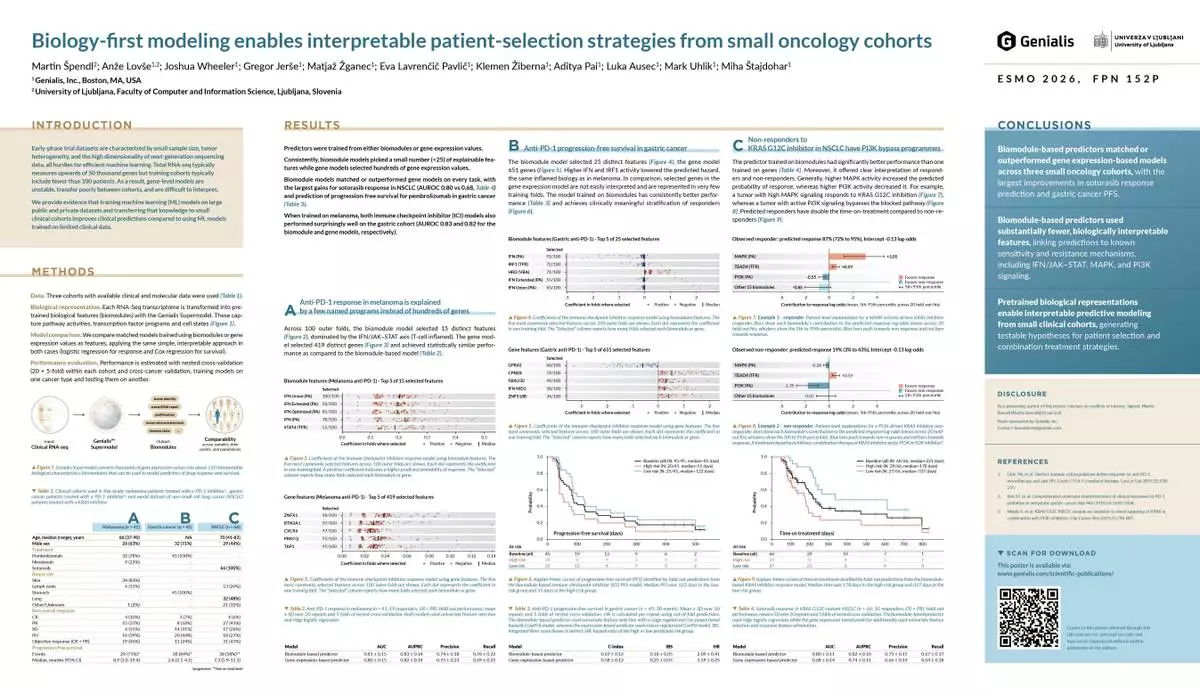
ESMO 2026 Poster