Chinese storage chip suppliers are expanding beyond smartphones and PCs into automotive and wearable applications, seeking growth with products tailored to emerging needs as advances in automotive technology also create opportunities in robotics, executives said at an industry conference in Beijing.
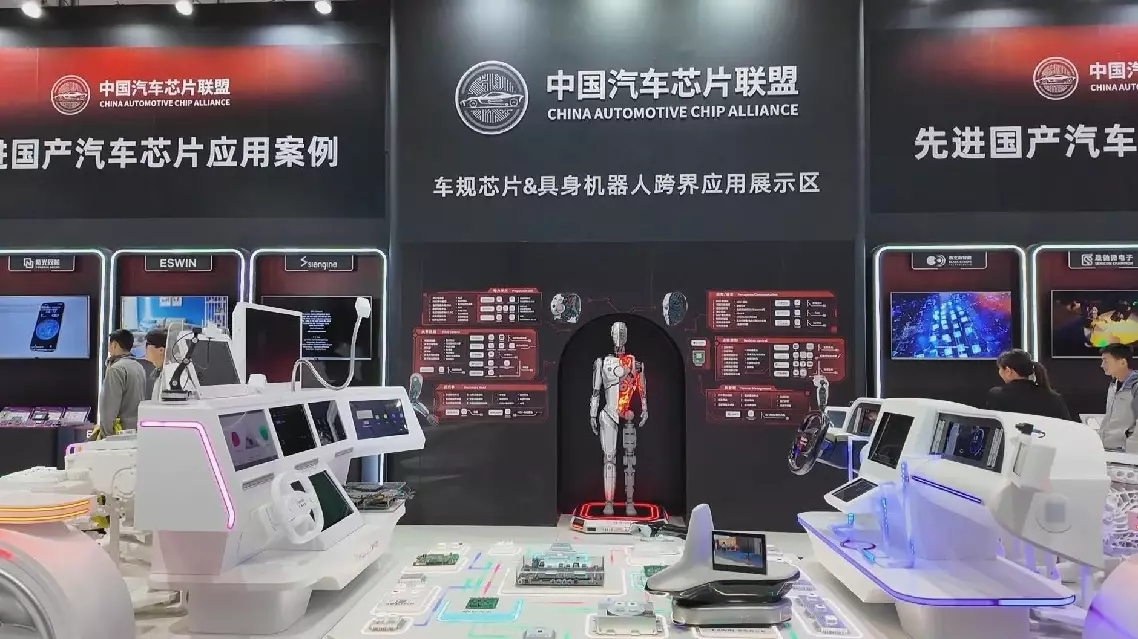
At the recently concluded World Intelligent Connected Vehicles Conference, a full-size model car demonstrated potential applications for nearly 100 domestically developed chip products.
The model was part of the "China Chips" pavilion organized by the China Automotive Chip Alliance, which brought together about 200 chip design companies and showcased more than 1,000 products.
The automotive market offers storage suppliers new opportunities but also imposes stricter reliability requirements than the consumer electronics market.
BIWIN Storage Technology, founded in 2010, began expanding beyond smartphones and PCs into industrial and automotive storage applications around 2020, according to a company product manager.
"With AI buildout accelerating over the past two years, the storage market has heated up. We have built on our consumer business and begun mass production for higher-end markets such as industrial and automotive storage. At a time of tight supply, we can offer customers across these markets solutions and reliable delivery," the product manager said.
Longsys Electronics, founded in 1999, began developing automotive-grade storage in 2017 as competition intensified in its commercial-grade business. The company is now involved earlier in new vehicle development, working with automakers to tailor storage to specific uses, marketing director Wang Zuopeng said.
"We've moved beyond simply offering substitutes for existing products. Our work with automakers has entered a new phase: we get involved while a new car or feature is still being developed. Because we control our own controller chips, firmware, research and production, we can work with automakers to meet their specific requirements," Wang said.
Continuous recording is one reason automakers need storage tailored to specific uses. An electric car may capture video around the clock, even if little of it is ever used. Frequent writing shortens a chip's life, while adding capacity raises costs. Extra writing within the chip, known as write amplification, adds to the wear.
"Once we partition the storage, we can keep system files and video files in separate areas. To extend the chip's life, we try to minimize write amplification. That lets a chip with the same capacity withstand more writing over its lifetime, helping balance customer requirements with production costs," said Wang.
The need to tailor storage to its end use extends beyond cars. BIWIN said it develops compact components for wearables, where size and weight are critical.
"With our own factory, we've made many customized, compact products for overseas customers, especially in the growing wearables market. These include products for AR glasses, smartwatches and fitness bands. Storage for these devices needs to be lightweight, customized and very small," the BIWIN product manager said.
Automotive technology could also find uses in robotics. Wang said some automakers were drawing on their autonomous-driving work as they developed robots.
"Why do you see so many automakers setting up teams to develop robot applications? One reason is that they can reuse chips and systems developed for autonomous driving. You start with the application that can move forward fastest. Once that works, you can adapt it for more specialized uses with some modifications," Wang said.
Robotics remains at an early stage, with low production volumes and standards still taking shape, Wang said, noting that in the meantime, chip suppliers can build on existing automotive-grade products, adapting them to different robots' requirements for speed, endurance or storage capacity.
Chinese storage chip firms eye growth in cars, wearables and robotics