As autumn fades in east China's Jiangxi Province, Poyang Lake's wetlands are attracting large numbers of wintering migratory birds seeking food and shelter for the colder months.
In the Nanjishan Wetland area of Poyang Lake, water levels are receding, revealing mudflats and grassy islets that provide ideal feeding grounds and safe resting spots for migratory birds. Species such as Oriental storks, Siberian cranes, tundra swans, and other waterbirds have started to gather in the area, foraging and preparing to settle for the winter.
Recent monitoring efforts have recorded 34 species of wintering waterbirds in the wetland. To ensure the birds' safety, local authorities are increasing patrols and monitoring activities while reducing human disturbance, helping to create a peaceful habitat for these seasonal visitors.

Wintering migratory birds arrive at Poyang Lake in Jiangxi
A quake-damaged primary school in Maru Township, southwest China's Xizang Autonomous Region, has set up more than 30 tents on the playground to serve as temporary shelters for the teaching staff and their families.
The 7.0-magnitude quake struck Baqen County of Nagqu City at 22:33 Beijing time (1433 GMT) on Thursday.
Maru Township was among the areas hit hardest by the quake. The township's only primary school, Maru Township Primary School, was damaged heavily.
Two teaching buildings showed varying degrees of destruction, including visible wall cracks, shattered windows, and some structural collapses. The dormitories for the teaching staff and the students were also affected. Fortunately, all the students and teachers were safely evacuated.
Many of the students were sleeping in their dormitories when the quake occurred. Following the earthquake, the teachers immediately evacuated the students to safety.
"We went to the dormitories right away. Some students were still sleeping, so we woke them up and got them out," a teacher said.
While some teachers were injured in the quake, no students were hurt.
The school's sports field has now been converted into a centralized shelter, where over 30 thick, cotton tents have been set up for the teaching staff, their families, and logistics workers.
Supplies inside the tents are plentiful, including thick quilts, food, snacks, and local specialty tea. Power was restored the day after the earthquake, and logistics staff are ensuring three meals a day for everyone.
One child living in the shelter said six people share a tent, and the quilts distributed to them are quite thick.
"It feels like home because my family is here, and I have my meals here in the morning, at noon, and in the evening," the child said.
Since the winter vacation has not yet begun, the school is actively working out a plan to address the students' schooling, including online teaching or transferring students to nearby safe schools.
To cope with the winter cold, the school has applied to local authorities for prefabricated housing units, which are expected to arrive in the next two days. These units will replace the tents and serve as temporary classrooms.
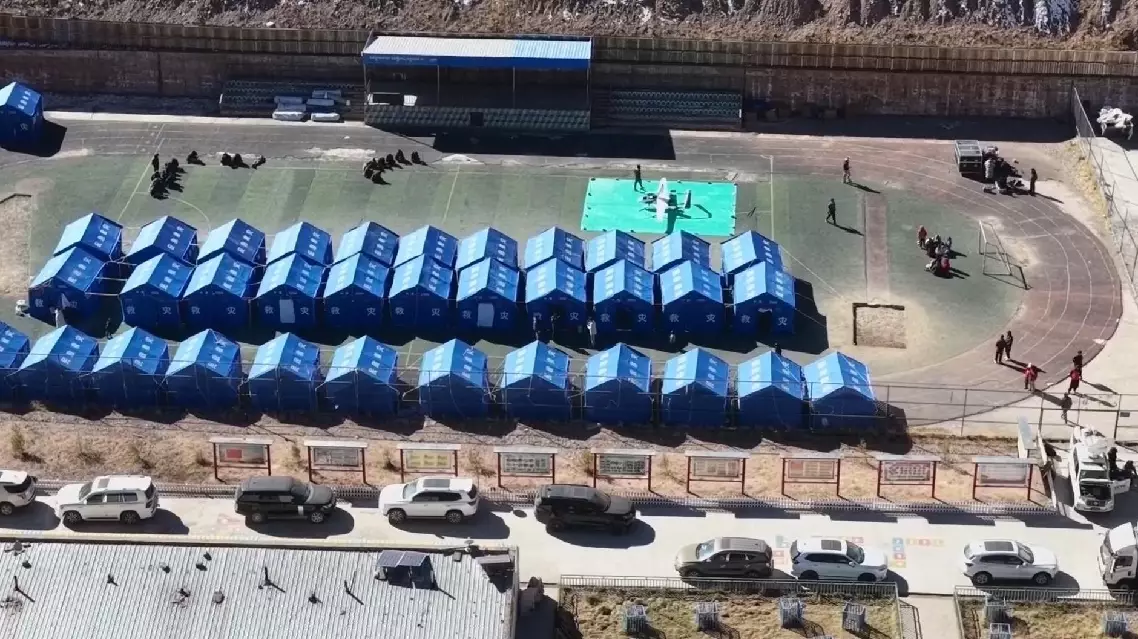
Quake-damaged school in Xizang sets up tents on playground to shelter teaching staff, their families