In the Ili Kazakh Autonomous Prefecture, northwest China's Xinjiang Uygur Autonomous Region, more than 200,000 hectares of corn achieved an average yield of 18.1671 tons per hectare in the concluding autumn harvest season, setting a world record among corn producers at a similar scale.
In particular, the yield in Ili's demonstration zone, which covers about 670 hectares, reached 24.141 tons per hectare.
Xue Quansheng, a farmer in the demonstration zone, attributed the sharp yield growth to the application of fertigation, an agricultural technique of injecting water-soluble fertilizers directly into a drip irrigation system.
"I grew about 2,670 hectares of corns this year. The yield was 1.5 tons higher per hectare than last year, raising my income by 3,000 yuan (about 450 U.S. dollars) per hectare. The main reason for the increase was fertigation," Xue said.
According to experts, compared with flood irrigation and manual plant fertilization, fertigation allows farmers to control much more precisely the amount of nutrients, increasing yields while saving water and fertilizer.
"With the fertigation system, our nitrogen fertilizer use efficiency has been lifted from 30 percent to 50 percent, and the water use efficiency has also risen from 30 percent to 40 percent," said Yang Hu, deputy director of Ili's Bureau of Agriculture and Rural Affairs.
In addition, the fertigation system also features intelligent devices, enabling farmers to monitor the fields in real time and carry out operations on their cellphones.
"A single person can easily manage hundreds of hectares of fields using a cellphone. We can get the work done without going to the fields, and the costs for water, fertilizer and labor are about 750 yuan lower per hectare than three or four years ago," Xue said.
China has been extensively promoting fertigation -- officially referred to as integrated water and fertilizer technologies -- in recent years to modernize agriculture, conserve water, and improve fertilizer efficiency.
By the end of 2025, the application area of integrated water and fertilizer technologies for grain and oil crops exceeded 5.86 million hectares. Over the past decade, China's annual agricultural water use decreased by 5.7 percent, according to the China Agricultural Green Development Report 2025.
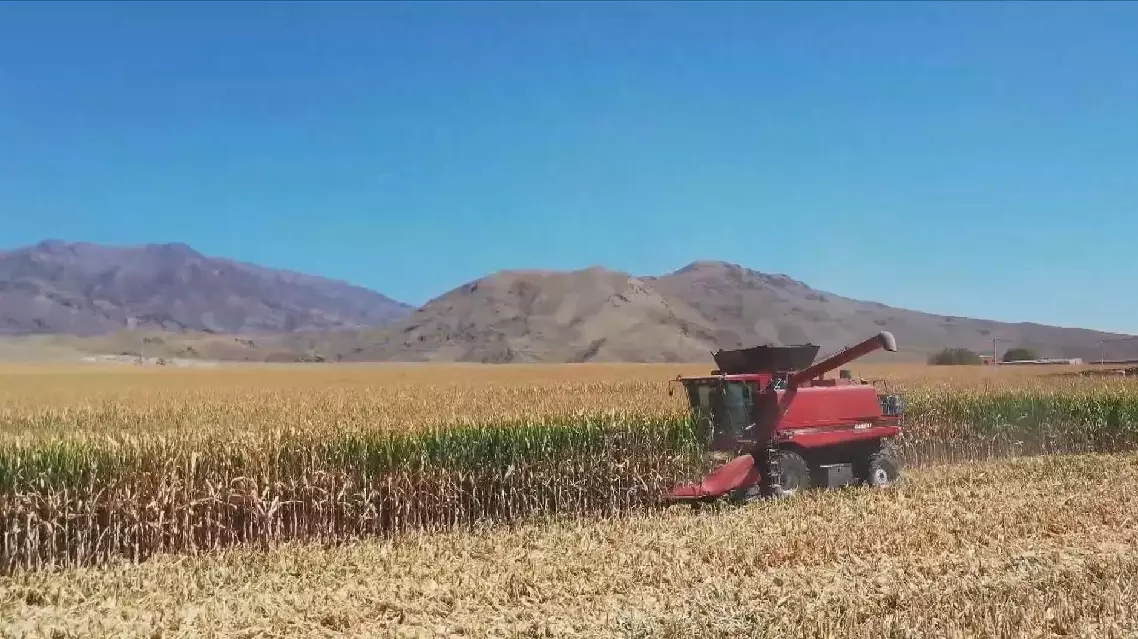
Fertigation raises corn yield in Xinjiang's Ili to world's record level