MELBOURNE, Australia (AP) — A prisoner on Monday lost his challenge to an Australian state’s ban on inmates eating Vegemite after he argued in court that withholding the polarizing yeast-based spread breached his human right to “enjoy his culture as an Australian.”
Andre McKechnie, 55, who is serving a life sentence for murder, took his battle for the salty, sticky, black-brown byproduct of brewing beer to the Supreme Court of the state of Victoria last year.
He had argued being refused Vegemite denied him his right under the Charter of Human Rights and Responsibilities Act to “enjoy his culture as an Australian in the community with other persons of Australian background,” court documents showed.
Justice Claire Harris accepted prison authorities’ refusal to allow McKechnie Vegemite “limited his cultural rights” under the charter.
But she found the ban was justified in meeting authorities’ goals of removing illicit drugs and alcohol from the prison system.
“The limitation on Mr. McKechnie’s ability to enjoy Vegemite in community with other persons of Australian background is primarily that he is a prisoner,” Harris wrote in her 47-page judgment.
Prison officials testified at a trial in July that Vegemite had been banned throughout the state’s 12 prisons for the past 20 years because it could potentially impair sniffer dogs’ ability to detect narcotics and could be used to brew alcohol because of its yeast content.
McKechnie, who represented himself in court by video link from maximum security Barwon Prison west of Melbourne, argued that the fact that neighboring New South Wales state did not ban Vegemite from its prisons was evidence that there were “less restrictive means reasonably available” to achieve such drug and alcohol outcomes.
Most Australians revere Vegemite as an unfairly maligned culinary icon, and more than 80% of Australian households are estimated to have a jar in their pantries. Vegemite is typically considered an acquired taste at best by those who weren't raised on it.
The last U.S. president to visit Australia, Barack Obama, once said: “It’s horrible.”
McKechnie had initially testified that the lack of Vegemite had contributed to his thiamine deficiency.
He said both Vegemite and pork were sources of thiamine, also known as vitamin B1. As a Jew who observed kosher law, he told the court he couldn’t eat pork either and took daily doses of the vitamin.
Vegemite has long been marketed as a source of B vitamins thiamine (B1), riboflavin (B2), niacin (B3) and folate (B9) which are promoted as healthy additions to the diets of growing children.
But McKechnie dropped the thiamine issue as “not important,” after lawyers for the prison authorities objected to his evidence.
McKechnie said not eating Vegemite made him feel “deprived of being able to practice my Australian culture, sad and disconnected from my family and community.”
The judge responded that “it is difficult to accept that the inability to consume Vegemite, rather than the fact of his imprisonment, is a material cause of his sadness and disconnection from his family and community.”
McKechnie cited an article published in the food studies journal “Gastronomica” in 2003 that said, “Vegemite may be the best predictor of national identity of any food in the world.”
The article, based on research by Australia’s Queensland University in 1995, found that a “taste for the spread strongly correlates with early exposure and to Australian birth and ancestry.”
McKechnie also referred to the Australian Olympic Committee overturning an Chinese import ban on Vegemite ahead of the 2008 Summer Olympics in Beijing.
He cited Australian band Men at Work's 1980s international hit “Down Under” that mentions a “Vegemite sandwich.”
On the effectiveness of smearing contraband with Vegemite, McKechnie cited a Melbourne newspaper article from 2017 that reported a man’s unsuccessful attempt to use the odor of the spread to conceal illicit drugs that he attempted to smuggle into a music festival in Victoria. The attempt was thwarted by police sniffer dogs.
The judge upheld prison authorities’ argument that McKechnie had failed to provide any proper foundations for his opinion that Vegemite does not interfere with drug sniffer dogs.
McKechnie also argued that Vegemite contained “no live yeast” and that any piece of fruit would be more useful in making alcohol than the spread.
A state prison department manager, Kevin White, cited publicly available research that said Vegemite helped home-brewed beer ferment more quickly.
Vegemite's owner, Bega Group, did not respond to a request for comment on Monday.

FILE - A piece of toast is prepared with Vegemite in Sydney, Australia, Monday, Nov. 17, 2025. (AP Photo/Rick Rycroft, file)
NEW YORK (AP) — Democrats and outside watchdogs are planning a massive presence at the polls on Election Day driven by concerns that President Donald Trump will further leverage the vast resources of the federal government to interfere with a midterm that could hobble his final two years in office.
They won't be the only ones there. A sprawling election protection effort on the left that is expected to deploy tens of thousands of monitors will be met by the largest-ever monitoring program by the Justice Department and still more observers from Republican-aligned groups. The result could be unlike anything seen at the polls in modern times.
The effort among Democratic and nonprofit groups includes training volunteers to stand watch outside polling places and report activities they consider concerning. The network includes traditional government watchdogs such as Common Cause and the American Civil Liberties Union plus a flood of volunteers assembled by state Democratic parties, congressional leaders, national activist groups and organizations focused on protecting democracy.
The Democratic National Committee created a first-of-its-kind cybersecurity unit staffed by former CIA and FBI officials to monitor and report online misinformation, including artificial intelligence deepfakes, said Jane Kleeb, vice chair of the DNC.
That's as Democratic mayors, attorneys general and secretaries of state host tabletop exercises simulating worst-case scenarios, such as a surge of Immigration and Customs Enforcement officials at voting locations or the seizure of ballots and voting equipment.
On Capitol Hill, Democratic leaders have assembled a legal team that rivals that of any presidential campaign.
“We’ve never done this before,” Kleeb said of the party’s sweeping efforts. But “we’ve never had to deal with the president of the United States saying that he may seize ballots, put ICE agents outside polling locations and other kinds of very clear direct threats to the voting process.”
The Department of Justice has already filed lawsuits in California and Alaska that could affect ballot counting or certification.
While Trump continues to make baseless allegations of cheating in the election, administration and military officials have said they have no plans to deploy immigration agents or troops to polling sites.
White House spokeswoman Lauren Bis blamed “radical Democrats” for creating fears about election security by refusing to enact voter ID requirements and other Republican-backed measures.
“President Trump has done more than any other president to ensure we have free and fair elections,” Bis said.
State Democratic parties have trained an estimated 10,000 volunteers to observe polling places and report anything potentially concerning they might see from federal agents. Common Cause has trained roughly 16,000 more volunteers to stand watch at voting precincts, said Suzanne Almeida, vice president of states for the group.
She said a broader Election Protection coalition involving 300 other groups has trained tens of thousands more.
Smaller pockets of volunteers from other groups also are preparing to show up, including roughly 100 organized by Senate Democrats and hundreds more from a Democratic-allied group called Save America, which is training clergy members, veterans, teachers and other local community members. National groups such as Indivisible and MoveOn are activating their own expansive networks.
There are so many organizations working to protect the voting process — including many that cannot legally coordinate with each other — that some officials involved worry about unintentionally creating chaos outside polling locations.
Almeida said Election Day confusion is possible in some precincts but the nature of the threat requires a collective effort.
“It will actually take all of us if some of the threats we are most worried about come to pass,” she said.
Harmeet Dhillon, a Trump appointee who leads the Justice Department's Civil Rights Division, was asked on CBS’ “60 Minutes” whether the Republican administration is planning to send ICE agents to polling places.
“There is no plan to do that,” she responded.
Still, the Justice Department is planning its largest-ever election monitoring effort, with about 1,000 department staff expected to observe voting and ensure federal laws are being followed, spokesperson Kiersten Pels said. That comes after a primary season in which the department said it deployed more than 100 election monitors across hundreds of polling locations.
At least one of those placements sparked tensions with local officials. Wyoming Gov. Mark Gordon, a Republican, said the behavior of two monitors during that state's primary was “a bit aggressive” and “irregular.” A Laramie County clerk said the Justice Department monitors arrived at the polls intending to interview voters, but her office didn’t allow it.
The department disagrees that the monitors did anything improper, Pels said. She added that the monitors are trained to comply with federal law governing conduct at polling places and won’t “interfere with the voting process.”
Democratic lawmakers and voting rights advocates have raised concerns that the Trump administration’s monitors could intimidate voters or abandon the duty they’ve had for decades to protect against civil rights violations.
The department plans to send them to every state, focusing on high-population areas, jurisdictions that have had problems in the past and districts with close elections, according to a senior department official who briefed reporters on the condition of anonymity.
The Republican National Committee said its operation involves deploying “election integrity deputy state directors” in 22 states, among them Arizona, Michigan, Georgia and North Carolina.
Those workers are the “eyes and the ears of the RNC in the field” who recruit volunteers and organize trainings, said Ally Triolo, the RNC’s election integrity communications director. Their mission is to surface anything that seems unlawful.
At the same time, the RNC has enlisted nearly 22,000 poll workers and is recruiting poll-watching volunteers for competitive districts. The poll watchers will “observe the process and help ensure election rules are followed in accordance with the law,” Triolo said.
While federal monitors have quietly observed elections for decades, largely without incident, some election officials are taking precautions.
Chris Swope, the city clerk in Lansing, Michigan, said he preemptively contacted law enforcement and his attorney in case federal monitors violate election law, although he expects them to abide by the rules.
The Democratic Mayors Association issued guidance to local Democratic officials with detailed instructions about what to do if federal agents appear at polling locations.
It notes that federal law prohibits the presence of federal immigration agents, the FBI or other investigative personnel. It also issued a reminder that federal agents are not allowed to be armed at the polls, nor are they allowed to interact with voters or handle ballots or election equipment.
Justice Department officials have said their monitors won't be armed and will not interfere with voting. Asked about department monitors being sent to Georgia, Trump told a reporter recently: “They’re not going to do anything other than watch."
Some of the poll observations have already begun. Mary Corcoran, Save America's executive director, said her group's volunteers have been monitoring precincts during early voting in Georgia, Michigan, North Carolina and Ohio to help give voters a sense of security.
“The fear is the point, and we must do something about it,” she said. “Left unanswered, fear does the work of keeping people home without a single agent setting foot at a polling place.”

FILE - The U.S. Department of Justice logo is seen on a podium before a press conference, May 6, 2025, at the Justice Department in Washington. (AP Photo/Julia Demaree Nikhinson, File)
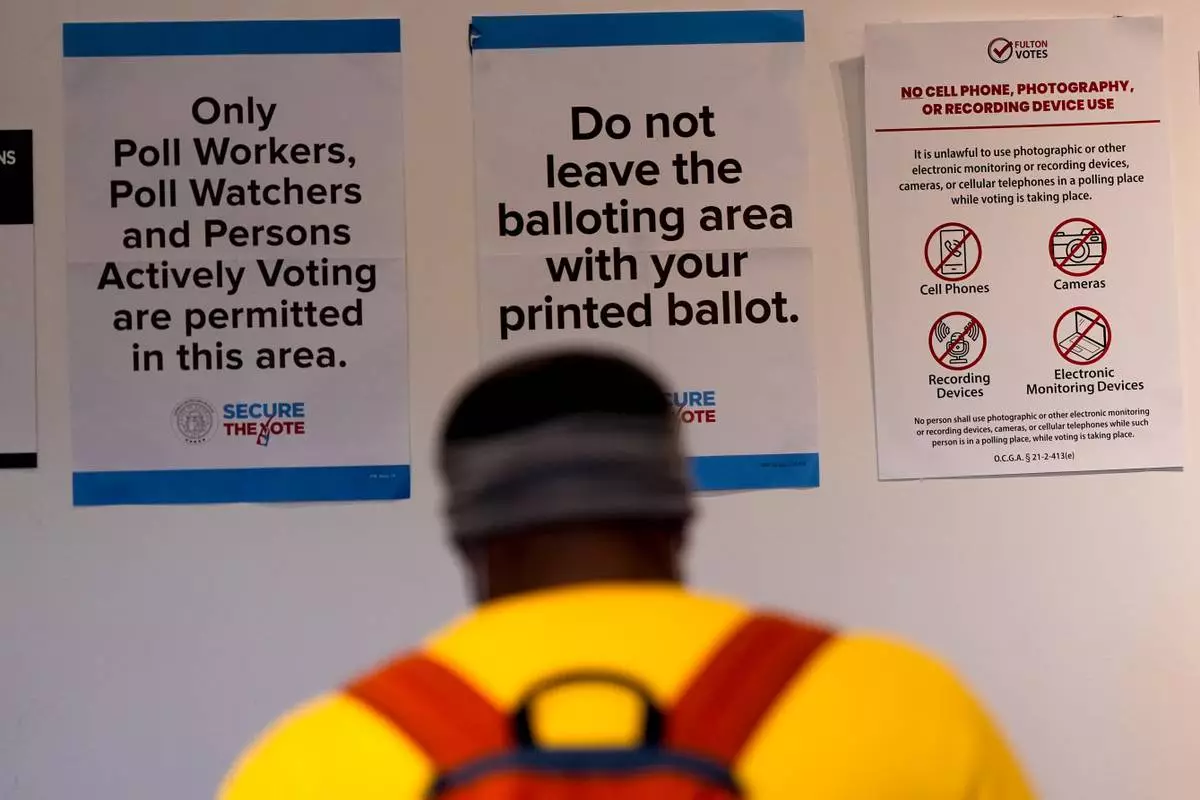
A man walks inside the The High Museum of Art voting center on the first day for early voting in Georgia, Tuesday, Oct. 13, 2026, in Atlanta. (AP Photo/Mike Stewart)
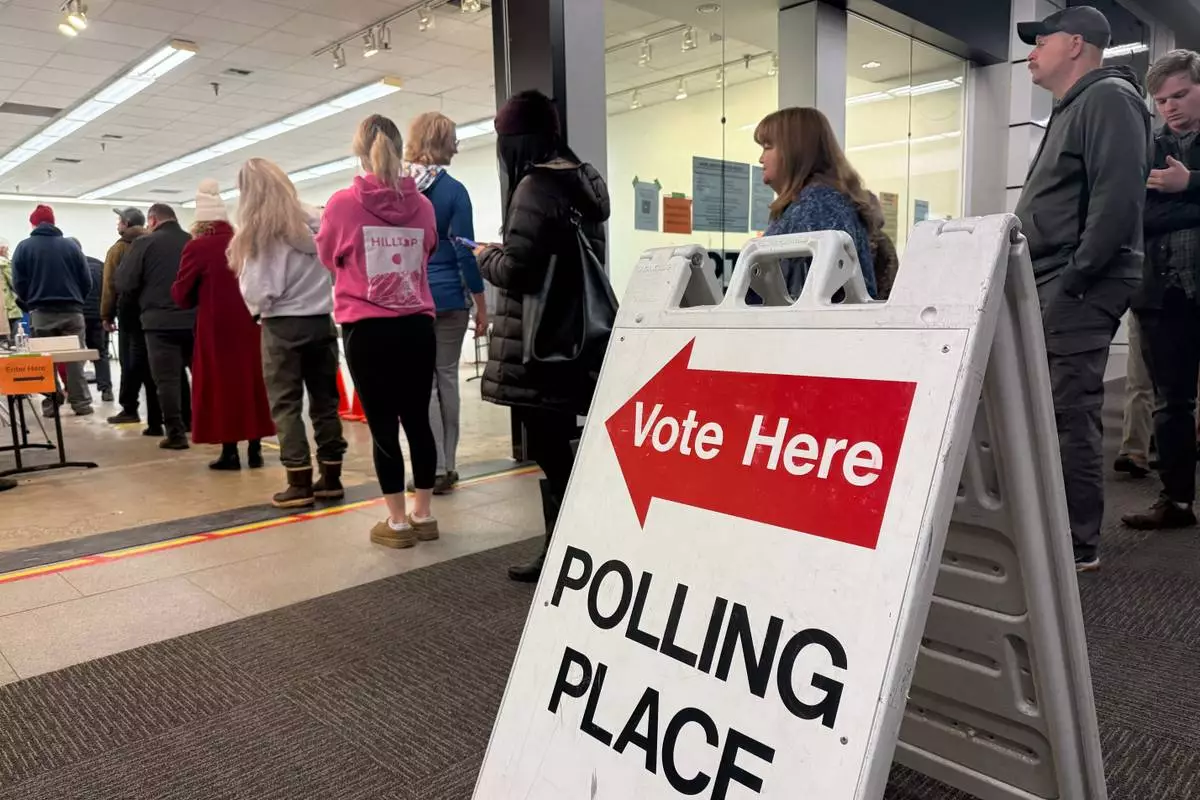
This photo taken with a smart phone, voters stand in line at an early voting location in a mall in Anchorage, Alaska, on Wednesday, Oct. 21, 2026. (AP Photo/Haven Daley)
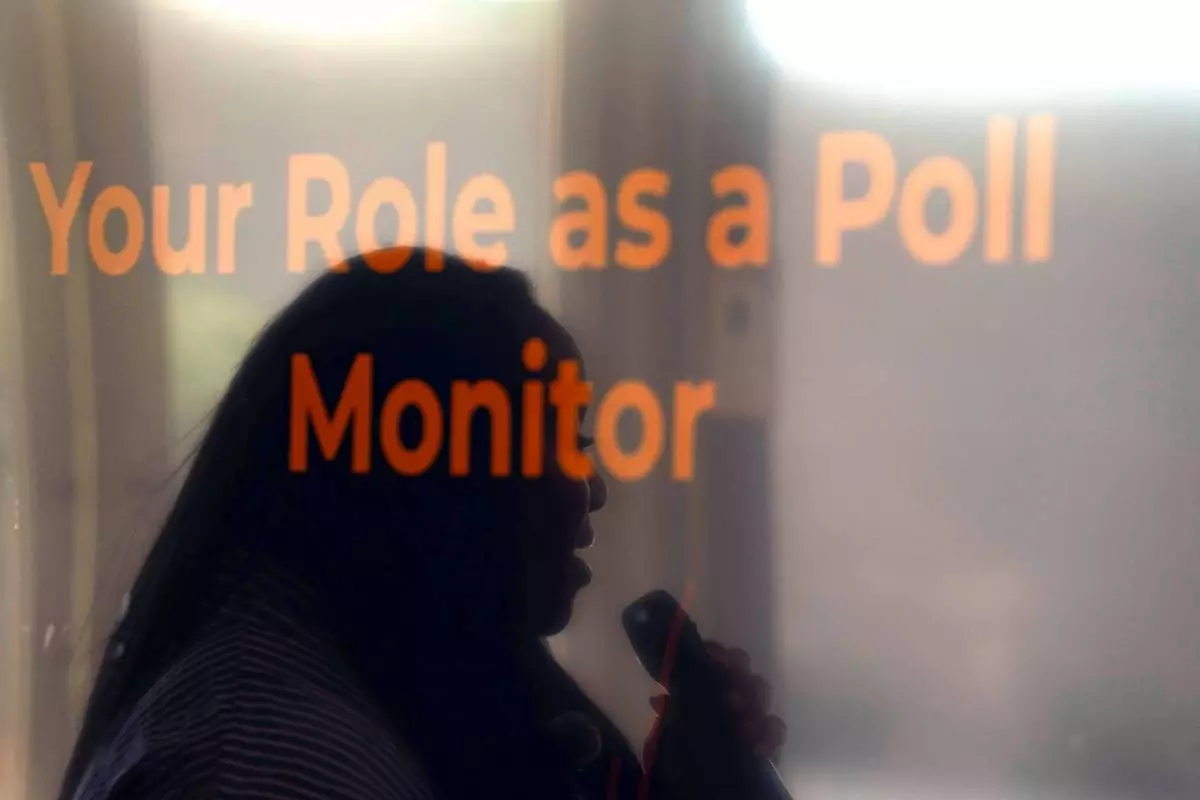
Rev. Medina Moore, an Arizona Faith Network voting rights organizer, is reflected on a television screen during a training for poll chaplains and peacekeepers, Tuesday, Oct. 6, 2026, ahead of the upcoming general midterm election, at Temple Chai in Scottsdale, Ariz. (AP Photo/Rebecca Noble)