In a hall where nearly every surface glitters, the Fashion Jewelry Zone of the 140th China Import and Export Fair is presenting a new face of Chinese jewelry, one that no longer competes on low prices but on technology, complete supply chains and cultural depth.
Better known as the Canton Fair, the event is being held in Guangzhou, the capital of south China's Guangdong Province. Staged for only the second time, the exhibition has already grown into a substantial showcase, gathering 59 companies across 180 booths displaying lab-grown diamonds, moissanite, pearls, silver and copper crafts, and items rooted in intangible cultural heritage.
Behind that move away from price competition stands technology, and nowhere is it more visible than among the lab-grown stones drawing the biggest crowds.
The undisputed highlight is a rough stone of 129 carats, weighing nearly 26 grams, the largest of its kind on display at this year's fair, and behind that single stone runs the story of an industry's ability to reinvent itself.
One exhibitor, whose own path led from military products to industrial cutting equipment and finally to jewelry, has brought that history with it in literal form, displaying a diamond-encrusted model of a J-20 fighter jet alongside bullet-shaped diamond pendants, a combination that has drawn significant attention from buyers.
What this industrial pedigree means in commercial terms becomes clear at the price tag, where a 1.5-carat loose lab-grown diamond sells for around 3,000 yuan, roughly 450 U.S. dollars. For these manufacturers, the value of technology lies not in making things cheap, but in releasing demand that scarcity once kept locked away.
Beyond the diamonds, the pavilion makes its case in humbler materials, and it is here that the strength of China's supply chains comes to the fore.
The booths carry a broad range of pieces, from the colorful acrylic bangles favored in European and American markets to stainless steel designs finished with gold plating, which their makers promote as hypoallergenic, durable and affordable.
Exhibitors say collections must be renewed at pace to keep up with the market, a tempo they describe as possible only because of China's complete industrial chain. The competitiveness of Chinese jewelry, they add, is evolving away from unit pricing toward small-batch customized production and rapid-response capability, allowing buyers to order narrowly and reorder quickly rather than gamble on volume.
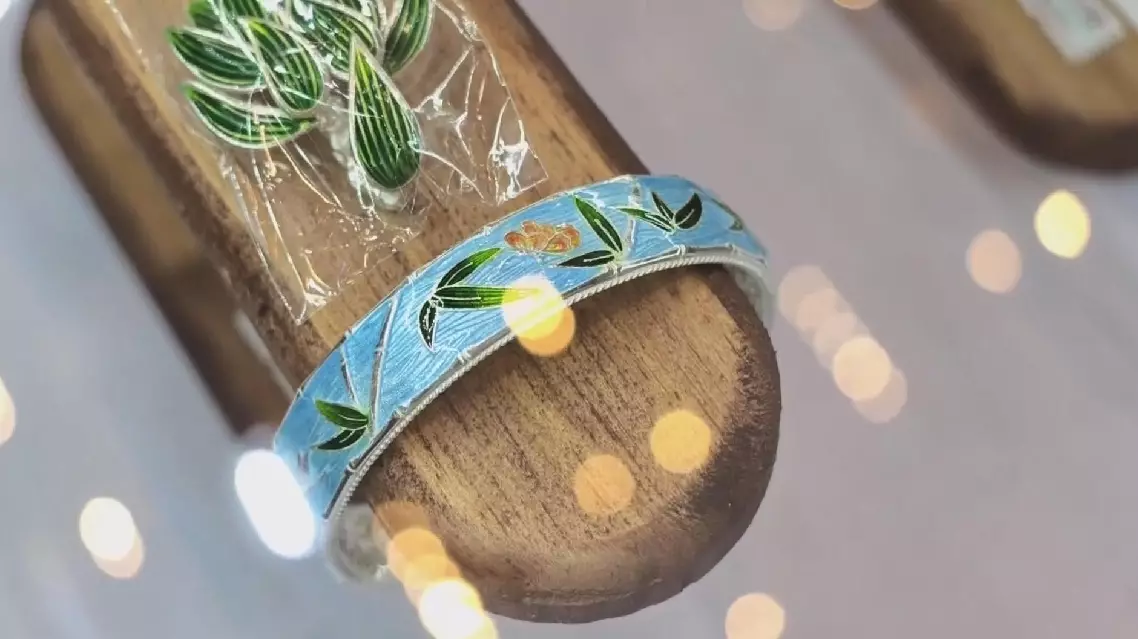
Cultural heritage adds the final, and increasingly decisive, layer of value. Designs built around intangible cultural heritage and the "Chinese trend," or guochao, rank among the most popular in the zone, with techniques such as filigree inlay, cloisonne and copper carving being worked into daily wear, wedding gifts and cultural collections.
Many note that buyers often stop questioning the cost once they understand the design concepts and the craftsmanship behind them. Culture, they say, is becoming the strongest premium Chinese jewelry can command, one that is carrying age-old techniques into markets that price alone could never open.
The 140th Canton Fair runs in three phases in Guangzhou through Nov. 4. Over nearly seven decades, it has grown into China's largest and longest-running international trade event, with the widest product range, the biggest buyer attendance and the highest transaction volume.
For the jewelry makers in this zone, the fair remains the stage where technology, supply chains and culture are placed directly before the world's buyers.
Chinese jewelry takes center stage at 140th Canton Fair with tech and tradition