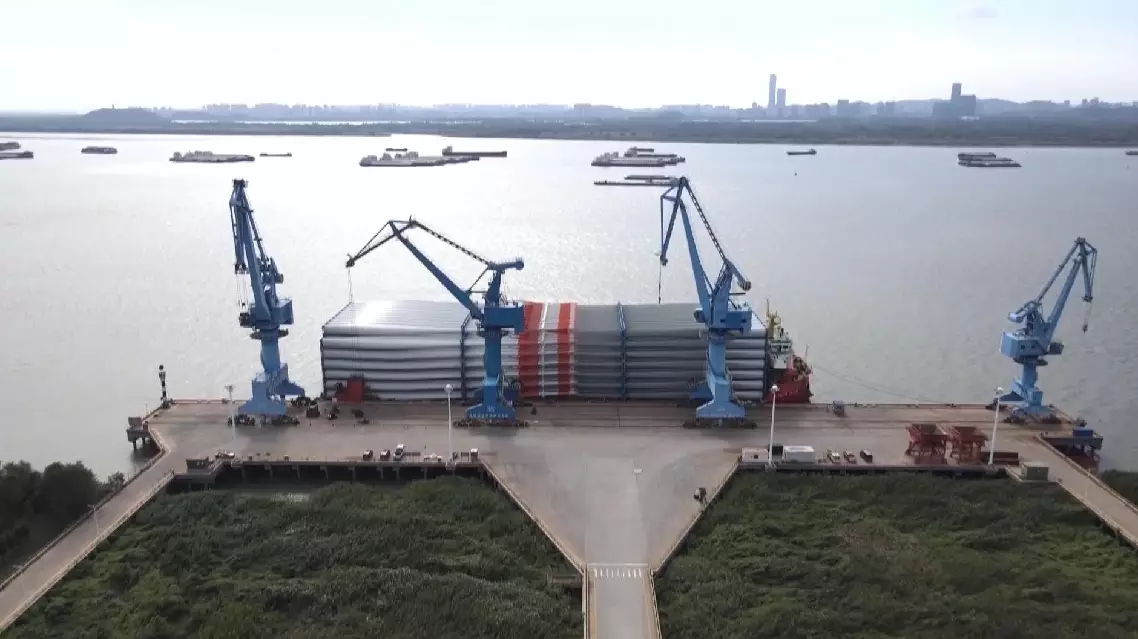
A cargo vessel loaded with 153 giant wind turbine blades departed Yangzhou Port in east China's Jiangsu Province for India on Friday, setting a new record for the largest single-vessel export of wind power equipment at the port.
The shipment comprised 51 sets of 153 wind turbine blades, each blade measuring 75 meters in length, with a total volume reaching 168,600 cubic meters.
To ensure smooth loading operations, the port coordinated closely with customs, maritime, border inspection and pilotage authorities. A dedicated green channel was established to enable zero-delay berthing and departure procedures.
Leveraging its geological advantages, complete industrial chain and efficient logistics network, Yangzhou Port has emerged as a major hub for wind power equipment exports in China.
According to port authorities, the volume of wind turbine blades and tower sections handled in the first nine months of this year rose by 53.2 percent and 380.31 percent, respectively, year on year. In September alone, the total volume of wind power equipment exports surpassed 15 million cubic meters.
Yangzhou Port sets single-vessel export record for wind turbine blades
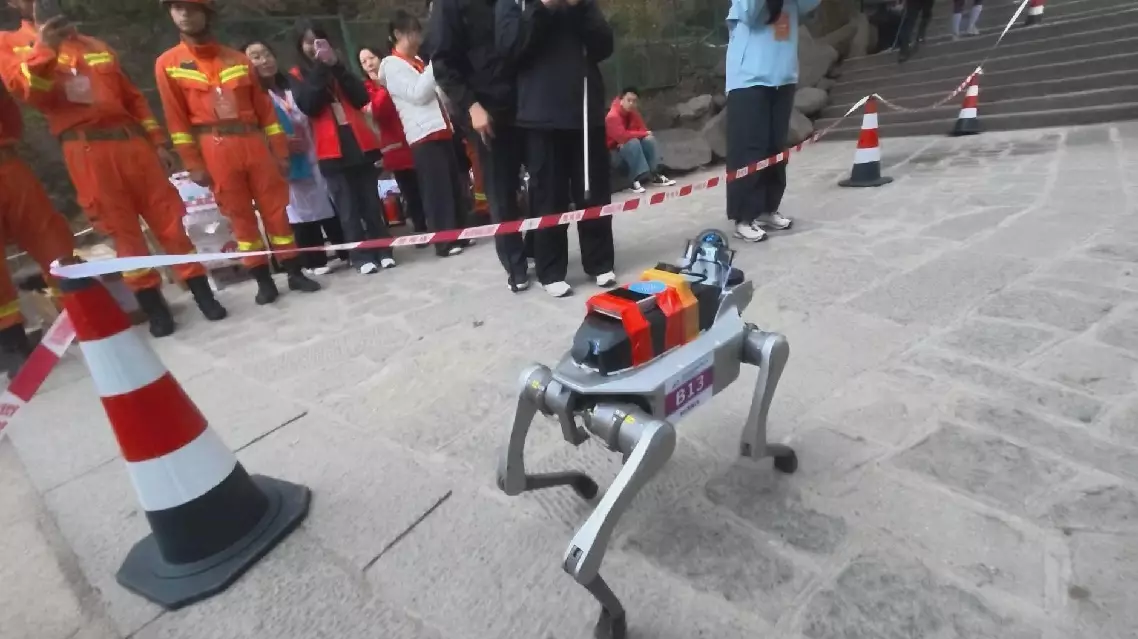
Robot athletes are gearing up to race on Mount Tai with the latest technology ahead of the main event of the inaugural China Media Group (CMG) World Robot Mount Tai Competition in Tai'an City, East China's Shandong Province, next Monday.
Before the main event, CMG held a qualifier on Monday, featuring four events—legged robot racing, legged robot load-bearing, all-terrain scouting, and humanoid robot racing- all starting from Hongmen Square at Mount Tai, with different landmarks on the mountain set as finish lines for different events.
The course consists mainly of continuous stone steps, slopes, and curves, putting the robots' perception and decision-making, balance control, and endurance to the test.
After the qualifier, engineers are making final adjustments for the final, with the best-performing robots reaching the destination within one hour, much faster than their engineer companions.
"At the average speed achieved in practical training, it can reach the event finish line at Zhongtianmen in less than an hour. It can judge for itself how to avoid obstacles and plan routes in real time. During this period, we can enjoy running with the robot during the day and go back at night to optimize the algorithms. After training on this complex Mount Tai course, robots can better adapt to scenarios like material delivery and inspection," said contestant Wang Kaimin.
Robots set for Mount Taishan climbing competition to test speed