CHICAGO--(BUSINESS WIRE)--Oct 28, 2026--
PPC, a family-oriented investment firm that partners with family-, founder- and management-owned businesses, announced today that it has reached a definitive agreement under which Platinum Equity would purchase EDP, a leading provider of propane distribution services.
This press release features multimedia. View the full release here: https://www.businesswire.com/news/home/20261028032793/en/
Founded in 2012 by Tom Knauff, a 40-year veteran of the industry, EDP provides safe, reliable propane services to more than 200,000 residential, commercial, industrial and agricultural customers across 24 states. The company has been built through the strategic acquisition of 45 market-leading operators while preserving their local brands and leadership teams. PPC invested in EDP in 2020 alongside the founders, existing family office investors and management. Since then, EDP has more than tripled EBITDA through organic growth and strategic acquisition.
“In 2020, we sought a partner that would honor the company’s legacy and culture while helping us expand our team, transition leadership and pursue accelerated growth,” said Tom Knauff, Founder and Executive Chairman of EDP. “We are fortunate to have found partners who embraced our vision and gave us the support to grow, and all of us at EDP are grateful for the partnership of PPC, Concentric Equity Partners and our other shareholders.”
“PPC has been a valuable partner through a period of rapid growth, bringing a deep understanding of founder-led businesses and strong financial and operational support,” said Kevin Pollack, Chief Executive Officer of EDP. “Their respect for our culture and our team allowed us to expand without compromising our commitment to our employees, customers and the local communities we serve.”
“We are proud to have supported Tom and the EDP leadership team over the past six years as they expanded their operational footprint and transitioned day-to-day leadership to the next generation,” said Eric Kieras, Investment Partner at PPC. “EDP is a terrific business, and we are confident the company is well positioned for continued success with its new partners.”
The EDP transaction reflects PPC’s approach of family direct investing, which pairs a like-minded capital base of families and other long-term investors with investing and operating expertise. This approach aligns PPC with management teams around building enduring businesses and creating long-term value.
Terms of the transaction were not disclosed. The transaction is expected to close in November 2026, subject to customary closing conditions.
Solomon Partners acted as exclusive financial advisor and Kirkland & Ellis LLP acted as legal advisor to EDP.
About PPC
PPC is a family-oriented investment firm that partners with family-, founder- and management-owned companies in the manufactured products and services sectors. The firm’s differentiated investor base, anchored by family investors, allows for aligned decision-making, flexible transaction structures and a focus on long-term business objectives. For more information, visit PPCPartners.com.
About Concentric Equity Partners
Concentric Equity Partners is a private investment firm that partners with leading middle market companies by providing capital and strategic advisory to accelerate long term value creation. Concentric’s approach is simple: support entrepreneurs and operators by providing the resources required to achieve extraordinary results. The firm’s investment team is made up of individuals with distinguished track records as operators and professional investors across a variety of growth oriented middle market companies. Concentric Equity Partners is the direct investing arm of Financial Investments Corporation, a private asset management firm and family office with over $2.5 billion in investment commitments under management. Financial Investments Corporation was founded in 1994 by father and daughter Harrison and Jennifer Steans and has been partnering with private companies for more than 30 years. Please visit www.ficcep.com for additional information.
About EDP
Chicago-based EDP is a growing propane distributor with deep experience in retail and commercial propane sales, operations and finance. The company provides safe, reliable propane service to residential and commercial customers in Arizona, California, Connecticut, Delaware, Florida, Indiana, Kentucky, Maine, Maryland, Massachusetts, Michigan, Minnesota, Nevada, New Hampshire, New Jersey, New York, Ohio, Pennsylvania, Rhode Island, South Carolina, Virginia, Washington, West Virginia and Wisconsin. EDP’s long-term strategy is to acquire successful propane and fuel operators while retaining their brand names, preserving local management and continuing to support local communities.
About Platinum Equity
Founded in 1995 by Tom Gores, Platinum Equity is a global investment firm with approximately $48 billion of assets under management and a portfolio of approximately 60 operating companies that serve customers around the world. Platinum Equity specializes in mergers, acquisitions and operations — a trademarked strategy it calls M&A&O® — acquiring and operating companies in a broad range of business markets, including manufacturing, distribution, transportation and logistics, equipment rental, metals services, media and entertainment, technology, telecommunications and other industries. Over the past 30 years, Platinum Equity has completed more than 550 acquisitions. For more information, go to www.platinumequity.com or visit Platinum Equity’s newsroom for the latest stories about the firm.
PPC Agrees to Sell EDP to Platinum Equity
JERUSALEM (AP) — Hawkish, reserved and unpolished, Israel's former military chief has a viable chance of unseating Prime Minister Benjamin Netanyahu.
His name is Gadi Eisenkot. And while the votes from Tuesday's election are still being counted, his centrist party, Yashar, along with other opposition allies, has the clearest path to power if they can join forces with Arab-led parties, though pulling it off may prove difficult.
It has been a remarkable climb for the 66-year-old, who was raised by Moroccan-Jewish immigrants, and whose son died fighting in the latest war in Gaza. But it's also a major challenge for a man relatively untested in Israel's hardscrabble tradition of coalition building.
The commander of some of Israel's most difficult wartime battles, he is now up against Netanyahu, who has shown, time and time again, an almost uncanny ability to survive the cutthroat world of Israeli politics.
Nevertheless, Eisenkot was ecstatic and determined late Tuesday as initial exit polls suggested a big loss for Netanyahu.
“We have made history!" he bellowed from a podium in Tel Aviv.
“Millions of Israelis have had enough of the culture of lies, of failure, of division and incitement," Eisenkot said. "Tonight marks the beginning of a path that must lead to the formation of a Zionist government.”
Preliminary results from Israel’s elections commission on Wednesday have since shown the prime minister’s party pulling ahead, but without a clear majority. Eisenkot's coalition — a mix of center-right and more liberal figures — is a close second but would need to partner with Arab-led parties for an outright majority.
In Israeli politics, where higher vote counts don’t automatically translate into political victories, the ability to amass a coalition is key.
Emerging results indicated that neither Netanyahu’s nor Eisenkot’s coalition blocs would reach the 61 seats needed for a majority; local media projected 53 seats for Likud and allied parties, 48 for Yashar and allied parties, and 19 for Arab-led parties.
While Netanyahu and many members of his party, Likud, have ruled out working with minority Arab parties, Eisenkot has not.
The parties, composed mainly of Palestinian Muslims and Christians, made a historic showing at the polls in Tuesday's election. If Eisenkot can convince them to join his coalition, he could gain enough seats to form a majority in the Knesset, Israel’s parliament.
Yousef Jabareen, leader of the Joint List of Arab parties, is calling for a “true and equal” Jewish-Arab partnership to help oust Netanyahu’s government after a strong showing by Arab-led parties.
By partnering with Arab parties, Eisenkot could lose the support of more right-wing members of his coalition, endangering his bloc from the opposite flank.
In a bid to prevent such defections, his party has asked Israel’s Arab parties to publicly profess certain principles: that Israel is a Jewish and democratic state, guided by the Israeli declaration of independence; that Hamas is a terrorist organization that should be disarmed and demolished; and that ultra-Orthodox Jews and Palestinian citizens of Israel must no longer be exempt from Israel’s mandatory military draft.
“There is currently no ultra-Orthodox or Arab party that supports these four principles,” Yashar candidate Lian Polak-David said to The Associated Press on Tuesday night.
They must reach an agreement soon or risk going to another round of elections. Thousands of citizens who flew into Israel to vote in the first round might be unable to return for a second, and Arab parties would likely suffer from lower turnout, too.
“We must act swiftly. This is the imperative of the hour, and uniting our people is essential," Eisenkot said Tuesday night in Tel Aviv.
Eisenkot has halting English and comes from a working-class family. He spent four decades in Israel’s military. His 25-year-old son, Gal Meir Eisenkot, was killed in combat in Gaza.
Netanyahu is a U.S.-educated elite, marred by corruption scandals. The International Criminal Court seeks his arrest. Netanyahu’s son, Yair Netanyahu, is a podcaster who lives part time in Florida and has used the legal name “Yonatan Hun,” according to Israel’s Haaretz newspaper.
After the Hamas attacks on Israel on Oct. 7, 2023, Eisenkot took on a role as an observer in Netanyahu’s war Cabinet. That day, the militants killed 1,200 people and took 251 hostage. Israel then launched a war in Gaza that has killed over 74,000 Palestinians, according to the territory’s health ministry, which doesn’t distinguish between civilians and combatants in its count.
In June 2024, Eisenkot followed a colleague out of the Cabinet, writing in his resignation letter that Netanyahu was letting politics influence decision-making, harming Israel’s ability to achieve its war goals.
Eisenkot’s two nephews who were deployed to combat were also killed fighting in Gaza.
The personal losses raised Eisenkot’s profile among Israelis and gave him credibility as someone who, having paid the ultimate price, wouldn’t needlessly sacrifice soldiers.
Eisenkot, like others in the opposition, says Netanyahu should be held accountable for Oct. 7 and the failure to turn battlefield victories into diplomatic achievements. They support launching a state inquiry into the failures that led to the Hamas attacks that day — a probe Netanyahu has long refused.
When it comes to the country’s ultra-Orthodox population, Eisenkot has said he will not compromise on legislation mandating they also serve in the military.
Eisenkot is no dove. Like nearly all the prime minister’s rivals, Eisenkot has supported Israeli military operations in Gaza, Lebanon and Iran.
He says he wants to dial tensions down with the Palestinians in the Israeli-occupied West Bank and follow U.S. President Donald Trump’s plan for Gaza.
He supports settlements but says he would evacuate unauthorized settler outposts, which rights groups say are the primary drivers of violence against Palestinians.
While at times he has emphasized diplomacy to address Israel’s security challenges, he also is credited with formulating Israel’s so‑called Dahiyeh Doctrine, named after the area in Beirut’s southern suburbs where the Hezbollah militant group has a stronghold. It's a military strategy advocating the use of disproportionate power against any entity that fires on Israel, no matter how small or insignificant.
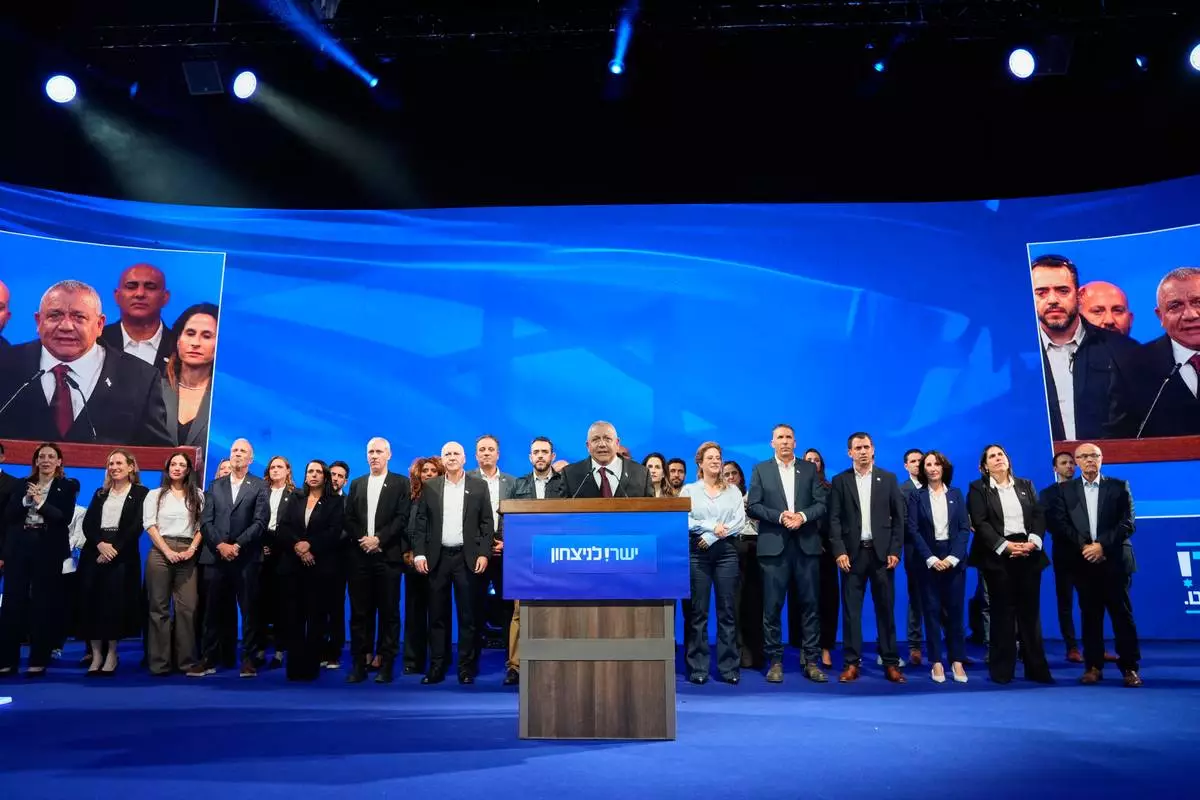
Gadi Eisenkot, leader of the Yashar ("Straight") party, speaks to supporters following the release of the first exit poll results in Israel's general election in Tel Aviv, Israel, Wednesday, Oct. 28, 2026. (AP Photo/Baz Ratner)
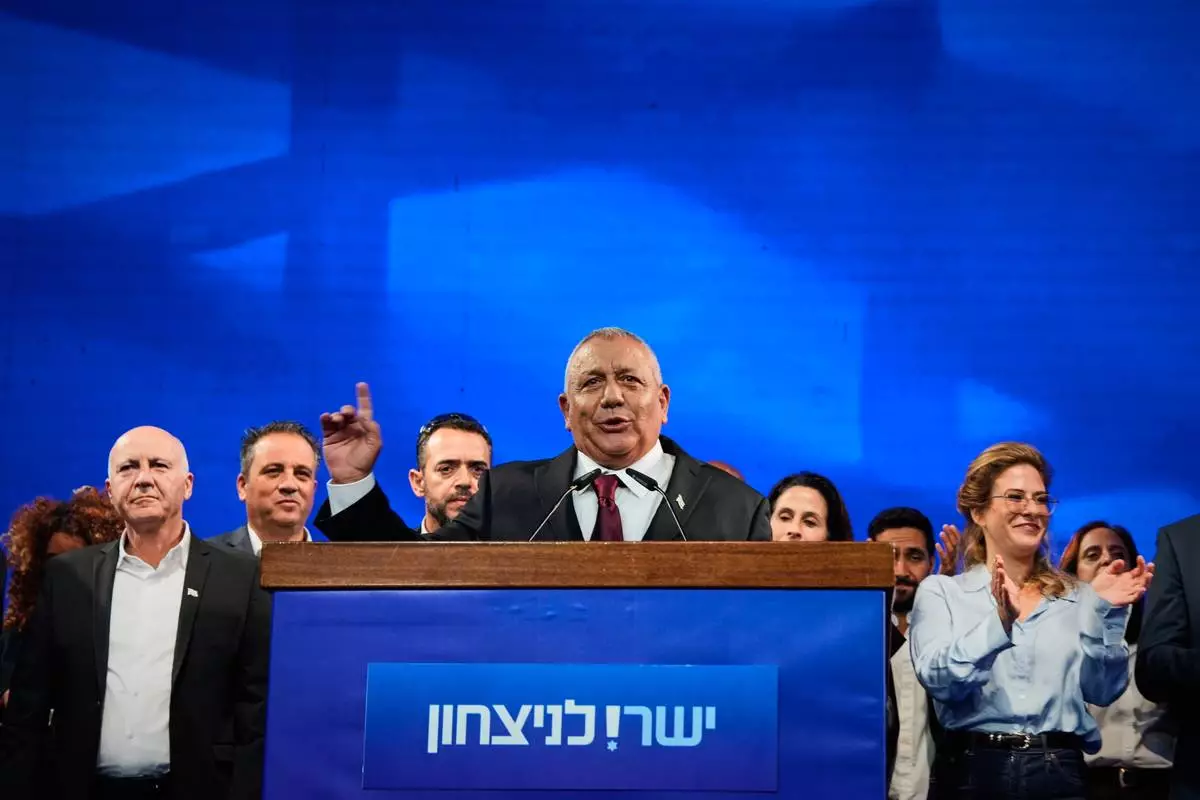
Gadi Eisenkot, leader of the Yashar ("Straight") party, speaks to supporters following the release of the first exit poll results in Israel's general election in Tel Aviv, Israel, Wednesday, Oct. 28, 2026. (AP Photo/Baz Ratner)
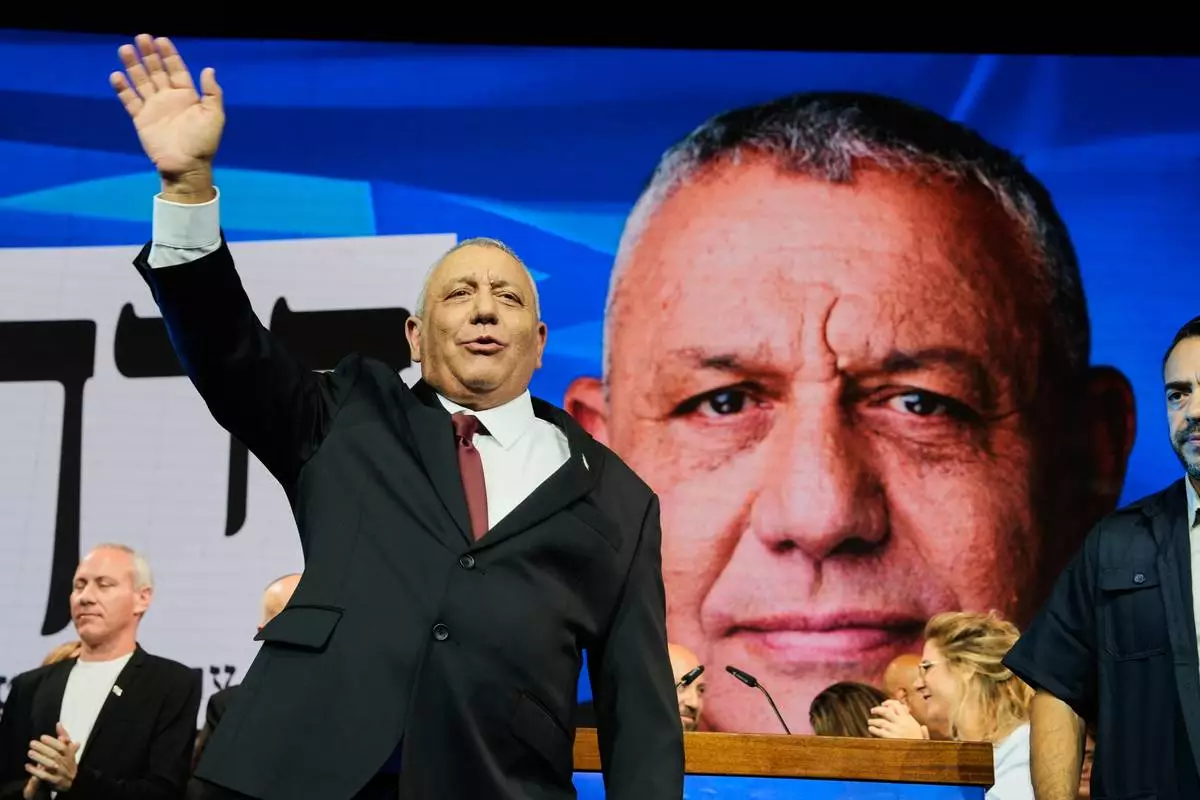
Gadi Eisenkot, leader of the Yashar ("Straight") party, waves to supporters following the release of the first exit poll results in Israel's general election in Tel Aviv, Israel, Wednesday, Oct. 28, 2026. (AP Photo/Baz Ratner)