In the news release, Autodesk named a Leader in the IDC MarketScape: Worldwide Construction Management Software 2026 Vendor Assessment, issued 28-Oct-2026 by Autodesk, Inc. over PR Newswire, we are advised by the company that the original version contained incorrect information introduced by PR Newswire during transmission. The complete, corrected release follows, with additional details at the end:
Autodesk named a Leader in the IDC MarketScape: Worldwide Construction Management Software 2026 Vendor Assessment
Autodesk leads the future of construction with a design-to-operate platform, embedded AI agents, and open partner ecosystem.
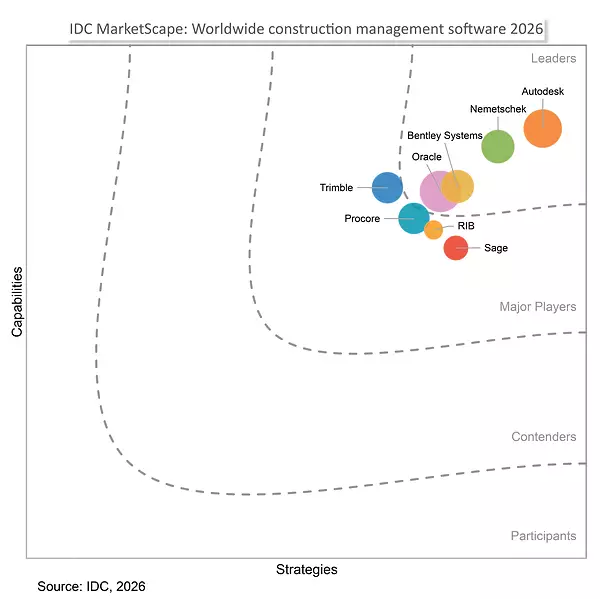
SAN FRANCISCO, Oct. 28, 2026 /PRNewswire/ -- Autodesk, Inc. (NASDAQ: ADSK) today announced that IDC MarketScape has positioned the company in the Leaders Category of the inaugural IDC MarketScape: Worldwide Construction Management Software 2026 Vendor Assessment (September 2026, IDC #US54135526).
The assessment evaluated Autodesk's construction management capabilities and strategies. According to the IDC MarketScape, "For the purposes of this research, the IDC definition of construction management software for this report is as follows: Software platforms that manage the construction lifecycle, including the following segments: BIM integration, coordination, conditioning/preparation, preconstruction; project management; virtual design and construction (VDC) and project team collaboration."
IDC MarketScape vendor analysis model is designed to provide an overview of the competitive fitness of technology and suppliers in a given market. The research methodology utilizes a rigorous scoring methodology based on both qualitative and quantitative criteria that results in a single graphical illustration of each supplier's position within a given market. The Capabilities score measures supplier product, go-to-market and business execution in the short-term. The Strategy score measures alignment of supplier strategies with customer requirements in a 3-5 year timeframe. Supplier market share is represented by the size of the icons.
In its profile, IDC MarketScape notes Autodesk's three areas of strength:
- Deep construction industry experience combined with a design-to-operate platform that includes project and geospatial information, as well as a digital twin offering to simplify post-project handoff.
- Embedded AI agents that are targeted for certain tasks (model info, schedule, RFIs, submittals) as well as a general Autodesk Assistant for cross-domain work and model analysis.
- Partnership ecosystem model: Autodesk Platform Services (formerly called Forge) provides a set of applications, APIs, and an open approach for development of new applications. It also has multiple construction communities and partner advisory councils to drive close customer engagement. One large general contractor customer describes its long-time relationship with Autodesk as "mutually beneficial;" other customers express similar sentiments.
In its guidance to buyers, IDC MarketScape says to consider Autodesk when seeking "a single construction management platform across the project life cycle that supports BIM visualization, model coordination, preconstruction, project management, and post-project operational hand-off, as well as an extensive, strong partner ecosystem of providers and a global team that complements the suite of products."
"Construction management software is increasingly being evaluated on its ability to connect workflows, data, and project teams across the construction lifecycle," said Jeffrey Hojlo, research vice president, industrial ecosystems, engineering, & product innovation strategies, IDC. "Autodesk's positioning as a Leader reflects its broad construction management capabilities, investments in embedded AI, and established partner ecosystem. Together, these are important considerations for organizations seeking to improve collaboration and continuity throughout project delivery."
Connecting construction workflows through Autodesk Forma
Autodesk is leading the shift toward more connected, AI-powered project delivery. Autodesk Forma, the industry cloud for architecture, engineering, and construction (AEC), unites architects, engineers and builders in one connected process instead of a chain of handoffs, using AI to weigh key decisions against desired outcomes, like cost, schedule and sustainability requirements. Forma's open ecosystem includes more than 400 integrations through technology partners and Forma Construction Connect, giving construction teams the flexibility to work with the tools they already use.
The construction management strengths noted by IDC MarketScape are central to that strategy, helping Autodesk build stronger connections across the AEC project lifecycle.
"Construction is entering a new era, where information needs to move with a project and inform decisions from design through delivery," said Lalith Subramanian, vice president, product and engineering, Autodesk Construction Solutions. "I believe IDC MarketScape's recognition is significant because it highlights both the strength of our construction capabilities and our design-to-operate platform. That's the future we're building with Autodesk Forma, bringing design, engineering and construction closer together, with AI embedded in project workflows to help teams move faster, make better decisions earlier, and design and build with greater confidence."
Autodesk is continuing to expand its construction capabilities within Forma. At Autodesk University 2026, the company announced Forma Bid, now in beta, to help contractors compare bids and identify potential gaps in scope; AI-powered insights in Project Home in Forma Build that surface project issues needing attention; and the Daily Log Agent, which turns spoken jobsite updates into structured daily logs.
Additional resources
Read Autodesk's licensed IDC MarketScape excerpt to learn more about the company's recognition as a Leader.
Explore Autodesk Forma for construction to learn more about the tools and capabilities supporting project teams from preconstruction through delivery.
Read Lalith Subramanian's blog on ADSK News for more perspective on the recognition and Autodesk's continued investment in connected construction.
About Autodesk
The world's designers, engineers, builders, and creators trust Autodesk to help them design and make anything. From the buildings we live and work in, to the cars we drive and the bridges we drive over. From the products we use and rely on, to the movies and games that inspire us. Autodesk's Design and Make Platform unlocks the power of data to accelerate insights and automate processes, empowering customers with the technology to create the world around us and deliver better outcomes for their businesses and the planet. For more information, visit autodesk.com or follow @autodesk. #MakeAnything
IDC MarketScape attribution
Source: "IDC MarketScape: Worldwide Construction Management Software 2026 Vendor Assessment", September 2026, IDC #US54135526
About IDC MarketScape: IDC MarketScape vendor assessment model is designed to provide an overview of the competitive fitness of technology and service suppliers in a given market. The research utilizes a rigorous scoring methodology based on both qualitative and quantitative criteria that results in a single graphical illustration of each supplier's position within a given market. IDC MarketScape provides a clear framework in which the product and service offerings, capabilities and strategies, and current and future market success factors of technology suppliers can be meaningfully compared. The framework also provides technology buyers with a 360-degree assessment of the strengths and weaknesses of current and prospective suppliers. IDC MarketScape vendor analysis model is designed to provide an overview of the competitive fitness of technology and service suppliers in a given market. The research methodology utilizes a rigorous scoring methodology based on both qualitative and quantitative criteria that results in a single graphical illustration of each vendor's position within a given market. The Capabilities score measures vendor product, go-to-market and business execution in the short-term. The Strategy score measures alignment of vendor strategies with customer requirements in a 3-5-year timeframe. Vendor market share is represented by the size of the circles. Vendor year-over-year growth rate relative to the given market is indicated by a plus, neutral or minus next to the vendor name.
Correction: The link to Lalith Subramanian's blog on ADSK News has been updated. Additionally, the accompanying image did not reach our international partners and should be included on those versions.
** This press release is distributed by PR Newswire through automated distribution system, for which the client assumes full responsibility. **
/C O R R E C T I O N - Autodesk, Inc./