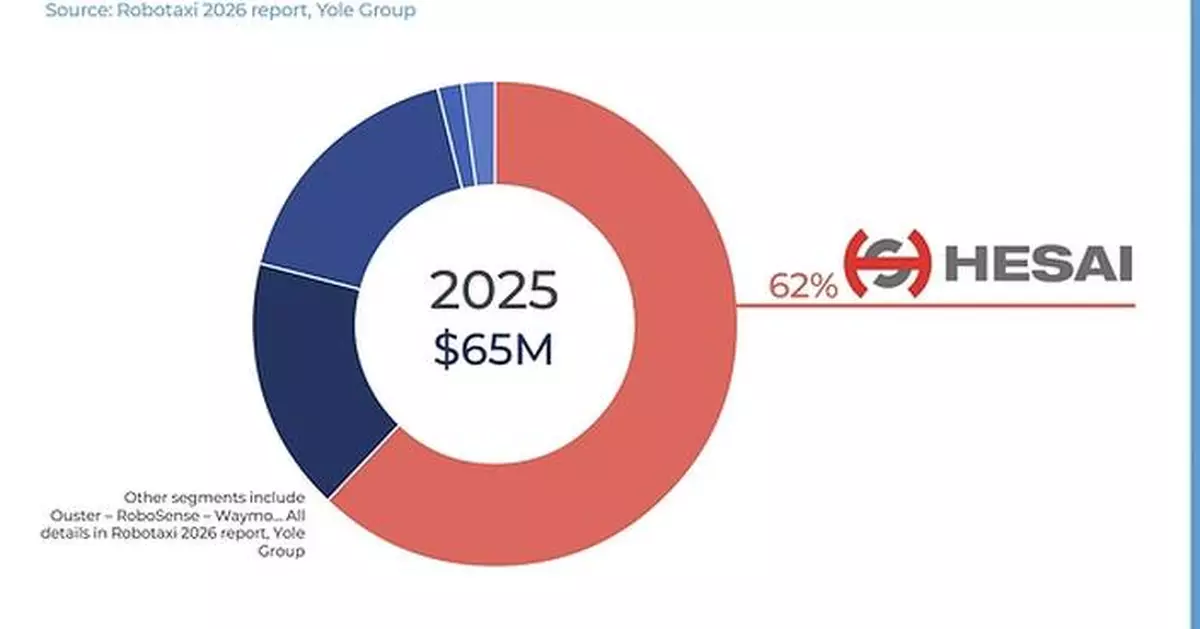
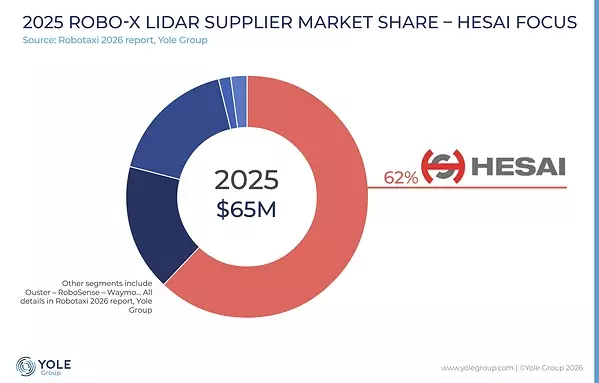
PALO ALTO, Calif., Oct. 29, 2026 /PRNewswire/ -- Hesai Group (Nasdaq: HSAI; HKEX: 2525) ("Hesai" or the "Company"), a Physical AI infrastructure company, today announced that Yole Group has ranked it the world's leading robotaxi lidar supplier in its Robotaxi 2026 report. Hesai held a 62% share of the global robotaxi lidar market in 2025, more than all other suppliers combined. The finding reinforces Hesai's leading position in a market that is entering a new phase, as robotaxi programs expand toward larger-scale fleet operations. Yole Group's previous report put Hesai's robotaxi lidar market share at 61%.
According to the Yole report, Hesai's lidar has been selected for leading Level 4 robotaxis and autonomous vehicles programs worldwide, including Baidu Apollo Go, Pony.ai, WeRide, DiDi, Motional, Aurora and KargoBot. The breadth of these deployments reflects the growing adoption of lidar across multiple robotaxi platforms and operating environments, rather than reliance on a single customer or program.
This year's report examines robotaxis and their enabling technologies in a dedicated study. Yole Group projects that the global robotaxi fleet will grow from approximately 10,000 vehicles in 2025 to 331,000 in 2031. As operators expand their fleets, they will need lidar that delivers precise perception in complex environments, consistent automotive-grade quality and reliable supply at scale.
"We are proud to be named the Robotaxi lidar leader in Yole Group's Robotaxi 2026 report," said Dr. Yifan "David" Li, Hesai's Co-Founder and CEO. "Robotaxis are moving into an important next phase, with operators increasingly focused on scaling deployment and delivering reliable autonomous mobility in real-world environments, and that raises the bar for every component on the vehicle. Operators need perception they can rely on across more vehicles, more roads and more hours of operation. Our continued market leadership reflects the trust we have earned through years of close collaboration with robotaxi developers, and our ability to deliver at scale."
As the robotaxi market expands, Hesai is also advancing its next-generation lidar platform for the next phase of autonomous driving. At the center of this effort is an upgraded ETX, Hesai's flagship lidar platform for Level 3 and higher autonomous driving. Powered by Hesai's proprietary Picasso SPAD-SoC, the next-generation ETX combines RGB sensing and time-of-flight ranging at the chip level, enabling it to capture both the geometry and color of its surroundings in a precisely aligned point cloud. With configurations of up to 4,320 channels and a maximum detection range of up to 600 meters, ETX is designed to give systems a more detailed view of distant objects and complex driving scenes. The Picasso-equipped ETX is undergoing customer validation and has progressed to RFI and RFQ discussions with leading robotaxi operators and global automakers, providing a pathway toward the next generation of high-performance perception systems.
Hesai is also scaling its manufacturing capabilities to support the anticipated growth in autonomous mobility. As of June 2026, the Company's cumulative lidar deliveries had surpassed 3.5 million units. Hesai is advancing construction of a new manufacturing facility in Bangkok, Thailand, expected to commence production in 2027, while its highly automated in-house production lines — with 100% automation across core processes — now roll out one lidar unit every 8 seconds. Together with its next-generation product development, these manufacturing investments position Hesai to support automakers and autonomous-vehicle customers as their programs move toward larger deployments.
About Hesai
Hesai Technology (Nasdaq: HSAI; HKEX: 2525) is a Physical AI infrastructure company. With a product portfolio spanning lidar, Kosmo spatial intelligence platform, and robotic actuation modules, Hesai is the only company in the industry covering the full robotics chain of "see, understand, and act" while achieving commercialization at scale. Leveraging full-stack proprietary ASIC capabilities and an integrated R&D-manufacturing approach, Hesai has established industry-leading positions across core physical AI domains, including autonomous mobility, spatial intelligence, embodied AI, and commercial robots, and holds a leading share of the global lidar market. Hesai has established offices in Shanghai, Palo Alto, and Stuttgart, and operates in-house factories in China and Thailand, with customers spanning more than 40 countries.
About Yole Group
Yole Group is a leading international market research and strategy consulting firm, delivering in-depth analyses across market trends, technology developments, teardowns, and reverse costing. Leveraging deep semiconductor expertise, its team of analysts also provides custom consulting services, offering strategic, technical, and market insights tailored to address specific business challenges and opportunities. More information on yolegroup.com.
** This press release is distributed by PR Newswire through automated distribution system, for which the client assumes full responsibility. **
Hesai Leads Global Robotaxi Lidar Market with 62% Share as Robotaxi Industry Moves Toward Scale, Yole Group Reports
A state-of-the-art general-purpose model in its class, built through automated AI research and designed to advance AI and scientific discovery.
BEIJING, Oct. 29, 2026 /PRNewswire/ -- Apex Intelligence has released Apex-35B-V1.0, its first model. Built on Qwen3.6-35B-A3B and further developed through mid-training and post-training, the 35B general-purpose model incorporates extensive proprietary datasets and research trajectories.
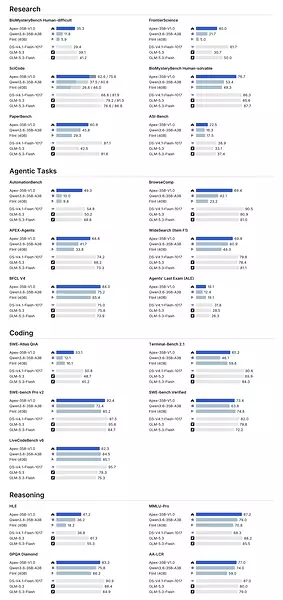
According to Apex Intelligence's evaluations, Apex-35B-V1.0 leads the similarly sized models tested in research and development capabilities while maintaining strong general-purpose performance. On selected benchmarks, it is competitive with substantially larger models.
AI participated autonomously in the model's development, including data construction, experiment design, code execution, analysis of training results and training optimization. Apex-35B-V1.0 can perform coding, agent workflows, question answering and deep search. It can also carry out end-to-end computational research workflows in AI research, computational science and robotics simulation.
Benchmark performance
Across 21 benchmarks, Apex-35B-V1.0 outperformed the similarly sized Qwen3.6-35B-A3B on 20 and Recursive Flint (40B) on 18, tying Recursive Flint on one. Beyond its strong performance on research tasks, the model demonstrated broad competitiveness in agentic tasks, coding, and reasoning, and surpassed larger models on selected benchmarks. Further details are available in the technical article.
Tech Blog:https://www.apexin.com/apex-35b/
Building Apex-35B-V1.0 Through Recursive Self-Improvement
Apex Intelligence developed Apex Research, an automated research system designed to enable recursive self-improvement. The system identifies model weaknesses, generates hypotheses, runs experiments and turns findings into measurable improvements. It contributed to the development of Apex-35B-V1.0 through self-evolving training data, automated experimentation, training recipes, GPU kernels and inference optimization.
Apex Research generates targeted training data to address weaknesses revealed by evaluation. When evaluations identified failures in computational fluid dynamics, the system analyzed the reasoning gaps, synthesized and validated new scientific training examples, and incorporated them into subsequent training rounds. Apex Intelligence reports that this process improved performance on its internal CFD-Bench by 32.1 points.
The system also analyzes evaluation results and agent trajectories to identify recurring failure patterns and refine training strategies. After identifying excessively long reasoning contexts and imbalanced data mixtures as factors affecting agent performance, it explored sequence-length distributions, short-to-long trajectory sampling ratios and token-aware batch compositions to improve agent reliability and training efficiency.
Apex Research extends this optimization to training and inference infrastructure. On the training side, its work on GPU load balancing, communication and computation overlap, dynamic batching, and token-aware workload distribution delivered 45–60% higher training throughput, according to Apex Intelligence. On the inference side, optimizations to attention kernels, KV-cache management and prefill/decode execution delivered 1.6–1.8 times faster decoding and 30–35% lower time to first token under comparable workloads.
Together, these improvements across data, training and infrastructure form a feedback loop in which each research iteration supports the next.
Availability
The weights for Apex-35B-V1.0 are available on Hugging Face. Accompanying code, a deployment guide and usage examples are available on GitHub. Developers can download and run the model for AI development, scientific computing and other research tasks. Model versions, hardware requirements, supported inference frameworks and licensing information are detailed on the project pages.
GitHub:https://github.com/apexin-ai/Apex-35B-V1.0
Hugging Face:https://huggingface.co/Apexintelligence-AI/Apex-35B-V1.0
About Apex Intelligence and what comes next
Apex Intelligence was founded by Yongchao Chen, an assistant professor at Tsinghua University's College of AI. The company aims to build the next generation of self-evolving foundation models for research. By "self-evolving," it means enabling AI to participate in research, experimentation and validation, then using the resulting discoveries to improve the model itself.
Apex Intelligence aims to advance AI from an assistant to a research collaborator capable of contributing to new discoveries. Its long-term vision is to develop models whose collective research capability matches and progressively surpasses that of 100,000 leading AI scientists across disciplines.
Following Apex-35B-V1.0, the company plans to release a larger self-evolving foundation model with stronger AI research capabilities and expanded applications in scientific fields including chip design and quantum computing. Apex Intelligence plans to announce further details on the model's capabilities, benchmark results and availability.
** This press release is distributed by PR Newswire through automated distribution system, for which the client assumes full responsibility. **
Apex Intelligence Releases Apex-35B-V1.0, a General-Purpose Model Built With Automated AI Research