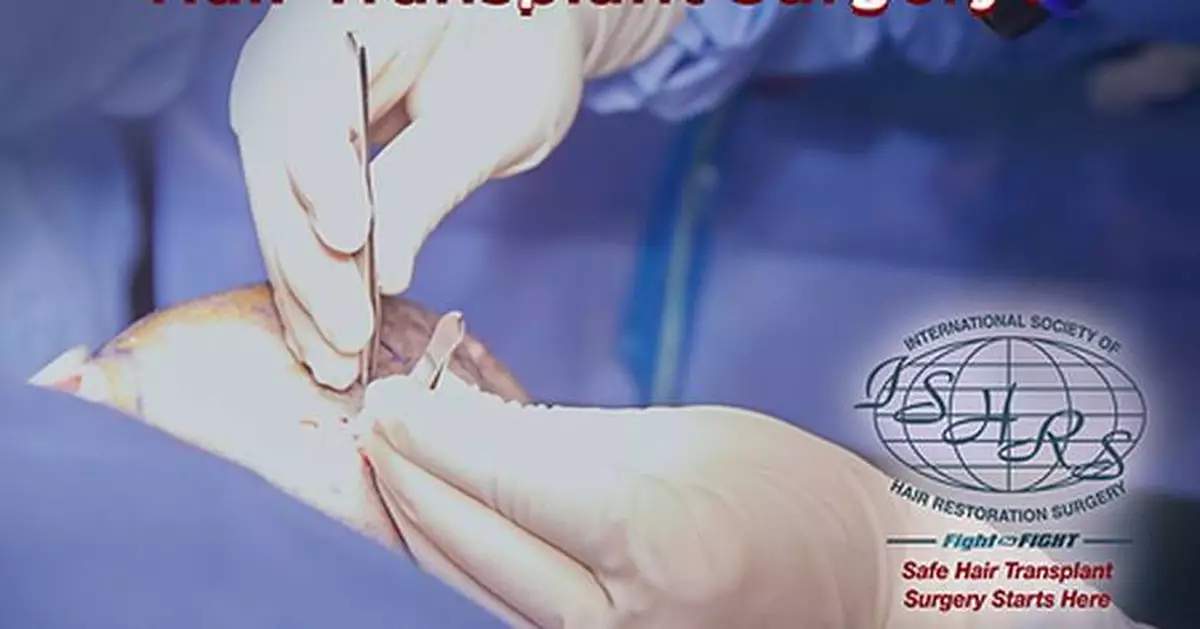
- Black-market hair transplant clinics are spreading – where unregulated individuals are illegally performing surgery that should only be done by a trained physician
- Patients are lured with steep discounts and fake photos of patient results, oftentimes with devastating results and little to no recourse
- The International Society of Hair Restoration Surgery is committed to raising awareness of this worldwide problem and connecting victims with potential corrective surgeries
CHICAGO, Oct. 29, 2026 /PRNewswire/ -- To combat the alarming trend of fraudulent hair transplant clinics operating around the world under the false pretense of a legal, physician-performed medical establishment, the International Society of Hair Restoration Surgery (ISHRS) has emerged as a leading voice in sounding the alarm about this widespread problem and providing people with the tools they need to make educated decisions about their hair restoration surgery.
On November 11, 2026, the ISHRS will host its sixth annual "World Hair Transplant Repair Day" to help victims of black-market hair transplants in need of corrective surgeries. Through the campaign's website, HairTransplantRepairDay.org, affected individuals can connect with participating volunteer ISHRS physicians for a chance to receive a pro bono corrective hair transplant procedure. Since its inception in 2020, the number of ISHRS participating physician members has increased to approximately 100 members around the world.
This worldwide event is part of the ISHRS's Fight the Fight global consumer awareness campaign that features educational resources available in more than a dozen languages, including blog posts, live stream replays, patient case studies, FAQs, a comprehensive guide to help patients choose a hair transplant surgeon, and physician interviews.
"The goal of this campaign is to not only raise awareness of these unscrupulous black-market hair transplant clinics, but also to empower patients struggling with hair loss to make confident, educated decisions about whose hands they trust with the expertise required for hair restoration surgery," said Robin Unger, MD, FISHRS, president of the ISHRS. "Every patient deserves a safe hair restoration surgery, and a physician's surgical skill, artistry, and medical training are the standard without exception."
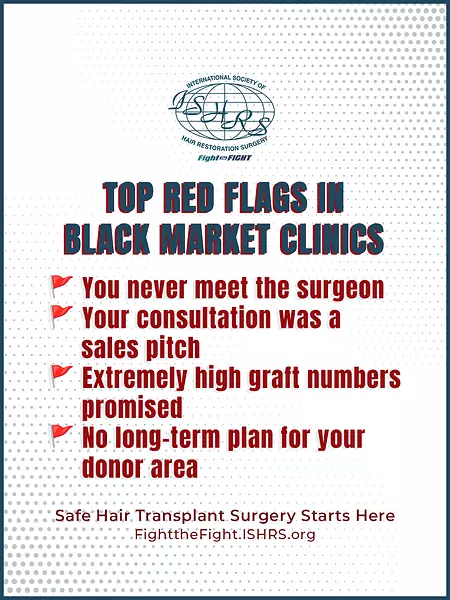
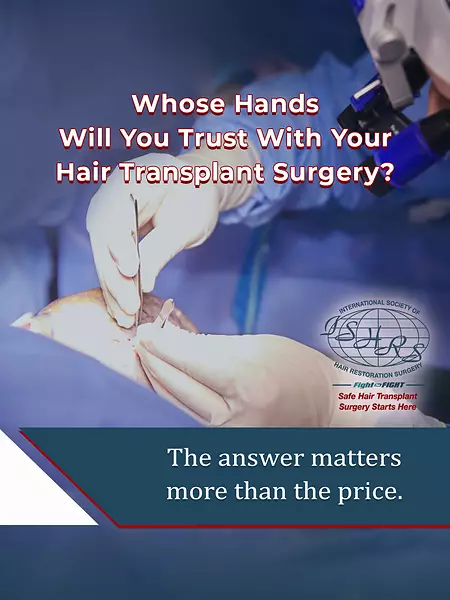
Under the new tagline Safe Hair Transplant Surgery Starts Here, the ISHRS is unveiling a series of new, multi-language digital ads promoting messaging essential to the overarching theme of the campaign:
- Showing patients what safe hair transplant surgery requires: medical training, surgical skill, artistic judgment, and physician accountability – while continuing to address black-market deception and its risks
- How the emotional and physical consequences of trusting the wrong clinic are permanent
- How fraudulent operators disappear, while real surgeons are registered, traceable, and accountable
- Why medical care with a physician is a lifetime relationship, not a one-day transaction
"Our data show that there has been an increase in the number of black-market hair transplant clinics in cities around the world. This has resulted in many instances of hair transplants done incorrectly. In some instances, patients have suffered severe medical issues and in others the aesthetic results have been poor. ISHRS members are assisting these patients with corrective surgery," said Paul T. Rose, MD, JD, FISHRS, chair of the ISHRS Fight the Fight Subcommittee. "This is why knowing whose hands and eyes you are relying on is imperative to a safe and successful surgery."
Frequently Asked Questions
How can patients avoid falling victim to a black-market hair transplant clinic?
The ISHRS urges patients to do their homework before undergoing hair restoration surgery. Patients should research the physician who will perform their surgery and verify their medical credentials with the local medical professional licensing authority. Patients also need to understand which portions of the hair restoration surgery need to be performed by a properly trained and licensed physician, and which tasks can be legally delegated to qualified medical technicians.
What are the risks of black-market hair transplants?
There are numerous risks to patients who undergo a black-market hair transplant, all of which jeopardize patient safety and outcomes. Consequences of hair transplants performed illegally can include permanent visible scarring, infection, thin patches of hair, bald spots, and over-harvested donor areas that can be very difficult to correct. In cases where damage can be fixed, patients will often require more than one corrective procedure.
How common are repair cases due to black-market hair transplants?
According to the ISHRS 2025 Practice Census, 59% of surveyed ISHRS members reported black-market hair transplant clinics operating in their cities in 2024, compared with 51% in 2021. Members also reported that an average of 10% of their repair cases in 2024 involved a previous black-market hair transplant, compared with 6% in 2021.
What is World Hair Transplant Repair Day?
Held annually on November 11, World Hair Transplant Repair Day is an ISHRS initiative designed to raise awareness of the dangers of black-market hair transplant clinics while helping connect victims with trained hair restoration surgeons for a chance to receive a pro bono corrective hair transplant procedure.
Where can consumers learn more?
The ISHRS's Fight the Fight campaign provides educational resources in more than a dozen languages, patient case studies, archived educational livestreams, and information designed to help consumers make informed decisions about hair restoration surgery.
About the ISHRS
The International Society of Hair Restoration Surgery (ISHRS) is a global non-profit medical association and the leading authority on hair loss treatment and restoration with 1,200 members throughout 80 countries worldwide. Above all, the ISHRS is dedicated to achieving excellence in patient outcomes by promoting the highest standards of medical practice, medical ethics, and research in the medical hair restoration industry. The ISHRS also provides continuing medical education to physicians specializing in hair transplant surgery and is committed to delivering the latest information on medical and surgical treatments to consumers suffering from hair loss, and most commonly from androgenetic alopecia – male pattern baldness and female pattern hair loss. It was founded in 1993 as the first international society to promote continuing quality improvement and education for professionals in the field of hair restoration surgery. For more information and to locate a physician, visit www.ishrs.org.
About the Survey
Conducted by Relevant Research Consulting of Evanston, IL, USA, the ISHRS 2025 Practice Census is a compilation of information provided solely by participating physicians. The information published in this survey was developed from actual historical information and does not include any projected information. The margin of error for the sample is within plus or minus 5.4 percent at the 95 percent confidence level. For a full reprint of the ISHRS 2025 Practice Census Report, visit Hair Restoration Statistics.
** This press release is distributed by PR Newswire through automated distribution system, for which the client assumes full responsibility. **
Sixth Annual "World Hair Transplant Repair Day" on November 11 Assists Victims of Black-Market Hair Transplants, Empowers People to Spot Warning Signs
Sixth Annual "World Hair Transplant Repair Day" on November 11 Assists Victims of Black-Market Hair Transplants, Empowers People to Spot Warning Signs