Skip to Content Facebook Feature Image

Sandy Hook families urge Supreme Court to uphold state and local bans on AR-15-style rifles

News

Sandy Hook families urge Supreme Court to uphold state and local bans on AR-15-style rifles
News

News

Sandy Hook families urge Supreme Court to uphold state and local bans on AR-15-style rifles

2026-10-30 04:22 Last Updated At:04:31

Relatives whose loved ones were killed in the Sandy Hook Elementary School shooting are making an impassioned plea to the U.S. Supreme Court to uphold state and local bans on certain semiautomatic rifles, citing the high body counts and devastating injuries the weapons can inflict.

The parents of five of the 20 first-graders killed in the 2012 Connecticut shooting and relatives of one of six educators who died filed a “friend of the court” brief on Wednesday, weighing in on two cases challenging bans in Connecticut and the Chicago area. Justices are scheduled to hear oral arguments in both cases on Dec. 2.

“The assault on Sandy Hook Elementary School, carried out by an untrained, 112-pound youth armed with an AR-15-style rifle, is graphic proof of the unusual and extreme lethality of that firearm and the harm it is capable of inflicting on American communities,” the relatives' filing says. They added that they “seek to protect other American families from becoming casualties in another AR-15 killing spree.”

Gun rights advocates and groups whose lawsuits led to the two Supreme Court cases are arguing that it's unconstitutional under the Second Amendment to ban semiautomatic rifles, which are legally owned by millions of Americans. Supporters of the bans say such rifles were designed for military use, are too dangerous for civilians and should be regulated like machine guns.

More than 40 other people and groups — most in favor of the rifle bans — also filed “amicus curiae” briefs on Wednesday. Such filings are submitted by parties who are not directly involved in the litigation.

The 20-year-old Sandy Hook gunman, Adam Lanza, shot his way into the locked school in Newtown, Connecticut, and unleashed a fury of more than 150 bullets in about four minutes with a Bushmaster AR-15-style rifle fueled by high-capacity ammunition magazines. The massacre led Connecticut to ban such rifles in 2013 — the same law now before the Supreme Court.

Jennifer Hensel, whose 6-year-old daughter Avielle Richman was killed in the shooting, was quoted in the relatives' brief saying Avielle was shot multiple times in the face and authorities told her that she would not recognize her daughter if she saw her body.

“A moral imperative is truly at hand,” Hensel said in supporting weapons bans. “Please, do not allow more blood to soak our Connecticut soil from assault-style weapons. A fundamental duty to protect all in Connecticut is at stake.”

A similar brief filed Wednesday by Sandy Hook Promise, the gun violence prevention group started by Newtown families, said another victim, 6-year-old Dylan Hockley, was shot five times — “his body destroyed so completely, his mother was told not to touch him to say goodbye as he lay in his coffin.”

“The effects of these weapons on children’s bodies are catastrophic and obscene,” the filing said.

Dylan's mother, Nicole Hockley, a co-founder of Sandy Hook Promise, urged the Supreme Court to consider children's safety.

“I know firsthand the devastation a semiautomatic rifle can inflict in minutes on the bodies, hearts, and minds of children — and the families who love them,” she said in a statement. “No family should have to live with that pain. As the Court considers this case, the consequences being experienced by children and communities cannot be an afterthought.”

Gun rights supporters say that while they sympathize with gun violence victims' families and condemn mass shootings, the solution isn't to curtail Second Amendment rights. They say school shootings happen despite bans on so-called “assault weapons.”

“Solving or at least mitigating school shootings is not about banning a type of gun,” said Konstadinos Moros, director of legal research and education for the Second Amendment Foundation, a plaintiff in the challenges to both the Connecticut and Cook County, Illinois, bans.

“While some guns are obviously more capable than others, school shooters inflict harm not because of the capability of their firearms, but because of the helplessness of their targets,” he said in an email to The Associated Press. “The real solution lies in proper school security, which can both more quickly respond to shootings, and deter attacks from happening in the first place, given that the depraved individuals who commit these sorts of crimes tend to pick ‘soft targets.’”

The current Supreme Court, which has expanded gun rights, announced in June that it would hear appeals challenging bans on the AR-15 and similar semiautomatic firearms in Connecticut and the Chicago area. The ban in Cook County was first passed in 1993. Lower courts have upheld both laws.

Similar laws are in place in about a dozen states, covering major cities like New York, Los Angeles and Washington, D.C. Congress allowed a national assault weapons ban to expire in 2004, but Democrats have supported renewing it in response to mass shootings. States have also continued to pass their own laws, including recent measures in Virginia and Rhode Island.

It is the latest high-profile dispute over guns to reach the court since its conservative majority handed down a landmark ruling in 2022 that expanded Second Amendment rights and spawned challenges to firearm laws around the country. The court said that any gun laws must have a strong grounding in the nation’s historical traditions.

FILE - Mark Barden, left, and Nicole Hockley, co-founders and CEOs of Sandy Hook Promise Foundation, answer questions during an interview, Dec. 5, 2022, in Newtown, Conn. (AP Photo/Julia Nikhinson, File)

FILE - Mark Barden, left, and Nicole Hockley, co-founders and CEOs of Sandy Hook Promise Foundation, answer questions during an interview, Dec. 5, 2022, in Newtown, Conn. (AP Photo/Julia Nikhinson, File)

FILE - Firearms training unit Detective Barbara J. Mattson, of the Connecticut State Police, holds up a Bushmaster AR-15 rifle, the same make and model of gun used by Adam Lanza in the Sandy Hook School shooting, for a demonstration during a hearing of a legislative subcommittee reviewing gun laws, Jan. 28, 2013, at the Legislative Office Building in Hartford, Conn. (AP Photo/Jessica Hill, File)

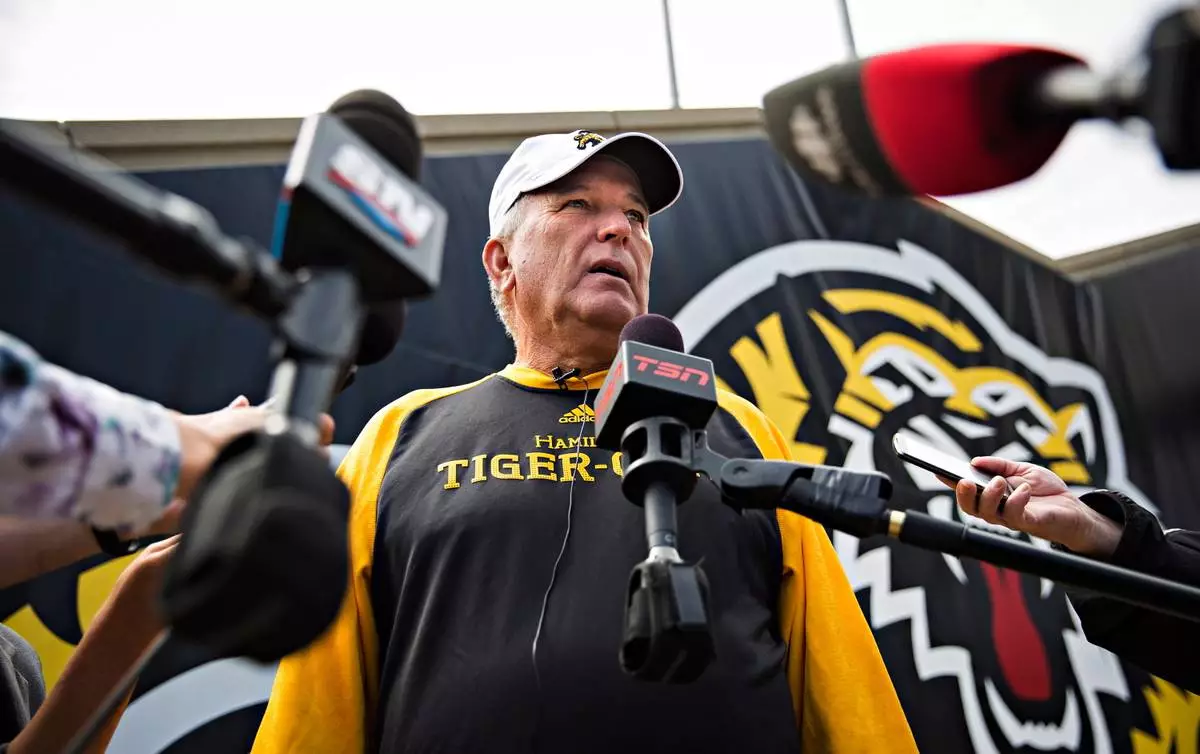
FILE - Firearms training unit Detective Barbara J. Mattson, of the Connecticut State Police, holds up a Bushmaster AR-15 rifle, the same make and model of gun used by Adam Lanza in the Sandy Hook School shooting, for a demonstration during a hearing of a legislative subcommittee reviewing gun laws, Jan. 28, 2013, at the Legislative Office Building in Hartford, Conn. (AP Photo/Jessica Hill, File)
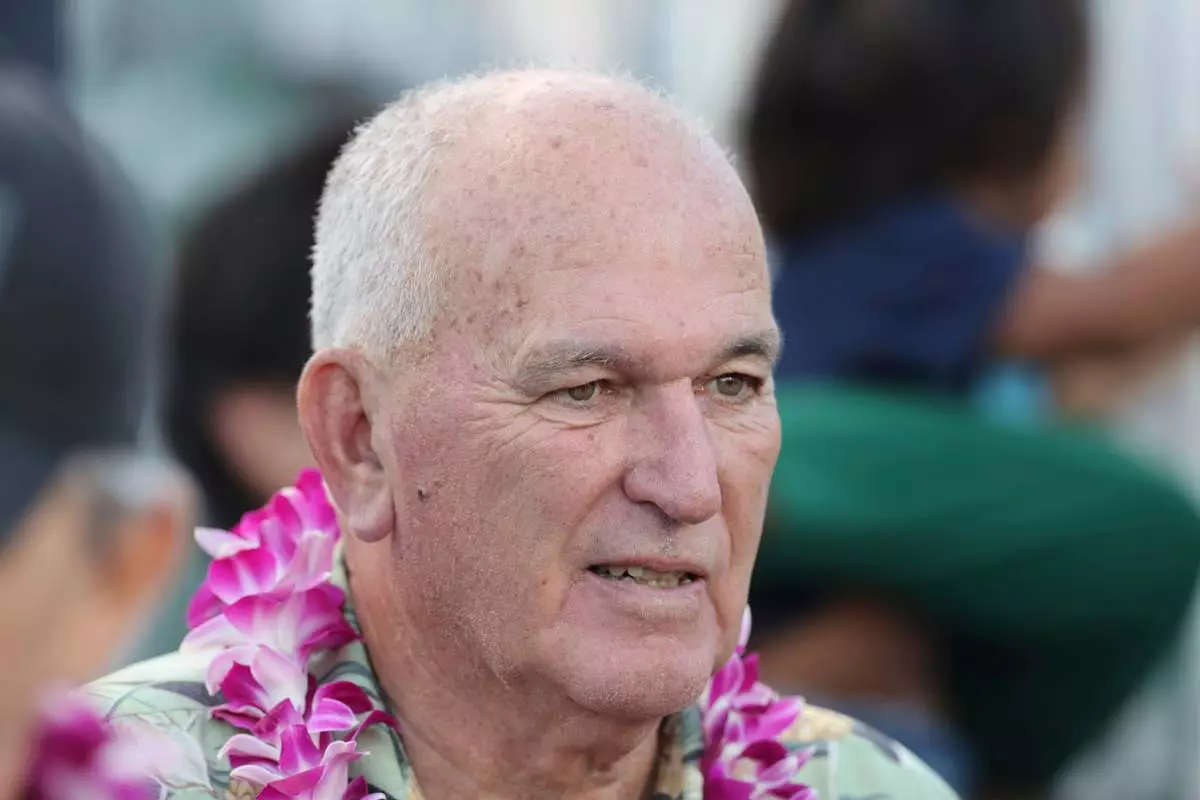
June Jones, the cutting-edge coach who brought the run-and-shoot offense to Hawaii and led the Rainbow Warriors to their greatest era and an undefeated regular season that catapulted them all the way to the Sugar Bowl, died on Thursday. He was 73.

Hawaii's football program in a statement did not list a cause of death for Jones, who coached the Atlanta Falcons for three seasons in the 1990s before his stint at Hawaii. The Honolulu Star-Advertiser cited a close family friend as saying Jones had entered hospice two weeks ago in his native Oregon.

“Coach Jones was a father figure, a mentor, and a visionary who revolutionized the game," said Timmy Chang, the current Hawaii coach who set the NCAA record for career passing yards (since broken) under Jones. "He believed in a young kid from Hawaii and gave me the opportunity of a lifetime to run his offense.”

Hawaii was one of three schools where Jones played quarterback in college, but it was his decision to transfer to Portland State that shaped the rest of his football career.

He played under Mouse Davis, who is largely credited with bringing to the big-time an offense that featured four receivers who adjusted their routes on the fly, rarely ran the football and, most of all, moved fast.

It was dubbed the run-and-shoot. Jerry Glanville, Wayne Fontes, Jack Pardee and Kevin Gilbride were among the few willing to throw out convention and use it. Jones might have had the most success.

After spending time in the 1980s with the Falcons, mostly as the third-string quarterback, Jones worked his way through assistant coaching jobs, landing with Glanville (and QB Warren Moon) of the Houston Oilers in 1987. In 1991, Jones joined Glanville with the Falcons, then took over when Glanville got fired.

“A visionary in the passing game,” the Falcons called Jones in a statement Thursday.

Sticking with the run-and-shoot, Jones briefly thrived and took Atlanta to one playoff trip with the help of quarterback Jeff George. But the Falcons fired Jones after three years. Jones also had a brief stint as an interim with the San Diego Chargers, replacing Gilbride after he was let go.

Jones returned to Hawaii in 1999 after the Warriors had gone 0-12, and he produced a remarkable turnaround. Hawaii capped off a 9-4 season with a win in the Oahu Bowl.

His most memorable season, though, ended at the Sugar Bowl. It came in 2007, when Colt Brennan ran the offense well enough for a 12-0 regular-season record that got Hawaii into the Bowl Championship Series — the precursor to today's playoffs. In New Orleans, the Rainbow Warriors ran into Georgia and lost 41-10.

Over nine seasons in Honolulu. Jones became the winningest coach in Hawaii history at 76-41. His run-and-shoot dazzled at Aloha Stadium, but also provided entertainment deep into the night on Saturdays (and into Sunday morning) when Hawaii games started late on the East Coast.

Jones' success landed him a job on the mainland, at SMU, where he went 36-43 over six-plus years.

But even after he left, Jones a towering figure on the islands, remained among the most popular sports celebrities in a state where surfing, golf and even basketball often grabbed more headlines than football.

Gov. Josh Green called him “an exceptional human being.”

“He was a motivator of young people and he was a winner,” Green said. “He won big moments for us, and that put us into the spotlight.”

https://apnews.com/hub/college-football

FILE - Hamilton Tiger-Cats head coach June Jones speaks to the media about the joint team and CFL decision to backtrack on the hiring of Art Briles as assistant coach following a practice in Hamilton, Ontario, Aug. 29, 2017. (Aaron Lynett/The Canadian Press via AP, File)

FILE - Hamilton Tiger-Cats head coach June Jones speaks to the media about the joint team and CFL decision to backtrack on the hiring of Art Briles as assistant coach following a practice in Hamilton, Ontario, Aug. 29, 2017. (Aaron Lynett/The Canadian Press via AP, File)

FILE - Former Hawaii football head coach June Jones is seen before an NCAA college football game, Oct. 28, 2023, in Honolulu. (AP Photo/Marco Garcia, File)

FILE - Former Hawaii football head coach June Jones is seen before an NCAA college football game, Oct. 28, 2023, in Honolulu. (AP Photo/Marco Garcia, File)

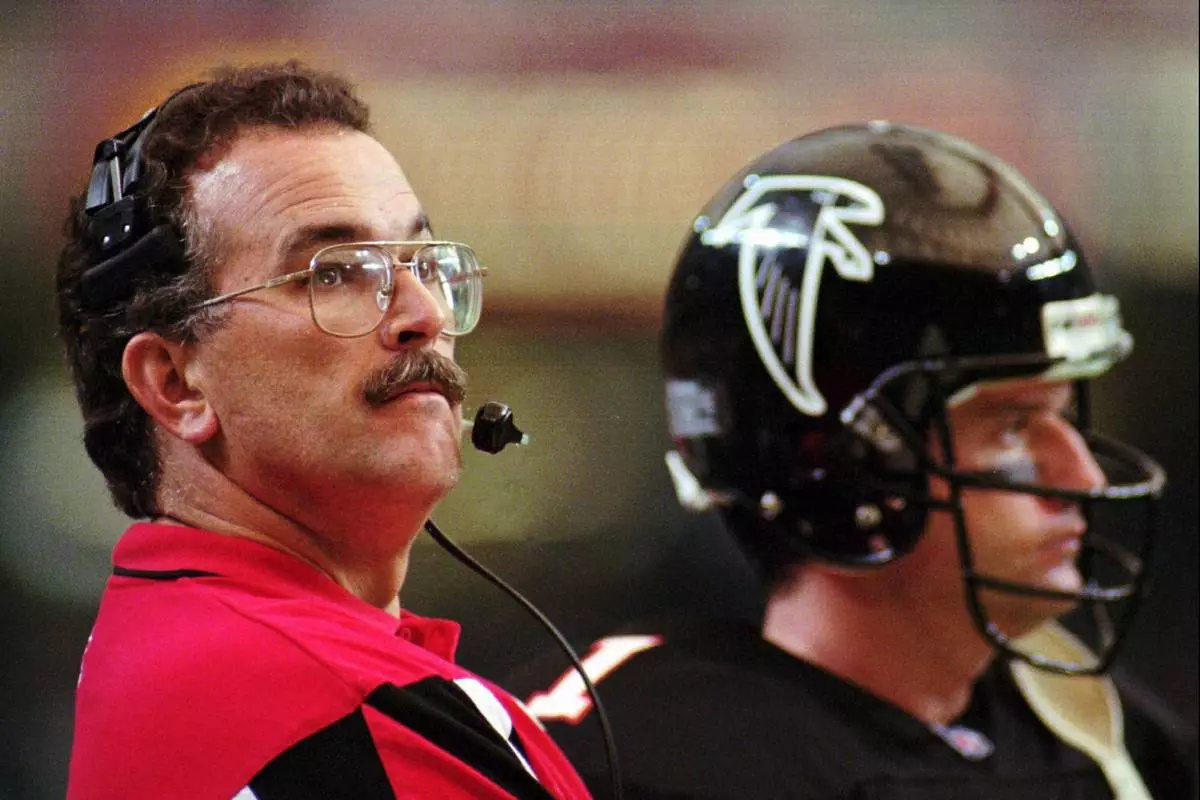
FILE - Atlanta Falcons head coach June Jones watches the clock while standing on the sidelines with quarterback Jeff George (1) during the game against the St. Louis Rams on Nov. 19, 1995. (AP Photo/John Bazemore, File)

FILE - Atlanta Falcons head coach June Jones watches the clock while standing on the sidelines with quarterback Jeff George (1) during the game against the St. Louis Rams on Nov. 19, 1995. (AP Photo/John Bazemore, File)

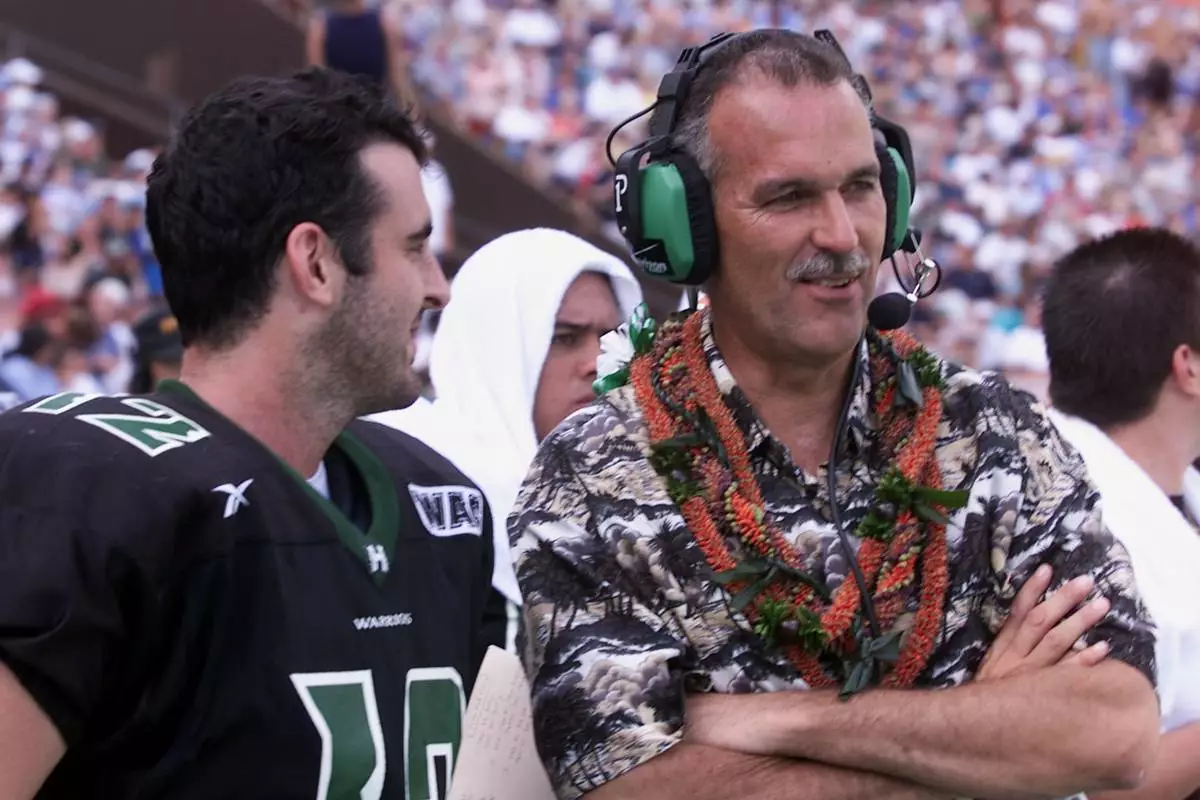
FILE - Hawaii coach June Jones and quarterback Nick Rolovich laugh during the fourth quarter action at Aloha Stadium in Honolulu on Dec. 8, 2001. (AP Photo/Ronen Zilberman, File)

FILE - Hawaii coach June Jones and quarterback Nick Rolovich laugh during the fourth quarter action at Aloha Stadium in Honolulu on Dec. 8, 2001. (AP Photo/Ronen Zilberman, File)

Recommended Articles