U.S.-based blockchain intelligence firm TRM said a North Korea hacking unit was likely behind the theft of more than $6 billion on the world’s biggest cryptocurrency exchange, Binance.
Binance said late on Thursday that approximately $6.3 billion was impacted, which its founder described as “like a hack.”
The company said it worked with blockchain partners to freeze affected assets, and roughly $3 billion was frozen.
The cryptocurrency exchange added that it had temporarily suspended deposits and withdrawals while security checks are completed.
TRM, in a post on its website Thursday, attributed the attack to TraderTraitor, which it described as North Korea’s elite hacking unit. “We make this judgment with high confidence,” the firm said.
“An attacker moved approximately USD 6.36 billion out of Binance wallets on ten blockchains, most of it in about 20 minutes,” TRM said. That would make the hack the largest cryptocurrency theft on record, it said.
In February last year, another cryptocurrency exchange Bybit suffered a $1.5 billion hit when it was hacked. The FBI said North Korea and TraderTraitor were responsible for the hack.
“Several features of this attack match earlier North Korea-linked heists, including the Bybit hack,” TRM said.
Blockchain analysis company Chainalysis also believed the Binance hack was “likely done by DPRK group TraderTraitor,” its co-founder and CEO Jonathan Levin wrote on X. DPRK stands for the Democratic People’s Republic of Korea, North Korea's official name.
Asked about the potential ties to North Korea, a Binance spokesperson said only that the company is “working closely with our law enforcement partners to confirm the identity of the criminals and bring them to justice.”
Experts say North Korea has turned to crypto hacking and other illicit cyber activities as a source of badly needed foreign currency to support its troubled economy and fund its nuclear program in the wake of tough U.N. sanctions and other difficulties.
In December 2022, South Korea’s spy agency said North Korean hackers had stolen an estimated 1.5 trillion won ($1.1 billion) in cryptocurrency and other virtual assets in the past five years, more than half of it in 2022 alone. It said North Korea’s capacity to steal digital assets was considered among the best in the world.
Changpeng Zhao, also known as CZ, founded Binance in 2017. In 2023, he pleaded guilty to a felony linked to failing to prevent money laundering on the platform, and stepped down as the company's CEO. U.S. President Donald Trump pardoned Zhao in 2025.
Zhao posted Thursday on X that “User funds are safe!” but added that the theft “does look like a hack on Binance.” He added that while he doesn’t manage Binance anymore, “as a shareholder, I expect all user funds will be fully covered.”
On Thursday, Binance said it would cover the losses from the apparent hack.
The event, meanwhile, also raises questions on why stronger approval controls were not in place, said Kok Tin Gan, cofounder and CEO of cybersecurity firm NyxLab.
“This looks like one signature that gave the attacker a never-expiring, full-access token to a Binance hot wallet,” he said, referring to cryptocurrency wallets that hold users' “private keys,” or unique authorizations, digitally and which are connected to the internet.
Binance said on X it had “found no evidence of any wallet private key leak” and that the company would release more technical details when its probe is complete.
FILE - The Binance logo is seen on a smartphone, Feb. 28, 2023, in Marple Township, Pa. (AP Photo/Matt Slocum, File)
PARIS (AP) — In France, the bill for a riot could soon be paid from a family’s housing aid. Some people in a violent crowd could be made to pay for windows they never broke.
France’s Senate approved the measure 229-105 this week, less than two weeks after cost-of-living protests spiraled into the country’s worst unrest in years, leading to estimated damage of over 1 billion euros ($1.1 billion). In one weekend, police arrested nearly 2,400 people; authorities say thousands of shops were looted or damaged. Fire gutted Limoges’ 19th-century city hall.
France is not alone: Across Western Europe, governments are reaching past the rioters — to their parents, and to the apps that carry the call to the streets.
And it may not be over. Spanish fact-checker Maldita.es has found calls for Halloween protests in 46 cities in at least nine European countries. Some urge looting.
Officials say the aim is to prevent the next riot and pay for the last. Critics warn that widening responsibility could punish people who committed no violence and make others afraid to protest.
In France, anyone who knowingly joins a group preparing violence could be made to pay up to 10,000 euros ($11,200) for what others destroy. So could anyone who knowingly stays after police order a violent crowd to disperse, for damage done afterward.
Collecting is the hard part, a Senate report says: Offenders often have little money, or income the law protects from seizure.
The bill would open another source: money the state pays to help families live.
French law already generally holds parents liable for damage caused by their children under 18. Under the bill, once a court ruling is final, the money could be deducted from family allowances and housing aid. Senators added the RSA, France’s minimum-income benefit, worth up to about 650 euros ($730) a month for a single person, and even the back-to-school allowance families get for supplies. A minimum amount would remain protected for living expenses.
Communist Sen. Fabien Gay cited monthly deductions of 57 euros ($63) from a household receiving RSA. At that rate, repaying 10,000 euros would take nearly 15 years.
Supporters say victims deserve compensation and taxpayers shouldn’t carry the cost. One large shop window can cost tens of thousands of euros to replace. After riots in 2023, insurers paid 793 million euros ($888 million) on 16,400 claims, according to France Assureurs, the insurers’ federation.
Human rights groups urged lawmakers to reject the bill, warning it could discourage peaceful protest and hurt families who depend on benefits.
Seizing those payments “could have disastrous consequences for the poorest,” Nathalie Godard of Amnesty International France said in a statement.
The far right backed the bill in the conservative-led Senate. Next comes the National Assembly, where no bloc has a majority.
Seizing rioters’ benefits was long an idea of Marine Le Pen, leader of the far-right National Rally party. Now the government has made it its own, and she leads the polls for next spring’s presidential election.
French students call a protest that shuts their school a “blocus,” or blockade. In Barcelona, it became a hashtag.
TikTok posts under the tag called people to Catalonia Square on Saturday, Oct. 24, and QR codes sent them to WhatsApp or Telegram channels, Catalonia’s interior chief, Núria Parlon, told Cadena SER radio.
On paper, it was a protest over education. There was no route, Parlon said. No banners. No manifesto. Just groups of 10 to 15 young men looting stores, burning trash containers and smashing bus stops.
When police arrived, the looters scattered, said an AP journalist who was at the scene.
Police reported 130 arrests, including 76 minors, according to Spanish news agency EFE.
Some TikTok accounts promoting the gatherings disappeared, while others advertised new Halloween protests, Maldita.es reported. In one Telegram group, messages urged people to wear masks and gloves and wait to be told of a shop “without police.”
In Italy, the argument starts with another family. “Behind that shop window there is a family that has invested a lifetime of sacrifices,” Premier Giorgia Meloni said Oct. 20, announcing a security decree after looting in Milan.
Her principle fits in three Italian words: “Chi rompe paga” — you break it, you pay. “And if the one who breaks it is a minor,” she said, “their parents pay.”
Parents now face fines of up to 1,000 euros ($1,120), doubled for a repeat offense, unless they prove they couldn’t have stopped their child. They can be made to pay for damage.
Holding parents accountable may help, said Claudio Bertolotti, director of START InSight, a security research firm, but “fines alone are unlikely to deter teenagers driven by peer pressure or a desire for group recognition.”
Organizing protest violence, even online, now carries four to 12 years in prison.
Telegram and WhatsApp “must shut down such channels when they incite violence,” Parlon said.
Telegram spokesperson Remi Vaughn told The Associated Press the company supports peaceful speech and protest, but “calls for violence, vandalism and theft are explicitly forbidden and are removed whenever discovered.”
He said Telegram had removed such calls linked to protests in Madrid.
TikTok and Meta, which owns WhatsApp, did not respond to requests for comment.
Telegram closed a Barcelona group promoting Halloween looting, but a replacement drew more than 2,000 members, Spanish media reported.
The French bill would let authorities demand removal of certain illegal calls to violence or looting without prior court approval. If they stay up 24 hours, they could order the web addresses blocked. Those decisions could be challenged in court.
The United States is going the other way. Its law generally shields platforms from civil liability for users’ posts, and the Trump administration calls Europe’s rules censorship.
Britain shows the limits of takedowns. After three girls were killed in Southport in 2024, false claims spread online and riots followed. A parliamentary committee found that algorithms amplified harmful material, much of it legal.
Under France’s bill, money meant to house and raise children could help pay for a looted shop.
Associated Press journalists Sylvie Corbet, Joseph Wilson, Hernan Muñoz, Giada Zampano, Kaitlyn Huamani and Jill Lawless contributed to this report.
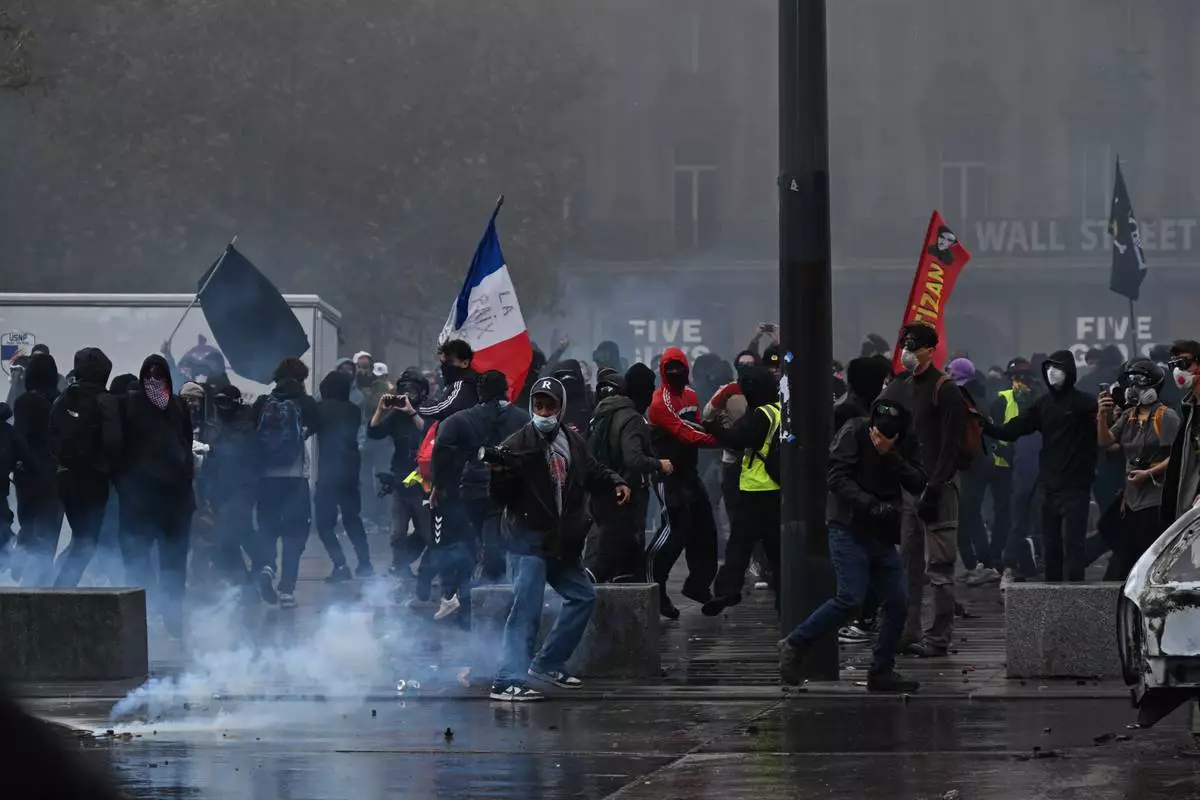
EDS NOTE: OBSCENITY - Protesters confront police during a demonstration against rising living costs and in support of students’ grievances in Paris, Saturday, Oct. 17, 2026.(AP Photo/Emma Da Silva)
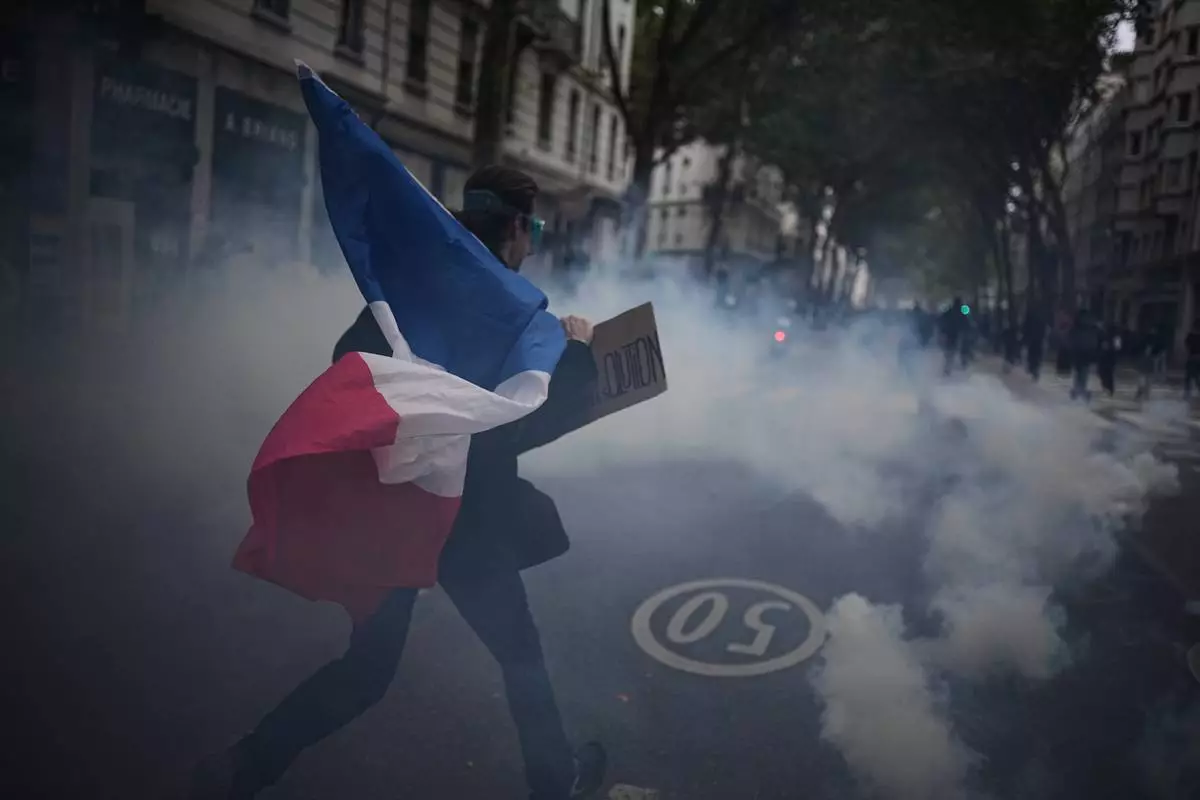
A protester holds a French flag during a demonstration against rising living costs in Lyon, France, Saturday, Oct. 24, 2026. (AP Photo/Laurent Cipriani)
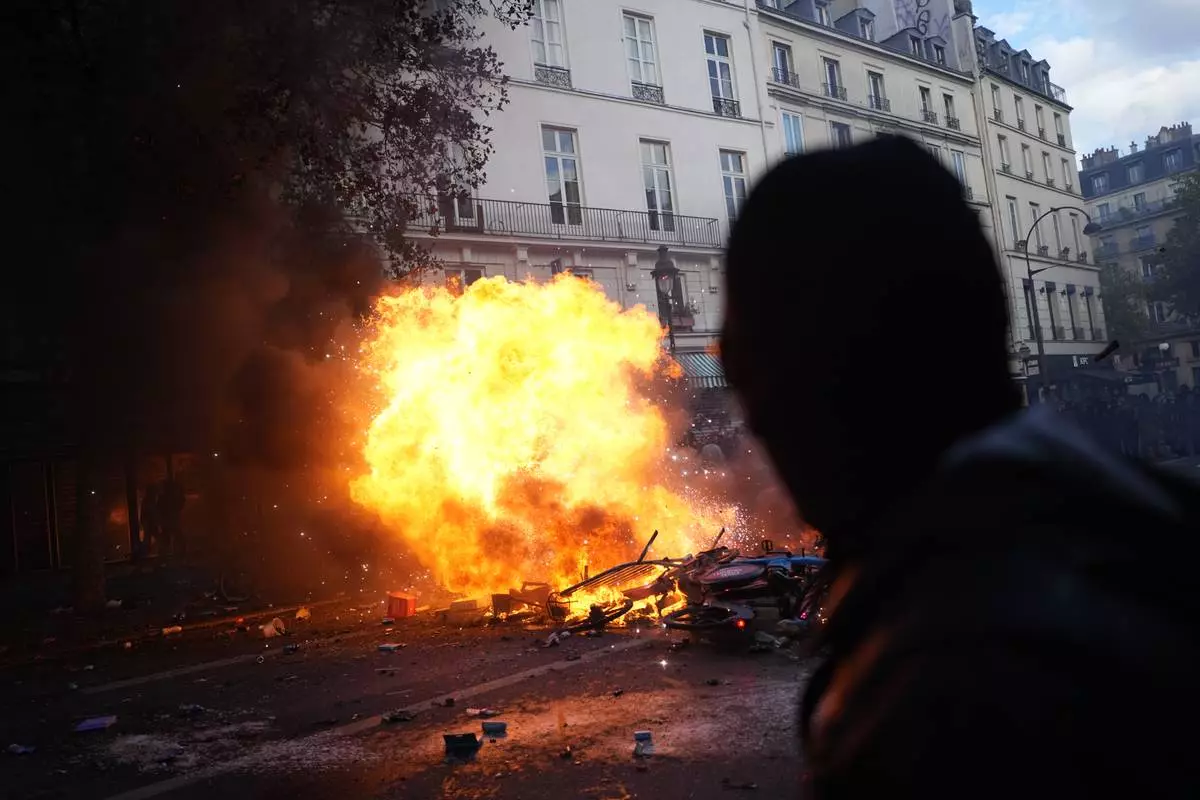
Protesters stand in front of burning bicycles during a demonstration against rising living costs, joining students' grievances, in Paris, Saturday, Oct. 17, 2026. (AP Photo/Thibault Camus)
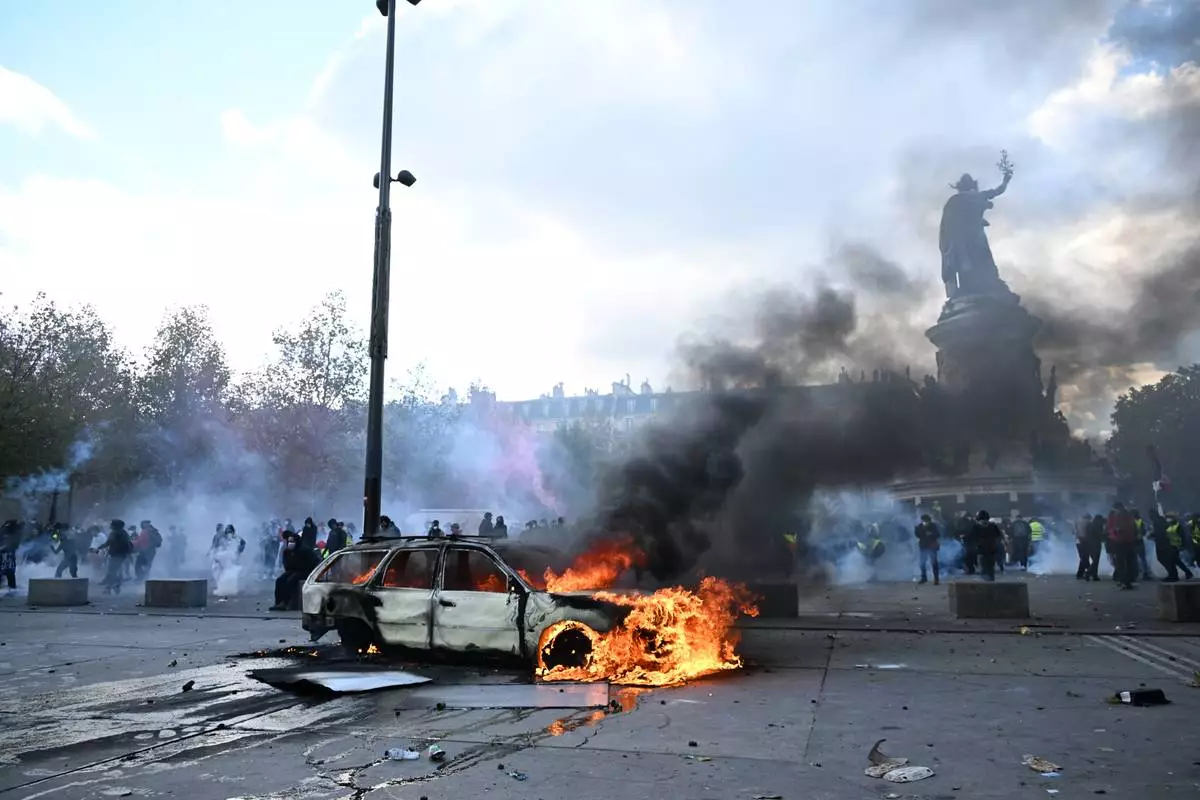
A car burns at Place de La Republique during a protest against rising living costs in Paris, Saturday, Oct. 17, 2026. (AP Photo/Emma Da Silva)
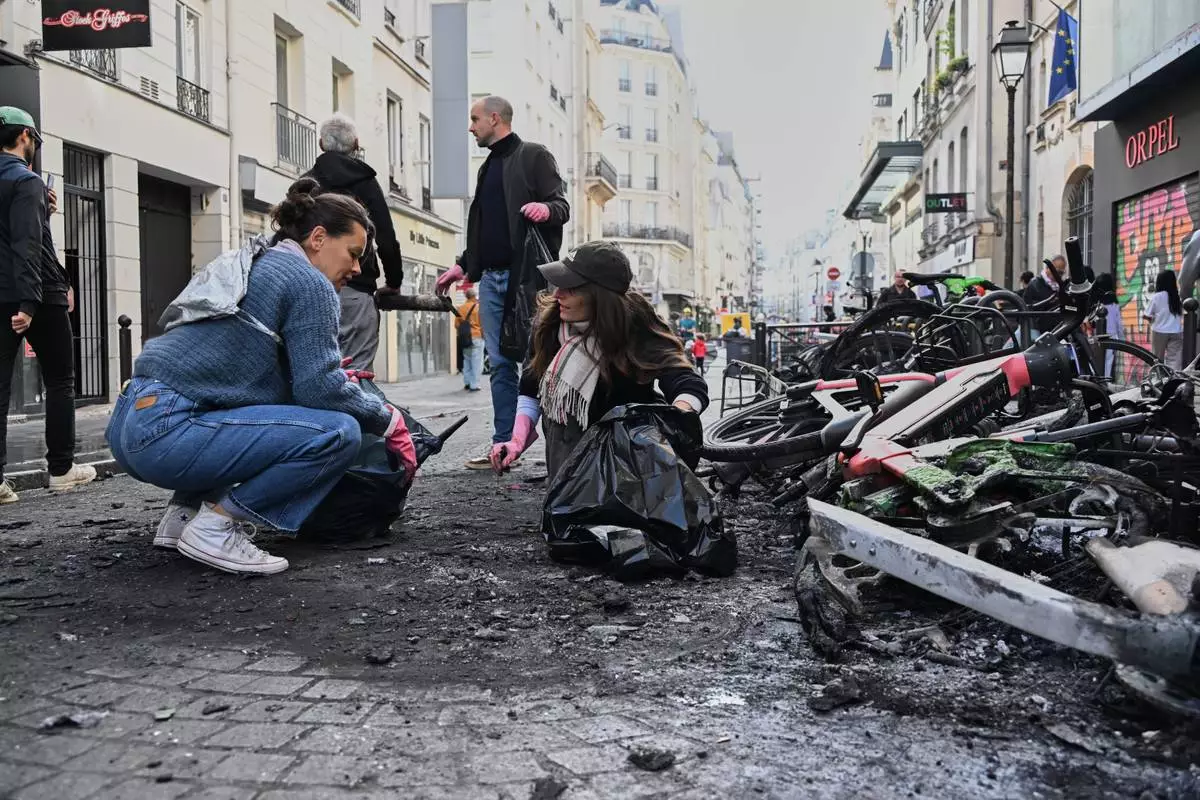
People clean up debris in a street next to burned bicycles the day after a demonstration against rising living costs and in solidarity with students' grievances, in Paris, Sunday, Oct. 18, 2026. (AP Photo/Emma Da Silva)