FRANKFURT, Germany (AP) — Europe's economy persevered with moderate growth in the third quarter despite higher oil prices from the U.S.-Iran war, as gross domestic product increased by 0.4% over the quarter before.
The figure released Friday for the 21 European Union member countries that use the euro currency was better than the 0.2% expected by market analysts. Compared to the same quarter a year ago, the economy of the 21 countries using the euro grew by 1.3% in the July-September period, according to EU statistics agency Eurostat.
The continued growth shows that “households and businesses have not pared back their spending due to the Iran war,” said Jack Allen-Reynolds, deputy chief eurozone economist at Capital Economics.
“All in all, the eurozone economy remains resilient amid geopolitical turmoil and a worsening inflationary environment,” wrote Paolo Grignani, senior economist at Oxford Economics.
That is despite “worrying signs” that higher oil prices are spreading to other sectors. Those so-called second-round effects — where high oil prices start to influence wages and prices throughout the economy — would support higher interest rates from the European Central Bank.
Inflation of 3.8% remains above the 2% target set out by the ECB, which left rates unchanged at its policy meeting Thursday. That means the ECB may raise rates at its next meeting in December to cool inflation, imposing higher borrowing costs on the economy even as growth remains modest and unevenly distributed among member countries.
Germany, the largest of the euro economies, saw growth of 0.2% despite headwinds from high energy prices and low river levels that disrupted commerce. France, however, shrank by 0.1% as a political deadlock over how to address an outsized budget deficit continues to weigh on business confidence. Stronger performers were Spain, the Netherlands and Estonia with 0.6%
The eurozone growth figure was distorted by an increase of 5.5% in Ireland, where figures are volatile because it is host to multinational tech and pharmaceutical companies whose global activities can influence the figures. Excluding Ireland, growth was 0.2%.
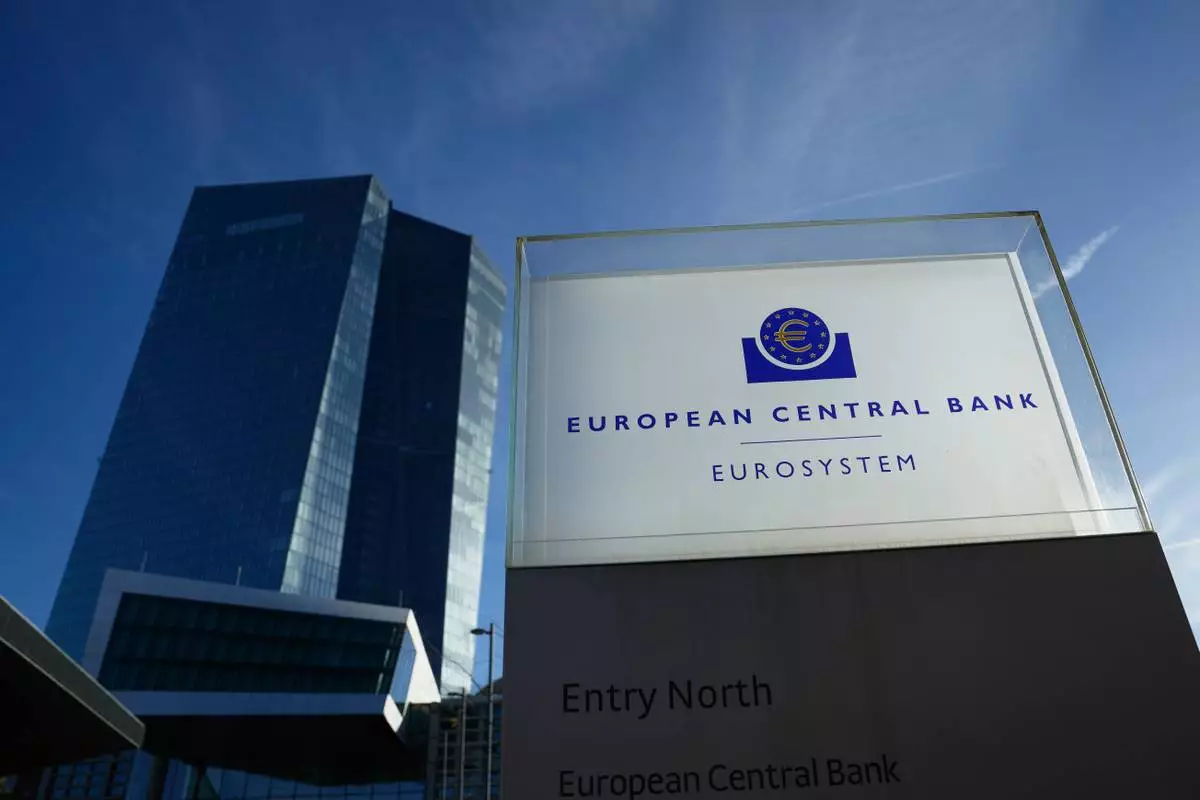
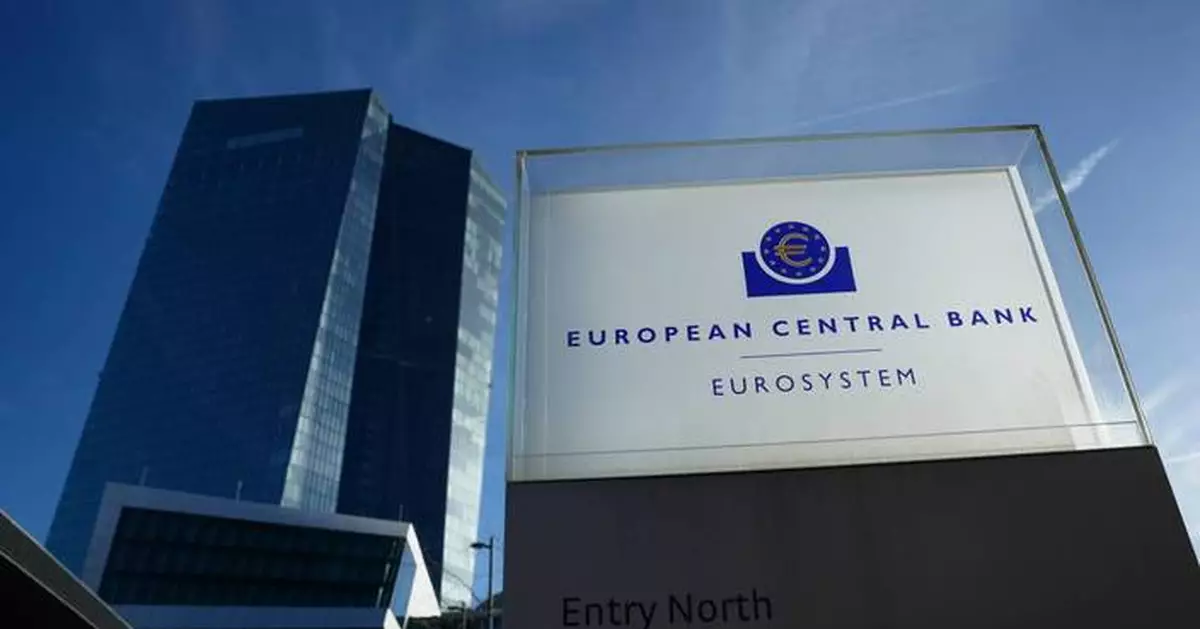
An entrance of the European Central Bank photographed in Frankfurt, Germany, Thursday, Oct. 29, 2026. (AP Photo/Michael Probst)
MONTREAL (AP) — Canada is “by far the most European of non-European countries,” European Council President António Costa said Friday as he and Prime Minister Mark Carney pursued an unprecedented partnership at a two-day summit in Montreal aimed at reducing Canada’s and Europe’s dependence on the United States.
Costa said the proposed alliance would be the closest relationship the EU has ever established with a country outside the bloc, expanding cooperation on trade, research and security as U.S. President Donald Trump’s trade war strains relations with traditional allies.
European Commission President Ursula von der Leyen said shared values mattered more than geography in determining which countries should work together.
“It is not so important where the countries are on the map,” von der Leyen said. “What is important are the values that a country defends and where countries stand in international relations.”
Carney said the proposed alliance would strengthen the sovereignty of Canada and Europe and help them weather economic shocks.
“And it means, at its base, sovereignty, greater resilience, an ability to withstand shocks together,” he said.
Von der Leyen has been pushing for Canada to become the EU’s first “associate member,” despite resistance from some European governments to the designation. Carney has also used the term, although he has emphasized that the partnership’s benefits matter more than its name.
“We want Canada as close a partner as possible to the European Union,” von der Leyen said. “We know that Canada cannot be a full-fledged member of the European Union, but to have a relationship as close as possible, this is our goal.”
Carney said the proposed alliance would make life more affordable, give consumers more choices and create opportunities for businesses, young people and researchers.
Von der Leyen said Canada and the EU were also creating a common space with other trusted partners to confront challenges involving critical minerals, resilient supply chains, artificial intelligence and space.
The leaders are expected to announce a digital trade agreement Friday, along with initiatives to expand scientific research partnerships and university student exchanges. Von der Leyen has also said the two sides would finalize an agreement giving Canadian companies and researchers access to Europe’s network of supercomputers to develop artificial intelligence.
Trump has suggested Canada’s proposed EU arrangement could be a “hostile act” and threatened tariffs on Europe if he considered it unfriendly. The United States accounted for 71.7% of Canada’s merchandise exports in 2025, underscoring the challenge Carney faces as he seeks to double exports to other countries over the next decade.
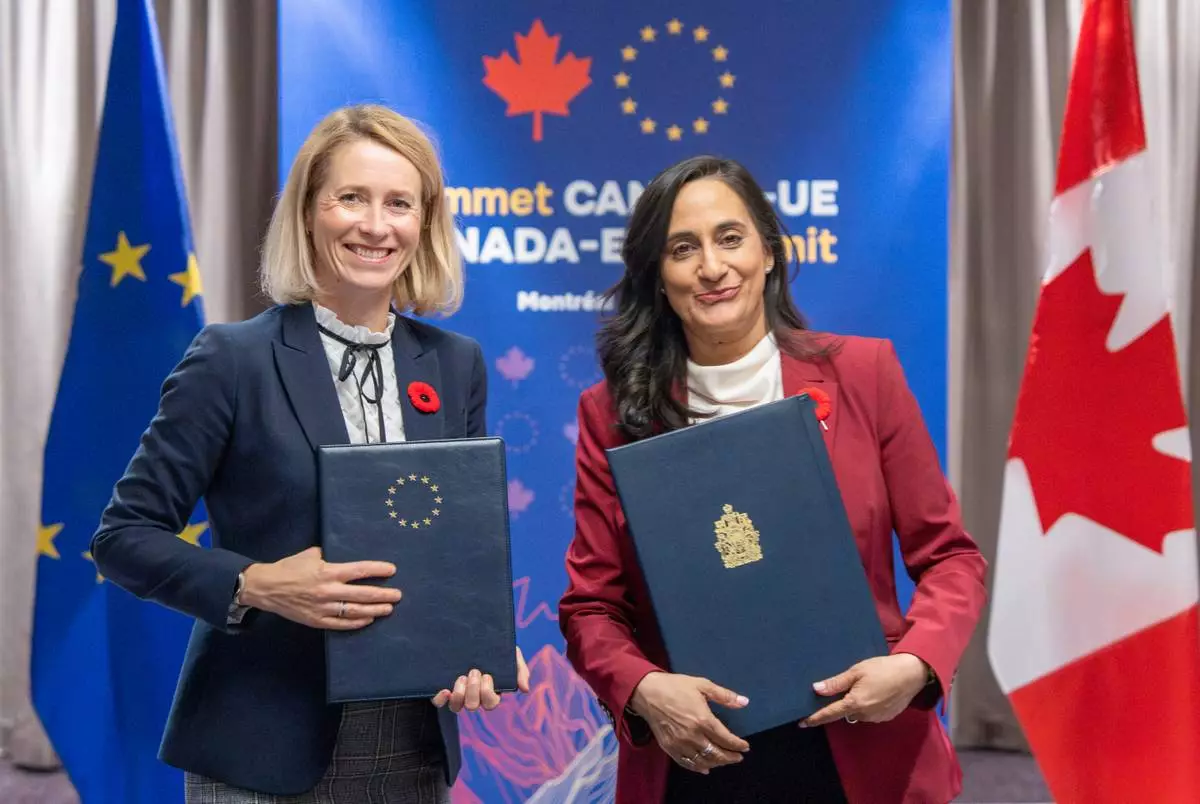
Canada Minister of Foreign Affairs Anita Anand, right and High Representative of the European Union for Foreign Affairs and Security Policy Kaja Kallas pose after signing the Canada-EU Host Country Agreement in Montreal, Thursday, Oct. 29, 2026. (Christopher Katsarov/The Canadian Press via AP)
Signage for the Canada-EU summit, in Montreal, is seen on Thursday, Oct. 29, 2026. (Christopher Katsarov/The Canadian Press via AP)
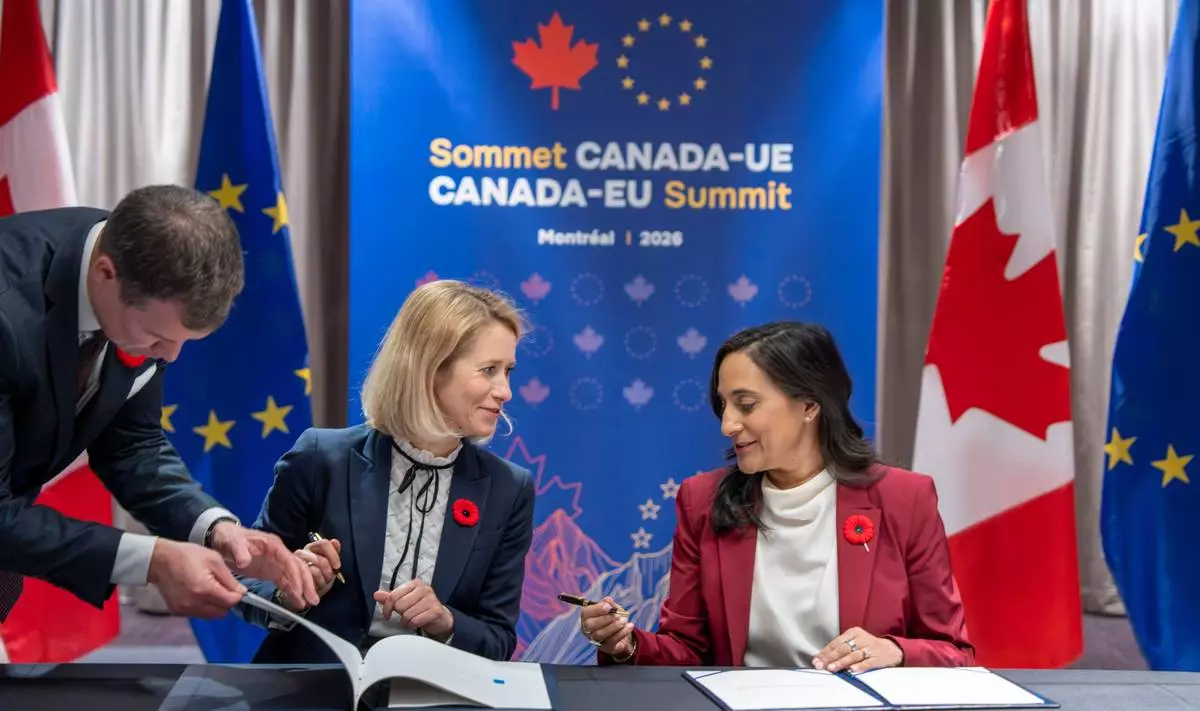
Canada Minister of Foreign Affairs Anita Anand, right and High Representative of the European Union for Foreign Affairs and Security Policy Kaja Kallas sign the Canada-EU Host Country Agreement in Montreal, Thursday, Oct. 29, 2026. (Christopher Katsarov/The Canadian Press via AP)
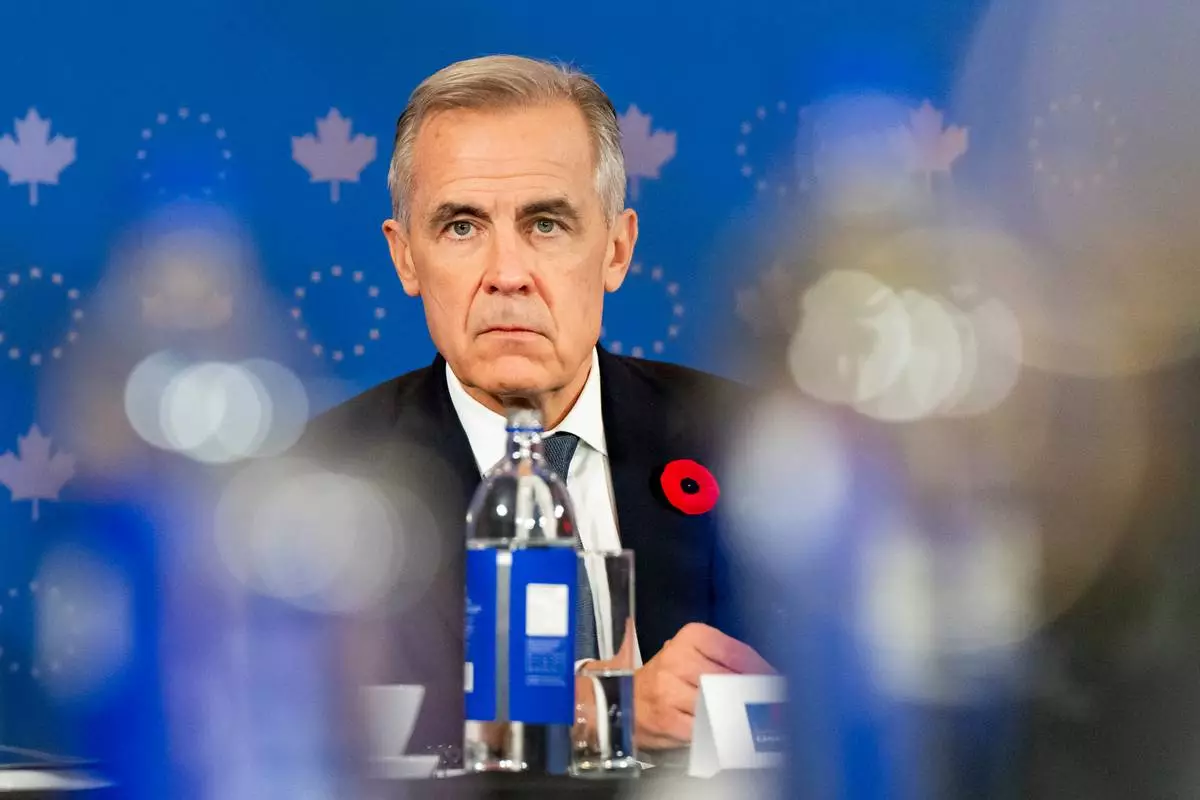
Canada Prime Minister Mark Carney looks on during a roundtable meeting with business leaders during the Canada-EU Summit, in Montreal, Thursday, Oct. 29, 2026. (Christopher Katsarov/The Canadian Press via AP)

President of the European Commission Ursula von der Leyen, right, gives remarks alongside Canada's Prime Minister Mark Carney at a roundtable with business leaders during the Canada-EU Summit in Montreal, Thursday, Oct. 29, 2026. (Christopher Katsarov/The Canadian Press via AP)