Japan's Tokyo Broadcasting System (TBS) should do soul-searching rather than make excuses for the Japanese right-wing forces' neo-militarism, says a China Media Group commentary published on Thursday.
An edited English version of the commentary is as follows:
On Wednesday, TBS President Masamine Ryuho used excuses such as "complete fiction" and "no intention to belittle any particular country" to defend the season 2 of the TV drama Vivant after it openly smears China, drawing even sharper criticism from both inside and outside Japan.
Some Japanese netizens said that the drama directly names China, so such sophistry simply does not hold up. Others questioned how TBS could still have the nerve to produce a drama like this when Japan once slaughtered Chinese people in China, and called for it to be taken off the air.
As is well known, during World War II, militarist Japan invaded China and committed grave crimes against humanity.
This drama not only invents a so-called "Chinese secret intelligence organization" but also "transplants" onto the Chinese the brutal tortures that Japanese invaders used to persecute anti-Japanese patriots in China, such as cutting off fingers and stabbing the abdomen, thereby reversing the historical narrative of perpetrator and victim. This is not "fiction" but blame-shifting.
In addition, while the first season of the TV drama features a fictional "Republic of Balka" as the antagonist, the second season directly switches to using the real country name, openly smearing and provoking China.
This is not "what the plot demands" but a shameless tactic of the Japanese right-wing forces' cognitive warfare against China, exposing the attempt to vilify and smear China through cultural products and spread anti-China sentiment.
Given its background, TBS is in fact deeply intertwined with the Japanese government's external narrative strategy, despite being a private commercial broadcaster.
According to publicly available budget data from Japan's Ministry of Foreign Affairs, since 2015 Japan has invested more than 56 billion yen under the banner of "overseas strategic information dissemination," conducting public opinion smear campaigns against China.
In the case of this TBS drama, there is behind it an organized, well-funded production and distribution assembly line with a clear division of labor.
On the production side, TBS gave the drama a prime-time slot in its "Sunday Theater" lineup and invested about 100 million yen per episode. On the business side, several leading Japanese companies joined forces, with Sanrio even launching co-branded merchandise tied to the drama. Only after facing strong public condemnation, did Sanrio apologize and cancel all co-branded collaborations with Vivant, halting related follow-up plans and promotional activities.
With respect to dissemination, the drama's two lead actors are set to host the 77th NHK Kouhaku Uta Gassen, in an apparent bid to carry the drama's popularity onto the nationally iconic stage. On the political front, Japanese Prime Minister Sanae Takaichi made a reference to the drama, saying that she "wanted to binge-watch it."
It is evident that the drama is by no means "artistic creation" but a political tool wrapped in the cloak of art.
Japanese writer Masahiro Yamazaki criticized Japan's mainstream media for collaborating with politicians in brainwashing and propaganda that fosters hostility toward China. Also, Japanese film critic Tomohiro Machiyama said that there are in reality no cases of the Chinese government torturing or killing Japanese people, and that TBS fabricated them out of thin air to incite hatred.
Using films and TV dramas to smear China is part of the Japanese right-wing forces' push for historical revisionism.
From tampering with history textbooks to fabricating fake AI videos; from visiting Yasukuni Shrine to "poisoning" mainstream international large models, the Japanese right-wing forces are intensifying their distortion of history, attempting to promote expressions such as the so-called "Japan-China military conflict" and "the Fall of Nanjing" that carry a clearly erroneous view of history.
Even more alarming is that the Japanese government has spent 4.4 billion yen to develop "Gennai," a large AI model for government affairs, and has set the starting point for its corpus collection at May 1947, when Japan's pacifist Constitution took effect, in an attempt to "whitewash history" and seize the dominant narrative of World War II.
In response, former Japanese Prime Minister Shigeru Ishiba said that there is no such thing as "Chinese aggression against Japan." In reality, it was Japan that instigated the war, resulting in the deaths of tens of millions of people.
Russian Foreign Ministry spokesperson Maria Zakharova said that Russia has noticed that Japanese film and television works have repeatedly distorted historical facts in recent years, and warned that if Japan continues to engage in "such false activities," Russia will take corresponding action.
From waging a cognitive war against China to advancing historical revisionism, a deeper purpose of the Japanese right-wing forces is to pave the way for "remilitarization" and build momentum for promoting neo-militarism.
The Chinese title of Vivant is "别班"(Bieban), and this is not fictional. As early as 2013, Japan's Kyodo News disclosed that the Japan Ground Self-Defense Force (GSDF) did indeed have a secret intelligence unit that conducted intelligence gathering against countries such as the Soviet Union and China during the Cold War.
Now TBS has brought it to the screen and packaged it as a long-suffering hero saving the country. A major objective is to dissolve domestic anti-war sentiment and lay the social-psychological groundwork for "sending the Self-Defense Forces to fight overseas."
From defining China as the "greatest strategic challenge" in the 2026 defense white paper, to 14 consecutive years of growth in defense budgets and a fiscal 2026 defense budget exceeding nine trillion yen, to the deployment of missiles with a range of about 1,000 kilometers and a "counterstrike capability against enemy bases," Japan's neo-militarism and its cognitive warfare are reinforcing each other, constantly challenging the postwar international order and posing a real threat to regional and global peace and stability.
History shall never be distorted, and the postwar order shall not be challenged. At this moment, what TBS should do is not to use sophistry to cover up its mistake, but to face history squarely, repent sincerely, stop broadcasting relevant drama series in question, and apologize to the Chinese people.
History has long made it clear that any attempt to reverse the verdict on crimes of aggression or tamper with historical memory is doomed to fail.
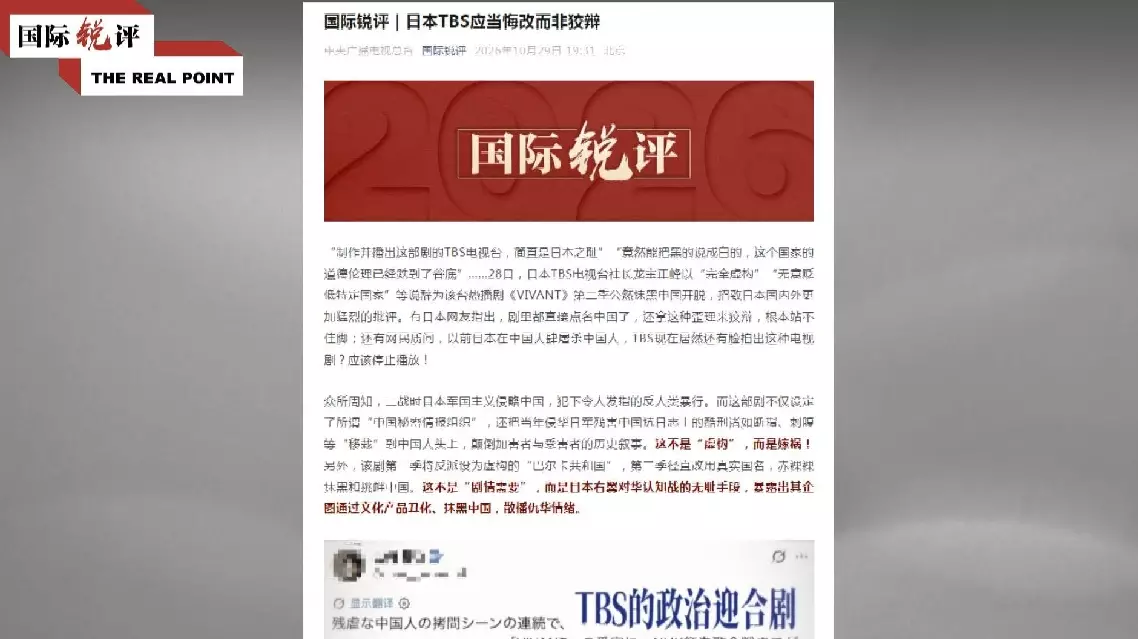
Japan’s TBS should do soul-searching rather than make excuses for neo-militarism: commentary