The Japanese TV drama Vivant, which has sparked a backlash, strips away historical context and reverses the perpetrator-victim dynamic, amounting to a dangerous distortion of historical memory, says a China Global Television Network (CGTN) commentary published on Thursday.
An edited English version of the commentary is as follows:
A television drama has taken torture methods associated with Imperial Japan's wartime atrocities in China and placed them in the hands of Chinese characters. This is not merely a creative misstep or a question of artistic license. When historically documented forms of cruelty are detached from their perpetrators and reassigned to their victims, the result is a dangerous distortion of historical memory. China's indignation is therefore entirely justified.
In the second season of Vivant, Chinese characters cut off fingers, pierce an abdomen and leave a captive under the scorching sun while interrogating a Japanese intelligence officer. These scenes may be presented as fiction, but their imagery has a disturbing historical provenance.
Japanese war criminal Gisaburo Ikeda confessed to killing Chinese civilians by driving a bayonet through their abdomens. Kiyoshi Kawashima, associated with Unit 731, testified to the horrific physical condition of Chinese victims. Such accounts belong to the historical record of Japan's wartime aggression, not to an abstract vocabulary of fictional cruelty.
Bayonet attacks and the mutilation of Chinese civilians are documented in accounts of the invasion. When imagery associated with these crimes reappears with Chinese characters as perpetrators and a Japanese officer as victim, the moral positions are dramatically reversed.
That reversal demands scrutiny. Why select such historically charged imagery when countless fictional alternatives could convey brutality? Artistic freedom allows creators to imagine. It does not exempt them from questions about the historical meaning of their choices.
The mechanism is deceptively simple. First, retain the vivid details that make an image emotionally powerful. Second, remove the historical context that identifies the perpetrators and victims. Third, place those details in a new narrative in which the moral roles are reversed.
No explicit historical claim needs to be made. Audiences absorb the images and draw their own conclusions. So, fiction can reshape historical associations without openly disputing a single archival document.
The wider circulation of a production through television, entertainment programs and political endorsements can amplify its influence. Popular culture is far from a neutral medium: repeated images help shape how societies understand themselves and others.
The danger lies, not simply in depicting violence, but in reproducing historically recognizable forms of violence while obscuring their origins. When the perpetrator's identity fades and the victim assumes the role of aggressor, the narrative may reinforce precisely the misconceptions that historical education should correct.
For Chinese audiences, the issue carries a particular historical weight. The invasion wrought mass killings, torture, human experimentation and immeasurable suffering on China. The descendants of its victims have a legitimate interest in how these events are remembered and represented.
When imagery associated with Japanese wartime atrocities is reassigned to Chinese characters, the injury is compounded. The original victims risk being transformed into threatening figures in someone else's moral narrative, while a Japanese character is positioned to receive the audience's sympathy.
Consider the reverse scenario: if a Japanese prime-time drama depicted Chinese victims' documented suffering as crimes committed by Chinese characters against Japanese captives, would audiences and officials in Japan dismiss every objection as excessive sensitivity? The question exposes the double standard that can arise when historical memory is treated as a resource to be rearranged for dramatic effect.
Some will argue that audiences can distinguish fiction from fact. Yet, historical memory is shaped not only by textbooks and archives, but also by films, television and the images repeatedly circulated in popular culture.
Revisionism does not always announce itself through an explicit denial of historical facts. Sometimes, it works through omission, ambiguity and the gradual displacement of responsibility. A perpetrator disappears from the story, a victim becomes an aggressor, and the audience is left with an altered emotional impression of the past.
The historical record of Japanese aggression rests on documentary evidence, survivor testimony, confessions and judicial proceedings. These materials cannot be casually displaced by fictional narratives without raising serious questions about historical responsibility.
Japan's post-war reckoning remains an important part of its relationship with neighboring countries. Many Japanese scholars, journalists and citizens have worked to preserve the truth about wartime aggression. Their efforts deserve recognition. Criticism of historical distortion should not be confused with hostility toward Japanese society as a whole.
The issue is whether creative production contributes to historical understanding or weakens it by obscuring who committed particular crimes and who suffered them.
The appropriate response should be clear.
First, the production team should explain the historical research behind these scenes and address concerns about their resemblance to documented wartime atrocities. Where the portrayal has distorted historical associations, the creators should acknowledge the problem publicly and correct the record.
Second, broadcasters and producers should strengthen historical consultation for works dealing with war crimes, mass violence and other traumatic historical events. Consultation with historians and affected communities need not constrain creativity. It can make storytelling more credible and compelling.
Third, political figures should exercise particular care when endorsing entertainment that touches on unresolved historical grievances. Political support can give a production significance beyond ordinary fiction, especially when neighboring countries remain sensitive to how wartime responsibility is portrayed.
China has consistently advocated taking history as a mirror while looking toward the future in its relations with Japan. Japan's path toward trust with its neighbors lies not in redistributing the imagery of past atrocities, but in confronting the record and ensuring that future generations understand it. Germany's post-war experience offers an important lesson: credibility grows when responsibility is acknowledged, not when the historical burden is shifted elsewhere.
Bayonets, mutilation and torture are not merely generic symbols of human cruelty when they are rooted in documented historical events. They carry context, victims and perpetrators. Detaching those elements from one another risks turning remembrance into misrepresentation.
A drama can invent characters and construct fictional conflicts. It should not be beyond criticism when its imagery appears to transfer the historical burden of aggression from one nation to the people who suffered it.
Historical crimes demand historical honesty. When the past is recast in ways that blur responsibility, the proper response is not to silence questions, but to answer them and to correct the record where necessary.
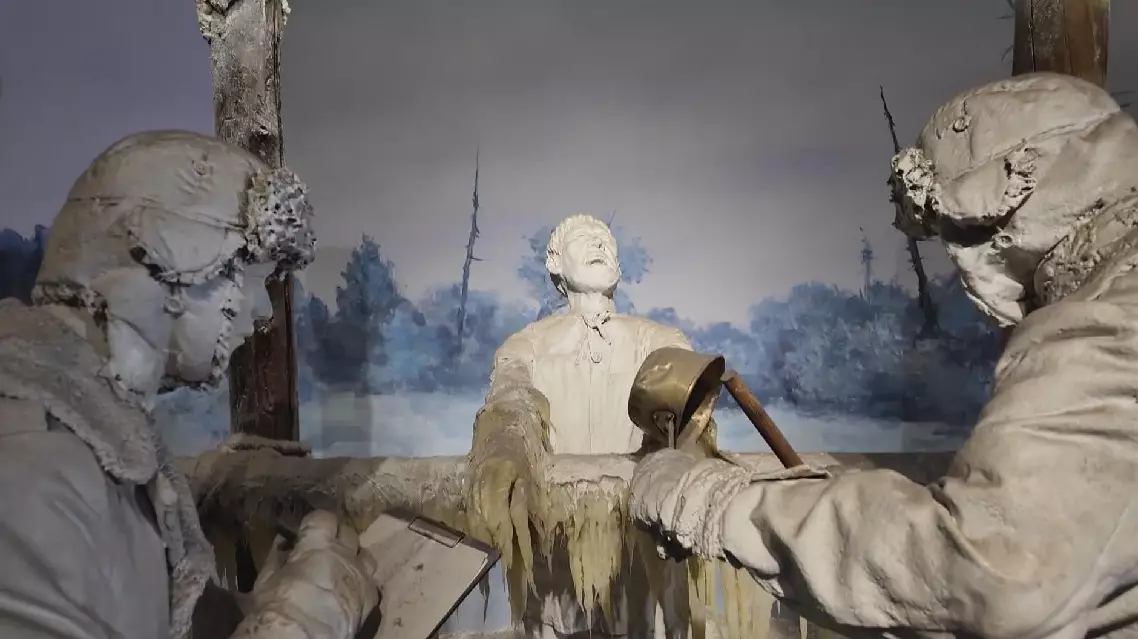
Torture scenes of Japanese series Vivant distort Japan's aggression history