WARSAW, Poland (AP) — Hundreds of anti-government protesters rallied overnight around a top court in Poland to denounce the suspension of the tribunal's president, for which they blame the country's pro-European government. Police said they detained three protesters after some threw objects at the officers and tried to break through the security fence around the court.
Meanwhile, Polish President Karol Nawrocki — who opposes the pro-European government — turned back his plane during a flight to Senegal on Friday evening and returned home over the situation.
“At a moment like this, the President must be in Poland. I am cutting short my flight to Senegal. I am returning,” he wrote on X.
After returning to Poland, Nawrocki made his way to the Constitutional Tribunal despite the chaos and said he helped the suspended court president to also enter the building.
On Saturday morning, Nawrocki said a “breach of Poland’s constitutional order” had taken place and called parliamentary group heads for an urgent meeting Saturday on "stabilizing the political situation.”
The protests over the long embattled Constitutional Tribunal are likely to sharpen the contention between Poland's pro-European government and its opponents, chiefly the main opposition party, the national-conservative Law and Justice, or PiS. Poland’s top judicial bodies, including the constitutional court, have been a major bone of contention between the two sides.
Critics in Poland and the European Union accuse PiS, which led the country between 2015 and 2023, of imposing political control over key judicial institutions. Reforms introduced under the PiS government prompted the EU to impose fines on Poland.
Prime Minister Donald Tusk's pro-European government came to power in 2023 with a promise to restore the independence of the judiciary. Since then, its efforts have been blocked by vetoes by two successive presidents aligned with PiS, including Nawrocki.
On Friday evening, the Constitutional Tribunal's website announced the suspension of court president Bogdan Święczkowski. Shortly after, the protesters — including PiS leader Jarosław Kaczyński and far-right politicians — started rallying outside the building.
The government says Święczkowski repeatedly broke the law and jeopardized the tribunal's work. Święczkowski became head of the court under the former PiS government. Tusk has accused him of blocking judges elected by the parliamentary majority from taking up their posts at the tribunal.
“Restoring the rule of law is our obligation,” Tusk wrote on X on Friday evening. “After years of lawlessness under PiS this is a difficult process, sometimes painful and it requires decisive action. There is no other way.”
Tusk had earlier pledged that his government would ensure the tribunal would be again staffed with lawfully appointed judges while acknowledging his methods may not be to everyone’s liking.
Politicians from PiS have criticized Święczkowski’s suspension.
“This is a blatant, criminal attack on the constitutional order,” former Justice Minister Zbigniew Ziobro wrote on X late Friday. “That is why I call for resistance that will be loud, firm, solidary and fearless.”
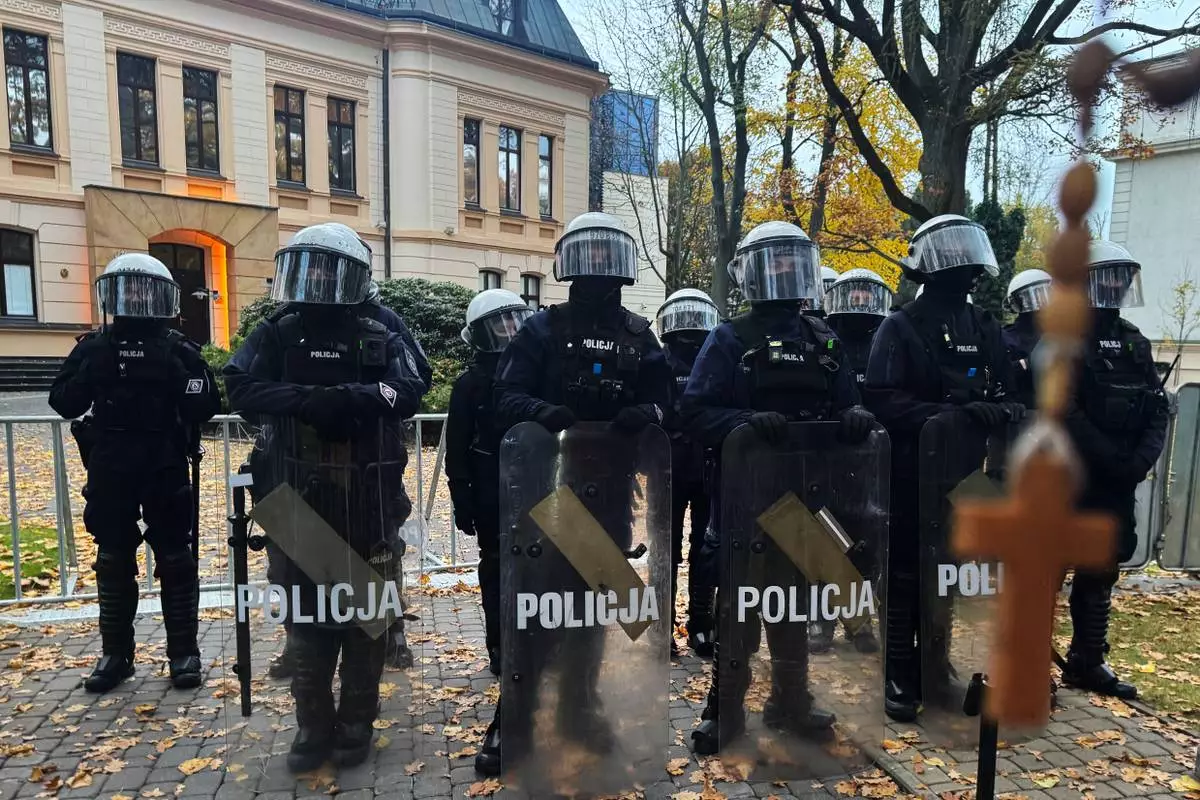
Police officers are guarding the entrance to the Polish Constitutional Court in Warsaw, Poland, Saturday, Oct. 31, 2026. (AP Photo/Rafal Niedzielski) Photo taken with a smartphone.
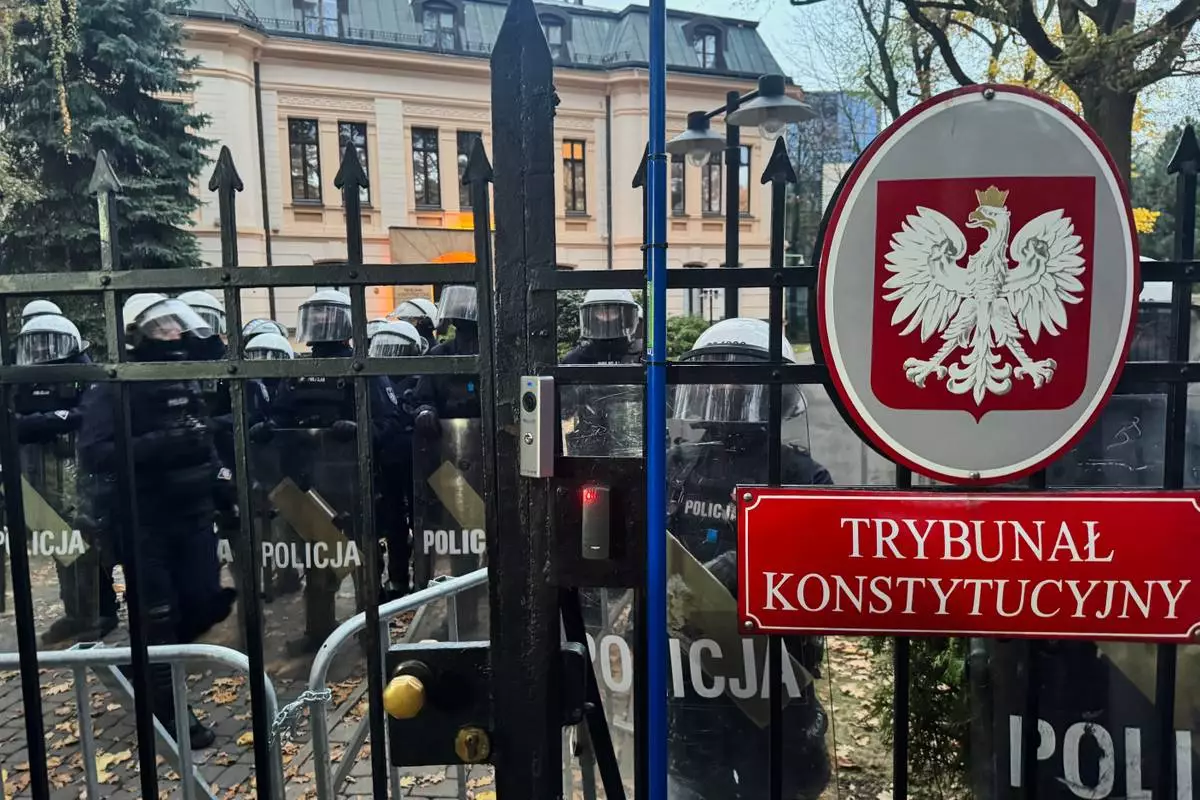
Police officers guard the entrance to the Polish Constitutional Court in Warsaw, Poland, Saturday, Oct. 31, 2026. (AP Photo/Rafal Niedzielski) Photo taken with a smartphone.
LAS VEGAS (AP) — Fawn Douglas puts an urban spin on traditional basketmaking.
Instead of using desert plants, she tightly weaves heavy conduit wire to form the base of a basket she plans to display at the new Wai Gallery in Las Vegas. There, she and her partner, A.B. Wilkinson, showcase pieces from Indigenous artists and host free art programs, from collage projects to sidewalk chalk paintings.
Douglas, a Las Vegas Paiute Tribe citizen, says she sees how art can heal and bring people together.
“They’re off their phones. They’re having actual conversations together,” Douglas said.
The gallery and IndigenousAF storefront dismantle stereotypes, including that Native Americans and Alaska Natives are a monolith and all live on reservations, she said. It opened just ahead of National Native American Heritage Month, which celebrates the diverse histories and cultures of hundreds of tribal communities across the U.S. in November.
Native American art isn’t just geometric, Douglas said, and each piece has a narrative.
A painting behind her featured a silhouetted Joshua tree and a backlit mountain range with a brilliant night sky. It’s a desert twist on Vincent Van Gogh’s “Starry Night” — and it acted as a call to action for turning Gold Butte into a national monument in Nevada.
A black-and-white underwater photograph depicts a Hawaiian dancer, seemingly floating in space. It is called “Ha’ina ’ia mai,” which translates to “let the story be told.”
Here is a collection of short stories highlighting joy in Native American and Alaska Native communities:
When the salmonberries are ripe in Kipnuk, Alaska, the Paul family isn’t far behind.
They are one of several families who returned to practice subsistence gathering a year after Typhoon Halong struck their village, damaging 90% of its buildings, floating some houses miles away and leaving nearly all of the community’s residents displaced.
It’s been an especially good year for salmonberries because of heavy snow last winter, locals say.
From a boat, Burt Paul scanned the tundra for the orange berries — or naunraqs as they’re called in coastal Yup’ik — like orange carpet on a sea of green grass. They giggled as the dogs ferociously defended them against two musk oxen grazing on shore.
The Pauls typically camp out for several days and pick berries. But this summer was broken up into shorter trips when Burt Paul’s scattered family could return together.
The family never misses a year of berry picking, they said.
“Coming home, seeing everyone, the community — it’s heartwarming,” Caley Paul said.
When the day ended, the family had a five-gallon bucket filled to the brim. Not as much as most years but enough for Burt Paul to make his famous naunraq pie. Enough for everyone to have a taste.
— Samantha Watson, KYUK
Foster care didn’t separate Rosa Soto Alvarez from her Pascua Yaqui community.
She and her siblings were placed with another family on the tribe’s reservation in Arizona, where their foster mother served up tortillas and fry bread with pots of chile con carne. They grew up surrounded by saguaros and the sounds of relatives speaking the Yaqui language. They took road trips to powwows.
Under the 1978 Indian Child Welfare Act, tribal children taken into foster care have the right to remain with Indigenous families.
That experience has guided Alvarez’s life work. At 50, she is a mother and grandmother who has cared for 25 foster children in her home. She leads the tribe’s ICWA Committee, coordinating statewide advocacy that supports the federal child welfare law and encourages states to adopt versions of it.
Nationwide, Native children are disproportionately represented in state foster care systems.
“I’m just a rez girl trying to make a difference,” she said. “There’s so many children out there who don’t have a voice, and I know I have to be that voice.”
— Nancy Marie Spears, The Imprint
A group of Indigenous girls carried a vessel of river water to the Eastern Band of Cherokee Indians Tribal Council and walked out with rights for the river.
The council unanimously passed a resolution this year recognizing the rights of the water system that rises in the Great Smoky Mountains and flows into the Gulf of Mexico. To the Cherokee, these waterways are known as Longperson and are a living relative.
The NAIWA Daughters, girls ages 10 to 17, brought the resolution forward after receiving training on the rights of nature, hosting community dinners, conducting surveys and meeting with council members. The Earth Law Center says it’s the first all-female-led rights-of-nature effort in the U.S.
The resolution grants the waterway five rights, including the right to flow freely and to be free from pollution.
The council later passed another resolution to raise money to remove the decommissioned Ela Dam in North Carolina, which has blocked the sicklefin redhorse, a freshwater fish, for more than a century.
“We hold the responsibility of stewarding the headwaters, so every living being downstream has water for life,” said NAIWA Daughters co-founder and Chairwoman Jasmine Smith.
— Liz Kimbrough, Mongabay
Sugarbush is a springtime tradition in many Native communities.
Students in the Minneapolis-based Wicoie Nandagikendan early childhood program trekked through the snow this past winter to learn about tapping maple trees and processing the syrup at Porky’s Sugarbush Camp.
The children and their parents walked past colorful buckets hanging on trees to catch the sap. They helped stir syrup already boiling in a large black kettle and helped make sugar and cakes. One student placed tobacco at a maple tree during a ceremony.
For parents like Christian Swor, the program provided his son and family an opportunity to connect with Indigenous culture and language. The early childhood program immerses children in the Ojibwe and Dakota languages.
Other cultural activities in the curriculum include how to cook dishes with rabbit or duck and how to process wild rice.
“We do hit all the state standards, but it’s like hitting all those early childhood indicators, progress and more,” said Ojibwe classroom teacher Liz Zoongwegiizhigook Zinsli.
— Chandra Colvin, Report for America corps member, MPR News
At 67, Kerry Butler still fits into his old Tulsa Indian Youth Center boxing jacket.
He joined the team for three years in the 1970s when he was 15. The center served a vital role for Native Americans after the federal government pushed them off their ancestral homelands and into major cities to assimilate them into white society.
Many Native youth had low self-esteem in those days, but a common gathering space and boxing helped change that, Butler said.
“When you got in front of a crowd of people, and they were cheering for you, and when you got into the ring, and people were clapping, ‘Awesome! Let’s go, Kerry! You can do it!’"
"It just rose up confidence inside that you never felt before,” Butler, who is Muscogee and Cherokee, added.
The youth center no longer exists. But a nonprofit called Tulsa Indian Community Center, Inc., recently formed with a vision to provide another gathering space for youth.
More than 60 tribes are represented in the Tulsa Public Schools district.
— Brittany Harlow, Crosswinds News
Hodokii Johnson leans in closely, as they tattoo three brown lines on each of Kristin Gentry’s fingers.
One is for the strength of Gentry’s mother. One is for Gentry. And one is for Gentry’s daughter.
When all the lines are darkened, the two say a prayer.
Johnson, a 24-year-old Muscogee Nation citizen and descendant of the Cheyenne and Arapaho Tribes, have been interested in body art since they were a teenager to cope with mental health struggles and now sees it with greater purpose.
They’ve worked with Inchunwa, a project dedicated to healing through traditional tattoos from the southeastern U.S., and recently attended a convention highlighting Indigenous tattoo practitioners in Oklahoma City.
Giving tattoos and ancestral markings is sacred work, they say, because of the permanence and deeper meaning.
“So much of the tattoo tradition that we had has since been weeded out through the efforts of colonization,” Johnson said. “Tattoos are seen as a taboo, unholy thing. When we talk about ancestral markings, it’s rather the opposite.”
— Sarah Liese, KOSU

Fawn Douglas puts a cup on a shelf at IndigenousAF, her store and gallery in Las Vegas, Thursday, Oct. 29, 2026. (AP Photo/Ty ONeil)

Students use wooden paddles to process maple syrup at a skigamizigan (sugarbush) camp in Maple Plain, Minn., Wednesday, March 18, 2026. (Kerem Yücel/Minnesota Public Radio via AP)