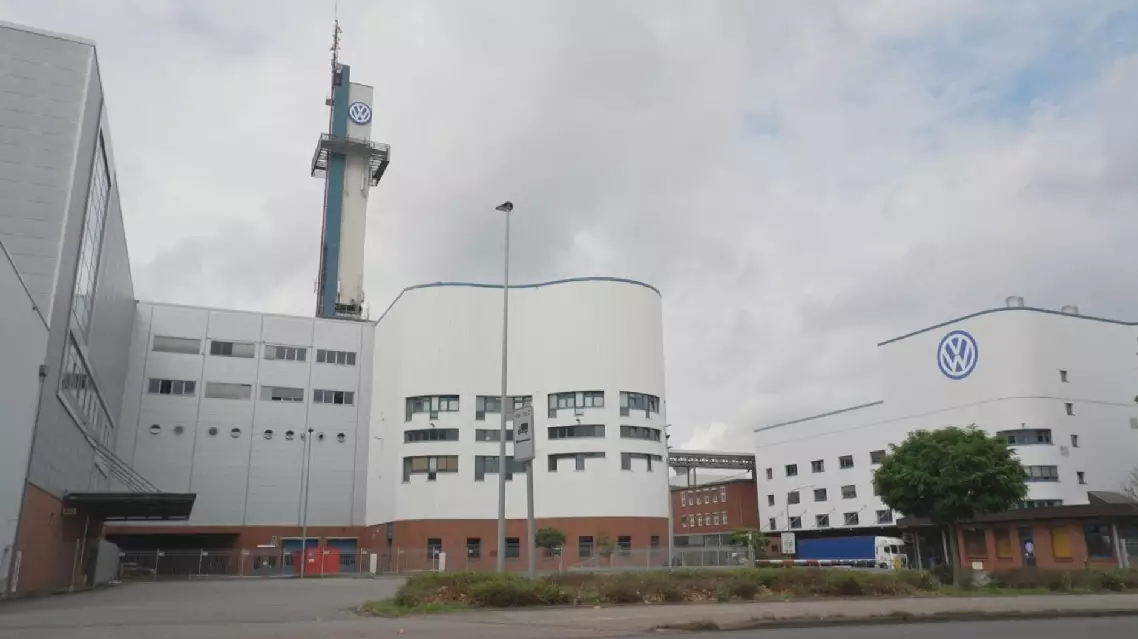
An Israeli investor wants to convert Volkswagen's plant in northwestern Germany's Osnabruck into an air-defense production hub as car manufacturing in the region winds down, a plan that could preserve jobs but is stirring deep tensions in a place that calls itself the "City of Peace."
Cars have been produced in Osnabruck for 125 years. But that legacy ends next year when production of Volkswagen's T-Roc SUV stops, creating uncertainty for its 1,800 workers. Now, a very different future is taking shape.
Israeli investor Aurelius Capital plans to purchase a majority stake in the Volkswagen plant, alongside the state of Lower Saxony. Volkswagen will have no say in what happens in the factory once the keys are handed over.
Israel's Iron Dome maker Rafael Advanced Defense Systems says it will become the first defense partner, potentially producing air-defense equipment here. This proposal could create jobs for three quarters of the plant's current employees.
"Rafael produces the Iron Dome, for example, air defense systems intended for the European market, including NATO countries, so it makes perfect sense to manufacture these defense systems somewhere within NATO, such as here in Germany. What's planned here isn't the manufacture of missiles; rather, it involves vehicles and the associated equipment needed to set up a system like the Iron Dome," said Wilfried Hinrichs, editor of Neue Osnabrucker Zeitung, a German daily newspaper based in Osnabruck.
Osnabruck could become a model for other German automotive plants struggling with high costs, weak demand and intensifying global competition, as carmakers slow down and Europe's defense industry ramps up.
Germany has called for a major shift in defense policy following the conflict in Ukraine that brought a sharp increase in military spending. Now that shift is reaching the factory floor, as some of the skills and industrial capacity behind Germany's automotive success move towards defense production.
That transition carries particular weight in Osnabruck. Its legacy as the "City of Peace" stretches back to the Peace of Westphalia in 1648, which ended a series of civil and religious wars in Europe.
"There are voices saying, 'No, this doesn't suit Osnabruck.' They touch a nerve in this city, specifically the question of whether the arms industry and a 'City of Peace' can coexist," said Wilfried Hinrichs.
The city council has overwhelmingly backed the plans, but many residents harbor mixed feelings.
"I think it’s important that the jobs are staying here in Osnabruck, and so I'm basically positive about it," said a local resident.
"For the weapons production, I am completely against all of that," another resident said.
As pressure on Germany's automotive sector continues, what happens in Osnabruck could offer a glimpse of the future for other German industries.
Israeli defense firm eyes Volkswagen's plant in 'City of Peace' for air-defense production