Skip to Content Facebook Feature Image

Faraday Future Founder and Global CEO YT Jia Shares Weekly Investor Update: FFR Sold and Shipped 351 Robot Devices in October, Setting Another Monthly Record and Bringing Cumulative Sales and Shipments to 1,168 Units

Business

Faraday Future Founder and Global CEO YT Jia Shares Weekly Investor Update: FFR Sold and Shipped 351 Robot Devices in October, Setting Another Monthly Record and Bringing Cumulative Sales and Shipments to 1,168 Units
Business

Business

Faraday Future Founder and Global CEO YT Jia Shares Weekly Investor Update: FFR Sold and Shipped 351 Robot Devices in October, Setting Another Monthly Record and Bringing Cumulative Sales and Shipments to 1,168 Units

2026-11-02 08:31 Last Updated At:08:41

LOS ANGELES--(BUSINESS WIRE)--Nov 1, 2026--

Faraday Future Intelligent Electric Inc. (NASDAQ: FFAI) (“Faraday Future”, “FF” or the “Company”), a California-based global Embodied AI (EAI) ecosystem company, today shared a weekly business update from YT Jia, Founder and Global CEO of FF and FFR.

This press release features multimedia. View the full release here: https://www.businesswire.com/news/home/20261101297093/en/

“YT: Welcome to Weekly Report 79. Jerry Wang and I are recording this week’s report right outside the FFR/FFAI New York and Northeast Regional Office. This is also my first report since becoming CEO of FFR. FFR has officially listed on the U.S. stock market as the first pure-play Four-Core Full-Stack AI humanoid and bionic robotics company.

For me and for the whole team, this is a fresh start. It also brings greater responsibility, mission, and opportunity. The CEO Weekly Report has been a key driver of change at the company for more than a year, and we will keep publishing it every single week. We want to make it a catalyst for the growth of the Physical AI industry and a platform for industry exchange.

Our first piece of good news this week is our October sales results. FFR sold and shipped 351 devices in October, setting another monthly record. Since we began sales and deliveries at the end of February, cumulative sales and shipments have reached 1,168 units, topping 1,000 for the first time, and we continue to deliver at a positive gross margin. As the first U.S. company to deliver both humanoid and bionic robots, FFR is turning its first-mover advantage into a competitive lead, and the strengths of our Four-Core Full-Stack AI products and technology are continuing to translate into sales.

Selling more than 350 units in October, and passing 1,000 cumulatively, matters for four reasons.

1. It strengthens the foundation for our full-year guidance. October’s growth was in line with expectations. We expect average monthly sales and shipments of more than 400 units in both November and December, which gives us greater confidence in reaching our full-year guidance of approximately 2,000 devices sold and shipped.

2. Commercialization of our four industry ecosystems is accelerating, with Education leading the way. The Education ecosystem is expanding quickly from Los Angeles into the Bay Area and Silicon Valley. Regional replication is already showing results and lays the groundwork for scaling across the U.S. The Security and Inspection ecosystem has entered the proof-of-concept stage. In Commercial and Services, we are working with customers to refine practical use cases and validate them in real scenarios. In Industrial and Logistics, development continues, building the product and technology capabilities for future volume.

3. It shows that the inflection point for the Physical AI industry is arriving faster.

4. The evolution flywheel of the Four-Core Full-Stack AI ecosystem is beginning to take shape.

The second major development is that the FFR and FFAI’s New York regional operations are now up and running, and we’ve officially begun recruiting business partners. The first phase covers New York, New Jersey, Massachusetts, southwestern Connecticut, and eastern Pennsylvania, with three priorities:

1. Around the four industry ecosystems, we are launching regional customer development, channel building, and ecosystem partnerships, step by step building a closed-loop regional business that spans product sales, solution deployment, and operating services. We will also speed up RoboShare’s rollout on the East Coast, to help it grow faster into the robot-sharing platform with the largest fleet and widest variety of robots in North America.

2. We will strengthen investor relations and communicate more directly with the capital markets, continuing to share FFR’s strategy, business progress, and path to value creation, and listening to our stockholders.

3. We will draw on New York’s and the East Coast’s rich government-affairs and public-institution resources to deepen engagement with relevant organizations and create the conditions for FFR to expand and scale faster.

Last week, FFR’s listing closing and first Investor Day were held successfully in New York. Not only did FFR capture Wall Street’s attention, but our robots also turned heads all over New York. On the streets of Manhattan, in the parks, and at the event itself, they drew crowds almost immediately. Well-known U.S. media outlets such as CBS News and the New York Post covered it on location. It reinforced our belief that Physical AI is gradually entering everyday life, and that FFR is leading this transformation.

At FFAI, we will pursue our upgraded strategy of “Robotaxi Sharing Network + AI VisiCabin Operator + Physical AI Investment Holding Company.” Drawing on New York’s capital markets and industry resources, we will pursue investment, business incubation, and holding opportunities across the Physical AI value chain. This will also work in tandem with the Robotaxi business we are preparing in the Los Angeles area, creating coordination between the East and West Coasts.

The New York region will also begin hiring. We welcome people from across the Physical AI industry to join us in driving innovation and growing the ecosystem.

New York has given us more than FFR’s successful listing. It has opened a new chapter. We believe FFR has become No. 1 in K–12 robotics education in the U.S. Our next goal is to become No. 1 in robotics education nationwide, remain among the top three companies in the Physical AI robotics industry overall, and become one of the most valuable companies of the Physical AI era.

Jerry Wang: ‘I’m really happy that we’ve completed our listing here in New York, and that our business is now up and running in the New York region too. What I’m really, really looking forward to is seeing FFR’s stock perform well, but even more than that, seeing the business move forward fast. That will reinforce the strong position we’re in today as the No. 1 robot deliverer in the U.S., and the outlook ahead of us. Let’s keep our heads down, run the business well, and keep creating value for our stockholders. Thank you!’

YT: Thank you, everyone. See you next week!”

ABOUT FARADAY FUTURE

Founded in 2014, Faraday Future (FF) is a U.S.-based Physical AI ecosystem company dedicated to merging the future of robotics and mobility solutions through AI innovation and technologies. Following the completion of the transfer of its robotics business to FF EAI Robotics Ecosystem Inc. (FFR), Faraday Future is upgrading into a Robotaxi and EAI Cabin (Intelligent cabin) shared mobility operations company and a Physical AI investment holding company. Evolving its automotive business from an EV manufacturer to a Robotaxi Sharing Network and AI Visicabin technology operator. FF aims to advance its “Four Future Trends” concept, once again helping to drive automotive-industry transformation. For more information, please visit Faraday Future's official website: https://www.ff.com/

FORWARD LOOKING STATEMENTS

Important factors that may affect actual results or outcomes include, among others: the Company’s ability to continue as a going concern and improve its liquidity and financial position; the Company’s ability to pay its outstanding obligations, which it currently lacks; the availability of sufficient share capital to meet its current obligations and execute on its strategy; the willingness of convertible debt investors to fund the Company after the sale of the Company’s robotics business; tariff uncertainty for imported products, particularly from China; the Company’s ability to homologate FX vehicles for sale; the Company’s ability to secure the necessary funding to execute on the FX strategy, which is substantial; the Company’s ability to secure an occupancy certificate covering all of its Hanford facility; the Company’s ability to remediate its material weaknesses in internal control over financial reporting and the risks related to the restatement of previously issued consolidated financial statements; the Company’s limited operating history and the significant barriers to growth it faces; the Company’s history of substantial losses and expectation of continued losses; the success of the Company’s payroll expense reduction plan; the Company’s ability to execute on its plans to develop and market its vehicles and the timing of these development programs; the Company’s ability to execute on its plans to enter the robotaxi and cybercab industries; the Company’s estimates of the size of the markets for its vehicles and cost to bring those vehicles to market; the rate and degree of market acceptance of the Company’s vehicles; the Company’s ability to cover future warranty claims; the success of other competing manufacturers; the performance and security of the Company’s vehicles; current and potential litigation involving the Company; the Company’s ability to receive funds from, satisfy the conditions precedent of and close on the various financings described elsewhere by the Company; the result of future financing efforts, the failure of any of which could result in the Company seeking protection under the Bankruptcy Code; the Company’s indebtedness; the Company’s ability to use its “at-the-market” program; insurance coverage; general economic and market conditions impacting demand for the Company’s products; potential negative impacts of a reverse stock split; potential cost, headcount and salary reduction actions may not be sufficient or may not achieve their expected results; circumstances outside of the Company’s control, such as natural disasters, climate change, health epidemics and pandemics, terrorist attacks, and civil unrest; risks related to the Company’s operations in China; the success of the Company’s remedial measures taken in response to the Special Committee findings; the Company’s dependence on its suppliers and contract manufacturer; the Company’s ability to develop and protect its technologies; the Company’s ability to protect against cybersecurity risks; and the ability of the Company to attract and retain employees, any adverse developments in existing legal proceedings or the initiation of new legal proceedings; the volatility of the Company’s stock price; the ability of the Company to maintain its stock price above $1.00; and the ability of the Company to maintain compliance with Nasdaq regulations for continued listing. You should carefully consider the foregoing factors and the other risks and uncertainties described in the “Risk Factors” section of the Company’s Form 10-Q for the quarter ended June 30, 2026, filed with the SEC on August 13, 2026; the quarter ended March 31, 2026, filed with the SEC on May 14, 2026; and Form 10-K filed with the SEC on March 31, 2026, and other documents filed by the Company from time to time with the SEC.

Faraday Future Founder and Global CEO YT Jia Shares Weekly Investor Update: FFR Sold and Shipped 351 Robot Devices in October, Setting Another Monthly Record and Bringing Cumulative Sales and Shipments to 1,168 Units

Faraday Future Founder and Global CEO YT Jia Shares Weekly Investor Update: FFR Sold and Shipped 351 Robot Devices in October, Setting Another Monthly Record and Bringing Cumulative Sales and Shipments to 1,168 Units
KOZATSKE, Ukraine (AP) — A white towel on her gate and a white rag in her hand were Ukrainian Nataliia Diadiuk’s only ways to tell Russian drone operators she is a civilian. When a brief ceasefire kicked in on Oct. 27, she had a moment of respite.

The 53-year-old is one of a handful of residents left in Kozatske, a riverside village located in the kill zone of Ukraine’s Kherson region less than 2 kilometers (1.2 miles) from a Russian-controlled area.

“I really want silence,” Diadiuk said, fighting back tears as she stood on an empty street lined with abandoned houses. “And I want to see the people who left, all of them. People left for both sides."

Diadiuk’s life has been reduced to basic survival: rainwater to drink, firewood gathered around town for heat, a radio she tries to tune in to for news, and the remnants of humanitarian aid that had not reached her in two years until the brief ceasefire that ended Sunday night just days after it began. Going out means dodging every kind of weapon, including mines scattered everywhere. The neighbors she mentions are more often the dead than the few still living nearby.

A team from The Associated Press gained rare access to a so-called red zone to see firsthand what life in the kill zone looks like, a visit made possible only because of a brief, localized ceasefire tied to the humanitarian aid mission in the Russian-occupied city of Oleshky.

Oleshky has drawn the world’s attention, but civilians are trapped in many more places on both sides of the front line. During the mission, Ukrainian regional officials, police, the Ukrainian Red Cross Society and volunteers, with the facilitation of civil-military cooperation specialists, used the rare window of time to reach people on their side of the river, some of them cut off for nearly two years.

In all, 180 people were evacuated from riverside communities and the city of Kherson, including 23 children, the regional administration said. About 140,000 people remain in the Ukrainian-held part of the Kherson region.

Before the war, the whole region, now nearly 70% under Russian control, had about 1 million residents. The riverside is designated a red zone, the highest level of military danger. With the ceasefire over, residents will again face drones, artillery, glide bombs and airdropped mines. Still, many refuse to leave. Some cannot afford to start over, and others will not abandon the places where they grew up.

On the road to Diadiuk’s village, burned-out cars sit abandoned where they were hit, alongside wrecked ground robots that Ukrainians try sending down roads too dangerous for people. A relic of peacetime still stands on that road: “Thank you for keeping the roadside clean.”

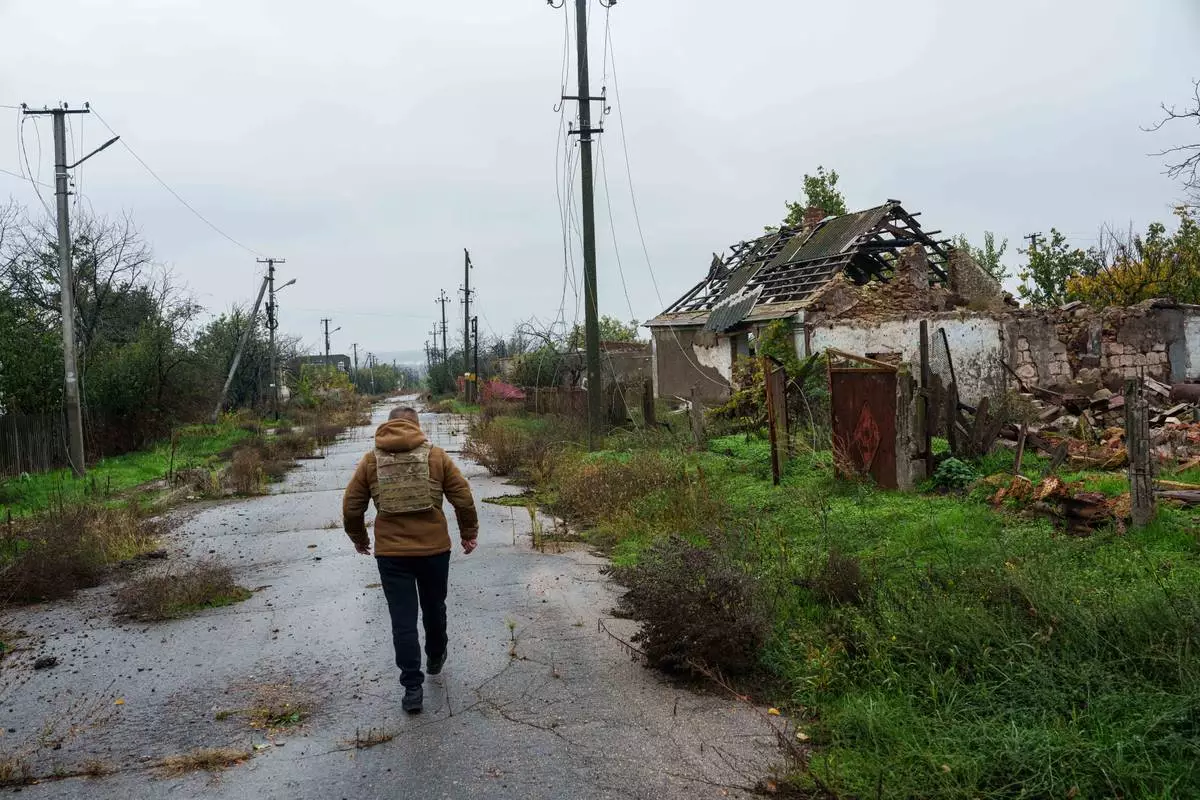
In the village, many houses are reduced to burned walls. Glide bombs have left craters, and the tail fins of shells stick out of the asphalt like flowers. Mines dropped from drones lie everywhere, some petal-shaped, others improvised and wrapped in foil or plastic, so every step must be taken with care. Thick vegetation swallows the ruins of empty houses.

What Diadiuk finds hardest to bear is the howling of the dogs left behind in the houses, surviving much as she is. “Even for the sake of these, I can’t leave them,” she says, pointing to two thin dogs that never stray far from her. But she shares what little food she has with other dogs as well.

Isolated and forced to fight for survival every day, she has lost track of time. “I turn on my phone only to see what day it is,” she says. She charges it with solar panels.

Diadiuk collects rainwater, strains it through gauze, treats it with chlorine and boils it. “The water here is more or less all right,” she says. “There are a lot of dead lying in the houses, so it’s good water only in a manner of speaking.”

The village’s ordeal began in the first days of Russia’s full-scale invasion, when it was occupied. After Ukrainian forces liberated it, Kozatske gradually came under siege by drones as the war turned increasingly technological.

“Before, I’d just open the door and walk out,” said Oleksii Shavokin, 54, who lives a little farther down the street. “Now I open it a crack, stick my ear out and listen to the sky."

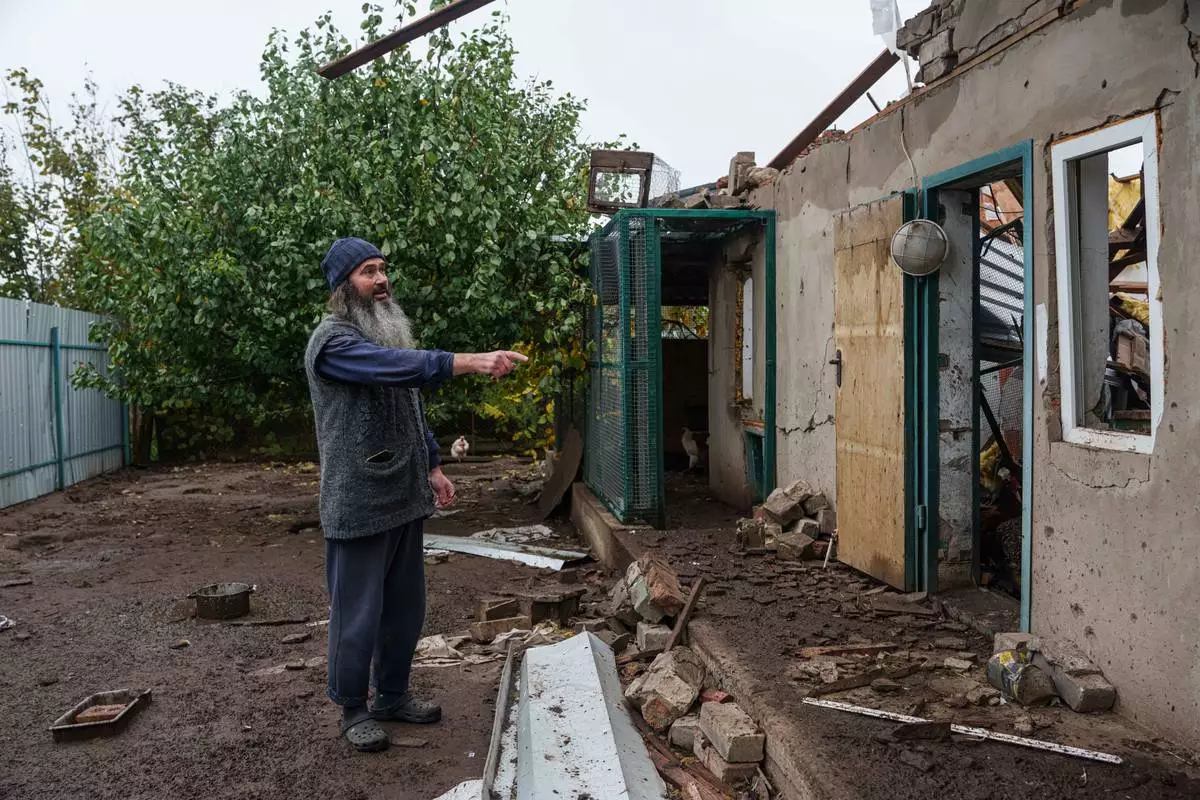
His house burned down in early 2023 after a mortar attack, he said, but he patched it up and stays on there. He lives off old humanitarian aid and eggs from the hens he still keeps. “I ration my food so it lasts. I’m used to it,” he said. “Now I eat once a day, in the evening, and that’s quite enough.” He has lost 30 kilograms (66 pounds) from a weight of close to 100 kilograms (220 pounds).

Many of the people he knew were killed by strikes, and others left. He decided to stay.

“I value life, but where’s the guarantee a car won’t hit me somewhere else?” Shavokin said. “Wherever it’s written for you, that’s where you’ll lose your life, or go on living. And still, I hope this all ends soon.”

Many residents who stay do not know where they would go and fear they would be left to fend for themselves, said Oleh Tarabaka, head of the Nova Kakhovka city military administration. He was part of the team that tried to persuade Diadiuk and Shavokin to leave.

But it is difficult, he said. Many have lived there their whole lives and fear that once they leave, they will have nothing to live on. Not everyone has someone to go to. Some have no relatives.

“If there hadn’t been a period of quiet, we simply wouldn’t have gotten people out,” Tarabaka said. “We wouldn’t have been able to drive in here.”

What residents are living through goes beyond survival, Tarabaka said, adding that perhaps no word has yet been invented to describe it.

Some, however, can be persuaded to leave. That was the case for Yevhen and his mother, Antonina, who declined to give their last names for security reasons.

One of the military officials turned to Yevhen. “Just make the right decision, the decision of a man and a son,” a Ukrainian soldier from the 42nd brigade who was part of the evacuation group told him.

Eventually, they agreed.

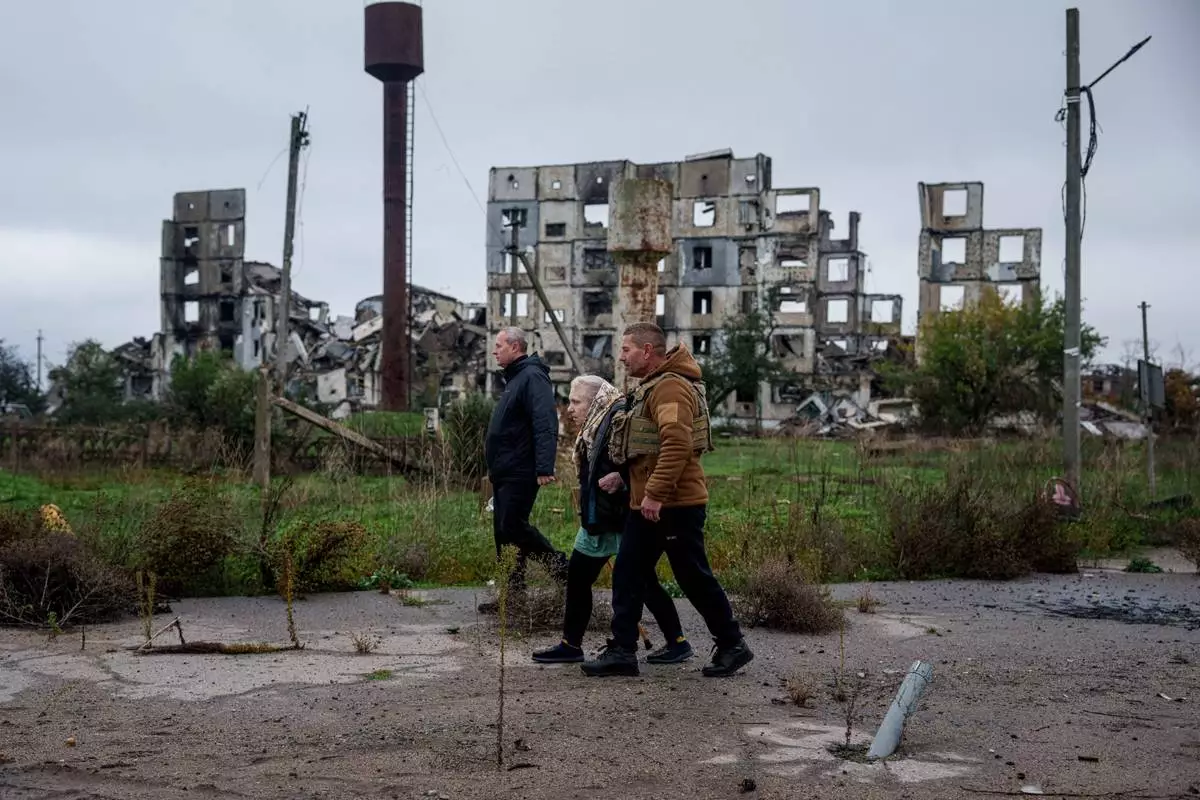
All the way through her bombed-out town, Antonina wailed and wept, not wanting to leave. Her cries echoed through the empty streets.

The temporary truce allowed the Red Cross to evacuate far more people than usual from Kherson city. Normally, every route and every stage must be planned around the constant threat of drones and other weapons.

“Right now, some streets and places in Kherson are a kill zone too. It’s simply impossible to slip through there. The risk is very, very high,” said Mykola Taranenko, commander of the Ukrainian Red Cross Society’s rapid response team in the Kherson region.

His team usually evacuates about 10 people a week, but during the ceasefire week, it took out at least 40.

Among those evacuated were Volodymyr and Kateryna Yakuba, both 77, who divorced more than 20 years ago but left the city together. Their daughter arranged the evacuation, and they are going to stay with her in Odesa.

“We need to get out before the cold sets in,” she said, adding about the ceasefire: “I don’t know how we would have gotten out otherwise.”

“It’s scary to leave home,” her voice trembled. "You don’t know if you’ll come back, or if there will be anything to come back to.”

Associated Press journalists Vasilisa Stepanenko and Evgeniy Maloletka contributed to this report.

Follow the AP’s coverage of the war in Ukraine at https://apnews.com/hub/russia-ukraine

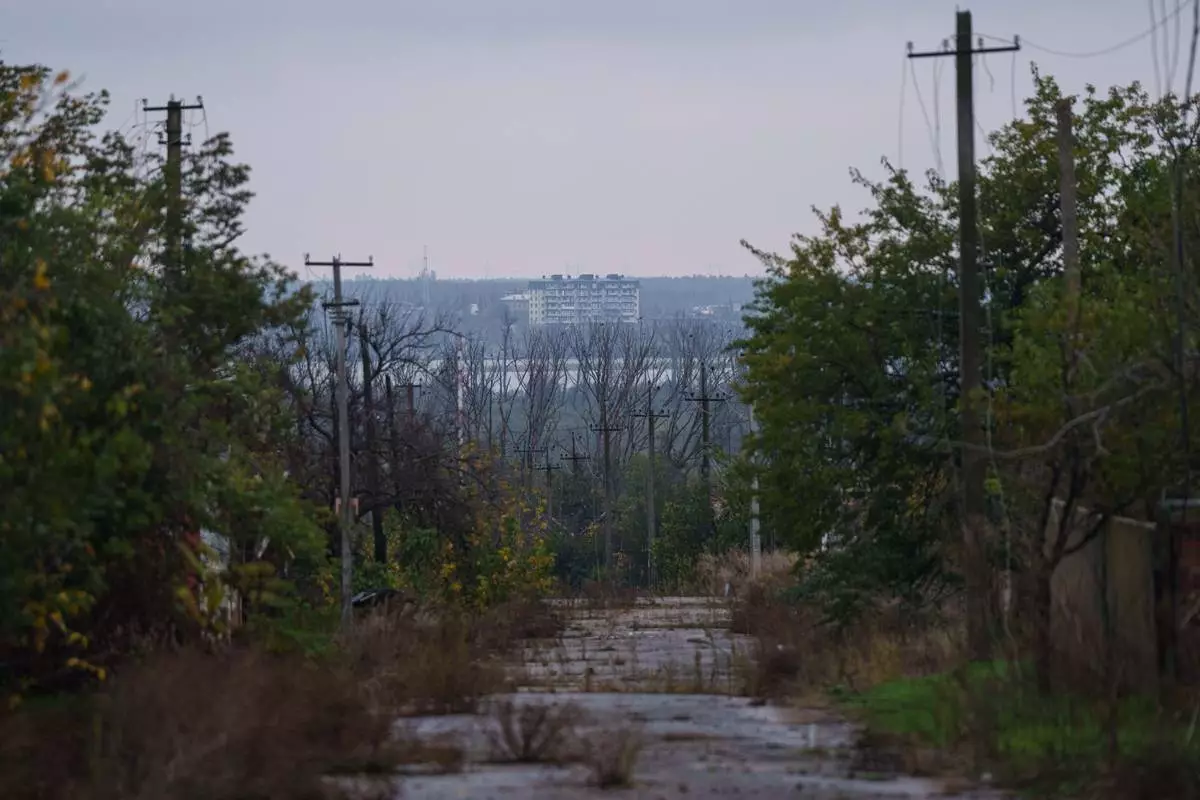
A residential building in Russian-occupied Nova Kakhovka is seen across the Dnipro River from the village of Kozatske during a localized ceasefire linked to a humanitarian aid mission to Oleshky in the Kherson region of Ukraine, Saturday, Oct. 31, 2026. (AP Photo/Evgeniy Maloletka)

A residential building in Russian-occupied Nova Kakhovka is seen across the Dnipro River from the village of Kozatske during a localized ceasefire linked to a humanitarian aid mission to Oleshky in the Kherson region of Ukraine, Saturday, Oct. 31, 2026. (AP Photo/Evgeniy Maloletka)

Oleksii Shavokin, 54, a local resident, stands in front of his house destroyed by Russian shelling during a localized ceasefire linked to a humanitarian aid mission to Oleshky, in the village of Kozatske, Kherson region, Ukraine, Saturday, Oct. 31, 2026. (AP Photo/Evgeniy Maloletka)

Oleksii Shavokin, 54, a local resident, stands in front of his house destroyed by Russian shelling during a localized ceasefire linked to a humanitarian aid mission to Oleshky, in the village of Kozatske, Kherson region, Ukraine, Saturday, Oct. 31, 2026. (AP Photo/Evgeniy Maloletka)

Vadym, a Ukrainian sergeant of the 42nd Marine Brigade walks through an area contaminated with anti-personnel mines in front of destroyed houses during an evacuation of local population to a safe area amid a local ceasefire linked to a humanitarian aid mission in Oleshky, in the village of Kozatske, Kherson region, Ukraine, Saturday, Oct. 31, 2026. (AP Photo/Evgeniy Maloletka)

Vadym, a Ukrainian sergeant of the 42nd Marine Brigade walks through an area contaminated with anti-personnel mines in front of destroyed houses during an evacuation of local population to a safe area amid a local ceasefire linked to a humanitarian aid mission in Oleshky, in the village of Kozatske, Kherson region, Ukraine, Saturday, Oct. 31, 2026. (AP Photo/Evgeniy Maloletka)

Natalia Diadiuk, 53, a local resident, reacts as she refuses to be evacuated during a localized ceasefire linked to a humanitarian aid mission to Oleshky, in the village of Kozatske, Kherson region, Ukraine, Saturday, Oct. 31, 2026. (AP Photo/Evgeniy Maloletka)

Natalia Diadiuk, 53, a local resident, reacts as she refuses to be evacuated during a localized ceasefire linked to a humanitarian aid mission to Oleshky, in the village of Kozatske, Kherson region, Ukraine, Saturday, Oct. 31, 2026. (AP Photo/Evgeniy Maloletka)

Oleh Tarabaka, head of the Nova Kakhovka military administration, left, and Vadym, a Ukrainian sergeant of the 42nd Marine Brigade, right, help evacuate Antonina, a local resident, as they walk past a destroyed residential building in an area contaminated with anti-personnel mines, during a localized ceasefire linked to a humanitarian aid mission to Oleshky, in the village of Kozatske, Kherson region, Ukraine, Saturday, Oct. 31, 2026. (AP Photo/Evgeniy Maloletka)

Oleh Tarabaka, head of the Nova Kakhovka military administration, left, and Vadym, a Ukrainian sergeant of the 42nd Marine Brigade, right, help evacuate Antonina, a local resident, as they walk past a destroyed residential building in an area contaminated with anti-personnel mines, during a localized ceasefire linked to a humanitarian aid mission to Oleshky, in the village of Kozatske, Kherson region, Ukraine, Saturday, Oct. 31, 2026. (AP Photo/Evgeniy Maloletka)

Recommended Articles