KOZATSKE, Ukraine (AP) — A white towel on her gate and a white rag in her hand were Ukrainian Nataliia Diadiuk’s only ways to tell Russian drone operators she is a civilian. When a brief ceasefire kicked in on Oct. 27, she had a moment of respite.
The 53-year-old is one of a handful of residents left in Kozatske, a riverside village located in the kill zone of Ukraine’s Kherson region less than 2 kilometers (1.2 miles) from a Russian-controlled area.
Click to Gallery
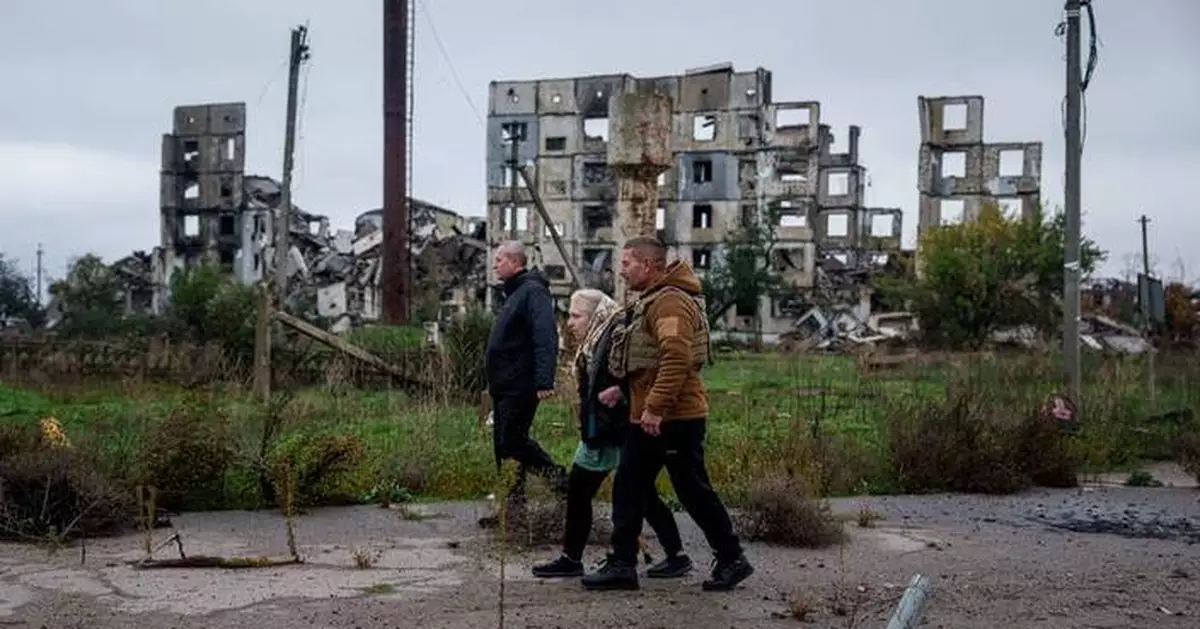
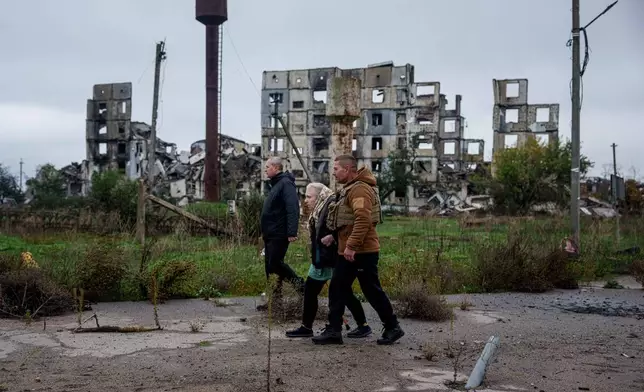
Oleh Tarabaka, head of the Nova Kakhovka military administration, left, and Vadym, a Ukrainian sergeant of the 42nd Marine Brigade, right, help evacuate Antonina, a local resident, as they walk past a destroyed residential building in an area contaminated with anti-personnel mines, during a localized ceasefire linked to a humanitarian aid mission to Oleshky, in the village of Kozatske, Kherson region, Ukraine, Saturday, Oct. 31, 2026. (AP Photo/Evgeniy Maloletka)
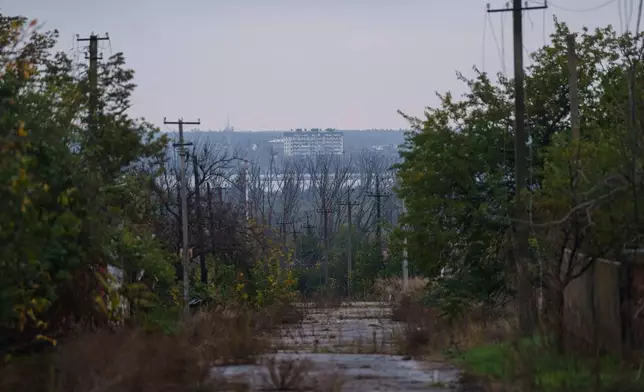
A residential building in Russian-occupied Nova Kakhovka is seen across the Dnipro River from the village of Kozatske during a localized ceasefire linked to a humanitarian aid mission to Oleshky in the Kherson region of Ukraine, Saturday, Oct. 31, 2026. (AP Photo/Evgeniy Maloletka)
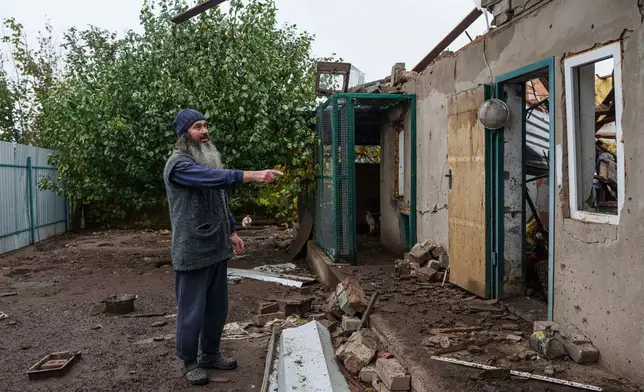
Oleksii Shavokin, 54, a local resident, stands in front of his house destroyed by Russian shelling during a localized ceasefire linked to a humanitarian aid mission to Oleshky, in the village of Kozatske, Kherson region, Ukraine, Saturday, Oct. 31, 2026. (AP Photo/Evgeniy Maloletka)
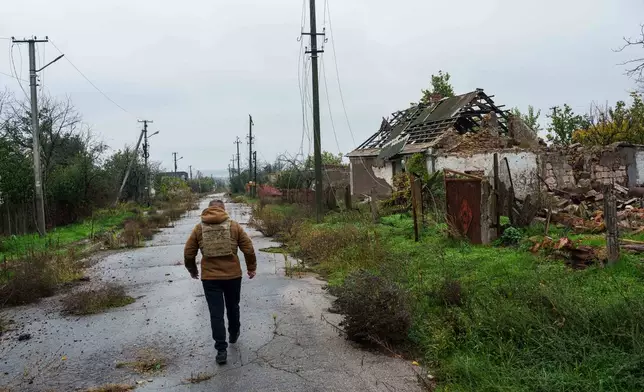
Vadym, a Ukrainian sergeant of the 42nd Marine Brigade walks through an area contaminated with anti-personnel mines in front of destroyed houses during an evacuation of local population to a safe area amid a local ceasefire linked to a humanitarian aid mission in Oleshky, in the village of Kozatske, Kherson region, Ukraine, Saturday, Oct. 31, 2026. (AP Photo/Evgeniy Maloletka)
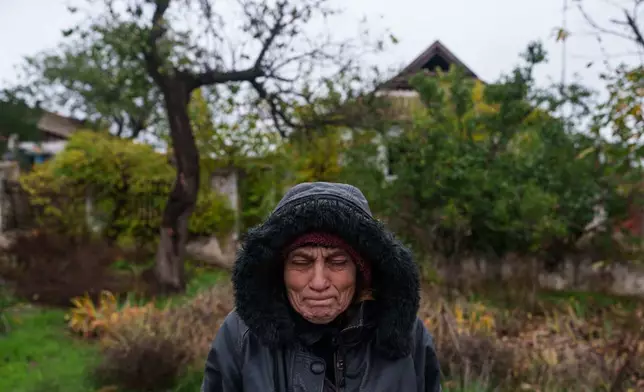
Natalia Diadiuk, 53, a local resident, reacts as she refuses to be evacuated during a localized ceasefire linked to a humanitarian aid mission to Oleshky, in the village of Kozatske, Kherson region, Ukraine, Saturday, Oct. 31, 2026. (AP Photo/Evgeniy Maloletka)
Oleh Tarabaka, head of the Nova Kakhovka military administration, left, and Vadym, a Ukrainian sergeant of the 42nd Marine Brigade, right, help evacuate Antonina, a local resident, as they walk past a destroyed residential building in an area contaminated with anti-personnel mines, during a localized ceasefire linked to a humanitarian aid mission to Oleshky, in the village of Kozatske, Kherson region, Ukraine, Saturday, Oct. 31, 2026. (AP Photo/Evgeniy Maloletka)
“I really want silence,” Diadiuk said, fighting back tears as she stood on an empty street lined with abandoned houses. “And I want to see the people who left, all of them. People left for both sides."
Diadiuk’s life has been reduced to basic survival: rainwater to drink, firewood gathered around town for heat, a radio she tries to tune in to for news, and the remnants of humanitarian aid that had not reached her in two years until the brief ceasefire that ended Sunday night just days after it began. Going out means dodging every kind of weapon, including mines scattered everywhere. The neighbors she mentions are more often the dead than the few still living nearby.
A team from The Associated Press gained rare access to a so-called red zone to see firsthand what life in the kill zone looks like, a visit made possible only because of a brief, localized ceasefire tied to the humanitarian aid mission in the Russian-occupied city of Oleshky.
Oleshky has drawn the world’s attention, but civilians are trapped in many more places on both sides of the front line. During the mission, Ukrainian regional officials, police, the Ukrainian Red Cross Society and volunteers, with the facilitation of civil-military cooperation specialists, used the rare window of time to reach people on their side of the river, some of them cut off for nearly two years.
In all, 180 people were evacuated from riverside communities and the city of Kherson, including 23 children, the regional administration said. About 140,000 people remain in the Ukrainian-held part of the Kherson region.
Before the war, the whole region, now nearly 70% under Russian control, had about 1 million residents. The riverside is designated a red zone, the highest level of military danger. With the ceasefire over, residents will again face drones, artillery, glide bombs and airdropped mines. Still, many refuse to leave. Some cannot afford to start over, and others will not abandon the places where they grew up.
On the road to Diadiuk’s village, burned-out cars sit abandoned where they were hit, alongside wrecked ground robots that Ukrainians try sending down roads too dangerous for people. A relic of peacetime still stands on that road: “Thank you for keeping the roadside clean.”
In the village, many houses are reduced to burned walls. Glide bombs have left craters, and the tail fins of shells stick out of the asphalt like flowers. Mines dropped from drones lie everywhere, some petal-shaped, others improvised and wrapped in foil or plastic, so every step must be taken with care. Thick vegetation swallows the ruins of empty houses.
What Diadiuk finds hardest to bear is the howling of the dogs left behind in the houses, surviving much as she is. “Even for the sake of these, I can’t leave them,” she says, pointing to two thin dogs that never stray far from her. But she shares what little food she has with other dogs as well.
Isolated and forced to fight for survival every day, she has lost track of time. “I turn on my phone only to see what day it is,” she says. She charges it with solar panels.
Diadiuk collects rainwater, strains it through gauze, treats it with chlorine and boils it. “The water here is more or less all right,” she says. “There are a lot of dead lying in the houses, so it’s good water only in a manner of speaking.”
The village’s ordeal began in the first days of Russia’s full-scale invasion, when it was occupied. After Ukrainian forces liberated it, Kozatske gradually came under siege by drones as the war turned increasingly technological.
“Before, I’d just open the door and walk out,” said Oleksii Shavokin, 54, who lives a little farther down the street. “Now I open it a crack, stick my ear out and listen to the sky."
His house burned down in early 2023 after a mortar attack, he said, but he patched it up and stays on there. He lives off old humanitarian aid and eggs from the hens he still keeps. “I ration my food so it lasts. I’m used to it,” he said. “Now I eat once a day, in the evening, and that’s quite enough.” He has lost 30 kilograms (66 pounds) from a weight of close to 100 kilograms (220 pounds).
Many of the people he knew were killed by strikes, and others left. He decided to stay.
“I value life, but where’s the guarantee a car won’t hit me somewhere else?” Shavokin said. “Wherever it’s written for you, that’s where you’ll lose your life, or go on living. And still, I hope this all ends soon.”
Many residents who stay do not know where they would go and fear they would be left to fend for themselves, said Oleh Tarabaka, head of the Nova Kakhovka city military administration. He was part of the team that tried to persuade Diadiuk and Shavokin to leave.
But it is difficult, he said. Many have lived there their whole lives and fear that once they leave, they will have nothing to live on. Not everyone has someone to go to. Some have no relatives.
“If there hadn’t been a period of quiet, we simply wouldn’t have gotten people out,” Tarabaka said. “We wouldn’t have been able to drive in here.”
What residents are living through goes beyond survival, Tarabaka said, adding that perhaps no word has yet been invented to describe it.
Some, however, can be persuaded to leave. That was the case for Yevhen and his mother, Antonina, who declined to give their last names for security reasons.
One of the military officials turned to Yevhen. “Just make the right decision, the decision of a man and a son,” a Ukrainian soldier from the 42nd brigade who was part of the evacuation group told him.
Eventually, they agreed.
All the way through her bombed-out town, Antonina wailed and wept, not wanting to leave. Her cries echoed through the empty streets.
The temporary truce allowed the Red Cross to evacuate far more people than usual from Kherson city. Normally, every route and every stage must be planned around the constant threat of drones and other weapons.
“Right now, some streets and places in Kherson are a kill zone too. It’s simply impossible to slip through there. The risk is very, very high,” said Mykola Taranenko, commander of the Ukrainian Red Cross Society’s rapid response team in the Kherson region.
His team usually evacuates about 10 people a week, but during the ceasefire week, it took out 32.
Among those evacuated were Volodymyr and Kateryna Yakuba, both 77, who divorced more than 20 years ago but left the city together. Their daughter arranged the evacuation, and they are going to stay with her in Odesa.
“We need to get out before the cold sets in,” Kateryna said, adding about the ceasefire: “I don’t know how we would have gotten out otherwise.”
“It’s scary to leave home,” her voice trembled. "You don’t know if you’ll come back, or if there will be anything to come back to.”
Associated Press journalists Vasilisa Stepanenko and Evgeniy Maloletka contributed to this report.
Follow the AP’s coverage of the war in Ukraine at https://apnews.com/hub/russia-ukraine
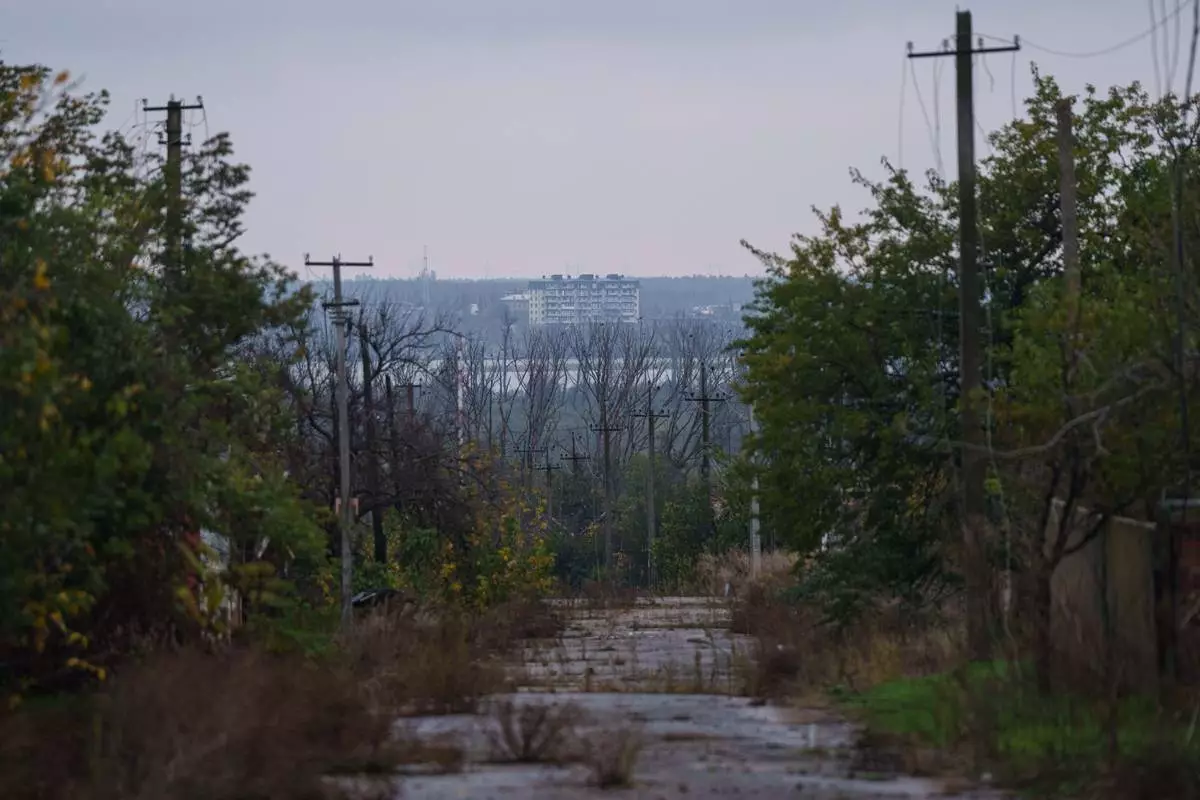
A residential building in Russian-occupied Nova Kakhovka is seen across the Dnipro River from the village of Kozatske during a localized ceasefire linked to a humanitarian aid mission to Oleshky in the Kherson region of Ukraine, Saturday, Oct. 31, 2026. (AP Photo/Evgeniy Maloletka)
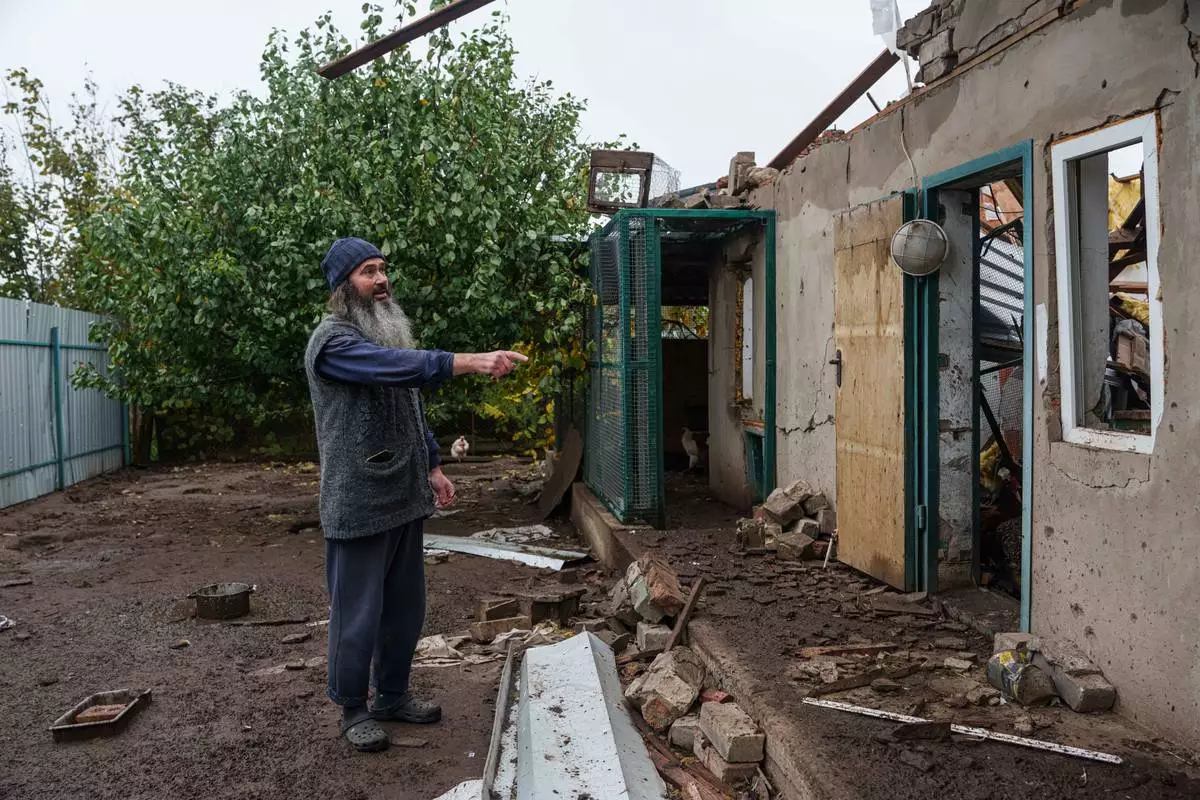
Oleksii Shavokin, 54, a local resident, stands in front of his house destroyed by Russian shelling during a localized ceasefire linked to a humanitarian aid mission to Oleshky, in the village of Kozatske, Kherson region, Ukraine, Saturday, Oct. 31, 2026. (AP Photo/Evgeniy Maloletka)
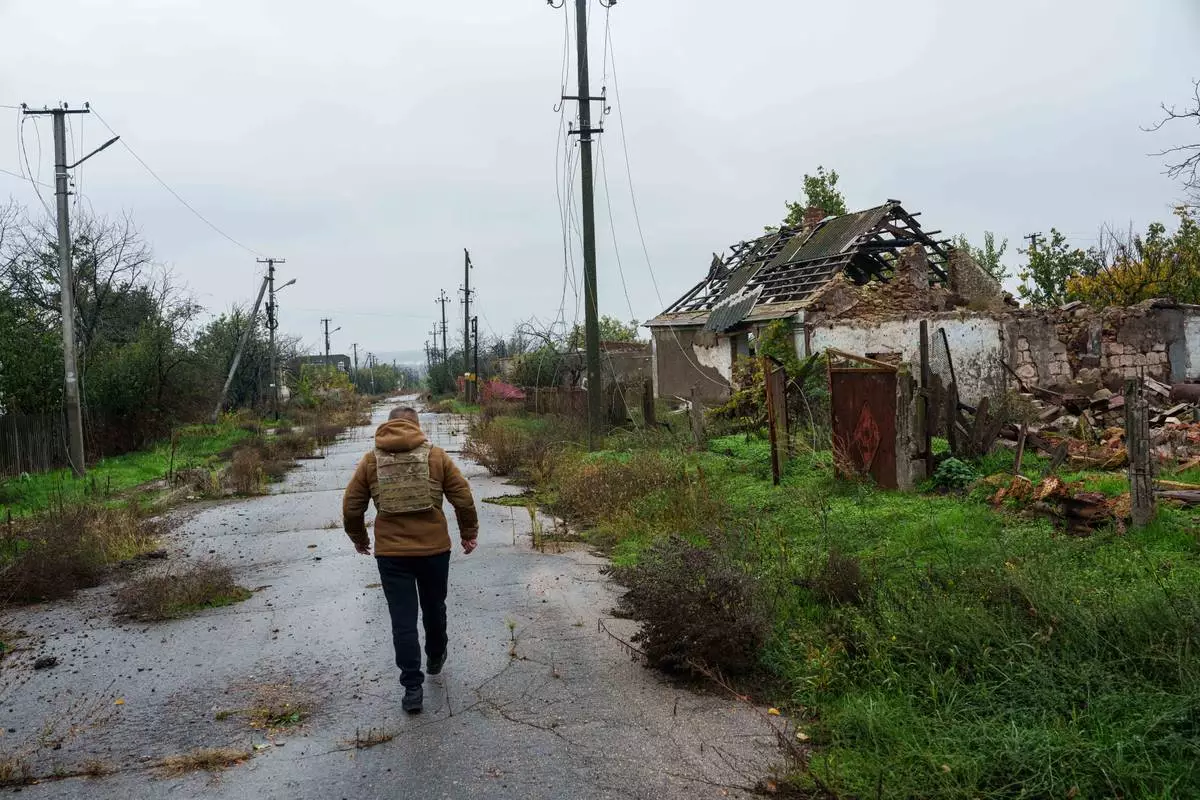
Vadym, a Ukrainian sergeant of the 42nd Marine Brigade walks through an area contaminated with anti-personnel mines in front of destroyed houses during an evacuation of local population to a safe area amid a local ceasefire linked to a humanitarian aid mission in Oleshky, in the village of Kozatske, Kherson region, Ukraine, Saturday, Oct. 31, 2026. (AP Photo/Evgeniy Maloletka)
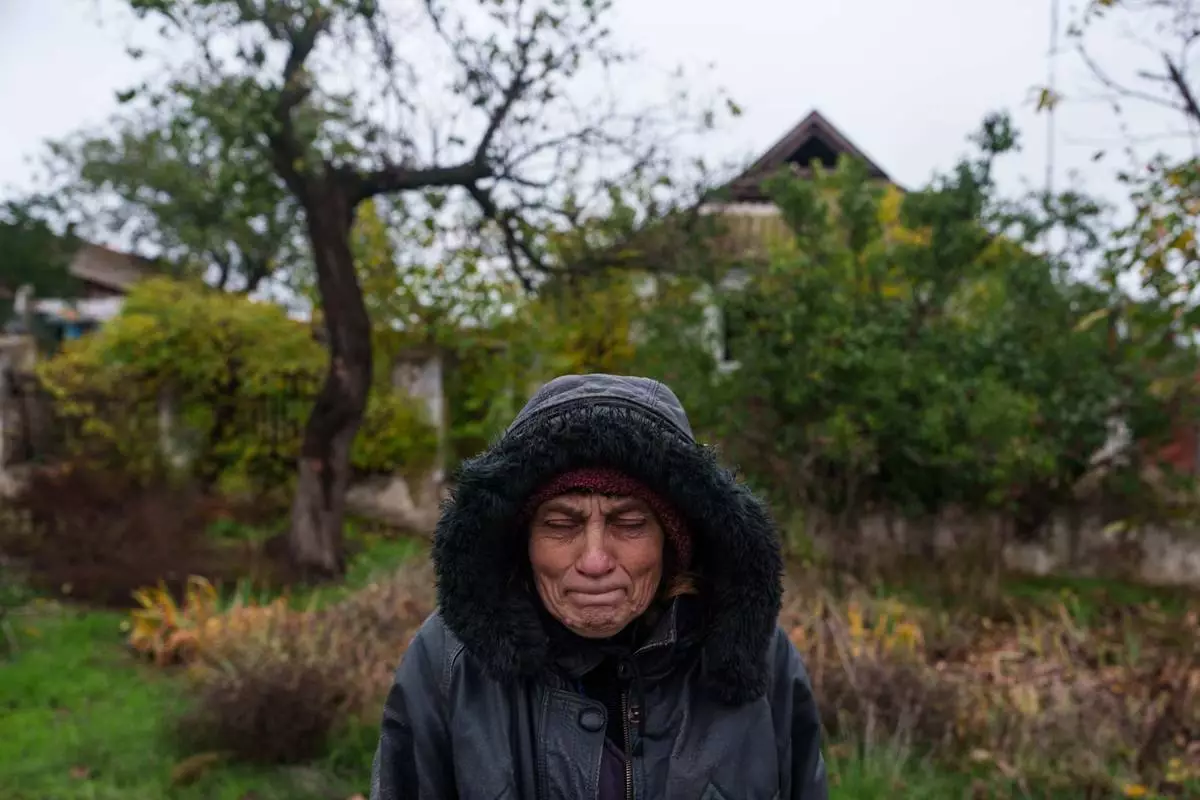
Natalia Diadiuk, 53, a local resident, reacts as she refuses to be evacuated during a localized ceasefire linked to a humanitarian aid mission to Oleshky, in the village of Kozatske, Kherson region, Ukraine, Saturday, Oct. 31, 2026. (AP Photo/Evgeniy Maloletka)
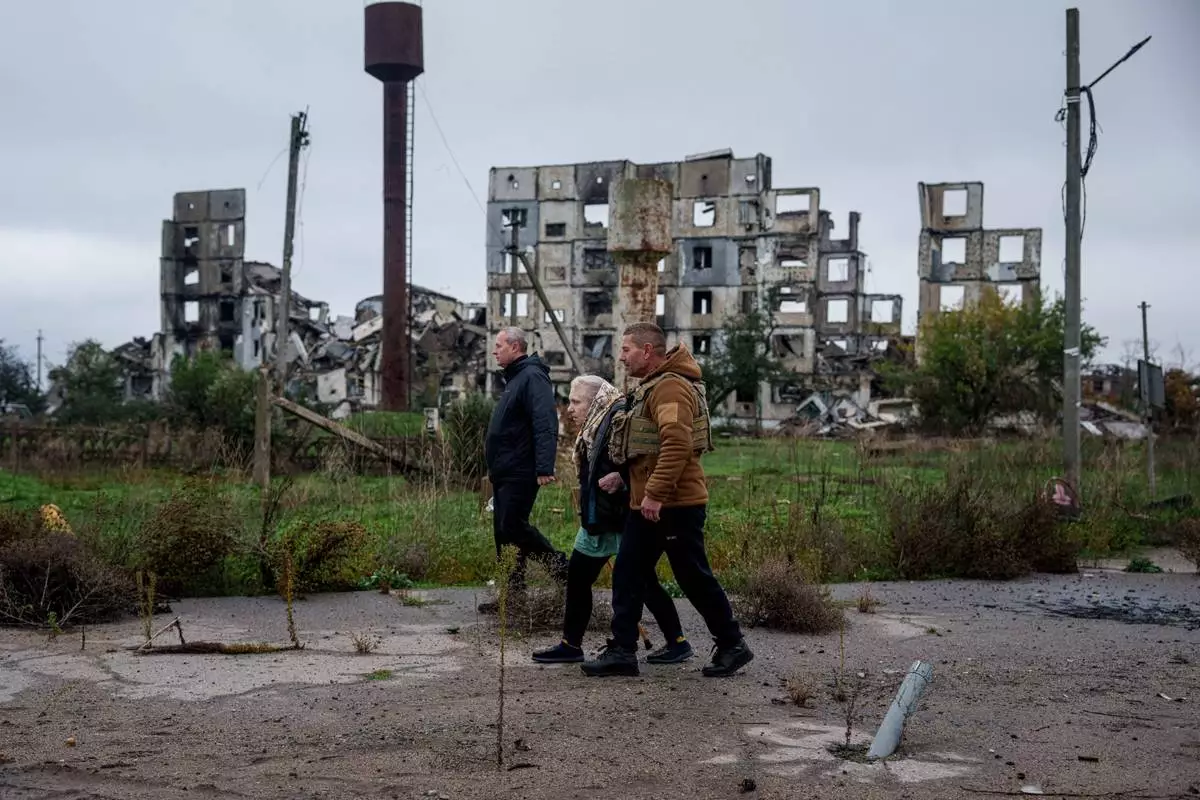
Oleh Tarabaka, head of the Nova Kakhovka military administration, left, and Vadym, a Ukrainian sergeant of the 42nd Marine Brigade, right, help evacuate Antonina, a local resident, as they walk past a destroyed residential building in an area contaminated with anti-personnel mines, during a localized ceasefire linked to a humanitarian aid mission to Oleshky, in the village of Kozatske, Kherson region, Ukraine, Saturday, Oct. 31, 2026. (AP Photo/Evgeniy Maloletka)
President Donald Trump's administration appealed to the Supreme Court on Monday in its push to sideline thousands of disputed California mail ballots the day before the pivotal midterm elections. The emergency appeal came after an appeals court rejected the request to set aside some 20,000 ballots from people the federal government suspects may not be U.S. citizens.
Trumpclosed out the final weekend before Election Day with rallies in two states he had handily won in the past.
At the same time, Democrats began to fracture in Michigan, risking their effort to retake the Senate. Michigan Democrat Abdul El-Sayed’s former opponent in the U.S. Senate primary, Haley Stevens, stunned party officials Sunday by endorsing Republican Mike Rogers as Democratic tensions boiled over days before the election.
Trump will make his closing pitch of the midterms Monday afternoon at the Lincoln Memorial Reflecting Pool, pushing his slow, expensive and problem-plagued efforts to repair it back into the spotlight on the eve of Election Day.
The Latest:
The president brought some visual aids to his speech on the Reflecting Pool, holding up photos to show what he deemed to be neglect of the iconic Washington site.
Trump held up pictures of “rusted” pipes and algae as he persisted in claiming that vandalism to his repairs had also been documented, a claim that was undermined in court filings by the president’s own administration.
“It was a work of art that never worked, but now it will work,” Trump said.
About 1,100 customers lost power earlier Monday after the city’s fire department said it was responding to reports of smoke coming from maintenance holes in the downtown Washington area.
Pepco, the electricity provider in Washington, is still investigating what caused the outage, according to spokesperson Jessica Babb.
Power has been restored to all customers, she added.
In a speech to mark the reopening of the Lincoln Memorial Reflecting Pool after repairs, President Donald Trump joked that he would rename it after himself.
The president is speaking about the troubled repairs to the pool, which he said was damaged by vandals despite an admission in court that shoddy renovations commissioned by Trump caused its shuttering.
The president has chosen this site to address voters on the final day before the Tuesday midterm elections, which will determine control of the House and Senate.
Shannon Taylor, the prosecutor seeking to oust longtime Republican Rep. Rob Wittman in Virginia’s 1st Congressional District and help Democrats flip control of the U.S. House, says voters are fired up and demanding change in this year’s midterm election.
Taylor held a news conference Monday in suburban Richmond, where she said voter enthusiasm and early voting trends leave her confident she’s headed to victory Tuesday.
“People are mad, and people want to see change,” said Taylor, who has run on an anti-corruption platform and focused on the cost of living.
Wittman, who has been in Congress for nearly two decades and touted his experience during this race, was scheduled to campaign later Monday with House Speaker Mike Johnson. Taylor said Johnson’s visit to a district that’s long leaned red highlights the struggles Republicans face this year.
Flooding in the Southwest has forced a Colorado tourist town to alter its Election Day voting plans.
In Pagosa Springs, town residents impacted by the floods who haven’t voted yet can “visit any voter center across the state to request and receive a replacement ballot,” the Secretary of State’s office said in a news release.
People who cast in-person ballots outside their home county can vote only for statewide races, the office said. But if they have access to their mail ballot, they can return it to any drop box or voter center in the state by 7 p.m. on Election Day, and it will be sent to their county clerk for signature verification and tabulation, the office said.
Voting centers will still be open in La Plata County, but some county offices, including the clerk’s office, will have special hours on Tuesday.
▶ Read more
The president’s closing argument for the midterms will have a backdrop of a cleaned-out reflecting pool and the Washington Monument in the distance.
He will stand on a platform decorated with signs that say “Restoring Our Capitol” and “The Reflecting Pool.” Behind him on the lectern is a sign with an aerial image of the pool that reads: “Back, and more beautiful than ever!”
It doesn’t appear that the event, occurring on a cool, clear autumn day, will be open to the public.
There are two short, reserved rows for administration officials and guests, including Interior Secretary Doug Burgum.
The rest of the space is dedicated to the press.
Vice President JD Vance campaigned in rural upstate New York, disparaging Democrats as “lunatics” and warning that failing to elect Republicans could lead to a leftward swing for the country.
Speaking in an airport hangar in the town of Rome, Vance also touted Trump’s achievements, pointing to legislation he signed to end taxes on tips and overtime, even as the president’s approval ratings on the economy slipped to 25% last month.
He stumped for two Republicans running for Congress but did not talk about Bruce Blakeman, the Republican competing to unseat Democratic Gov. Kathy Hochul.
Vance said voters could send a message to Democrats “that here in the New York 21st Congressional District, we are fighting for people who love the United States of America, not those who hate it.”
Secretary of State Marco Rubio was holding talks with Foreign Minister Oliver Blanco at the State Department on Monday, just two weeks after Venezuelan authorities and opposition figures agreed on a blueprint to reform the country’s electoral process so that free and fair elections can take place at some point in 2027. Neither man spoke as they posed for photographs ahead of their meeting.
Rubio said last week that the Trump administration, which ousted former President Nicolas Maduro in a January military operation, would be watching events closely and urged all sides to comply with the new process. He said the goal is a sustainable election architecture that will give all parties confidence in the vote.
“If we’re nervous about where we’re going to go from here, go vote,” Michigan Democratic Senate candidate Abdul El-Sayed said Monday at a campaign event in Ypsilanti.
El-Sayed spent the final day before the election campaigning alongside fellow Michigan Democrat Debbie Dingell and Massachusetts Democratic Sen. Elizabeth Warren.
Much of his speech focused on getting corporate money out of politics and establishing universal Medicare.
Haley Stevens, whom El-Sayed defeated in the August Democratic primary, endorsed Republican Senate candidate Mike Rogers on Sunday, exacerbating tensions among Democrats on the eve of the midterm elections that will determine control of Congress.
A spokesperson for Pepco, the electric utility provider in Washington, says the company is working to restore power to about 1,100 customers after an outage this morning in the city’s Foggy Bottom neighborhood.
Jessica Babb says they’re investigating what caused the outage.
The city’s fire department said on its X account that it was responding to multiple reports of smoke coming from maintenance holes in the area. Photos of the area shortly after showed the smoke had cleared.
The power outages appeared to cover at least a five- or six-block radius between 21st and 17th Streets and from Virginia Avenue to Pennsylvania Avenue.
That area includes the State Department. The agency’s headquarters had brief and limited power interruptions, but several off-site annexes, including the Washington Passport Agency, lost power and closed to the public.
The World Bank building was also without power, as were numerous businesses in the vicinity.
The Trump administration appealed to the U.S. Supreme Court on Monday in its push to sideline thousands of disputed California mail ballots the day before the pivotal midterm elections.
The emergency appeal came after an appeals court rejected the request to set aside some 20,000 ballots from people the federal government suspects may not be citizens. The Republican Trump administration has prioritized identifying noncitizen voters this year, despite them being rare.
The federal government says those ballots should not be counted until the voters’ status can be verified. California officials say the list is highly unreliable and likely includes many people who are U.S. citizens.
A district court judge forcefully denied the Justice Department’s request and warned that the demand could disenfranchise citizens in the Nov. 3 midterm elections to determine control of Congress.
On a rainy Monday ahead of Election Day, Democrat Rob Sand asked canvassers in the suburbs north of Des Moines, Iowa, to keep knocking doors during the final stretch.
“We have had some of the closest races in the country right here every single election cycle,” said Sand, a candidate for governor. “This is it. We have thirty-whatever hours to change the direction of the state of Iowa.”
Sand passed the microphone to Kentucky Gov. Andy Beshear, who cited his own races as proof that a Democrat can win over Trump-backed candidates in states like his own and Iowa. He, too, reminded the volunteers in the room that even those were by tight margins.
Most Iowans want to vote for a person, not a party, Sand told reporters after. Up and down the ballot this year in Iowa, he said, “there’s a lot of situations where that person might happen, this time around, to be a Democrat.”
In a new interview released Monday, the president indicated he’d have no qualms about issuing pardons to those surrounding him to protect them from potential criminal liability.
The comments come as Democrats could take control of at least one chamber of Congress, giving them investigative powers such as subpoena authority.
“I would if I needed to, sure,” Trump told the New York Post’s Miranda Devine on her “Pod Force One” podcast. “I would not even think about — I’d do it.”
He pointed to preemptive pardons former President Joe Biden issued to family members, administration officials and key lawmakers, such as those who worked on a special committee investigating the Jan. 6, 2021, insurrection at the Capitol.
The stakes in Tuesday’s midterm elections are so high that Shane Dunn voted for the first time in his life, at age 65.
After a career as a cook up and down the East Coast, Dunn moved to the Philadelphia suburbs and voted last week in Levittown. “I was always a busy man,” he said outside his polling place. But now, “I’m learning what’s going on within our country, and this is actually what brought me out.”
Voters across the United States are getting their word in, too, as they determine which party controls the Senate and the House and takes charge of governors’ offices, legislatures and state leadership posts in the final two years of Republican Donald Trump’s presidency.
In dozens of Associated Press interviews with people who cast ballots at advance polling places or drop boxes across the country, the angst was palpable, most sharply from those who oppose Trump but also from many who support him.
▶ Read more
For President Donald Trump, this week’s elections are about him. For his fellow Republicans, the risk is voters will agree.
Midterms almost always serve as a referendum on the president’s party, and losses typically ensue. But Trump’s decisions to impose tariffs, start a war and oversee extravagant Washington renovations — largely without congressional consultation — have made it harder for Republicans to navigate those historical headwinds.
There is a direct connection between his actions and higher gas prices, costlier groceries and persistently high inflation.
Republicans cannot blame the fallout from those decisions on past administrations when Trump has owned them so fulsomely. They also cannot easily distance themselves from an unpopular president who demands loyalty and routinely tells voters the economy is just fine.
At virtually every juncture before Election Day on Tuesday, Trump has complicated the task of protecting Republican majorities in Congress.
The Iran war is “making it exponentially harder for Republicans to keep the House and Senate,” Rep. Derrick Van Orden of Wisconsin, one of the most vulnerable House Republicans, said in a debate while noting his support for the effort.
The NAACP is asking a judge for an emergency order limiting which federal staffers can monitor the polls on Election Day.
The group wants law enforcement agents from the Federal Bureau of Prisons, the Drug Enforcement Administration and the Bureau of Alcohol, Tobacco, Firearms and Explosives to be barred from the role because they could intimidate voters.
“DOJ’s decision to deploy federal law enforcement agents and personnel to election sites is unlawful and serves a plain purpose: to intimidate voters and election workers alike, and to have a chilling effect on in-person voting on Election Day,” the group wrote in its overnight filing.
The Justice Department has insisted its election monitors around the country on Election Day will be there to observe and will not interfere with voting.
President Donald Trump’s administration has made $15 billion in promises to agricultural producers in the weeks before Tuesday’s midterm elections, initiatives intended to offset higher diesel and fertilizer costs that farmers have endured largely due to his tariffs and the Iran war.
Whether that will motivate more voters to turn out in agricultural states where traditionally Republican seats are now seen as competitive is unclear. It may explain Trump’s increased attention on rural areas, including visits Sunday to Iowa and Kansas.
Of the $15 billion, more than half will go toward a one-time payment plan for farmers impacted by soaring diesel prices. Beyond the $15 billion, the agency also plans $13.8 billion in payments to offset shortfalls during the 2025 crop year for farmers who grow key crops such as corn, soybeans, wheat and rice.
Increased fertilizer and fuel costs have made it difficult for farmers to turn a profit this year. Last year, tariffs drove up expenses for other equipment farmers use, and the trade war with China caused a near boycott of U.S. agricultural goods.
The Justice Department has defended the accuracy of a list that it says has more than 20,000 suspected noncitizens registered to vote in California and suggested that an immigrant rights group should face contempt charges over an analysis of the names.
U.S. District Court Chief Judge James Boasberg had allowed the Coalition for Humane Immigrant Rights access to data on people the Trump administration alleges are noncitizen voters. Boasberg ordered the plaintiffs not to disclose any names and to use the data only for arguments about why they have legal standing to challenge its use.
In a Saturday court filing, the group said more than 40% of the people on the list do not appear in the state’s voter file. The filing also identified 22 people who were likely naturalized U.S. citizens while saying that thousands more American citizens appeared to be on it.
The Justice Department argued Sunday that the group’s filing had nothing to do with its legal standing and therefore violated Boasberg’s order. The agency also suggested that Boasberg refer the matter for investigation into possible contempt of court.
▶ Read more

President Donald Trump speaks at a campaign rally at the Salina Regional Airport, Sunday, Nov. 1, 2026, in Salina Kan. (AP Photo/Jacquelyn Martin)

President Donald Trump walks across the South Lawn of the White House after stepping off Marine One, Monday, Nov. 2, 2026, in Washington. (AP Photo/Allison Robbert)

President Donald Trump walks across the South Lawn of the White House after stepping off Marine One, Monday, Nov. 2, 2026, in Washington. (AP Photo/Allison Robbert)