Skip to Content Facebook Feature Image

Ukraine and Russia report fake emergency alerts after cyberattack targets apps

News

Ukraine and Russia report fake emergency alerts after cyberattack targets apps
News

News

Ukraine and Russia report fake emergency alerts after cyberattack targets apps

2026-11-02 18:22 Last Updated At:18:30

KYIV, Ukraine (AP) — Authorities in Ukraine and Russia say their emergency alert mobile apps were targeted by cyberattacks late Sunday, with users in Ukraine receiving false warnings of dangerously high radiation levels in the capital, Kyiv.

In a Telegram post late Sunday, Ukraine’s air raid alert channel said “unauthorized parties” had interfered with the app’s operation and that the service had been temporarily suspended. It warned users not to click on links in “suspicious notifications.”

More Images
This screenshot made on a smartphone shows a series of false alerts received late Sunday, Nov. 1, 2026 from an emergency alert mobile application that was subject to a cyberattack, in Kyiv, Ukraine. Third message in Russian reads "Hi! There will be a nuclear threat across Ukraine. Do not worry, the Oreshnik is incoming. Telegram channel: [link]", Fifth and sixth messages in Ukrainian read "Increased danger, Go to the shelter". (AP Photo) Photo taken with a smartphone.
This screenshot made on a smartphone shows a series of false alerts received late Sunday, Nov. 1, 2026 from an emergency alert mobile application that was subject to a cyberattack, in Kyiv, Ukraine. Third message in Russian reads "Hi! There will be a nuclear threat across Ukraine. Do not worry, the Oreshnik is incoming. Telegram channel: [link]", Fifth and sixth messages in Ukrainian read "Increased danger, Go to the shelter". (AP Photo) Photo taken with a smartphone.

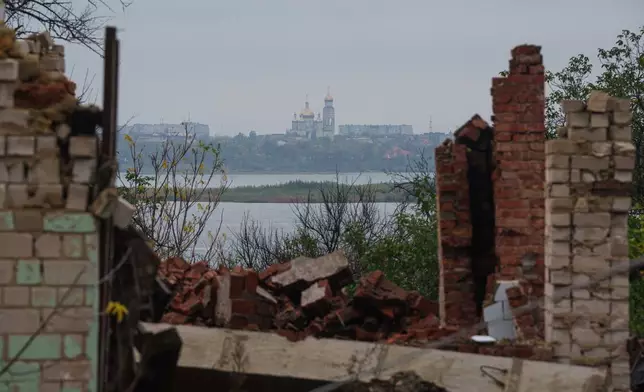
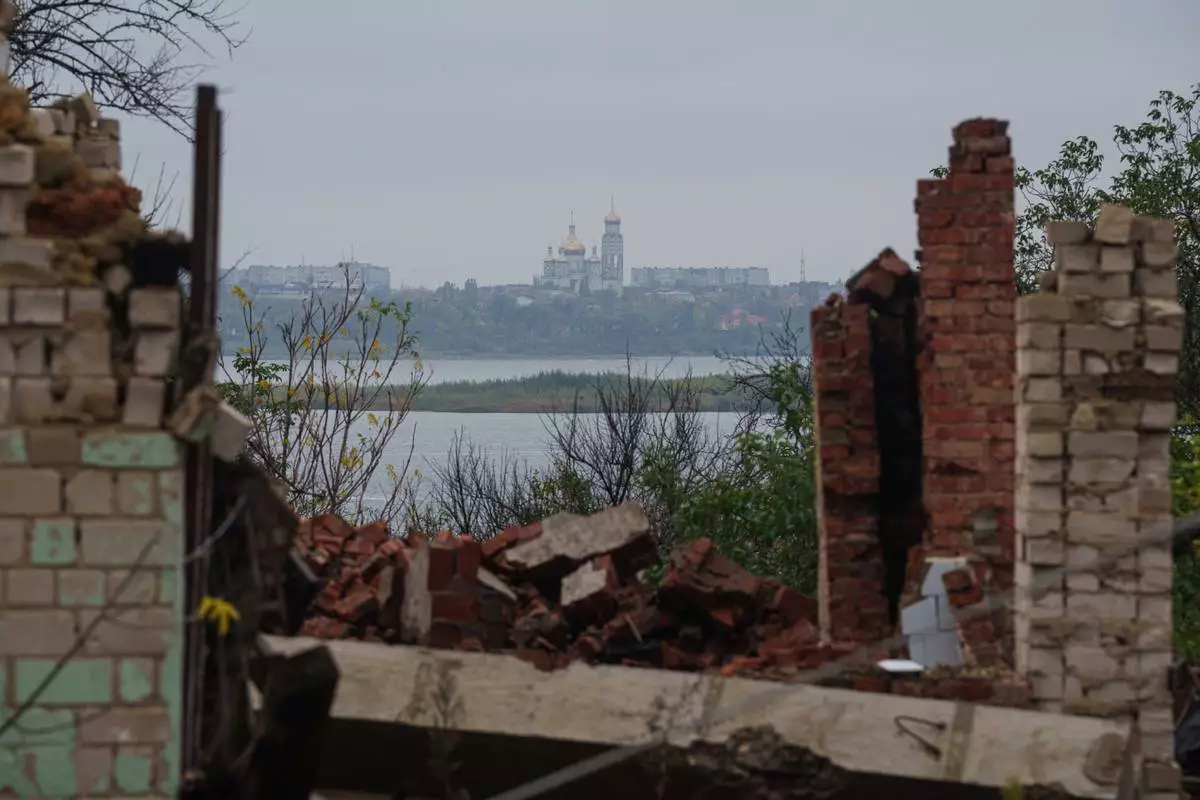
St. Andrew's Cathedral in Russian-occupied Nova Kakhovka, is seen across the Dnipro River from the village of Kozatske, during a localized ceasefire linked to a humanitarian aid mission to Oleshky, Kherson region, Ukraine, Saturday, Oct. 31, 2026. (AP Photo/Evgeniy Maloletka)
St. Andrew's Cathedral in Russian-occupied Nova Kakhovka, is seen across the Dnipro River from the village of Kozatske, during a localized ceasefire linked to a humanitarian aid mission to Oleshky, Kherson region, Ukraine, Saturday, Oct. 31, 2026. (AP Photo/Evgeniy Maloletka)

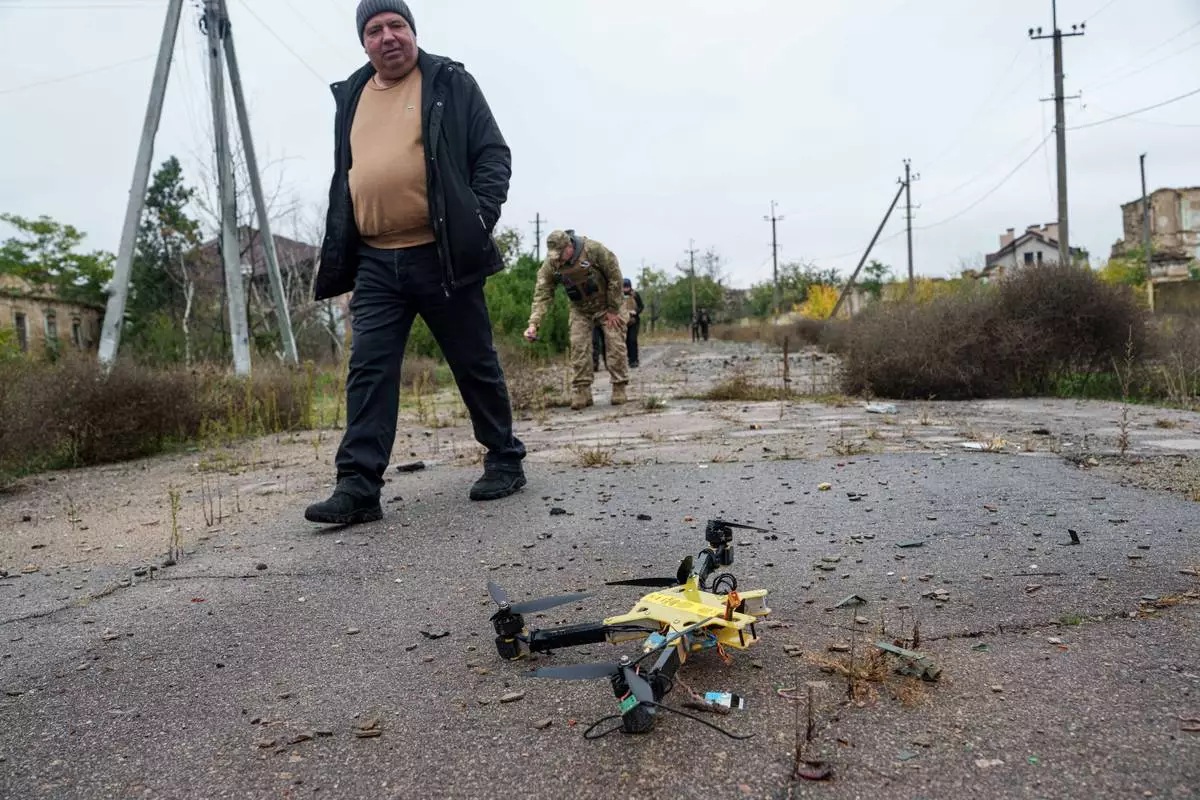
A representative of the Nova Kakhovka administration walks past an unexploded Russian FPV drone during a localized ceasefire linked to a humanitarian aid mission to Oleshky, in the village of Kozatske, Kherson region, Ukraine, Saturday, Oct. 31, 2026. (AP Photo/Evgeniy Maloletka)
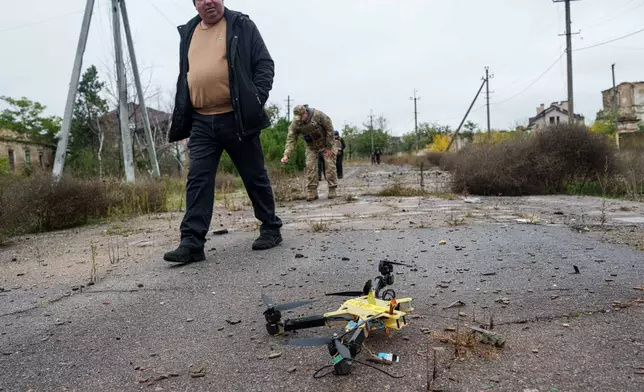
A representative of the Nova Kakhovka administration walks past an unexploded Russian FPV drone during a localized ceasefire linked to a humanitarian aid mission to Oleshky, in the village of Kozatske, Kherson region, Ukraine, Saturday, Oct. 31, 2026. (AP Photo/Evgeniy Maloletka)
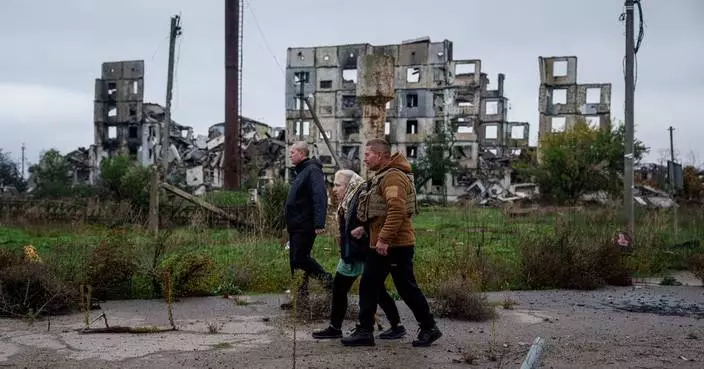
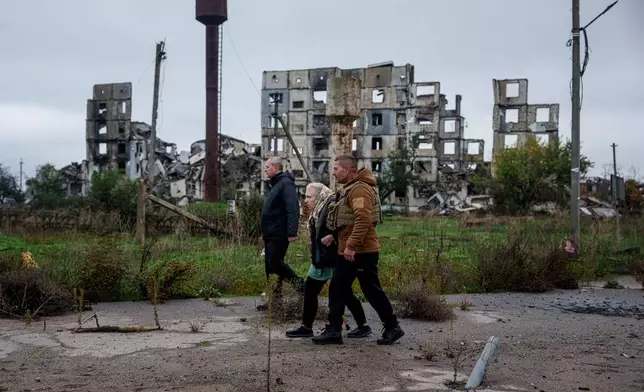
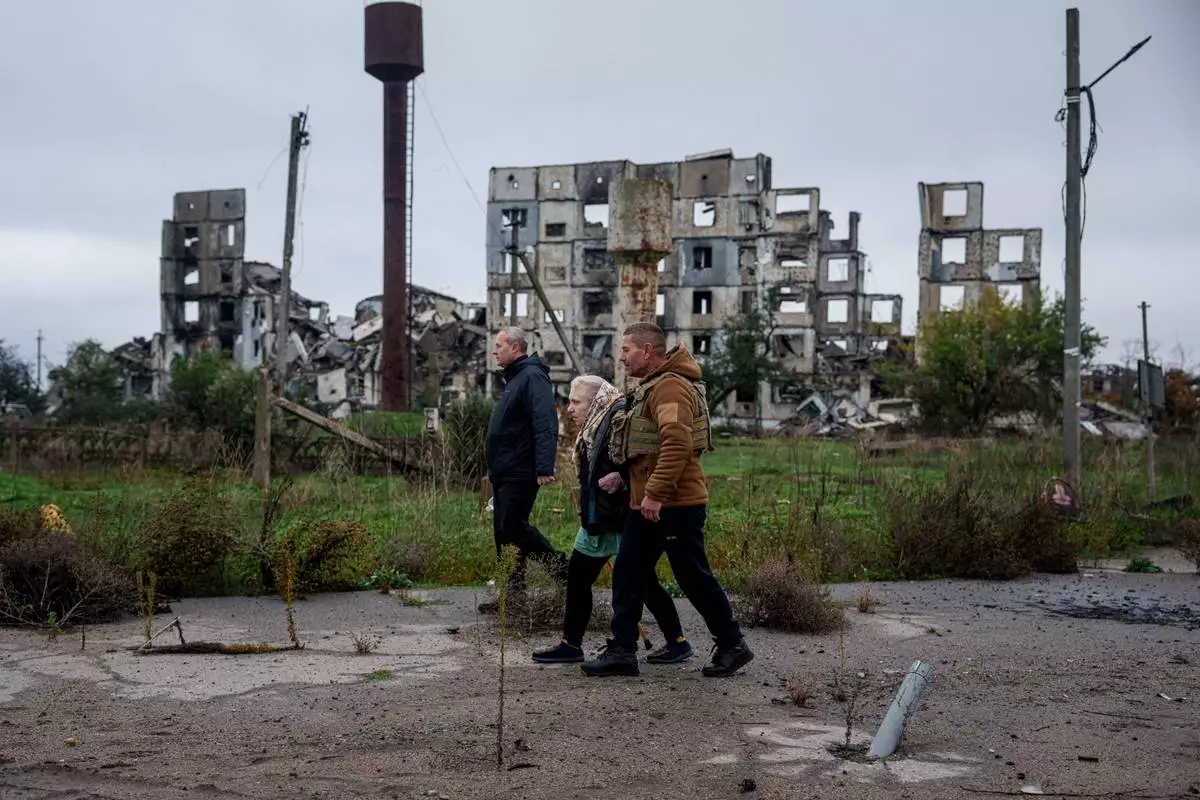
Oleh Tarabaka, head of the Nova Kakhovka military administration, left, and Vadym, a Ukrainian sergeant of the 42nd Marine Brigade, right, help evacuate Antonina, a local resident, as they walk past a destroyed residential building in an area contaminated with anti-personnel mines, during a localized ceasefire linked to a humanitarian aid mission to Oleshky, in the village of Kozatske, Kherson region, Ukraine, Saturday, Oct. 31, 2026. (AP Photo/Evgeniy Maloletka)

Oleh Tarabaka, head of the Nova Kakhovka military administration, left, and Vadym, a Ukrainian sergeant of the 42nd Marine Brigade, right, help evacuate Antonina, a local resident, as they walk past a destroyed residential building in an area contaminated with anti-personnel mines, during a localized ceasefire linked to a humanitarian aid mission to Oleshky, in the village of Kozatske, Kherson region, Ukraine, Saturday, Oct. 31, 2026. (AP Photo/Evgeniy Maloletka)

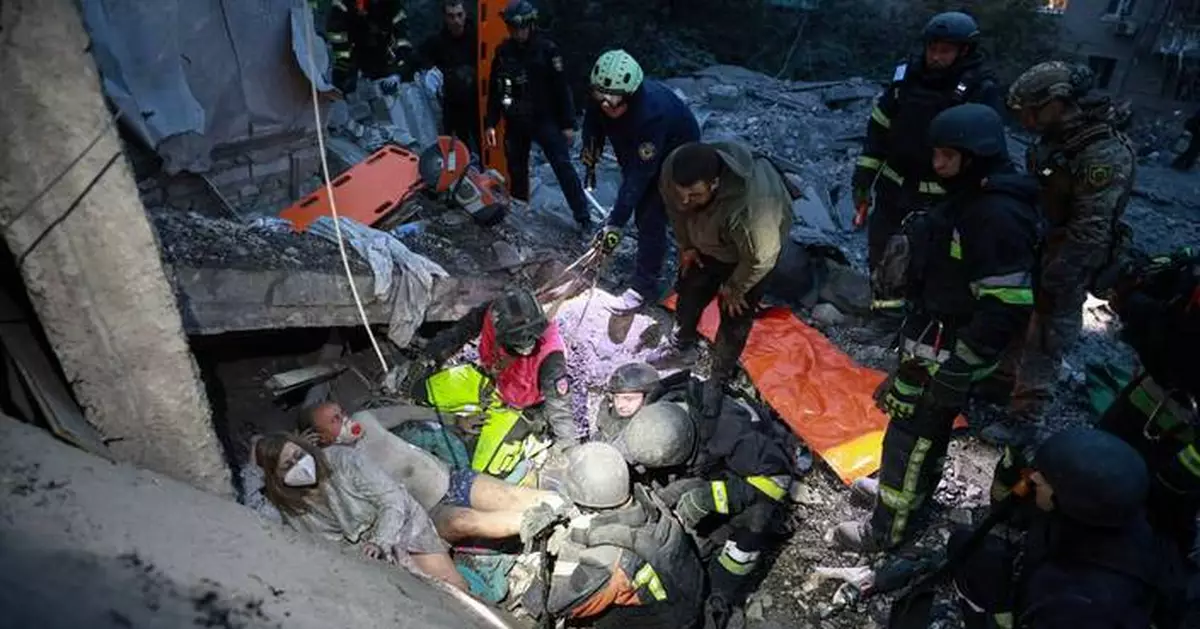
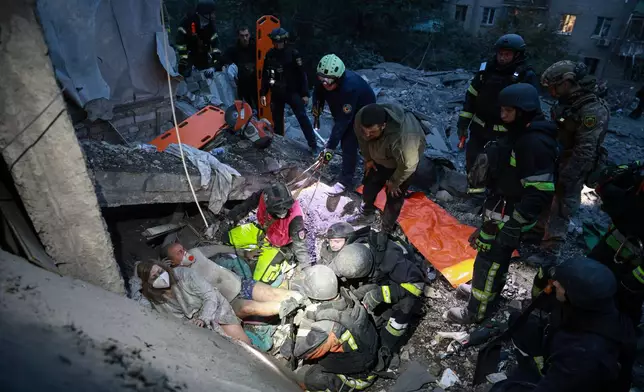
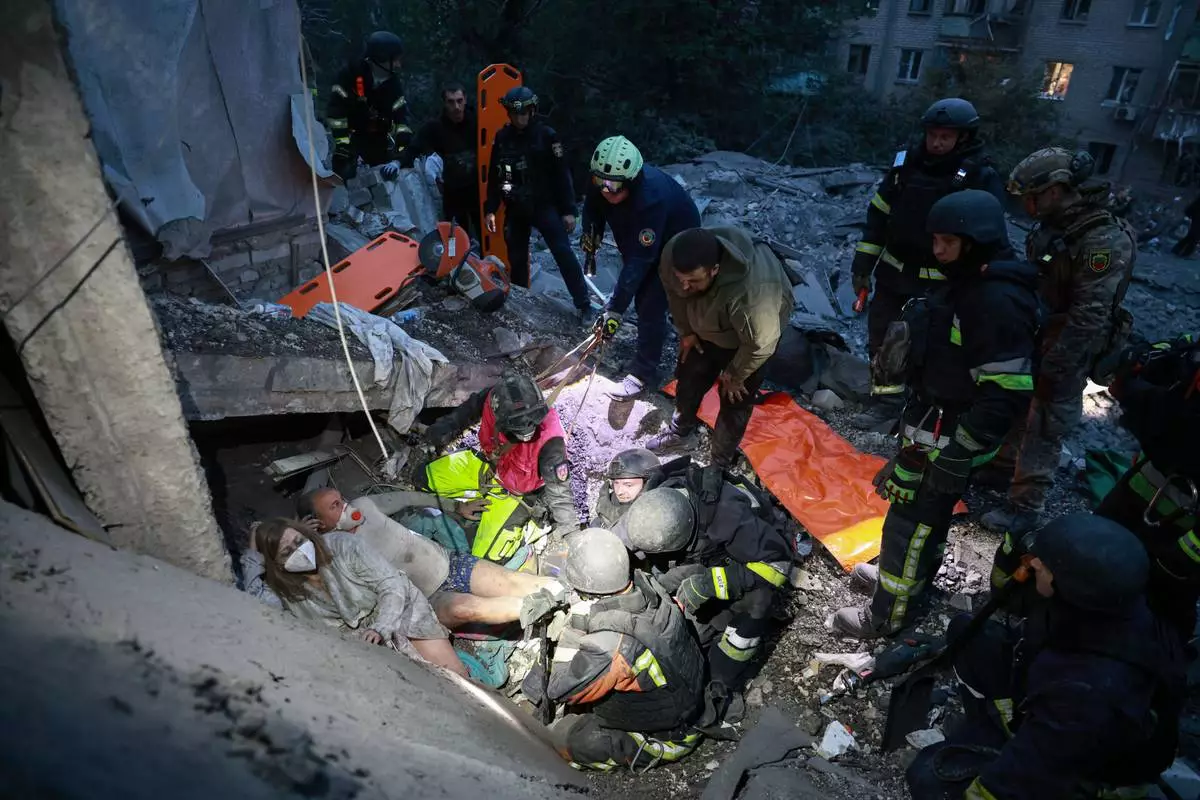
Rescue workers pull a family from the rubble of a residential building destroyed by a Russian airstrike in Zaporizhzhia, Ukraine, Saturday, Oct. 10, 2026. (AP Photo/Kateryna Klochko)

Rescue workers pull a family from the rubble of a residential building destroyed by a Russian airstrike in Zaporizhzhia, Ukraine, Saturday, Oct. 10, 2026. (AP Photo/Kateryna Klochko)

Authorities in Ukraine said the app, which Ukrainians rely on to seek safety amid daily Russian missile and drone strikes, was restored overnight. The alerts — making false claims of high radiation levels, a chemical threat and public disturbances in Kyiv — were written in English with spelling and grammatical errors as well as in a mix of Russian and Ukrainian.

One of the false posts mentioned the hacking group Hitcore. Mash, a Russian Telegram channel with links to the security services, said it had spoken to representatives of Hitcore and that they had claimed responsibility for the attack. That claim could not be independently verified.

Ukraine's state-run Center for Countering Disinformation reported the breach and urged users to monitor emergency channels on social media and rely on physical alerts while the cyberattack was being addressed.

Yurii Ihnat, a spokesman for Ukraine’s air force command, said the cyberattack had no impact on Ukraine’s security and defense operations because the app is separate from military command systems.

Ihnat told Ukraine’s private 1+1 television that the air force continues to report real-time threats through independent communication channels, including popular social media platforms.

In Russia, officials said Monday that hackers had sent fake emergency alerts after gaining access to the Russian Emergency Ministry's mobile app.

The ministry did not name who carried out the attack. In a statement, it reassured Russians that the wider public alert system was working normally, and that the mobile app acted as a supplementary service alongside alerts shared through SMS messages, media broadcasts and municipal sirens and loudspeakers.

Kremlin spokesperson Dmitry Peskov said that all of Russia’s state agencies were under the constant threat of cyberattacks, including a growing number that use artificial intelligence.

“All government bodies must take steps to improve the cybersecurity of our digital resources,” Peskov said.

Ukrainian authorities in the war-divided Kherson region reported multiple Russian drone attacks early Monday, hours after a humanitarian ceasefire expired.

The regional administration said a 62-year-old woman and a 73-year-old man were hospitalized with blast injuries in the city of Kherson, across the Dnipro River from Russian-occupied territory.

The localized ceasefire ended at midnight at the start of Monday. The brief pause in fighting was tied to a humanitarian aid mission in the Russian-occupied city of Oleshky.

The ceasefire, which began Oct. 27, marked the most significant truce between Kyiv and Moscow since Russia’s full-scale invasion of Ukraine began nearly five years ago.

The White House said U.S. first lady Melania Trump helped broker the limited truce. Civilian negotiators from Russia and Ukraine also helped secure the pause, which allowed besieged residents of Oleshky to be evacuated in a rare joint operation that ended Saturday.

An estimated 2,000 civilians were in Oleshky when the temporary truce took effect. They could evacuate to territory controlled by either Ukraine or Russia, or remain in the city with replenished food and medical supplies. Exact evacuation totals were withheld to protect those who stayed.

Ukraine’s general staff said Monday that Russia’s military had bolstered its drone defenses and replenished ammunition supplies in the area during the ceasefire.

Elsewhere in Ukraine, emergency services reported that drone strikes injured 12 people in the eastern Kharkiv region and damaged a refrigeration facility, greenhouses and residential buildings.

Five people were also reported injured in the Black Sea port city of Odesa, where a warehouse was targeted and homes were damaged.

Russia’s Ministry of Defense said Monday that it had shot down 212 Ukrainian drones overnight, while the head of Russia’s Samara region, Gov. Vyacheslav Fedorishchev, said in a statement that local air defenses were repelling an aerial attack, but did not give further details.

Independent Russian media outlets later reported that Ukrainian drones had targeted one of Europe’s largest oil transport hubs in Russia’s Samara region.

Katie Marie Davies contributed to this report from Manchester, England.

Follow the AP’s coverage of the war in Ukraine at https://apnews.com/hub/russia-ukraine
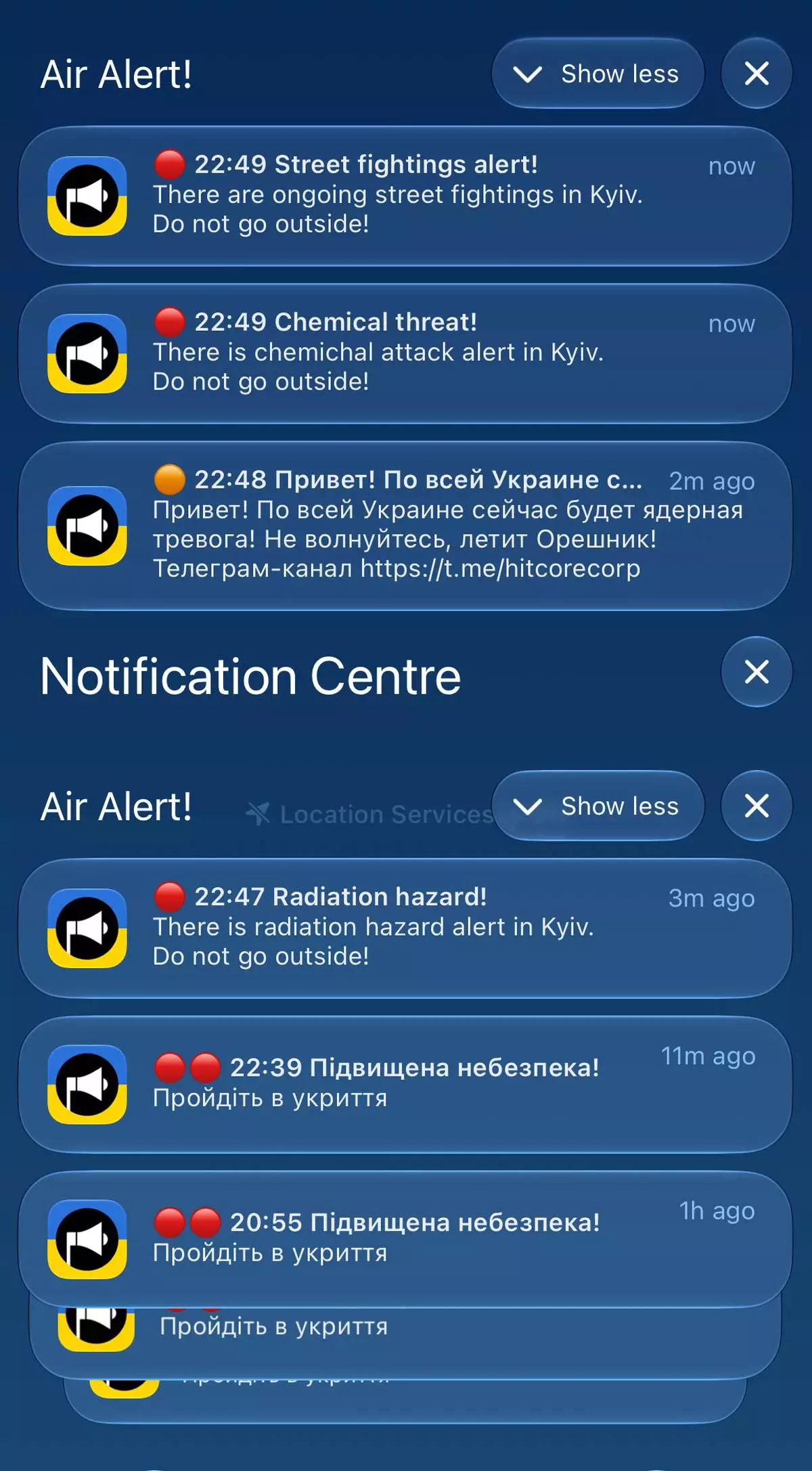
This screenshot made on a smartphone shows a series of false alerts received late Sunday, Nov. 1, 2026 from an emergency alert mobile application that was subject to a cyberattack, in Kyiv, Ukraine. Third message in Russian reads "Hi! There will be a nuclear threat across Ukraine. Do not worry, the Oreshnik is incoming. Telegram channel: [link]", Fifth and sixth messages in Ukrainian read "Increased danger, Go to the shelter". (AP Photo) Photo taken with a smartphone.
This screenshot made on a smartphone shows a series of false alerts received late Sunday, Nov. 1, 2026 from an emergency alert mobile application that was subject to a cyberattack, in Kyiv, Ukraine. Third message in Russian reads "Hi! There will be a nuclear threat across Ukraine. Do not worry, the Oreshnik is incoming. Telegram channel: [link]", Fifth and sixth messages in Ukrainian read "Increased danger, Go to the shelter". (AP Photo) Photo taken with a smartphone.

St. Andrew's Cathedral in Russian-occupied Nova Kakhovka, is seen across the Dnipro River from the village of Kozatske, during a localized ceasefire linked to a humanitarian aid mission to Oleshky, Kherson region, Ukraine, Saturday, Oct. 31, 2026. (AP Photo/Evgeniy Maloletka)
St. Andrew's Cathedral in Russian-occupied Nova Kakhovka, is seen across the Dnipro River from the village of Kozatske, during a localized ceasefire linked to a humanitarian aid mission to Oleshky, Kherson region, Ukraine, Saturday, Oct. 31, 2026. (AP Photo/Evgeniy Maloletka)

A representative of the Nova Kakhovka administration walks past an unexploded Russian FPV drone during a localized ceasefire linked to a humanitarian aid mission to Oleshky, in the village of Kozatske, Kherson region, Ukraine, Saturday, Oct. 31, 2026. (AP Photo/Evgeniy Maloletka)
A representative of the Nova Kakhovka administration walks past an unexploded Russian FPV drone during a localized ceasefire linked to a humanitarian aid mission to Oleshky, in the village of Kozatske, Kherson region, Ukraine, Saturday, Oct. 31, 2026. (AP Photo/Evgeniy Maloletka)
Oleh Tarabaka, head of the Nova Kakhovka military administration, left, and Vadym, a Ukrainian sergeant of the 42nd Marine Brigade, right, help evacuate Antonina, a local resident, as they walk past a destroyed residential building in an area contaminated with anti-personnel mines, during a localized ceasefire linked to a humanitarian aid mission to Oleshky, in the village of Kozatske, Kherson region, Ukraine, Saturday, Oct. 31, 2026. (AP Photo/Evgeniy Maloletka)

Oleh Tarabaka, head of the Nova Kakhovka military administration, left, and Vadym, a Ukrainian sergeant of the 42nd Marine Brigade, right, help evacuate Antonina, a local resident, as they walk past a destroyed residential building in an area contaminated with anti-personnel mines, during a localized ceasefire linked to a humanitarian aid mission to Oleshky, in the village of Kozatske, Kherson region, Ukraine, Saturday, Oct. 31, 2026. (AP Photo/Evgeniy Maloletka)

Rescue workers pull a family from the rubble of a residential building destroyed by a Russian airstrike in Zaporizhzhia, Ukraine, Saturday, Oct. 10, 2026. (AP Photo/Kateryna Klochko)


Rescue workers pull a family from the rubble of a residential building destroyed by a Russian airstrike in Zaporizhzhia, Ukraine, Saturday, Oct. 10, 2026. (AP Photo/Kateryna Klochko)
MAASTRICHT, the Netherlands--(BUSINESS WIRE)--Nov 2, 2026--

Qorium, the company that develops cultivated real leather, today announces that it is becoming Reyva. The new name and identity mark its next stage: moving from a pioneering technology business towards a global material brand built for the exacting standards of the luxury leather sector.

This press release features multimedia. View the full release here: https://www.businesswire.com/news/home/20261102661351/en/

Reyva grows collagen directly from animal cells and cultivates it through a proprietary process to create uniform sheets. The resulting material is then tanned to become real leather, made from the same natural material that gives conventional leather its strength, breathability and durability. It does so without the necessity of raising or slaughtering animals, and with dramatically reduced waste, water and energy demands compared with traditional leather production. Reyva’s process is designed to give brands greater control over thickness, structure, quality and traceability, while eliminating the variability and waste associated with animal hides.

The relaunch gives the company a more distinctive platform for commercial growth while preserving what sits at its core: advanced tissue engineering, deep leather knowledge and a commitment to creating a premium material that can work with established tanning, finishing and manufacturing processes.

The name Reyva brings together “RE,” inspired by reinventing leather, and “VA,” expressing forward movement. It also echoes rey, the Spanish word for “king,” offering a subtle nod to luxury. Reyva is pronounced RAY-vuh, with the emphasis on the first syllable “ray,” as in a ray of light.

“Reyva reflects the company we have become: ambitious, design-led and ready to stand alongside the world’s leading material brands,” said Michael Newton, CEO of Reyva. “Our science gives us a fundamentally new way to make real leather. Our next chapter is about turning that capability into a material that designers and manufacturers choose for its beauty, consistency and performance, as well as its sustainability credentials.”

Reyva’s platform begins with a small, painless biopsy. Selected cells are banked and multiplied before being cultivated in proprietary tissue bioreactors, where they form collagen sheets. These sheets are then tanned and finished using leather-industry craftsmanship and expertise. The material can be cut, stitched, embossed, tanned and finished, and can be engineered to meet the requirements of different applications.

The company is industrialising its process at the Brightlands Maastricht Health Campus in the Netherlands. It is working with selected partners in automotive and luxury fashion as it progresses from development to commercial volumes. Initial availability will be limited, with capacity increasing as the company scales.

“Leather is an extraordinary natural material, but its conventional production begins with the limits and variability of an animal hide,” said Dr Mark Post, co-founder and Chief Science Officer of Reyva. “By cultivating collagen in a controlled environment, we can preserve the qualities people value in leather while introducing a new level of precision, consistency and resource efficiency.”

An independent life-cycle assessment by CE Delft projects that Reyva’s cultivated leather could achieve an 87% lower carbon footprint than conventional cow-derived leather at full-scale production in 2029 using renewable electricity. The assessment calculated 10.5 kg CO₂-equivalent per square metre at the tannery gate, including finishing, compared with a benchmark of 77–83 kg CO₂-equivalent per square metre for conventional French calf leather. Reyva will continue to update its assessment as the process scales and primary data becomes available.

Reyva was founded by tissue-engineering pioneer Dr Mark Post, leather-industry expert Rutger Ploem who comes from a family of tanners spanning six generations, and sustainability entrepreneur Stef Kranendijk. The company is led by CEO Michael Newton and has raised €30 million to date, including a €22 million Series A announced in November 2025.

Reyva creates beautiful, high-performing real leather. By cultivating leather in uniform sheets, we can move beyond the natural limits of traditional hides, with greater control over its shape, size, thickness and structure. Reyva sample photography by Laurent Stevens

Reyva creates beautiful, high-performing real leather. By cultivating leather in uniform sheets, we can move beyond the natural limits of traditional hides, with greater control over its shape, size, thickness and structure. Reyva sample photography by Laurent Stevens

Recommended Articles