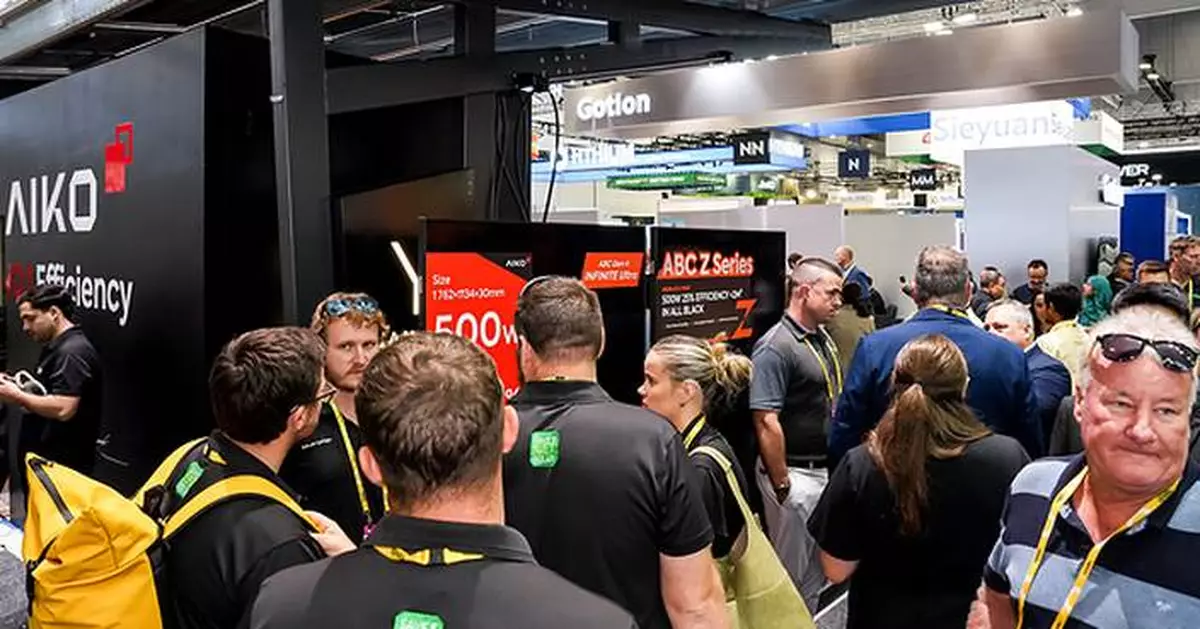
Gen 4 panels with ABC 4.0 INFINITE Ultra cell technology lift power and efficiency across AIKO's entire range, from home rooftops to solar farms, in the same panel sizes. It is the fourth generation in five years since AIKO took all-back-contact solar into mass production.
MELBOURNE, Australia, Nov. 2, 2026 /PRNewswire/ -- Solar manufacturer AIKO today introduced its Gen 4 solar panels to Australia at All-Energy Australia in Melbourne. Built on ABC 4.0 INFINITE Ultra cell technology, the new range of all-back-contact (ABC) solar panels delivers up to 20 W more per panel, without making panels bigger or heavier.
For homes, Gen 4 brings 500 W performance to all-black panels in both dual-glass and mono-glass designs. For commercial and utility projects, the same performance upgrade extends across larger 60-, 66- and 72-cell formats.
Gen 4 reflects the growing maturity of back-contact technology. Over three generations, AIKO moved back contact from a premium niche into mainstream solar. With its fourth generation, the focus now shifts to maximising value for installers and customers on every roof.
What's new in Gen 4
In the new ABC 4.0 INFINITE Ultra cell, six process upgrades lift average production cell efficiency from 27.2% to 27.4%. At the panel level, zero-gap cells, hidden rear connections (InvisiRibbon) and tighter string spacing cut non-generating area by about 20%, so 97% of the surface now produces power.
Every ABC INFINITE Ultra series format gains up to 20 W over the previous generation, at exactly the same size and weight. Against TOPCon panels of the same dimensions on the market today, that means up to 30 W more power per panel. In the 54-cell size used on most Australian homes, where AIKO released the world's first 500 W, 25% efficient white-backsheet panel under 2 m² last year, Gen 4 pushes further to 510 W and 25.5% efficiency.
The INFINITE Ultra series also comes in a choice of larger formats to suit different projects. The 60-cell panel (1,954 × 1,134 mm) reaches 560 W, and the 72-cell panel (2,382 × 1,134 mm) reaches 700 W at 25.9% efficiency, the highest in the range.
Gen 4 also tackles back contact's traditional weakness in rear-side generation, with the 66-cell bifacial panel now reaching up to 85% bifaciality and 670 W. This opens back contact to high-albedo sites, carports, ground-mounted systems and solar farms.
All-black 500 W: extreme power and aesthetics for Australia's premium homes
For many owners of high-end homes, the look of solar has long been a reason to hold back. Visible gridlines, blue cell edges and uneven colour can clash with a carefully designed roof. And an all-black finish has historically come at the cost of performance, as older types of black panels typically run hotter and produce less power.
Gen 4 removes that trade-off, bringing 500 W and 25.0% efficiency to an all-black panel in the standard 1,762 × 1,134 mm size, with no visible gridlines and the same black colour between cells. Homeowners are no longer forced to choose between a premium look and premium performance, and they can choose between two designs.
Z Series is the premium choice, with a uniform pure-black finish front and back. Its sharp look is paired with a stronger frame, enhanced reliability and dual-glass construction, which together support a 40-year product and power warranty, matching the life of a new roof. Z Series is already open for orders in Europe and is expected to be available in Australia in 2027.
Neostar Champion, part of the Gen 4 Neostar range, delivers the same 500 W all-black performance in a mono-glass design, backed by a 30-year product and power warranty.
Designed with installers in mind
As the industry races toward higher wattage, a common shortcut has been to simply make panels bigger or thinner. It produces an eye-catching number on the datasheet, but the cost falls on installers: heavier lifts, awkward non-standard sizes, and roof layouts and racking that must be reworked.
AIKO chose a different approach. The INFINITE Ultra series gains power from better technology rather than a bigger frame. Each panel keeps the same size and weight as the matching previous-generation panel, and the 54-cell panels stay under 2 m² and 25 kg.
Installers also get more ways to mount Gen 4, where approved in the installation manual: short-side or long-side clamping, with or without rails, and short-side or long-side insertion. On the Z Series, an optimised structural design boosts the four-corner front-side mounting load from 1,600 Pa to 2,400 Pa. More watts per panel also means fewer panels, clamps and rails for the same system size, and AIKO's local Australian team backs installers with training and technical support.
Value beyond wattage
With AIKO, customers don't have to trade one benefit for another. Alongside higher output, the INFINITE Ultra series strengthens fire safety, reliability and long-term energy performance, addressing the operating conditions and asset-life considerations that matter to installers, EPCs and system owners. Features vary by model.
- Fire safety. Anti-ignition features, active and passive fire protection and IEC Fire Class A, with hot-spot temperatures more than 35% lower than TOPCon under shading in TÜV Rheinland testing.
- Reliability. Copper interconnection resists micro-cracking, with zero cracks recorded in TÜV NORD's 230 kg treading test, while improved insulation and moisture resistance protect the panel edges.
- Durability. Hail tested with 35 mm hailstones on specified dual-glass models and 40 mm on specified mono-glass models.
- Long-term performance. Low degradation, cell-level partial-shading optimisation and a low temperature coefficient help protect output under challenging Australian conditions, from partial shade to summer heat, over the life of the system.
"Australian households have had AIKO back-contact panels on their roofs for several years, and Australian installers have helped prove the technology in some of the toughest conditions in the world," said Alex Hang, Head of APAC, AIKO. "The INFINITE Ultra series gives them more power from every roof, more ways to mount it, and the confidence that comes from technology built to last for decades. We never stop advancing, and we want Australia to be among the first to benefit."
What it means for Australian homes
Australia's rooftops are being asked to do more than ever. Around 42% of homes already have solar, and more than 500,000 home batteries have been installed under the Cheaper Home Batteries Program since July 2025. As households add batteries, EVs and heat pumps, the question is no longer whether to go solar, but how much a roof can deliver: more energy from limited space, with a finish that complements the home, and the confidence that it will last for decades.
Gen 4 is built around those priorities. With up to 30 W more per panel than TOPCon panels of the same size, homeowners can fit around 6% more solar capacity on the same roof. More generation means bigger savings, more solar to charge the home battery and fewer grid purchases in the evening. It also gives households the capacity to keep adding, from an EV to a heat pump or pool, on the path to a fully electrified home.
What it means for businesses
The expansion of the Small-scale Renewable Energy Scheme to systems up to 1 MW is a rare opportunity to bring more Australian businesses into commercial solar. By lowering upfront costs and improving project feasibility, it opens the benefits of renewable energy to a much broader segment of the economy.
To make the most of it, businesses need to get the most from every square metre of roof. High-efficiency panels like AIKO's ABC INFINITE Ultra series do exactly that, unlocking higher system capacity and, with it, greater STC value. For small or complex sites, that extra capacity can be the difference between a token installation and a system large enough to meaningfully support the business's energy demand. And with multiple formats to suit different buildings, including a high power-to-weight ratio for weight-constrained roofs, more businesses can find the right fit.
Never stop advancing: delivering more value with every generation
Gen 4 reflects AIKO's commitment to making high-performance back-contact solar accessible to every rooftop. Across its first three generations, AIKO focused on overcoming the technology and manufacturing barriers that had kept back contact in a premium niche. By making mass production commercially viable and bringing the technology to more accessible price points, it helped move back contact into the mainstream, helping more homes and businesses enjoy better performance and greater value from solar.
Gen 4 builds on that foundation by addressing a wider range of customer needs and project constraints. Its significance goes beyond a higher number on the datasheet: it brings together output, installation flexibility, reliability, safety and design, rather than asking customers to choose one or two strengths.
The ambition is not simply to make back contact more accessible, but to make it deliver more: greater productivity from every roof, stronger project economics and lasting value over the life of the asset.
"The expanded scheme is a rare opportunity to bring more Australian businesses into solar, but it shouldn't be wasted on poorly matched systems or short-term thinking," said Thomas Bywater, Head of AIKO ANZ. "For business owners, installing solar is never abstract. Behind every commercial project is a business trying to manage costs, protect jobs and build a more resilient future, and it needs a system that delivers real returns, not just an incentive claim. With the right technology and the right design for each site, the incentive will do more than reduce the cost of solar. It will help Australian businesses invest with confidence."
See it at All-Energy Australia
AIKO will present Gen 4 and Z Series at a live launch at 9:30 am on Wednesday 28 October, Booth PP113, All-Energy Australia, Melbourne Convention and Exhibition Centre. Media are welcome; interviews and product images are available on request.
More details on the launch can be found at aikosolar.com/au/all-energy-australia-2026.
About AIKO
AIKO is a global leader in all-back-contact (ABC) solar technology. Guided by its mission of empowering the transformation to a carbon-free society, AIKO was the first to take back-contact solar into gigawatt-scale mass production and continues to set the industry's efficiency benchmarks, with its ABC modules ranked No. 1 on TaiyangNews' TOP SOLAR MODULES list for more than three years running. AIKO has shipped more than 200 GW of solar cells and modules worldwide, is rated Tier 1 by BloombergNEF and was named a Top Performer in the 2025 Kiwa PVEL PV Module Reliability Scorecard.
In Australia, AIKO has been voted installers' No. 1 choice for solar panels in the SolarQuotes Installers' Choice Awards two years running, in 2025 and 2026. With a strong distribution network through Australia's leading distributors and a local team working closely with installers and customers, AIKO delivers high-performance solar to Australian homes and businesses.
Learn more at aikosolar.com/au.
** This press release is distributed by PR Newswire through automated distribution system, for which the client assumes full responsibility. **
Never stop advancing: AIKO brings its fourth generation of back-contact solar to Australia