BANGKOK (AP) — Myanmar has dropped its case against a former American Chamber of Commerce board member and canceled an Interpol “red notice” for his arrest, saying that its investigation concluded that there wasn't enough evidence to support his extradition.
Misfit Technologies CEO Munimul Islam was detained upon his arrival at the international airport in Barcelona, Spain, in late September at the request of Myanmar officials investigating a complaint by the AmCham Myanmar. Islam was beginning a vacation with his wife and children at the time.
Spanish judicial authorities said in a document dated Oct. 26 that they had dropped all legal proceedings against Islam, who had been freed on bail earlier in October, after being informed of Myanmar's decision.
“This case exposes serious weaknesses in Interpol's safeguards, allowing a military regime to trigger detention in a European democracy over unsubstantiated allegations,” Islam, a Bangladesh national, told The Associated Press on Monday.
Paris-based Interpol told the AP that only Myanmar authorities could provide information on the case. Acting Police Brig. Gen. Soe Lin Aung, a spokesperson for Myanmar’s Home Affairs Ministry, which oversees the country’s police forces, wouldn't comment on specifics, saying only that “all the cases have been concluded” before hanging up.
The case began as an internal AmCham Myanmar dispute, with the current board accusing Islam, former board president Adam Castillo, an American, and former executive director Ye Khaung “Danny” Kyaw, an Australian, of financial impropriety for the hiring of an American public relations firm to assist in lobbying efforts in Washington.
It garnered international attention after authorities began investigating it as a criminal case and arrested Castillo and Ye Khaung Kyaw, and issued the “red notice” for Islam, who lives in the United Kingdom.
U.S. President Donald Trump's administration then stepped in and sent a delegation to Myanmar to secure Castillo's release and return to the United States in September, and Ye Khaung Kyaw was deported after pleading guilty to breach of trust, which he said was done under pressure from authorities.
Myanmar, which is embroiled in a civil war, is headed by President Min Aung Hlaing, who led the group of military officers that seized control from the democratically elected leader, Aung San Suu Kyi, in 2021.
The country is widely sanctioned, and Min Aung Hlaing has been on a charm offensive recently to try and win more international support for his government. When Castillo was released, the state-run Global New Light of Myanmar newspaper said that the government's “primary goal” was friendly bilateral relations with the U.S.
The president's spokeswoman didn't respond to a request for comment on the decision not to pursue the case against Islam.
The original AmCham complaint centered on Castillo’s creation of the U.S.-Burma Economic Forum as a lobbying organization for the chamber he served as president from 2023 to 2025, and the 2024 contract Castillo signed with Mercury Public Affairs.
AmCham Myanmar maintains that Castillo “illegally collected” $300,000 and used the association’s name to enlist Mercury to assist in lobbying efforts without approval from the current board.
Myat Phyu The, the executive director of AmCham Myanmar, didn't respond to a request for comment on Islam's case, but previously said that the concern was that transaction could bring “potential legal, financial and criminal exposure” to the organization and current board.
A signed board resolution provided by Castillo’s supporters indicated that the board had approved the lobbying initiative, but AmCham Myanmar maintains that the document is a fake.
The AmCham also maintained it had received no services, but the AP confirmed that Mercury did organize and attend multiple meetings in Washington with Castillo and others. Mercury also declared all payments to American authorities as required under the Lobbying Disclosure Act, with reports available online to the public.
The $300,000 came entirely from Islam's company and was paid in installments. He questioned how the payments could have exposed the current AmCham to legal issues in Myanmar, which has strict foreign currency restrictions, noting he hadn't been a Myanmar resident since 2022 and that the funds were paid by his company's U.S. operation.
His contention appears supported in the official finding by Myanmar authorities, who wrote to their Spanish counterparts that they had concluded Islam “merely carried out corporate invoicing and disbursement directives while based abroad.”
Islam, 40, said that while he is relieved that the case is over, he is “certainly not satisfied” with the outcome and was exploring what legal action he could take against AmCham and the current board members involved.
“I spent 14 days detained, separated from my two infant daughters, causing enormous emotional, financial and reputational harm,” he said. “My freedom has been restored but the damage remains — I want accountability and safeguards so no other innocent family endures this.”

FILE - Pedestrians walk past entrance of Junction City Tower, where the American Chamber of Commerce in Myanmar has its office, on Tuesday, Sept. 15, 2026, in Yangon, Myanmar. (AP Photo, File)
As a child, Rebeca Quiñonez-Piñón wondered where monarch butterflies stop for a meal and a night's rest on their long migrations across North America. Now she and other scientists are attaching tiny tracking devices to hundreds of butterflies to find those critical stopover locations before they disappear.
Swarms of dazzling orange-and-black monarchs use environmental cues to travel some 3,000 miles (4,800 kilometers) from as far as southern Canada to spend the winter in forests of oyamel fir trees in central Mexico, a protected biosphere reserve that's also a World Heritage site.
For decades, however, scientists have struggled to build a clear picture of the butterflies' routes, how far they fly each day and where they settle at night. Solar-powered radio tags attached to nearly 1,750 monarchs this year are helping provide answers.
As habitat loss, pesticides and climate change pummel monarch populations, the research could help their numbers rebound. Quiñonez-Piñón said the uniquely famous monarch butterfly helps draw attention to the threats facing insects and their vital role in sustaining plant life across the continent.
“Pollinators are crucial to protect and ensure that our ecosystems remain healthy,” she said, “and also to have the sources of food that we require as humans.”
The public can follow the progress of individual butterflies on the free app called Project Monarch Science.
Quiñonez-Piñón is the senior scientist at the National Wildlife Federation, a nonprofit that recently joined a tri-national science team to track monarchs. She’s leading a study that mixes real-time migratory tracking with community science to better understand where they stop in Texas.
Only some monarchs migrate. Of the ones that do, a big portion of the butterflies east of the Rocky Mountains fly through a narrow corridor known as the “Texas funnel” every fall and spring, when they head north again to lay their eggs before dying.
But depending on the year, they might favor different parts of the Lone Star State, based on where they can find water, nectar and overnight shelters like trees. It’s a detail that has fascinated scientists, including Quiñonez-Piñón.
Since the tracking started last year, scientists have found the first evidence of a butterfly in Utah, west of the Rockies, joining eastern monarchs in central Mexico. Others migrated down the Eastern Seaboard to Florida, jumped the Gulf of Mexico and are now tracking across Mexico, a connection scientists hadn’t seen before in such numbers.
“There’s just all these unique stories of their paths, connections between the population, that we didn’t know existed or we hypothesized but couldn’t prove,” said Emma Pelton, senior conservation biologist with the Xerces Society for Invertebrate Conservation.
“We’re a year into it, and I think we’re all just thrilled,” she said, especially since older tracking devices proved too big or heavy.
Since their migration started this year, about 175 tagged butterflies have been detected in Mexico.
The new $200 tags weigh about as much as a drop of water and were developed by Cellular Tracking Technologies. If the person attaching the tag is properly trained and puts it on correctly, Quiñonez-Piñón said, “the monarch will be completely safe.”
Not all monarchs are good contenders for the tags. To ensure they’re not overburdened, most of the butterflies that get a tag weigh more than 400 milligrams (about as much as a standard pill), said David La Puma, vice president of global market development for Cellular Tracking Technologies and coordinator of the Project Monarch Collaboration, the team the National Wildlife Federation recently joined. Other researchers and community scientists look for longer-winged monarchs to tag.
Many monarchs are caught with nets and kept in cool temperatures to calm them before they're tagged, which requires delicacy and care. The insect is positioned in the middle of a special board, its legs and antennae protected, where adhesive is cotton-swabbed onto its abdomen and the tag. Then the transmitter is gently pressed to its body and the butterfly is eventually released.
Louie Yang, an insect ecologist at the University of California, Davis, said the technology is “pretty remarkable” because “we haven’t previously been able to see what path they take or how quickly they’re moving over different parts of that journey.”
But there are also limitations. The technology doesn't tell us a butterfly's exact location, he said, but rather where there was a receiver that detected it. And just because a butterfly was detected doesn't mean it's still alive.
Yang also said further studies will be needed to understand how and if the tags impact butterfly behavior.
Monarchs typically live two to six weeks, but the butterflies that migrate to Mexico can live up to nine months and spend their lives moving south, waiting out the winter and migrating north again before breeding in the spring. The monarch’s feat has made it a symbol for the rights of international migrants.
Since the mid-1990s, the population of eastern monarchs has dropped more than 80%, and in the west by about 95%. Pesticides are a pervasive threat to milkweed, the plant where monarchs lay their eggs and the exclusive food source for its caterpillars.
Human-caused climate change — driven by burning coal, oil and gas — is also a primary threat year-round, said Tierra Curry, senior scientist and endangered species codirector with the Center for Biological Diversity.
“One of the problems now is that it stays too hot too long in the northern areas, and so they don’t get the cues to migrate. And then if the temperature freezes, they’re probably not going to make it to Mexico,” she said. “The later they start, the less the chances that they’re going to get all the way to the forest.”
Prolonged drought can dry up the water and nectar flower sources they need. They get hit by cars and trucks. And out in California, forests where western monarchs fly for the winter are being razed for development.
Late last year, the Trump administration delayed a decision on federal protections for monarchs. Several groups filed a lawsuit, and a court ordered the government to make a final decision by 2030.
However, conservationists are pushing ahead with new ways to protect the dwindling monarch population.
In Texas, nets on some highways are encouraging butterflies to fly higher so they don't get smashed, especially at night when they fly down to roost. Other efforts involve mass plantings of milkweed and pollinator plants in gardens, along roadsides and transportation corridors, Curry said. Several studies show they're boosting local populations.
The Associated Press receives support from the Walton Family Foundation for coverage of water and environmental policy. The AP is solely responsible for all content. For all of AP’s environmental coverage, visit https://apnews.com/hub/climate-and-environment
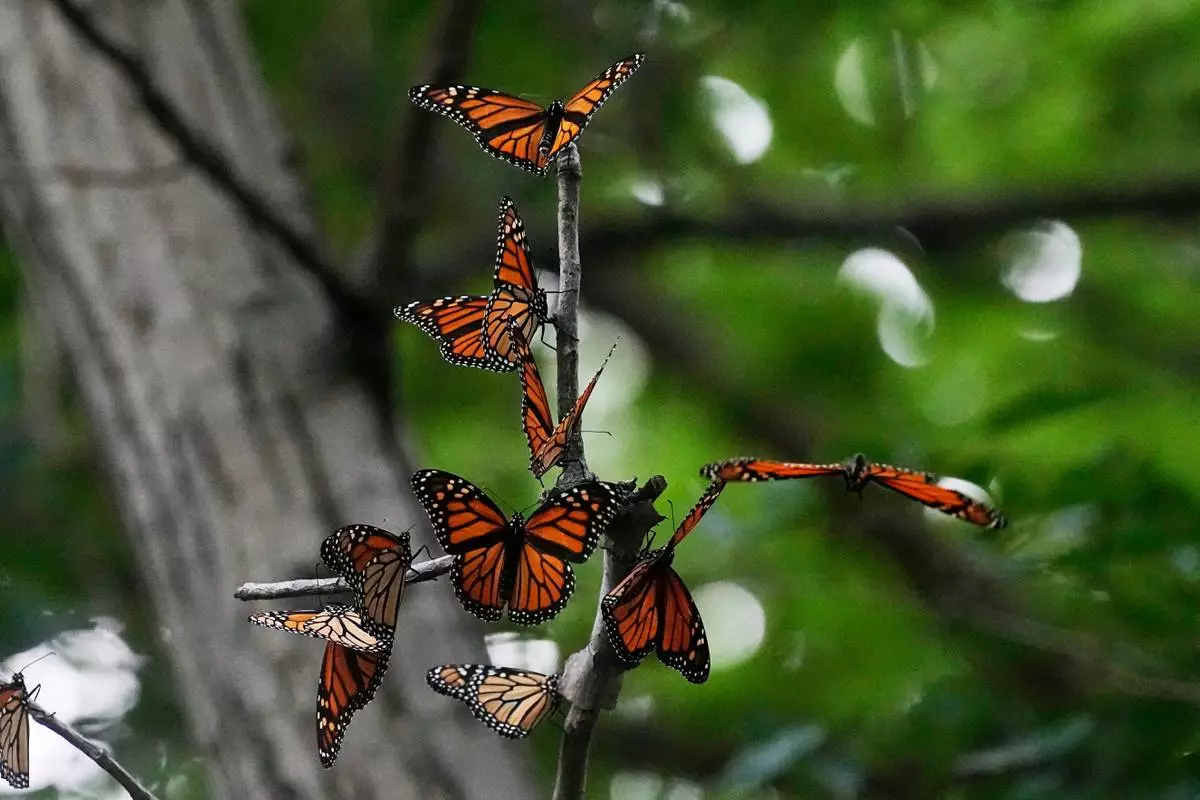
FILE - Monarch butterflies rest on their way to Mexico, Sept. 12, 2023, in Cleveland. (AP Photo/Sue Ogrocki, File)