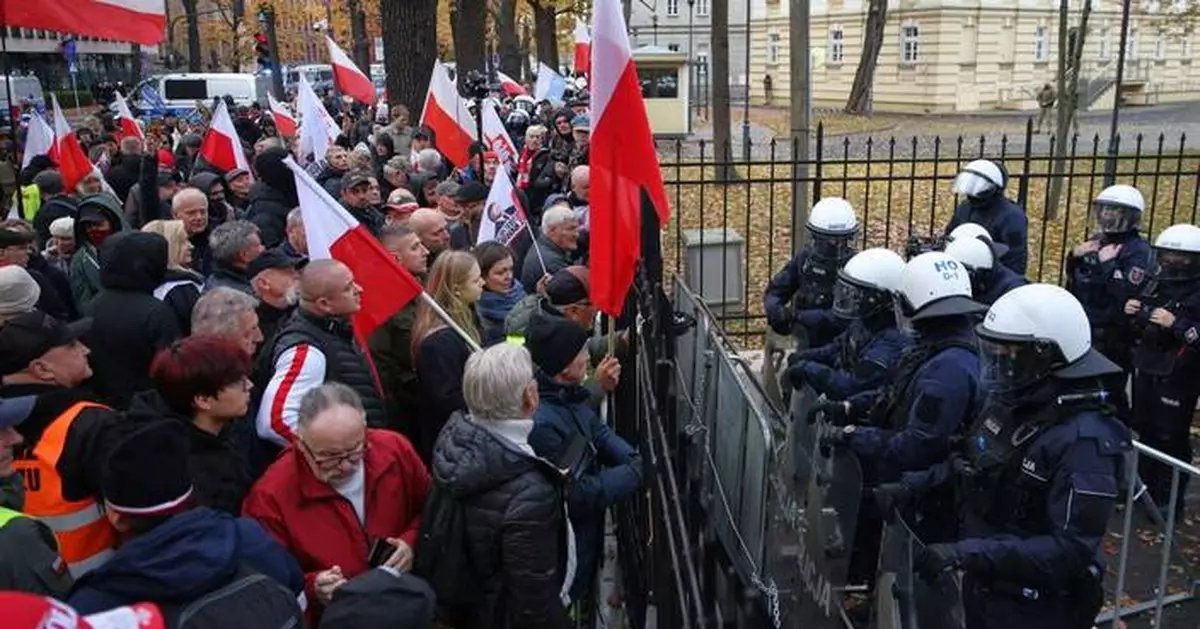
WARSAW, Poland (AP) — Judges at Poland’s Constitutional Tribunal are meeting Tuesday to decide its future, following the suspension of the court president in a dispute with the government and a battle over the future of the rule of law.
Protesters have gathered daily outside the court in Warsaw since the suspension of the tribunal’s top judge, Bogdan Święczkowski, who was appointed under the nationalist-conservative PiS party when it was in power 2015-2023.
The pro-European government of Donald Tusk accuses Poland’s President Karol Nawrocki, who is aligned with PiS, of blocking judges elected by the parliamentary majority from taking up their posts at the tribunal.
Święczkowski has called his suspension a “coup d’etat.”
On Friday, riot police encircled the building while the most senior of the newly elected judges announced Święczkowski's suspension from inside.
Nawrocki, who was on a visit to Senegal, turned his plane around to return to Warsaw, joining the protesters outside the tribunal.
Here's what to know.
The current crisis around the Constitutional Tribunal is the latest round in a long-term battle between the pro-European government led by Prime Minister Donald Tusk and the main opposition party, Law and Justice (PiS), which seeks to return to power in elections next year.
Critics in Poland and the European Union accuse PiS, which led the country between 2015 and 2023, of imposing political control over key judicial institutions, including the Constitutional Tribunal. The European Union fined Poland for undermining the rule of law.
Tusk’s government came to power in 2023 promising to restore the independence of the judiciary, but its efforts have been blocked by two successive PiS-aligned presidents, including Nawrocki.
After repeated failed attempts to wrest control of the tribunal from PiS, the government decided to take a less orthodox path, one that Tusk himself said might not be to everyone’s liking.
Judges on the Constitutional Tribunal are elected by Parliament and sworn in by the president. In mid-October, parliament elected another judge, meaning judges not friendly to PiS would have a majority, but Nawrocki refused to swear in the new appointment.
The judges elected this year took an oath anyway during a ceremony in parliament, a move recognized by the government camp but rejected by PiS. On Friday, the new appointees entered the tribunal premises while riot police guarded the building.
One of the new judges, Anna Korwin-Piotrowska, published the notice of suspension for Święczkowski, the tribunal president, on the court's website. She argued that she had the authority to do so because she is the most senior judge on the court and that he had allegedly committed irregularities while in office.
Many legal experts, as well as the European Commission and the EU's top court, agree that reforms to the justice system introduced by PiS while in power were highly problematic. In 2023 the EU Court of Justice ruled that the Polish Constitutional Tribunal was no longer an impartial court after PiS appointments.
Tusk’s camp and PiS accuse each other of breaking Polish law, including the Constitution.
“Restoring the rule of law is our obligation,” Tusk wrote on X on Friday evening. “After years of lawlessness under PiS this is a difficult process, sometimes painful and it requires decisive action. There is no other way.”
“This is a blatant, criminal attack on the constitutional order,” former PiS Justice Minister Zbigniew Ziobro, the architect of the reforms criticized by the European Union, wrote on X Friday evening. “That is why I call for resistance that will be loud, firm, united and fearless.”
But while human rights campaigners back the principle of reversing the PiS changes, some have criticized the methods.
“The legal basis for the suspension are doubtful and the presence of the police on the tribunal grounds caused a strong escalation of political emotions on both sides,” said Maciej Nowicki of the Helsinki Foundation for Human Rights in Poland. “Those emotions might bury any hope for finding a solution to the crisis.”
A complete “reset” of the Constitutional Tribunal, involving the appointment of an entirely new bench under revised rules, could be necessary, he said.
Anna Korwin-Piotrowska called a general assembly of the Constitutional Tribunal judges for Nov. 3, to decide on the future of the court but also potentially on Święczkowski's immunity. That could potentially pave the way for the court president's criminal prosecution.
But it is unlikely the assembly will reach decisions that all sides accept. Judges chosen by the post-2023 parliamentary majority do not recognize the legitimacy of some judges appointed under PiS, while PiS takes the opposite view.
Decisions require a quorum, but the government and PiS disagree over which judges are eligible to vote and what constitutes a quorum. Some judges appointed under PiS may not even show up for the meeting on Tuesday in protest.
The current crisis is unlikely to be resolved on Tuesday
The functioning of the Constitutional Tribunal had already been impaired for years. Trust in judicial institutions has been eroded both by political conflicts around the courts and the daily inefficiencies of an overburdened judiciary.
In that sense, the current crisis will not suddenly make things worse for regular Poles.
But the Constitutional Tribunal makes decisions that are consequential. A ruling by this court in 2020 led to further restrictions on Polish women's access to legal abortions. The tribunal is needed to curb potentially illegal government decisions, Nowicki said.
Ensuring the Constitutional Tribunal operates well and independently of political power remains a key objective for Polish society.
The current crisis will also intensify the already high political polarization in Poland, one year ahead of general elections. In turn, that will make it much harder to achieve the kind of consensus needed to really fix the court.
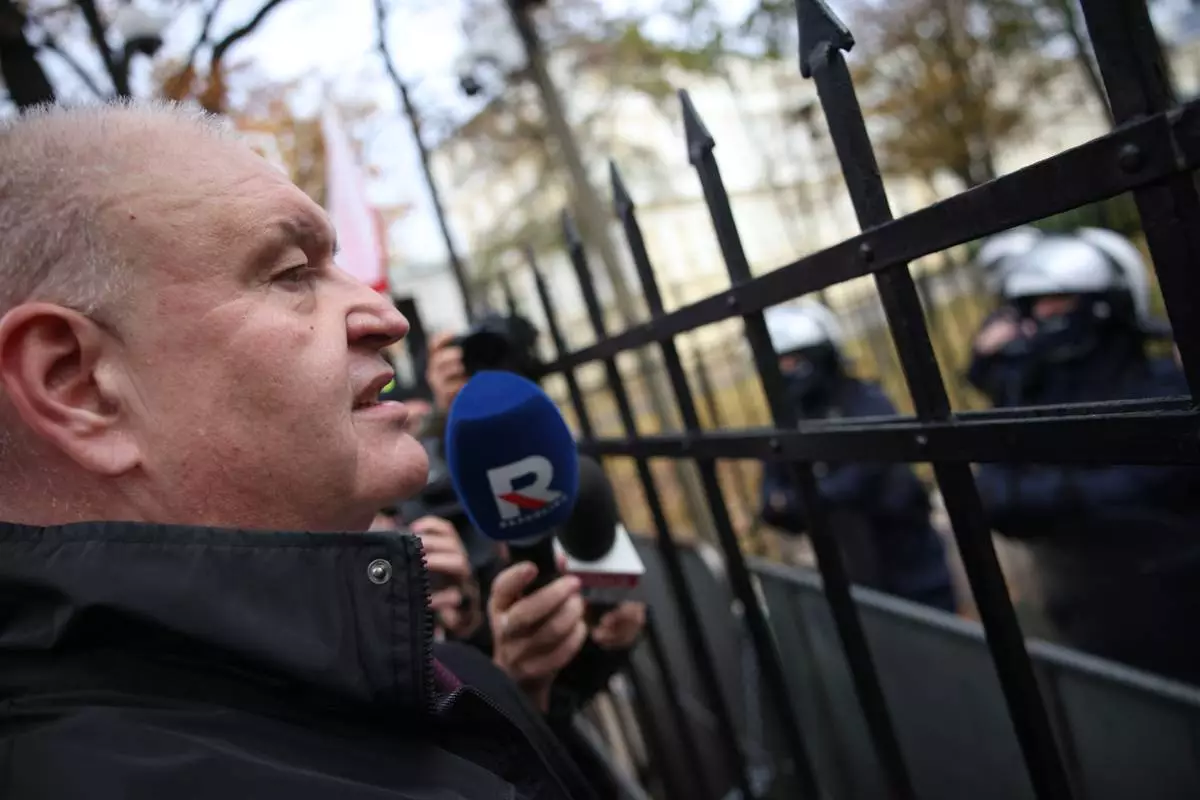
Suspended President of the Polish Constitutional Tribunal Bogdan Swieczkowski, left, speak to police officers during a protest in front of the Constitutional Court in Warsaw, Poland, Saturday, Oct. 31, 2026. (AP Photo/Beata Zawrzel)
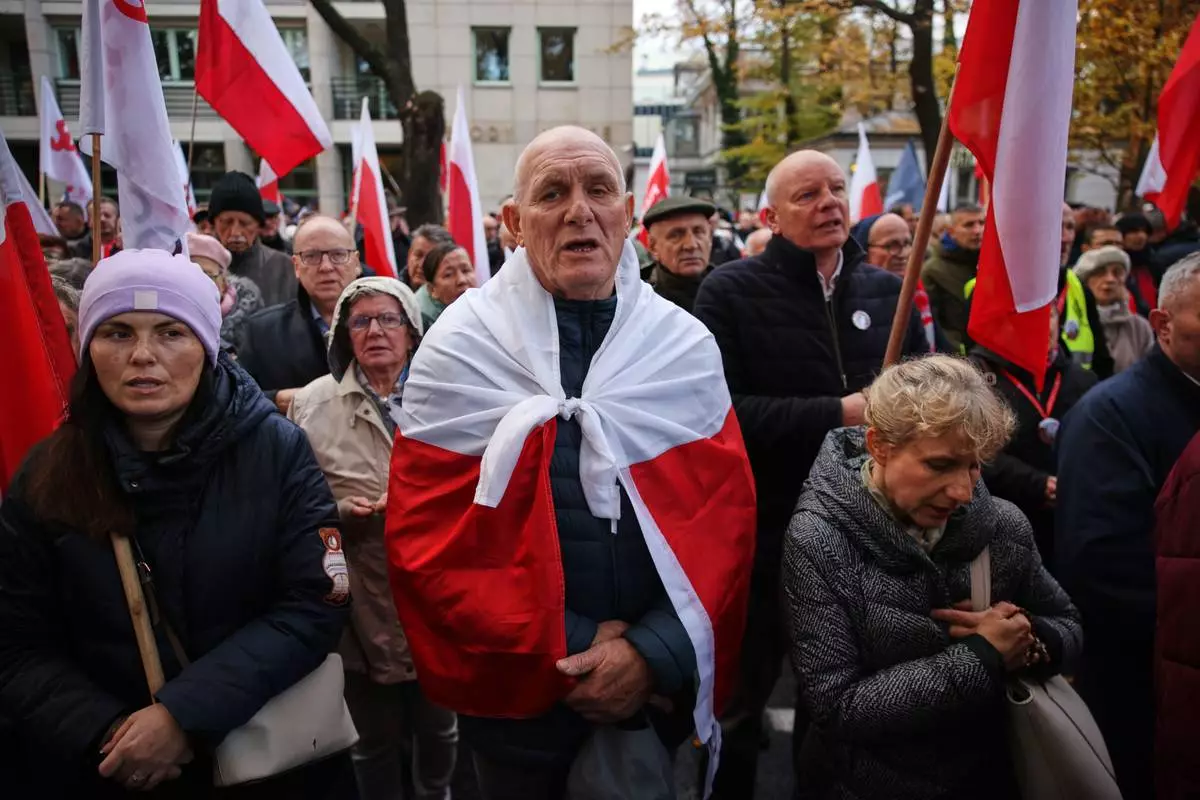
Demonstrators pray during a protest in front of the Polish Constitutional Court in Warsaw, Poland, Saturday, Oct. 31, 2026. (AP Photo/Beata Zawrzel)
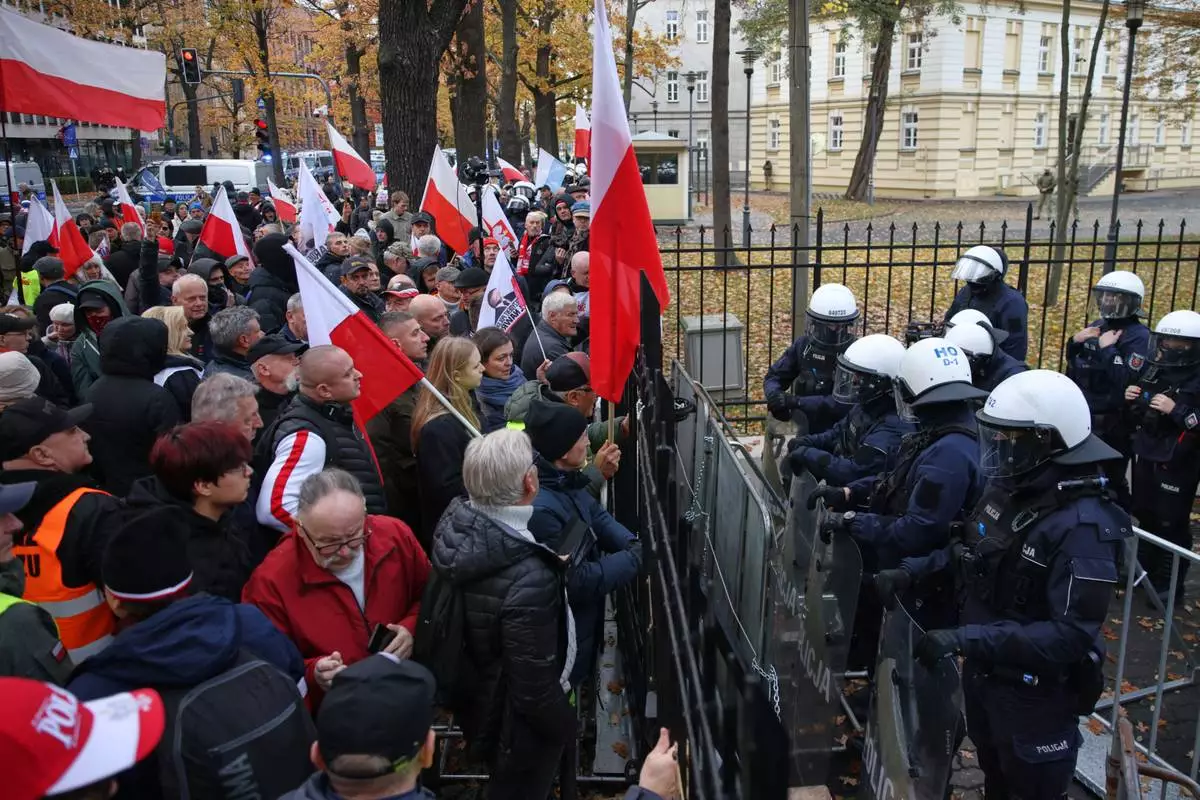
Demonstrators speak to police officers during a protest in front of the Polish Constitutional Court in Warsaw, Poland, Saturday, Oct. 31, 2026. (AP Photo/Beata Zawrzel)