U.S. stocks traded mixed on Tuesday as investors weighed solid gains across artificial intelligence hardware and semiconductor makers ahead of key corporate earnings.
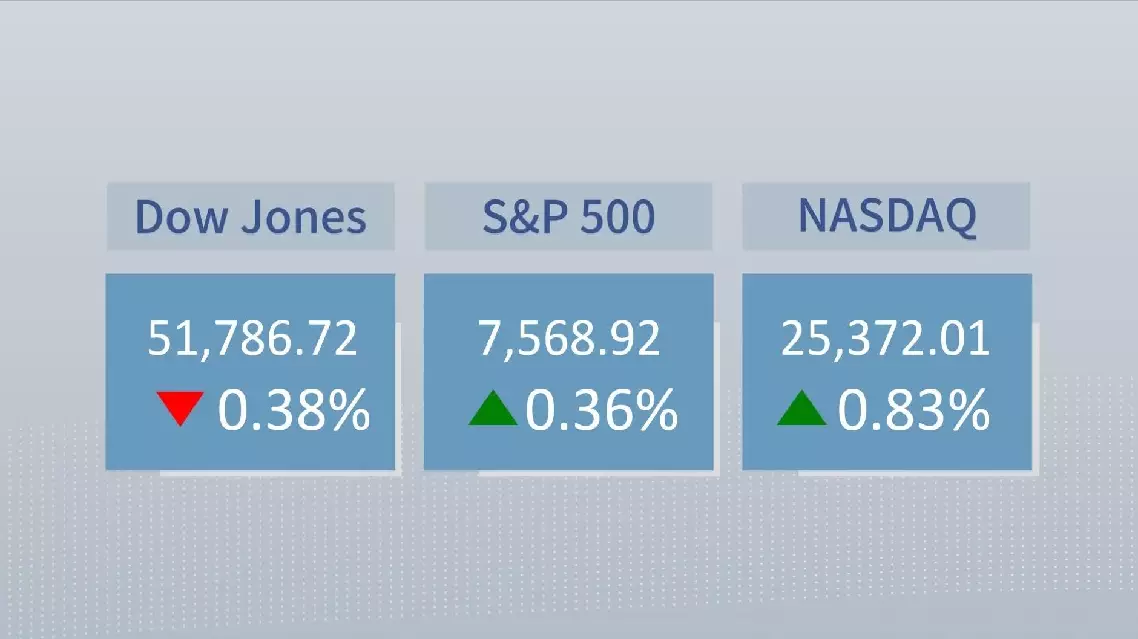
The Dow Jones Industrial Average fell 197.26 points, or 0.38 percent, to 51,786.72. The S and P 500 added 27.52 points, or 0.36 percent, to 7,568.92. The Nasdaq Composite Index increased 207.65 points, or 0.83 percent, to 25,372.01.
Seven of the 11 primary S and P 500 sectors ended in the red, with materials and consumer staples leading the laggards, falling 1.93 percent and 1.76 percent, respectively. Technology and industrials led the gainers by going up 1.31 percent and 0.96 percent, respectively.
Market attention focused heavily on the semiconductor and AI computing sectors ahead of Advanced Micro Devices' (AMD) post-close financial report. With investors seeking clarity on whether corporate capital spending can maintain its recent momentum, shares of AMD gained 3.65 percent, while Broadcom rose 3.07 percent.
Micron Technology and Nvidia also supported tech benchmarks, each advancing more than two percent. Analysts noted that market sentiment remains sensitive to fourth-quarter forward guidance following severe volatility seen across the chip sector in recent trading sessions.
Apple dropped nearly two percent following its latest quarterly earnings report, which paired solid iPhone revenue with softer sales in Greater China, capping broader market upside. Data analytics software provider Palantir Technologies also fell 1.65 percent despite posting quarterly results that topped consensus expectations.
On the macroeconomic front, the U.S. Department of Labor released its monthly Job Openings and Labor Turnover Survey, indicating that domestic job openings and overall hiring activity held largely steady through September.
In energy markets, crude oil futures turned lower amid signs of potential diplomatic progress aimed at easing tensions in the Middle East. Global benchmark Brent crude declined more than 1 percent to trade 103.6 U.S. dollars per barrel, while West Texas Intermediate crude declined 37 cents, or 0.38 percent, at 96.09 dollars per barrel.
Beyond corporate earnings and macroeconomic data, financial markets monitored midterm election voting underway across the United States. Investors are closely assessing the potential legislative and regulatory implications for key sectors, including healthcare and pharmaceutical pricing, residential real estate, and federal policy surrounding AI data center energy infrastructure.
U.S. stocks trade mixed as chips rebound