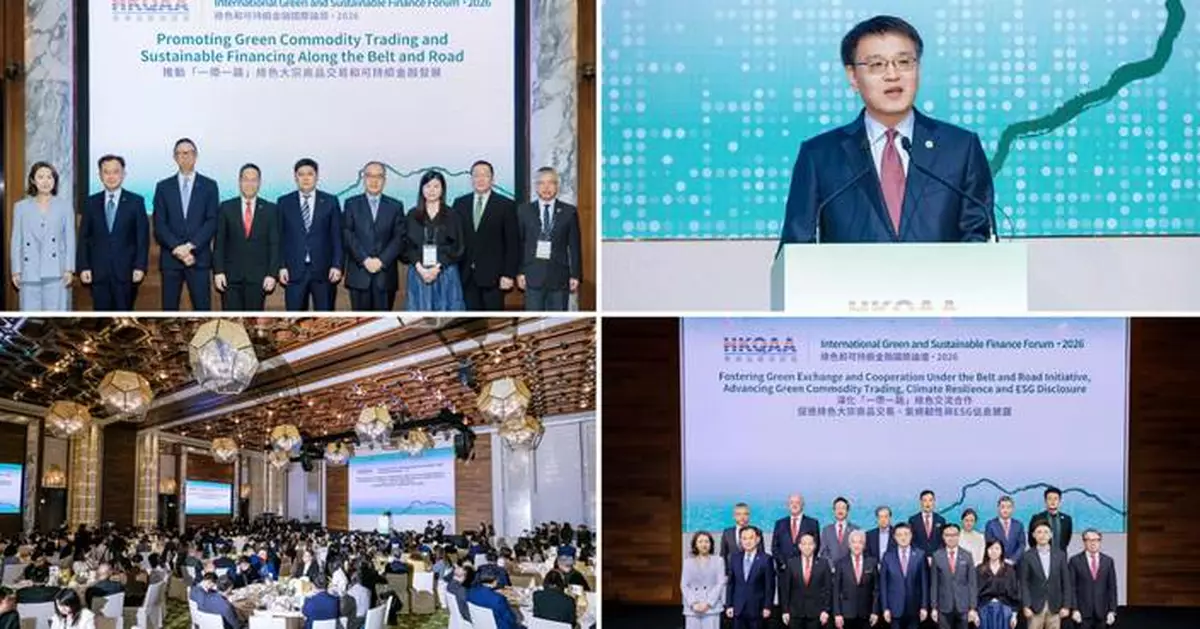
HONG KONG SAR – Media OutReach Newswire – 4 November 2026 – On 27 October 2026, HKQAA International Green and Sustainable Finance Forum · 2026 was successfully held at Rosewood Hong Kong. The Forum invited Mr Christopher Hui, GBS, JP, Secretary for Financial Services and the Treasury of the HKSAR Government, and Mr Zhao Yingmin, President of the BRI International Green Development Coalition and Former Vice Minister of the Ministry of Ecology and Environment, to be the officiating guest and special guest.
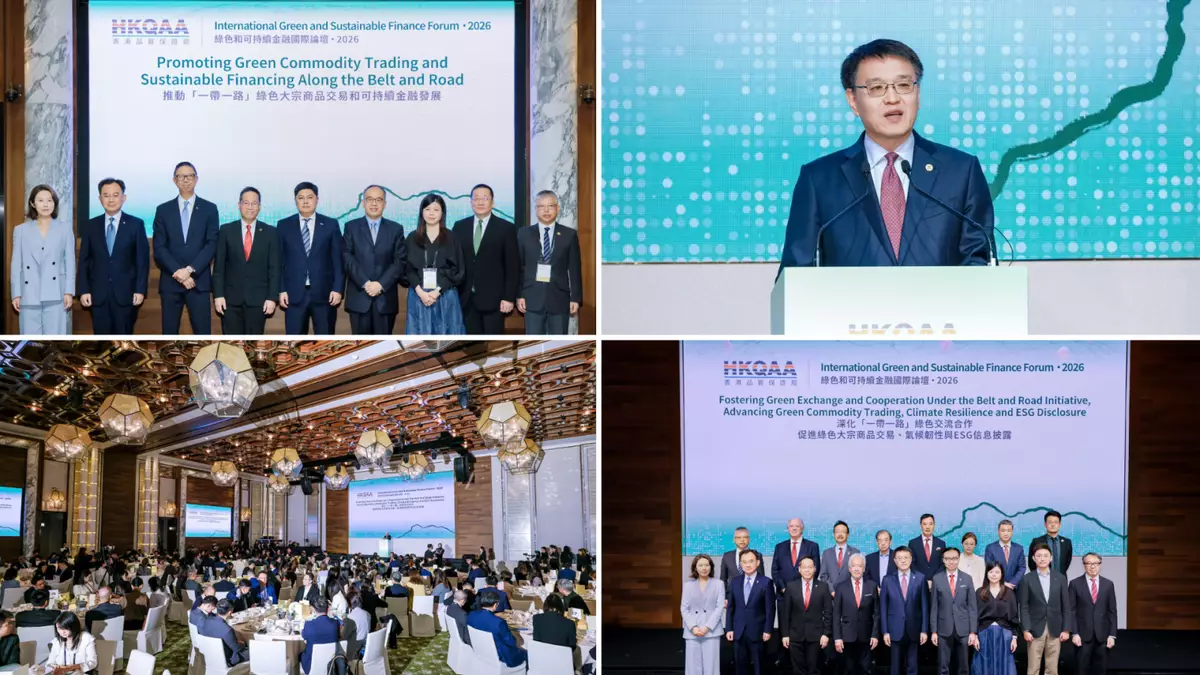
HKQAA International Green and Sustainable Finance Forum • 2026 : Fostering Green Cooperation Along the Belt and Road, Advancing a Green Commodity Trading Ecosystem
Opening Forum: Kick-off of Hong Kong Registration – Green Commodities
The Forum brought together leaders, experts and academics from international organisations, foreign consulate and EU Office in Hong Kong, government departments and various industries to explore collective responses to global climate risks and opportunities for sustainable development.
The Opening Forum was themed "Promoting Green Commodity Trading and Sustainable Financing Along the Belt and Road". To join hands with different sectors to shape a green commodity trading ecosystem to support government policies, the kick-off ceremony of Hong Kong Registration – Green Commodities was held at the Forum. The ceremony was participated by Mr Christopher Hui, GBS, JP, Secretary for Financial Services and the Treasury of the HKSAR Government; Mr P C Chan, Chief Executive Officer of HKQAA; and senior management representatives from enterprises and associations of the industry of green commodities that support the scheme.
Other guest speakers at the Opening Forum included Mr Paul Chow, Group General Counsel and Group Chief Sustainability Officer of HKEX; Mr Stephen Chan, Deputy Chief Executive of Bank of China (Hong Kong) Limited, Acting Chairman of the Hong Kong Association of Banks; and Mr Tan Kun, Deputy General Manager, Marketing and Customer Service Department, Shenzhen Power Supply Bureau of China Southern Power Grid.
Keynote Luncheon: Fostering the development of Belt and Road Standards; sharing research on climate resilience of buildings and ESG investment value
The theme of the Keynote Luncheon was "Fostering Green Exchange and Cooperation under the Belt and Road Initiative, Advancing Green Commodity Trading, Climate Resilience and ESG Disclosure". Mr Zhao Yingmin, President of the BRI International Green Development Coalition and Former Vice Minister of the Ministry of Ecology and Environment was the special guest.
Prof Simon Wong Ka Wo, BBS, JP, Chairman of HKQAA, said in his speech, "HKQAA will actively support the BRI International Green Development Coalition to engage organisations in Hong Kong and the Chinese Mainland in advancing the development of Belt and Road Standards that support green development across Belt and Road countries, with an initial focus on green hydrogen, green computing tokens, and zero-waste and waste-circularity practices. Both parties will also explore initiatives to facilitate the issuance of green finance instruments in Hong Kong for green projects in these countries, while contributing their respective expertise and networks to the development of a green commodities trading ecosystem in Hong Kong, in alignment with the National 15th Five-Year Plan."
HKQAA is also actively responding to the strategic direction of nurturing hydrogen energy as a key future industry under the National 15th Five-Year Plan. In August this year, HKQAA was appointed by the Electrical and Mechanical Services Department for the development of Hong Kong's green hydrogen standard and certification scheme. This will promote the alignment of hydrogen standards across markets, supporting the global expansion of the Chinese hydrogen industry. It will also help facilitate connectivity with green finance and satisfy international green capital requirement.
The Forum has once again invited Dr Bertrand Piccard, Chairman of Climate Impulse and President of the Solar Impulse Foundation, to be a featured keynote speaker. His newly developed green-hydrogen-powered aircraft is scheduled to undergo endurance test flights in 2027, marking a new milestone in the future development of the hydrogen energy industry and the green economy, which closely aligns with the theme of the Forum.
Dr Piccard shared insight from hydrogen-powered flight for clean energy innovation and green commodity market through video. He said in his speech, "I know very well that the HKQAA is deeply involved in sustainability and green commodities trading. Hydrogen, I believe, will become part of it... and, we need to harness our pioneering spirit to achieve the impossible. That's my passion. I hope it's yours."
HKQAA has collaborated closely with stakeholders from different sectors in research work. In recent months, we have collaborated with Taiping Reinsurance Co. Ltd on the "Research Project on Climate Resilience and Insurance Risk Quantification Standard for Buildings in Hong Kong". We have also kick-started with the China International Capital Corporation Limited to conduct a research project on ESG and the investment value of enterprises. Mr Michael Fung, General Manager, Analytics Centre of Taiping Reinsurance Co. Ltd, and Mr Chen Ji, Managing Director, Head of the Green Economy Team of CICC Global Institute, shared the preliminary findings of the two research projects respectively at the Keynote Luncheon.
Other guest speakers at the session included Mr Zhang Jun, Vice Chairman, Executive Director and Chief Executive Officer of China Construction Bank (Asia) Corporation Limited.
Moreover, some of the locally grown food ingredients served at the Keynote Luncheon were sponsored by the Vegetable Marketing Organization, thereby supporting and promoting the Agriculture, Fisheries and Conservation Department's Hong Kong Harvest Scheme. HKQAA is honoured to serve as the Certification Organisation for the Scheme, establishing a certification and traceability mechanism for local agricultural and fisheries products.
Thematic Forum: Co-hosted with APLMA; promoting application of the Hong Kong Taxonomy for Sustainable Finance
The Thematic Forum in the afternoon, themed "Advancing ESG Disclosure Ecosystem, Fostering Wider Adoption of Sustainable Financial Instruments", was co-hosted by HKQAA and Asia Pacific Loan Market Association. Mr Philip Kam, Chief Executive Officer of Asia Pacific Loan Market Association, delivered the keynote remarks, and Mr Ronald Young, Head of Sustainable Banking Development of Hong Kong Monetary Authority, shared on the Hong Kong Taxonomy for Sustainable Finance.
Afterwards, Dr Nigel Croft, Chair, ISO Joint Technical Coordination Group for Management System Standards (2020 – 2023), Member of ISO Strategic Advisory Group on ESG (2021 – 2023), and Mr K T Ting, Chief Operating Officer of HKQAA, introduced the HKQAA Taxonomy-based KPI & SPT Toolkit. The Toolkit is a sector-based KPI library and SPT setting guide for applying the Hong Kong Taxonomy for Sustainable Finance to sustainability-linked loans and bonds, with the aim of fostering a climate-resilient financial system and strengthening Hong Kong's green finance ecosystem. After the sharing session, the kick-off ceremony of the HKQAA Taxonomy-based KPI & SPT Toolkit was held.
Other guest speakers at the Thematic Forum included Ms Phyllis Ng, Assistant General Manager and Head of Loan Syndicate of Global Banking & Capital Market Division of China Construction Bank (Asia) Corporation Limited; and Ms Jennifer Zhou, Head of Transition Finance and Advisory, GCNA, Standard Chartered Bank.
Hashtag: #HKQAA
The issuer is solely responsible for the content of this announcement.
** This press release is distributed by Media OutReach Newswire through automated distribution system, for which the client assumes full responsibility. **
New research from KPMG China and GS1 Hong Kong highlights three key priorities for retailers: building trust in AI, delivering market-specific strategies for the growing silver economy, and strengthening brand confidence across Hong Kong and other cities in the Greater Bay Area
HONG KONG SAR – Media OutReach Newswire – 4 November 2026 – Consumer confidence in artificial intelligence is rising across Hong Kong and other cities in the Greater Bay Area (GBA), but new research from KPMG China and GS1 Hong Kong shows that retailers will need markedly different strategies to convert that confidence into growth. While consumers in other GBA cities show greater openness to personalised experiences and Chinese Mainland brands, Hong Kong consumers place more emphasis on value for money.
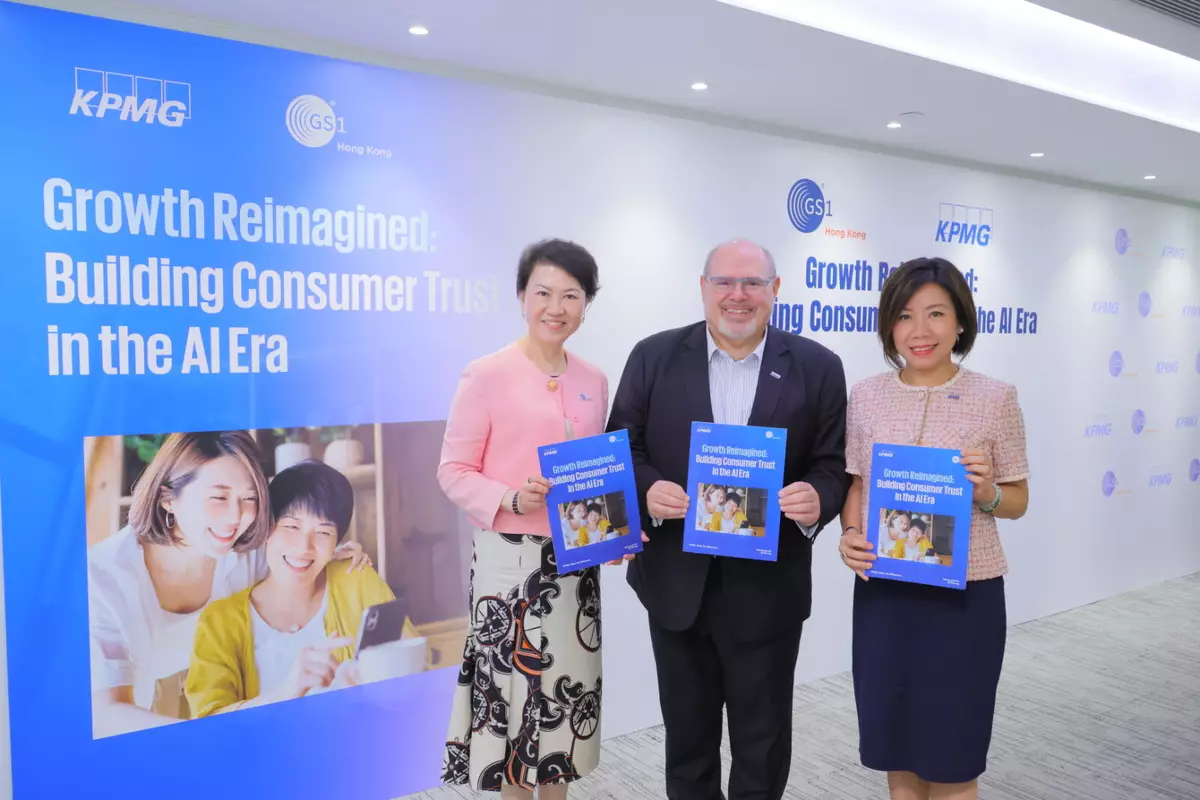
AI trust gap reveals distinct retail priorities: Divergent paths to consumer growth in Hong Kong and the GBA
The Growth Reimagined: Building Consumer Trust in the AI Era report identifies three themes which have emerged as a roadmap for future growth:
- Trusted AI builds consumer confidence: AI can enhance personalisation and speed up service delivery, but privacy, accuracy, transparency and a human touch will determine consumer adoption.
- Silver shoppers diverge by market: To capture the growing silver economy, brands must prioritise price in Hong Kong, and brand reputation and engaging experiences in other GBA cities.
- The low-cost-only label no longer fits Chinese Mainland brands: Their advances in quality and innovation are forcing competitors to rethink where future brand advantage will come from.
AI trust is rising but a transparency gap persists, creating new opportunities for growth
Trust in AI has risen significantly since last year's survey. In Hong Kong, 48% of consumers now trust AI at least somewhat, up from 28%, while trust in other GBA cities has increased from 59% to 76%. Yet growing trust has not translated into the same willingness to share personal data: just 10% of Hong Kong consumers who trust AI are comfortable doing so, compared with 32% in other GBA cities.
The difference in AI trust between Hong Kong and other GBA cities is particularly pronounced among silver shoppers, defined in the report as consumers aged above 55. Just 38% of Hong Kong silver shoppers trust AI, compared with 76% in other GBA cities, underscoring the challenge retailers face in building AI confidence among older Hong Kong consumers.
To bridge this gap, retailers in Hong Kong need to demonstrate clear value before asking consumers to share more data, while providing transparency and control over how their data is used. Consumer confidence should extend across the entire retail journey: from payment and product authenticity to returns and customer support. AI should help consumers find what they need more easily, while maintaining accuracy, fairness and access to human support.
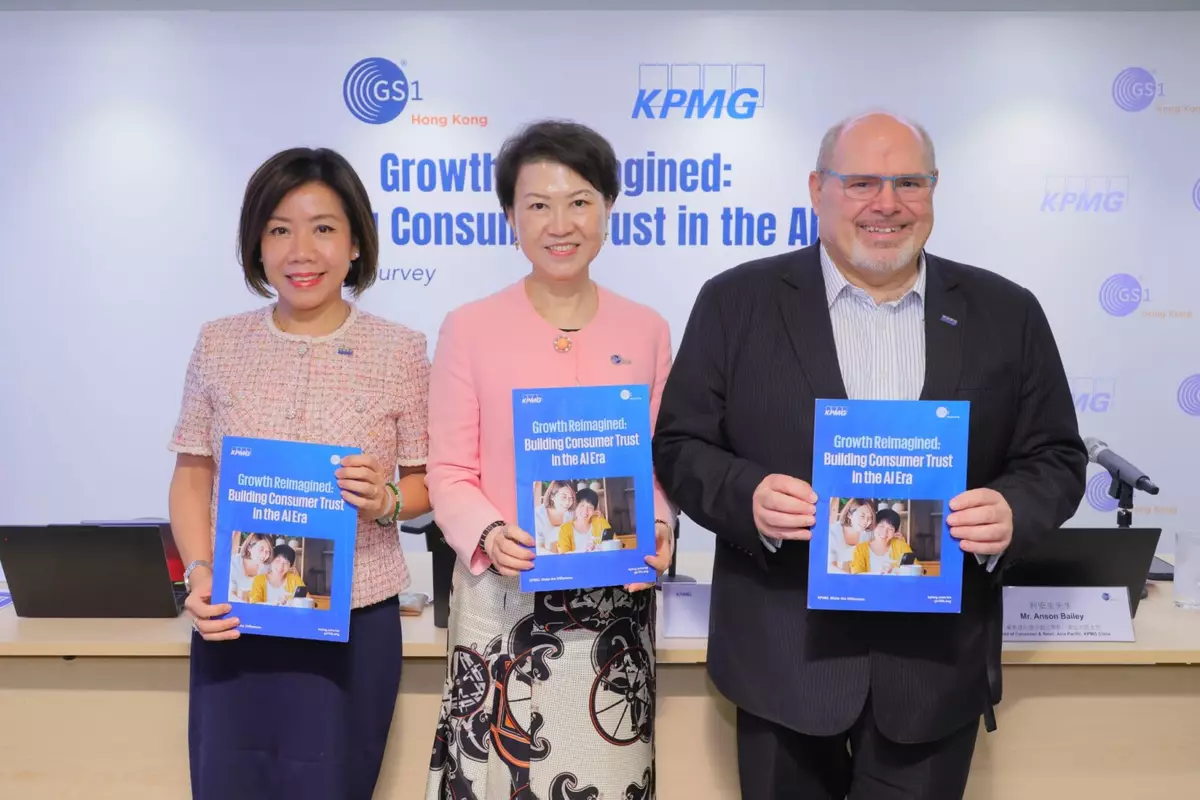
AI trust gap reveals distinct retail priorities: Divergent paths to consumer growth in Hong Kong and the GBA
Anna Lin, Chief Executive, GS1 Hong Kong, says: "AI is increasingly shaping how consumers discover and evaluate products, and it tends to recommend those backed by data it can readily interpret and trust. Businesses with trusted, standardised product data that is structured for machines to understand and use and traceable to an identifiable source will be best positioned to earn consumer confidence and influence future purchasing decisions."
The silver economy is not a single consumer market
Across all age groups, value remains a priority for 73% of Hong Kong consumers, compared with 45% in other GBA cities.
When asked to describe their shopping style, 57% of silver shoppers in Hong Kong identify primarily as value shoppers, compared with only 23% in other GBA cities, where brand reputation, at 37%, and shopping experience, at 27%, emerge as their leading considerations.
The findings suggest that age alone is not enough to define the silver shoppers. Retailers looking to capture the opportunities created by the region's ageing population will need to understand how expectations differ by market, and develop propositions that reflect those differences.
Alice Yip, Partner, Head of Consumer & Retail, Hong Kong SAR, KPMG China, says: "Growth in the silver economy depends on recognising that shoppers' priorities differ across markets. Hong Kong's silver shoppers prioritise competitive prices, while those in other GBA cities place greater emphasis on brand reputation and shopping experiences. Capturing this opportunity involves understanding what matters locally and tailoring the retail offer accordingly, rather than treating the silver economy as one uniform market."
Chinese Mainland speed raises the stakes for Hong Kong and global brands
Chinese Mainland brands are emerging as a stronger force in innovation and speed. In other GBA cities, that progress is already reflected in consumer perceptions: 64% choose them for value for money, 58% for safety and reliability and 50% for brand reputation.
In Hong Kong, however, they are still seen primarily through the lens of value. While 81% of consumers choose Chinese Mainland brands for value for money, fewer cite safety and reliability (39%), higher quality (33%) or brand reputation (31%). Their next opportunity is to turn Chinese Mainland speed and improving quality into stronger brand confidence.
Hong Kong brands retain a clear advantage in trust. Consumers in Hong Kong (74%) and other GBA cities (61%) cite safety and reliability as the leading reason for choosing Hong Kong brands. Among Hong Kong consumers, preference for Hong Kong brands is particularly strong in airlines (78%) and food and beverages (71%).
But trust cannot be taken for granted. As Chinese Mainland brands strengthen their safety and reliability credentials, Hong Kong brands will need to combine their reputation for reliability with greater innovation, sharper value and faster execution.
Anson Bailey, Head of Consumer & Retail, Asia Pacific, KPMG China, says: "Any brand that still sees Chinese Mainland competitors as a low-cost threat is looking in the rear-view mirror. Chinese Mainland speed is now producing better products, sharper design and faster innovation at a scale few markets can match. The real shift is that Chinese Mainland brands are learning to build brand equity at the same pace as they have built scale through value and speed. This is increasingly influencing who can win – not only in the GBA, but in consumer markets worldwide."
Hashtag: #KPMG #GS1HongKong
The issuer is solely responsible for the content of this announcement.
About KPMG
KPMG in China has offices located in 31 cities with over 14,000 partners and staff, in Beijing, Changchun, Changsha, Chengdu, Chongqing, Dalian, Dongguan, Foshan, Fuzhou, Guangzhou, Haikou, Hangzhou, Hefei, Jinan, Nanjing, Nantong, Ningbo, Qingdao, Shanghai, Shenyang, Shenzhen, Suzhou, Taiyuan, Tianjin, Wuhan, Wuxi, Xiamen, Xi'an, Zhengzhou, Hong Kong SAR and Macau SAR. It started operations in Hong Kong in 1945. In 1992, KPMG became the first international accounting network to be granted a joint venture licence in the Chinese Mainland. In 2012, KPMG became the first among the "Big Four" in the Chinese Mainland to convert from a joint venture to a special general partnership.
KPMG is a global organisation of independent professional services firms providing Audit, Tax and Advisory services. KPMG is the brand under which the member firms of KPMG International Limited ("KPMG International") operate and provide professional services. "KPMG" is used to refer to individual member firms within the KPMG organisation or to one or more member firms collectively.
KPMG firms operate in 138 countries and territories with more than 276,000 partners and employees working in member firms around the world. Each KPMG firm is a legally distinct and separate entity and describes itself as such. Each KPMG member firm is responsible for its own obligations and liabilities.
About GS1 Hong Kong
GS1 Hong Kong is the local chapter of GS1®, a global, not-for-profit data standards organisation represented in over 120 countries. Through globally recognised standards such as GTIN (barcodes), we enable businesses to identify, capture and share trusted data across physical and digital supply chains, helping them accelerate digital transformation, access global markets, strengthen supply chain resilience and efficiency, and advance transparency, safety and sustainability.
Building on global data standards, GS1 Hong Kong provides solutions including ezTRADE for B2B data exchange, ezTRACK for supply chain traceability, and 1QR, powered by GS1 Digital Link, connecting 2D barcodes to rich product information such as certifications and sustainability data.
The trusted data infrastructure also supports emerging business needs, from trade finance to Scope 3 emissions reporting and ESG compliance. In an AI-driven economy, we provide the foundation for high-quality data that is accurate, visible, linkable, searchable, shareable and traceable.
GS1 Hong Kong supports close to 8,000 corporate members across 20 sectors, including retail and consumer goods, food and beverage, healthcare, apparel and footwear, logistics and ICT.
Website: www.gs1hk.org
** This press release is distributed by Media OutReach Newswire through automated distribution system, for which the client assumes full responsibility. **